
Summarize with AI


Studio Maydit, Lazarev, 8020, Ramotion, Digidop, Finsweet, Refokus, Flowout, Edgar Allan, and Engine Digital are the ten studios an AI automation startup should look at for a website. Lazarev and 8020 lead. Lazarev is the only studio in this group with direct AI-sector proof, working across platforms from San Francisco since 2015 with fifty-one to two hundred people and a published starting price, for Payoneer, Peel, Elva, and Mozayix. 8020 earns second place on client relevance rather than sector: Wave, Superlist, Pilot.com, Vanta, and Circle are business software products sold to the same operations buyers you are chasing. Edgar Allan and Engine Digital fit least well, both being built for large brand engagements with no published price.
Half the people who land on your site cannot tell whether you are software or a consultancy.
That is the category problem, and it is worse for automation than for almost anything else in AI. On one side sit low-code tools people already own. On the other sit agencies who will build the same workflow by hand for a fee. You are neither, and a visitor who cannot place you in ten seconds defaults to whichever they already understand, which is never you.
The second problem is that your value is a number and your website is full of adjectives. Seamless. Intelligent. Effortless. Meanwhile the buyer is trying to work out whether this removes twelve hours a week from a named team, and whether that is worth a line in next year's budget. Automation is one of the few categories where a specific, unglamorous figure outperforms any amount of craft.
Then there is the bespoke trap. Every customer's workflow is different, so your deployments genuinely are different, and the honest instinct is to describe the product abstractly enough to cover all of them. What the visitor reads is a company that has not decided what it does. The sites that work in this category do the opposite: they show one workflow in humiliating detail and let the reader infer their own.

How we picked these agencies
Five checks decided the order, all of them answerable from public pages before anyone gives up an hour to a call.
Platform depth, judged against the number of pages an automation company ends up needing. You will want a page per workflow, per industry, and per integration, and that set only grows. If publishing one takes an engineering ticket, marketing will stop asking and the long tail of search traffic those pages capture will never exist.
Proof with business automation and operations buyers. This is the criterion carrying the most weight here, and it is deliberately not the same as general AI experience. Your reader is an operations lead counting hours, not an engineer admiring a model. A studio that has sold to that person before will reach for a number where another studio reaches for an adjective.
Pricing. Whether a minimum is stated publicly, rather than the size of it. It is the same discipline you are trying to apply to your own buyers, and a studio that will not name a floor is asking you to run a process you would not accept in reverse.
Team shape. Whether one senior person stays across the work or the account is handed down after the pitch. Your brief is really a positioning question, and those do not survive delegation intact.
Their own website. The single project where the studio is its own client, which makes it the honest sample.
Everything in the tables comes from what each studio has chosen to publish about itself. Nothing has been filled in by inference, so a Not published row is their decision rather than a hole here.
What goes wrong for AI automation startups
Three failures dominate, and the first is the reason so many automation sites feel interchangeable.
The page describes capability instead of a saving. It lists what the product can connect to and what it can trigger, which is a specification. The buyer wants an outcome expressed in their own units, meaning hours, headcount, error rate, or days to close. Capability lists are easy to write because they require no commitment. Savings are hard to write because they can be checked, which is exactly why they persuade.
The site hedges to cover every workflow. Because each deployment differs, the copy climbs to a level of abstraction where it is true for all of them and vivid for none. Any workflow. Any tool. Any team. A visitor scanning for their own situation finds nothing recognisable and leaves believing the product is not really for them, which is the opposite of what the hedging was for.
Nobody says what the product does not do. Automation buyers have been sold this before and it did not work, so they arrive suspicious rather than curious. A page that claims universal coverage confirms the suspicion. A page that names the workflows it is bad at, and the point where a human still has to look, reads as a company that has actually run this in production and is worth a call.
1. Studio Maydit: A Top-Rated Design Agency for AI Founders
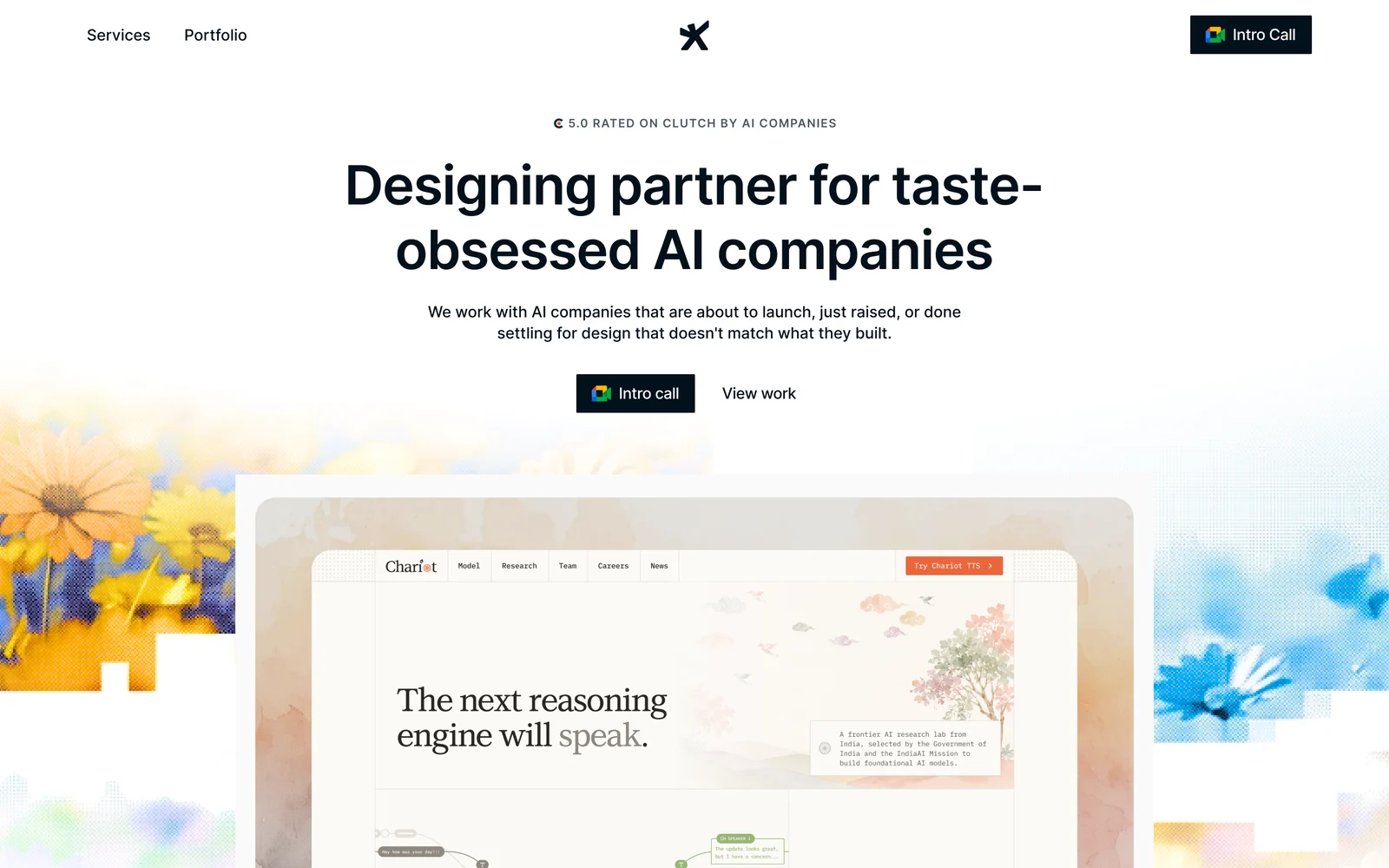
An automation company usually needs many pages rather than one, and that shapes the platform choice. Studio Maydit builds in Framer when a founder is still rewriting the pitch weekly, Webflow when a marketing hire has to publish a workflow page every few days without asking anyone, and custom code when the site needs something neither will carry. It is a web and product design studio, and its clients are AI founders in the US, UK, and Europe.
The work continues into product design once the site ships, which matters when the marketing page promises hours saved and the product opens on a configuration screen. That gap between the promise and the first screen is where automation trials are lost, and it is not a marketing problem.
Dualite is the published outcome, and the order of events is the transferable part. The team settled a repositioned ICP, the design was built for the narrower group that choice defined, and 100,000+ users arrived over seven months. For an automation startup fighting the urge to cover every workflow, that sequence is the whole argument: narrowing is what makes the page specific enough to be believed. Recent clients include Wave, PixelFlow, Mi-VAD, and 15 other AI and SaaS teams.
There are two ways to buy, and for a company building a page-per-workflow library the difference is real. Fixed scope, three to four weeks, gets a core site live when there is a launch or a funding date to hit. The monthly retainer suits the long tail instead, covering new pages, campaigns, and product design at whatever rate you can produce case material, and carrying no long lock-in. Fixed-scope work ends with a diagnosis of what is leaking in the product rather than a handoff and goodbye.
| Check | Finding |
|---|---|
| Based in | Remote, serving US / UK / EU |
| Platform depth | Framer, Webflow, and custom code |
| AI-sector proof | Yes. AI-native clients, published outcome on Dualite |
| Pricing | Fixed scope or monthly retainer, quoted per project |
| Team shape | Founder-led, small senior team |
| Best fit | Automation teams whose site covers everything and convinces nobody |
Pick one workflow and show it in full. Book a 30-minute call.

2. Lazarev
Lazarev has worked from San Francisco since 2015 with fifty-one to two hundred people across mixed platforms, publishes a starting price, and is the only studio here with direct AI-sector proof. Its portfolio sits in complex software, and Payoneer in particular is a product where an operational process had to be made legible on a marketing page, which is your exact problem.
The weakness is the standard cost of scale. A team is assigned, so the senior person who understood your workflow in the first call may not be the one writing the page describing it.
| Check | Finding |
|---|---|
| Based in | San Francisco, USA |
| Founded | 2015 |
| Team size | 51-200 |
| Primary platform | Mixed |
| AI-sector proof | Yes |
| Named clients | Payoneer, Peel, Elva, Mozayix |
| Pricing | Published minimum |
| Best fit | Automation products with a real interface behind the promise |
3. 8020
8020 works from San Francisco and New York in Webflow, and its client list is the most relevant on this page for your buyer: Wave, Superlist, Pilot.com, Vanta, and Circle. Pilot and Vanta both sell process automation into operations and finance teams, and both had to convince a buyer who counts hours rather than admiring interfaces.
The weakness is disclosure. Neither team size nor a starting price is published, and its AI-sector proof is partial, so the AI framing would be new even though the buyer is familiar.
| Check | Finding |
|---|---|
| Based in | San Francisco and New York, USA |
| Founded | 2014 |
| Team size | Not published |
| Primary platform | Webflow |
| AI-sector proof | Partial |
| Named clients | Wave, Superlist, Pilot.com, Vanta, Circle |
| Pricing | Not published |
| Best fit | Automation startups selling into finance and operations teams |
4. Ramotion
Ramotion has worked from San Francisco since 2009 with eleven to fifty people across mixed platforms, and publishes a starting price. Mozilla, Okta, Netflix, Adobe, and Xero are products with substantial existing traffic, so this is a studio used to building something that has to perform rather than only launch.
The weakness is sector fit. AI-sector proof is partial, and a practice oriented around established technology brands runs a heavier process than a lean automation startup may want to resource.
| Check | Finding |
|---|---|
| Based in | San Francisco, USA |
| Founded | 2009 |
| Team size | 11-50 |
| Primary platform | Mixed |
| AI-sector proof | Partial |
| Named clients | Mozilla, Okta, Netflix, Adobe, Xero |
| Pricing | Published minimum |
| Best fit | Automation companies with existing traffic they cannot afford to break |
5. Digidop
Digidop has worked from Paris since 2021 as a one to ten person Webflow team, publishes a starting price, and has shipped for TSE Energy, Ramify, and StreamNative. Small and Webflow-based fits the page-per-workflow model well, since the site stays editable and you talk to whoever is doing the work.
The weakness is capacity and language. A team this size runs few projects at once, and a French-first studio writing English copy for a US operations buyer is worth testing rather than assuming.
| Check | Finding |
|---|---|
| Based in | Paris, France |
| Founded | 2021 |
| Team size | 1-10 |
| Primary platform | Webflow |
| AI-sector proof | Partial |
| Named clients | TSE Energy, Ramify, StreamNative |
| Pricing | Published minimum |
| Best fit | European automation teams wanting a small senior Webflow partner |
6. Finsweet
Finsweet has worked from Denver since 2017, distributed, with fifty-one to two hundred people, and is the deepest Webflow practice on this page. It builds tooling other Webflow developers rely on, and Dropbox, Clay, GitHub, and Steadily show it operating at scale rather than at launch size.
The weakness is emphasis. AI-sector proof is partial and no starting price is published, so you would be buying build quality and supplying the automation argument yourself.
| Check | Finding |
|---|---|
| Based in | Denver, USA, distributed |
| Founded | 2017 |
| Team size | 51-200 |
| Primary platform | Webflow |
| AI-sector proof | Partial |
| Named clients | Dropbox, Clay, GitHub, Steadily |
| Pricing | Not published |
| Best fit | Teams whose page library will grow fast and must not break |
7. Refokus
Refokus works remotely from Germany with eleven to fifty people in Webflow, for Mural, BASF, Spotify, Yahoo, and BCG. That is a strong list for a team of this size, and Webflow means your marketing hire can publish workflow pages without a developer in the loop.
The weakness is disclosure and orientation. No starting price is published, AI-sector proof is partial, and a client list weighted to large enterprises implies a process sized for organisations rather than for a startup with two people in marketing.
| Check | Finding |
|---|---|
| Based in | Germany, remote |
| Founded | 2021 |
| Team size | 11-50 |
| Primary platform | Webflow |
| AI-sector proof | Partial |
| Named clients | Mural, BASF, Spotify, Yahoo, BCG |
| Pricing | Not published |
| Best fit | Automation companies who want enterprise-grade craft in Webflow |
8. Flowout
Flowout is a distributed Webflow team on a subscription model with a published starting price, and clients including Jasper, Kajabi, Riverside, and Sendlane. Jasper is an AI product, and the subscription shape maps unusually well onto a page-per-workflow strategy where you need a steady stream of similar pages rather than one big build.
The weakness is depth. A subscription queue is optimised for throughput, not for the positioning work that decides what those pages should say, and neither team size nor founding date is published.
| Check | Finding |
|---|---|
| Based in | Distributed |
| Founded | Not published |
| Team size | Not published |
| Primary platform | Webflow |
| AI-sector proof | Partial |
| Named clients | Jasper, Kajabi, Riverside, Sendlane |
| Pricing | Published minimum |
| Best fit | Teams with settled messaging who need many pages produced steadily |
9. Edgar Allan
Edgar Allan has worked from Atlanta since 2014 with fifty-one to two hundred people in Webflow, for Porsche, Duracell, and NCR. It is a substantial practice with the process to carry long review cycles, which is useful once a company is big enough to have them.
The weakness is direction of travel. The portfolio is consumer and enterprise brand work, AI-sector proof is partial, and no starting price is published, so an operations buyer counting hours is not the reader this studio is practised at persuading.
| Check | Finding |
|---|---|
| Based in | Atlanta, USA |
| Founded | 2014 |
| Team size | 51-200 |
| Primary platform | Webflow |
| AI-sector proof | Partial |
| Named clients | Porsche, Duracell, NCR |
| Pricing | Not published |
| Best fit | Later-stage automation companies needing brand weight |
10. Engine Digital
Engine Digital has worked from Vancouver and New York since 2002 in custom code, for Adidas, Autodesk, Goldman Sachs, and HP. Two decades of complex builds means it can carry a project through many stakeholders without losing the thread, which matters in an enterprise setting.
The weakness is that nearly every dimension points away from this brief. Custom code makes the page-per-workflow model slow and expensive, no team size or price is published, and the client list describes an engagement shaped for organisations rather than startups.
| Check | Finding |
|---|---|
| Based in | Vancouver and New York |
| Founded | 2002 |
| Team size | Not published |
| Primary platform | Custom code |
| AI-sector proof | Partial |
| Named clients | Adidas, Autodesk, Goldman Sachs, HP |
| Pricing | Not published |
| Best fit | Large estates with internal teams and long approval chains |
How to choose between them
Sort by what is actually broken.
If nobody can tell whether you are software or a service, buy a studio used to explaining complex products. Lazarev.
If the site does not speak the language of an operations buyer, buy proof from products that sold to that exact person. 8020.
If the real need is thirty workflow pages rather than one homepage, buy throughput and settle the messaging yourself first. Flowout.
If you already rank and cannot afford to lose it in a rebuild, buy redesign discipline. Ramotion.
One test before you sign. Give each studio one customer workflow and ask for the headline. A studio that comes back with a number and a named role has understood your buyer. A studio that comes back with a sentence containing the word seamless has written the page you already have.