Reading time:
13 min read
Last updated:
10 Best Framer Design Agencies for AI Agent Startups - September 2026
What is the best Framer agency for an AI agent startup? Ten Framer studios ranked for agent products, with pricing, team size and AI work compared.


The best Framer design agencies for AI agent startups in 2026 are Studio Maydit, Trueform, Feely Studio, SuperSkills, Lazarev, Clay, Fantasy, Push Refresh, Feels Like, and basement.studio. Studio Maydit and Trueform lead for funded agent startups that need a site built natively in Framer and changed often. Clay and Lazarev are the stronger pick when the real problem is brand or product experience rather than the website itself.
Your agent's best feature is that the user is not watching.
It runs while they are in a meeting. It works through a queue overnight. The whole promise is that somebody gets their attention back. That is a genuinely good product.
It is also a very hard thing to put on a web page, because a web page is the one moment where the user is watching, and there is nothing to see.
So agent startups reach for the same shortcuts. A looping terminal. A flowchart of boxes and arrows. A chat window with a cursor blinking in it. Your buyer saw all three before lunch. None of them answer the only question that matters, which is what job this thing finishes and how they will know it did.
That is the real brief. Not a website that looks well funded. A website that makes an invisible piece of work feel finished, reliable, and worth handing over.

How we picked these agencies
This is a teardown, not a directory listing. For each agency we read their own site and their public record, then checked five things you can verify yourself in an afternoon:
Platform depth. Is Framer the main build tool, or one line on a long service menu?
AI-sector proof. Named AI clients and published work, or just the word "AI" in the copy?
Pricing. Do they publish a minimum at all, or keep it behind a call?
Team shape. Who actually does the work, and how many clients are they carrying at once?
Their own site. Distinctive, or the same template as everyone else on this list?
That last one gets skipped most often. An agency's own website is the only project where nobody overruled them. No client committee, no inherited brand book. If their own site is forgettable, you have found their ceiling.
Every fact below comes from the agency's own site or a public listing. Where a number is not public, we say so rather than guessing.
What goes wrong when an agent startup hires a design agency
Three failures come up again and again.
The site sells the model instead of the job. Agencies working in AI learn quickly that founders like talking about architecture, so the homepage fills up with the reasoning loop, the tool calls, the context window. Buyers do not purchase a reasoning loop. They purchase a task that is finished by Tuesday. The site that wins describes the job leaving the buyer's plate, and treats the machinery as a detail further down.
The pricing page cannot describe how an agent is actually sold. Agents get charged per run, per resolved ticket, per seat, or on some mix of all three. Most agencies default to a three-column SaaS pricing table because that is what they have built forty times. It fits badly. Buyers cannot work out what a month costs them, so they do not start, and the drop-off gets blamed on the pricing rather than the layout that failed to explain it.
The site is built for one reader when there are two. An engineer wants to know what it plugs into, what it can reach, and how it fails. The person signing wants to know what it costs and what breaks if it is wrong. One page trying to satisfy both usually serves neither, and the engineer is the one who quietly decides. Good agencies split those paths early. Weak ones write a single stack of sections and hope.
1. Studio Maydit: A Top-Rated Design Agency for AI Founders
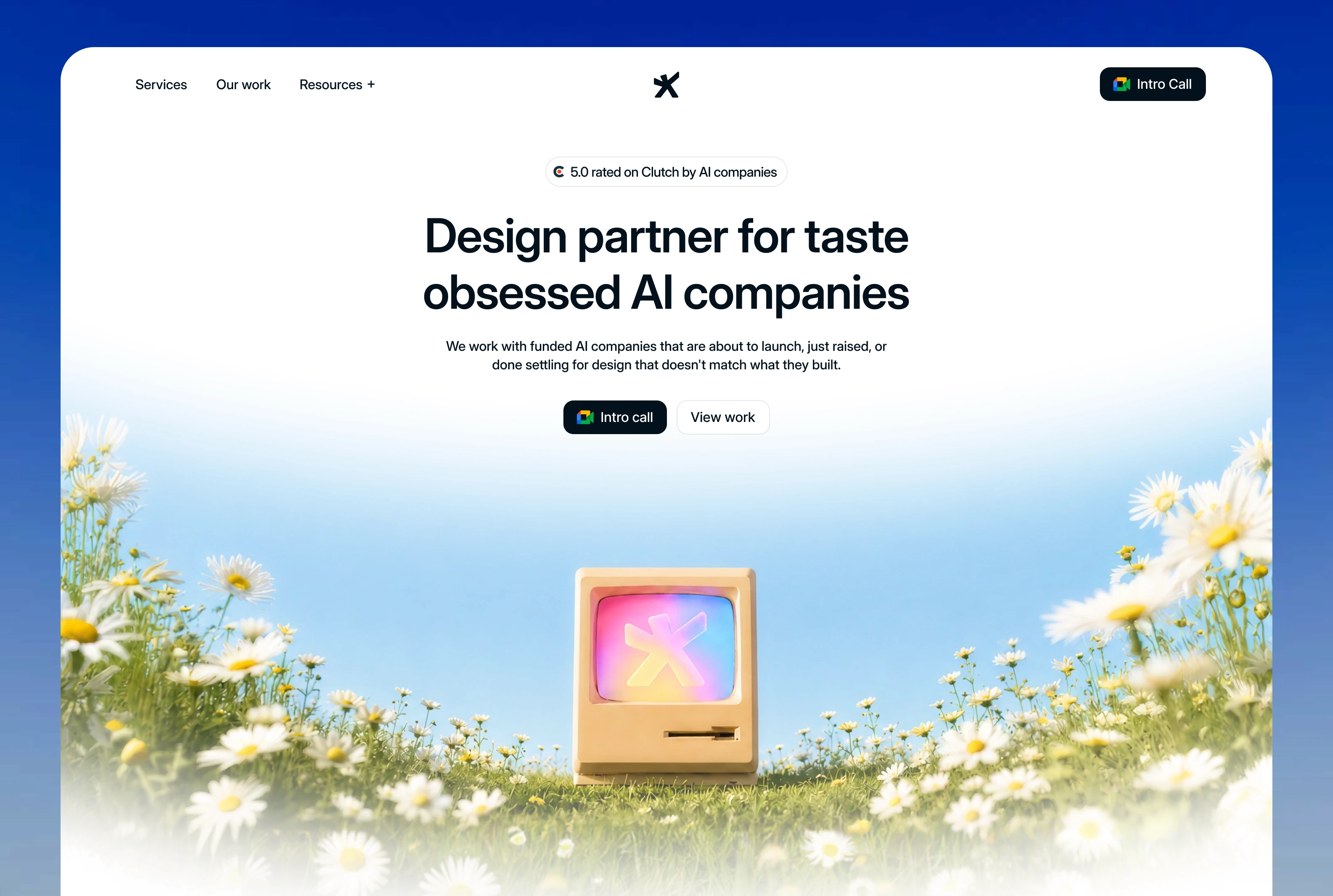
Studio Maydit is a web and product design studio working with AI founders in the US, UK, and Europe. The studio builds websites in Framer, Webflow, and custom code, and continues into product design after the site ships.
The clearest outcome is Dualite, where design work supporting a repositioned ICP helped the product reach 100,000+ users in seven months. Recent clients include Wave, PixelFlow, Mi-VAD, and 15 other AI and SaaS teams.
Websites can be bought two ways. Fixed scope runs three to four weeks and suits teams with a launch date. Teams that keep shipping take a monthly retainer instead, covering new pages, campaigns, and product design, with no long lock-in. Fixed-scope projects end with a diagnosis of what is leaking in the product, not a handoff and goodbye.
Check | Finding |
|---|---|
Based in | Remote, serving US / UK / EU |
Platform depth | Framer, Webflow, and custom code |
AI-sector proof | Yes. AI-native clients, published outcome on Dualite |
Pricing | Fixed scope or monthly retainer, quoted per project |
Team shape | Founder-led, small senior team |
Best fit | Agent teams who need the marketing site and the product itself handled by one team |
Maydit is the right call if your agent already works and the homepage is the reason nobody believes it. Book a 30-minute call.

2. Trueform
Trueform is a Swiss studio built specifically around Framer, with clients including Miro, Morning Brew, and Bilt Rewards. The thing that matters for an agent startup is that they build natively in Framer instead of exporting a Figma file into it. Your positioning will move. Agent companies rewrite their homepage more often than any other category we track, usually because the product got better at something nobody planned for, and a native build means that rewrite takes an afternoon instead of a new statement of work.
They are a small senior studio with no published team size and no Clutch presence, so the question for the first call is capacity, not craft.
Check | Finding |
|---|---|
Based in | Wil, Switzerland |
Founded | 2022 |
Team size | Not published |
Primary platform | Framer |
AI-sector proof | Yes. Published AI client work |
Named clients | Miro, Morning Brew, Bilt Rewards, Gather |
Pricing | Published minimum |
Best fit | Funded agent startups that want top-tier Framer craft and expect their message to keep moving |
3. Feely Studio
Feely is a small distributed European studio doing brand identity alongside Framer and Webflow build, with AI clients including Noxus and Mutiny. They publish an entry point, which makes them one of the few teams here a seed-stage agent company can afford for brand and site in one go. For a company whose category does not have an agreed name yet, getting naming, tone, and site from the same people is worth more than it sounds.
Very small team with no single base and no published founding year, so their availability shapes your timeline more than your launch date does.
Check | Finding |
|---|---|
Based in | Distributed, Europe |
Founded | Not published |
Team size | 1-10 |
Primary platform | Mixed |
AI-sector proof | Yes. Published AI client work |
Named clients | Noxus, Mutiny, Luasai, Basic Capital |
Pricing | Published minimum |
Best fit | Seed-stage agent startups buying brand and website together on a startup budget |
4. SuperSkills
SuperSkills is a very small US studio working across Framer and Webflow with published AI client work. The offer is Series B polish at a seed price, which is a real gap for agent teams who raised a modest round and still have to look credible next to companies that raised ten times more.
Effectively a one-person operation with a single named public client, so you are betting on one person's judgement rather than a studio with cover.
Check | Finding |
|---|---|
Based in | Walnut Creek, USA |
Founded | Not published |
Team size | 1-10 |
Primary platform | Mixed |
AI-sector proof | Yes. Published AI client work |
Named clients | The Cut |
Pricing | Not published |
Best fit | Pre-seed and seed agent startups who need to look more established than their round |
5. Lazarev
Lazarev is a San Francisco studio that has been doing AI interface work since well before the current wave, with award-winning work on Elva. Their process starts with research, which fits agent products because the hard question is not how the buttons look. It is what a person needs to see during the ninety seconds they are not in control, and what they need to see afterwards to trust that it went well.
They publish a minimum that rules out most pre-seed teams, and a research-led process runs slower than a hard launch date usually allows.
Check | Finding |
|---|---|
Based in | San Francisco, USA |
Founded | 2015 |
Team size | 51-200 |
Primary platform | Mixed |
AI-sector proof | Yes. Published AI client work |
Named clients | Payoneer, Peel, Elva, Mozayix |
Pricing | Published minimum |
Best fit | Funded agent startups where the product experience is the problem, not the marketing site |

6. Clay
Clay is a San Francisco studio of 51 to 200 people covering branding, UX, and front-end build, with clients including Slack, Stripe, and Coinbase. They are the safe premium choice on this list. Their front-end capability matters here because an agent site usually needs something built rather than styled, whether that is a live demo or a explorable log of a real run, and that work dies at a Figma handoff.
Premium positioning puts them out of reach for pre-seed teams, and they are not built for a four-week Framer turnaround.
Check | Finding |
|---|---|
Based in | San Francisco, USA |
Founded | 2016 |
Team size | 51-200 |
Primary platform | Mixed |
AI-sector proof | Yes. Published AI client work |
Named clients | Slack, Stripe, Google, Coinbase, Amazon |
Pricing | Published minimum |
Best fit | Series A and later agent startups where brand credibility justifies a premium |
7. Fantasy
Fantasy has been running since 1999 and now leads with AI strategy alongside product innovation and brand. They are one of the few teams here that treats AI as a strategy question rather than a styling question, which is closer to what an agent company needs when the category itself is still being argued about.
Enterprise scale brings enterprise process. A seed-stage agent team will be their smallest account and will feel it in the calendar.
Check | Finding |
|---|---|
Based in | San Francisco and New York, USA |
Founded | 1999 |
Team size | Not published |
Primary platform | Mixed |
AI-sector proof | Yes. Published AI client work |
Named clients | Not published |
Pricing | Not published |
Best fit | Larger companies rolling agent products out across several business units |
8. Push Refresh
Push Refresh is a very small Dallas studio working across Framer and Webflow, including migrations between them. The appeal for a founder is directness. You are talking to the people doing the work rather than an account manager carrying messages back to a team you never meet, which shortens the loop when your positioning changes twice during the build.
Two people means limited parallel capacity, and their published work is healthcare and services rather than AI.
Check | Finding |
|---|---|
Based in | Dallas, USA |
Founded | Not published |
Team size | 1-10 |
Primary platform | Framer |
AI-sector proof | Partial. Tech and SaaS clients, no AI case study |
Named clients | SmithRx, Synonym, Northern National |
Pricing | Published minimum |
Best fit | Founders who want senior contact directly and a fast Framer or Webflow build |
9. Feels Like
Feels Like is a Los Angeles studio founded in 2023 building custom-coded work for clients including Google, Nike, and Suno AI. They are worth a call if your agent needs to be experienced rather than explained, because custom code is what lets a visitor actually run something on the page instead of watching a recording of it.
They do not publish a team size and do not publish pricing, and custom code is slower and more expensive to change later than a Framer build.
Check | Finding |
|---|---|
Based in | Los Angeles, USA |
Founded | 2023 |
Team size | Not published |
Primary platform | Custom code |
AI-sector proof | Yes. Published AI client work |
Named clients | Google, Nike, LVMH, Suno AI |
Pricing | Not published |
Best fit | Agent companies whose product only lands once somebody has tried it in the browser |
10. basement.studio
basement.studio works out of Argentina and Los Angeles building custom-coded sites, and their client list is unusually close to home for an agent startup. Vercel, Cursor, ElevenLabs, Harvey AI, and Scale AI are all companies that had to explain a technical product to a technical buyer. That is the exact problem, and it is rare to find a studio that has solved it this many times.
Custom code as the default means more engineering time and less in-house editing afterwards, so plan for a developer to stay involved.
Check | Finding |
|---|---|
Based in | Mar del Plata, Argentina and Los Angeles, USA |
Founded | 2018 |
Team size | 11-50 |
Primary platform | Custom code |
AI-sector proof | Yes. Published AI client work |
Named clients | Vercel, Cursor, ElevenLabs, Harvey AI, Scale AI |
Pricing | Published minimum |
Best fit | Agent startups selling to engineers who want a site with real interaction, not screenshots |
How to choose between them
Sort by what is actually broken.
Nobody understands what your agent does. This is a language problem before it is a design problem. Lazarev or Fantasy, both of whom start from research instead of layout.
People understand it and still do not trust it. You need permissions, activity history, and a stop button designed as real parts of the product. Studio Maydit or Clay.
It works and the site makes it look like a side project. Straight production. Trueform, Push Refresh, or SuperSkills, depending on what you can spend.
It only makes sense once you have tried it. basement.studio or Feels Like, for something that genuinely runs in the browser.
One test before signing anything. Ask them to explain your product back to you in two sentences, with no jargon. If they cannot do it after a week of talking to you, your buyers will not get there in eight seconds on a homepage.

Need more info?
Can't find your answer? Book a call and let's talk.
Continue Reading
10 Best Framer Design Agencies for AI Agent Startups - September 2026
What is the best Framer agency for an AI agent startup? Ten Framer studios ranked for agent products, with pricing, team size and AI work compared.

Siddarth Ponangi
10 Best Framer Design Agencies for Newly Funded Startups - September 2026
Your funding announcement is the biggest traffic day you will have all year. We checked 10 Framer agencies on five public criteria to see which can hit that date.
Siddarth Ponangi
10 Best Custom Code Website Development Agencies for AI Agent Startups - September 2026
AI web development agencies for agent startups. Which teams build custom coded sites a small team can still update weekly after launch.
Siddarth Ponangi