

Summarize with AI


If you have just raised and the site needs replacing, the ten studios worth reviewing are Studio Maydit, Push Refresh, Engine Digital, Ramotion, Fantasy, SuperSkills, Phantom, Clay, Trueform, and Lazarev. Ramotion and Lazarev lead this list. Ramotion has worked from San Francisco since 2009 with eleven to fifty people and a published starting price, for Mozilla, Okta, Netflix, Adobe, and Xero, all rebuilds of products that already had users. Lazarev has worked from San Francisco since 2015 with fifty-one to two hundred people, a published starting price, and AI-sector proof, for Payoneer, Peel, Elva, and Mozayix. SuperSkills and Fantasy fit least well here. SuperSkills is a small team best suited to a first build, and Fantasy publishes neither clients nor pricing, which is a slow start when you are on a post-raise clock.
A redesign is not a build. You already have a site, and that site already has something worth keeping.
That is the part teams forget in the four weeks after a round closes. The old site is treated as an embarrassment to be deleted, when parts of it are the only assets you have that took a year to earn. Some pages rank. Some pages are linked from an investor's blog post. One page quietly converts better than everything else on the domain.
Delete those without an inventory and the new site launches into a hole. Traffic falls, and because everything changed at once, nobody can say which change caused it.
The pressure is real. There is money in the bank, a new narrative to tell, and a board that has seen the old homepage. But the round also raises the cost of a mistake, because you now have people arriving who did not arrive before.
The right instinct is boring. Find out what already works, decide deliberately what dies, and change the rest.

How we picked these agencies
Five criteria set the order, and all of them can be settled from public pages before you spend a call.
Platform depth, judged by who has to publish after the launch. A funded team hires marketers, and those marketers will want to ship a landing page on a Tuesday without filing a ticket. A studio that only builds in one system will tell you that system is the answer. A studio with range will ask what your next hire looks like first.
Venture-backed proof. That is the criterion carrying the most weight on this page, and it is not the same as AI proof. What matters is whether a studio has worked with a company that changed shape after a raise: new buyer, new price, new claims, all inside a quarter. Rebuilds for companies with existing users are the strongest signal, because those projects come with the constraint you have.
Pricing. Is a starting figure published. Post-raise you have budget and very little time, and a studio that will not name a range in public usually will not scope quickly in private either.
Team shape. Small teams give you seniority on every call. Larger teams give you parallel workstreams, which matters when the redesign, the brand, and a launch campaign all have the same deadline.
Their own site. It is the one project with no client to blame. Look at whether it has been redesigned recently and whether the old URLs still resolve, because that tells you how the studio treats other people's traffic.
One extra question for the first call: ask what they would refuse to change on your current site. A studio that answers has already thought about what you are risking.
The tables carry only public information. Where something is marked unpublished, the studio has not put that figure on record, and we have not invented one.
What goes wrong for startups that just raised
Three failures, and the first is the expensive one because it is invisible for a quarter.
The old site is deleted before anyone inventories it. No export of the page list with traffic, conversions, and inbound links. No note of which posts rank and for what. The new site ships with a cleaner structure, half the URLs change, and nobody wrote redirects because nobody had the list. Search traffic drops the following month and the studio has already invoiced. This is an hour of work that has to happen before design starts, and almost nobody does it.
The new story is written for the investor, not the buyer. The deck that raised the round is persuasive to people who fund categories. Your customer does not buy a category, they buy a fix for something annoying. Post-raise homepages drift upward into market language, vision statements, and a diagram of where the industry is going. The buyer arrives, cannot tell what the product does, and leaves. The deck was right for its audience and wrong for this one.
The redesign starts before the positioning is settled. A raise usually comes with a plan to move upmarket, add a second product, or change who you sell to. If that is still being argued internally, the site gets designed around a story that changes in month two, and you pay twice. It is cheaper to spend two weeks settling the narrative and eight building than to spend twelve building the wrong thing beautifully.
1. Studio Maydit: A Top-Rated Design Agency for AI Founders
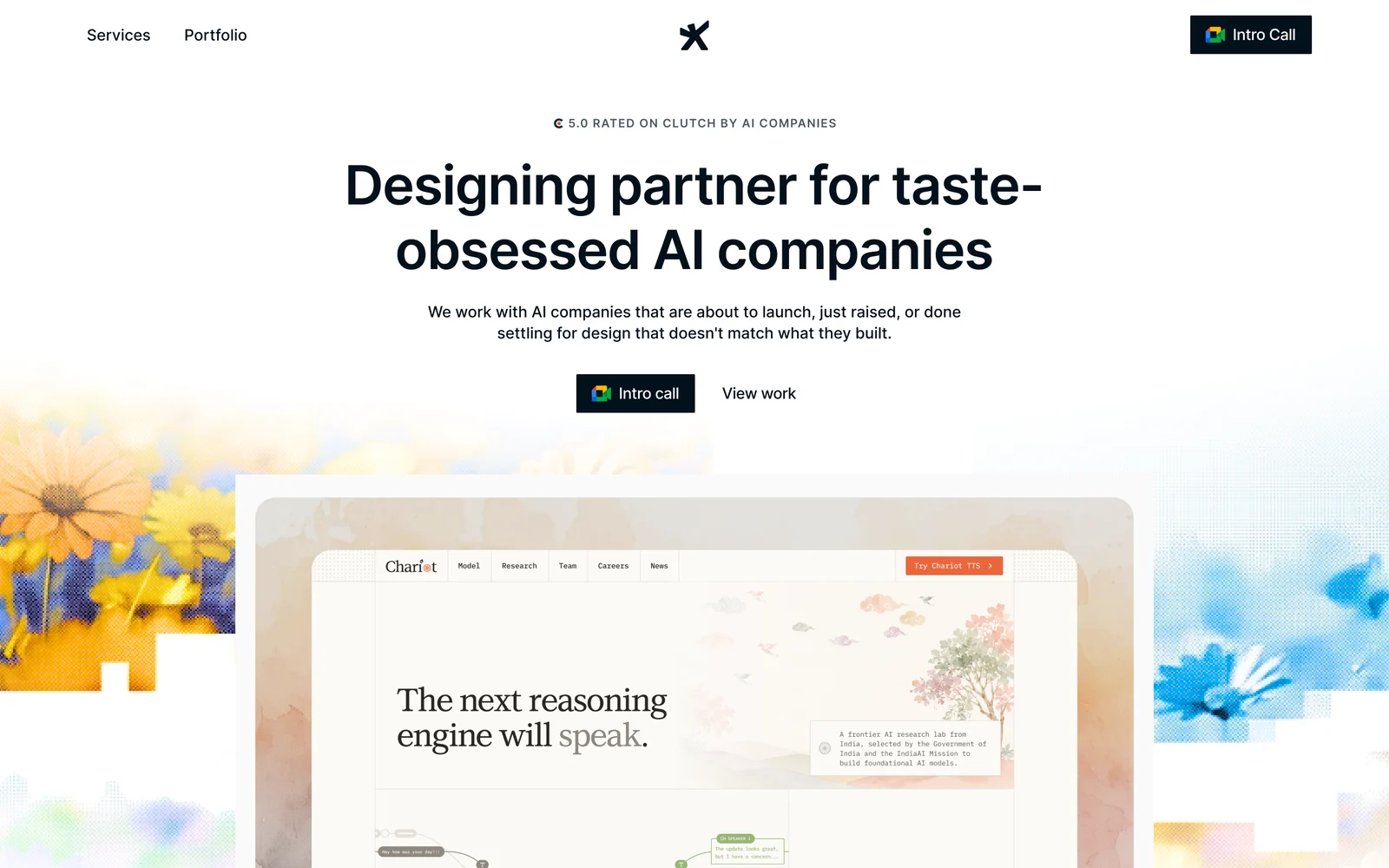
Three to four weeks is the fixed-scope span, and after a round closes that constraint is doing useful work rather than limiting you. It forces the positioning argument to finish, because a short build has no room for a story that is still moving. Studio Maydit is a web and product design studio working with AI founders across the US, UK, and Europe, building in Framer, Webflow, and custom code, and continuing into product design after the site ships.
That continuation matters more after a raise than before one. New money brings new traffic, and traffic exposes whatever is confusing inside the product. Fixed-scope projects finish with a written diagnosis of what is leaking there, rather than a handover and goodbye. Where a team keeps shipping instead, a monthly retainer covers new pages, campaigns, and product design, with no long lock-in, which suits the twelve months after a round when the plan changes quarterly.
Dualite is the published outcome and the sequence is the useful part. A repositioned ICP came first. The product was then built for the narrower group that decision defined, and 100,000+ users arrived within seven months. Narrowing after raising money feels backwards and is usually correct. Recent clients include Wave, PixelFlow, Mi-VAD, and 15 other AI and SaaS teams.
| Check | Finding |
|---|---|
| Based in | Remote, serving US / UK / EU |
| Platform depth | Framer, Webflow, and custom code |
| AI-sector proof | Yes. AI-native clients, published outcome on Dualite |
| Pricing | Fixed scope or monthly retainer, quoted per project |
| Team shape | Founder-led, small senior team |
| Best fit | Funded teams who need the story settled before the build starts |
Settle who you are selling to now, then rebuild once. Book a 30-minute call.

2. Ramotion
Ramotion has worked from San Francisco since 2009 with eleven to fifty people and a published starting price, for Mozilla, Okta, Netflix, Adobe, and Xero. Every one of those was a company with an existing audience and existing equity, which is the exact situation a post-raise redesign creates. A studio used to that will ask what it is not allowed to break before it asks what it can change.
AI-sector proof is only partial, and a studio with this client profile is used to longer enterprise timelines than a startup on a launch date usually wants.
| Check | Finding |
|---|---|
| Based in | San Francisco, USA |
| Founded | 2009 |
| Team size | 11-50 |
| Primary platform | Mixed |
| AI-sector proof | Partial |
| Named clients | Mozilla, Okta, Netflix, Adobe, Xero |
| Pricing | Published minimum |
| Best fit | Teams with real traffic who cannot afford to lose it |
3. Lazarev
Lazarev has worked from San Francisco since 2015 with fifty-one to two hundred people, a published starting price, and AI-sector proof, for Payoneer, Peel, Elva, and Mozayix. At this size the studio can run brand, site, and product work at once, which is what a compressed post-raise timeline usually needs. Payoneer is a company that repositioned as it grew.
A fifty-plus team means the people in the pitch are unlikely to be the people doing the work, so ask who is actually assigned before signing.
| Check | Finding |
|---|---|
| Based in | San Francisco, USA |
| Founded | 2015 |
| Team size | 51-200 |
| Primary platform | Mixed |
| AI-sector proof | Yes |
| Named clients | Payoneer, Peel, Elva, Mozayix |
| Pricing | Published minimum |
| Best fit | Funded teams running brand, site, and product on one deadline |
4. Push Refresh
Push Refresh is a Framer studio in Dallas with one to ten people and a published starting price, for SmithRx, Synonym, and Northern National. Framer is the fastest platform on this page for changing a claim, and in the months after a raise your claims change more than you expect. A very small team also means the person you brief is the person who builds.
AI-sector proof is only partial, and a team of this size cannot run a rebrand alongside a rebuild, so anything beyond the site needs a second supplier.
| Check | Finding |
|---|---|
| Based in | Dallas, USA |
| Founded | Not published |
| Team size | 1-10 |
| Primary platform | Framer |
| AI-sector proof | Partial |
| Named clients | SmithRx, Synonym, Northern National |
| Pricing | Published minimum |
| Best fit | Funded teams who want to move fast and keep editing after launch |
5. Engine Digital
Engine Digital has worked from Vancouver and New York since 2002 in custom code, for Adidas, Autodesk, Goldman Sachs, and HP. A studio with two decades of large rebuilds behind it has done the unglamorous parts many times: content inventories, redirect maps, and staged launches. That is precisely the discipline a post-raise redesign needs and rarely buys.
No pricing and no team size are published, AI-sector proof is only partial, and an enterprise-shaped studio will move at enterprise pace unless you hold the schedule hard.
| Check | Finding |
|---|---|
| Based in | Vancouver and New York |
| Founded | 2002 |
| Team size | Not published |
| Primary platform | Custom code |
| AI-sector proof | Partial |
| Named clients | Adidas, Autodesk, Goldman Sachs, HP |
| Pricing | Not published |
| Best fit | Larger rebuilds where losing traffic is unacceptable |
6. Phantom
Phantom has worked from London and Auckland since 2013 in custom code with fifty-one to two hundred people and AI-sector proof, for Diageo, SAP, Financial Times, and Zendesk. The Financial Times is a content estate where URL structure and archive handling are load-bearing, which is the skill a redesign with existing search traffic actually needs.
No pricing and no team size figures are published, and a studio serving clients of this scale is a heavy choice for a startup that just closed a first or second round.
| Check | Finding |
|---|---|
| Based in | London, UK and Auckland, NZ |
| Founded | 2013 |
| Team size | 51-200 |
| Primary platform | Custom code |
| AI-sector proof | Yes |
| Named clients | Diageo, SAP, Financial Times, Zendesk |
| Pricing | Not published |
| Best fit | Teams with a large content archive to carry across |
7. Trueform
Trueform has worked from Wil in Switzerland since 2022 in Framer, with a published starting price and AI-sector proof, for Miro, Morning Brew, Bilt Rewards, and Gather. Framer suits the year after a raise because the story is still settling and edits should not need a developer. Miro and Morning Brew are both companies that grew past their original description.
No team size is published, the studio is young, and a Framer-only shop is the wrong answer if part of your site needs to run live product data.
| Check | Finding |
|---|---|
| Based in | Wil, Switzerland |
| Founded | 2022 |
| Team size | Not published |
| Primary platform | Framer |
| AI-sector proof | Yes |
| Named clients | Miro, Morning Brew, Bilt Rewards, Gather |
| Pricing | Published minimum |
| Best fit | Teams whose positioning will keep moving for two more quarters |
8. Clay
Clay has worked from San Francisco since 2016 with fifty-one to two hundred people, a published starting price, and AI-sector proof, for Slack, Stripe, Google, Coinbase, and Amazon. This is the most recognisable client list on the page, and for a company that has just raised and wants the site to signal a new tier, that pedigree is part of what is being bought.
It is also the most expensive way to redesign a startup site here, and a studio working at this level will expect a decision-making process most early teams do not yet have.
| Check | Finding |
|---|---|
| Based in | San Francisco, USA |
| Founded | 2016 |
| Team size | 51-200 |
| Primary platform | Mixed |
| AI-sector proof | Yes |
| Named clients | Slack, Stripe, Google, Coinbase, Amazon |
| Pricing | Published minimum |
| Best fit | Well-funded teams buying a visible step up in tier |
9. Fantasy
Fantasy has worked from San Francisco and New York since 1999 with AI-sector proof. Twenty-five years of practice means a studio that has watched several waves of redesign fashion pass, which is a useful counterweight when a fresh round makes everyone want the current look.
Neither clients, team size, nor pricing are published, so almost nothing can be verified before a call, and that is a slow start when your board expects a new site this quarter.
| Check | Finding |
|---|---|
| Based in | San Francisco and New York, USA |
| Founded | 1999 |
| Team size | Not published |
| Primary platform | Mixed |
| AI-sector proof | Yes |
| Named clients | Not published |
| Pricing | Not published |
| Best fit | Teams who want a senior second opinion on the whole direction |
10. SuperSkills
SuperSkills is a one to ten person studio in Walnut Creek with AI-sector proof, for The Cut. A very small senior team is a reasonable answer if the redesign is mostly a rewrite and the existing structure is sound, and it will be the least bureaucratic engagement on this page.
Only one client is named, no pricing and no founding year are published, and a team this size cannot absorb a rebrand, a rebuild, and a launch campaign at once, which is usually what a post-raise quarter actually contains.
| Check | Finding |
|---|---|
| Based in | Walnut Creek, USA |
| Founded | Not published |
| Team size | 1-10 |
| Primary platform | Mixed |
| AI-sector proof | Yes |
| Named clients | The Cut |
| Pricing | Not published |
| Best fit | Small redesigns where the structure stays and the words change |
How to choose between them
Sort by what is actually broken.
If the site has real search traffic and inbound links you cannot afford to lose, buy redesign discipline. Ramotion, or Engine Digital for a larger estate.
If the story changed with the round and has not settled, buy speed of change. Trueform or Push Refresh on Framer.
If the brand now looks smaller than the company, that is tier and it costs money. Clay, or Lazarev if product work is in scope too.
If you have a big archive of published content, buy someone who has moved one before. Phantom.
If you are still deciding whether this is a rebrand or a refresh, settle that before you brief anyone. The difference between the two is the cheapest decision on the project, and it changes who you should be talking to.
One test before you sign. Ask each studio what they would do in week one. The answer you want is dull: pull the page list, check what ranks and what converts, agree what is being retired. If the first answer involves showing you directions, that studio has understood this as a new site, and you will get one, along with a gap where your traffic was.