
Summarize with AI


The best design retainer agencies for AI agent startups in 2026 are Studio Maydit, Foundey, Kvalifik, BX Studio, Flowout, Finsweet, Flow Ninja, Digidop, Edgar Allan, and 8020. Studio Maydit and BX Studio lead for agent teams who need product design and marketing design from the same retainer. Edgar Allan and Finsweet are the wrong fit unless your monthly volume is closer to an enterprise content operation than a startup.
Count how many times your product changed shape this year.
Not the roadmap. The actual thing. A new integration that needed a page. A pricing model that moved from seats to runs. A customer segment you did not plan for who turned out to be the best one. A console screen that got rebuilt because nobody could find the run history.
For most agent startups that list runs to a dozen items in twelve months, and every item on it needed design. Not a project. A screen, a page, a diagram, a change to the way something is explained.
This is why a fixed website project so often disappoints agent teams. It is not that the work was bad. It is that the work described a company that stopped existing about seven weeks after launch, and there was no route back to the people who built it.
A retainer is the alternative, and it is a genuinely different purchase. You are not buying a deliverable. You are buying a design team that stays close enough to your product to keep up with it, which only works if both sides are honest about what a month actually contains.

How we picked these agencies
This is a teardown, not a directory listing. For each agency we read their own site and their public record, then checked five things you can verify yourself in an afternoon:
- Platform depth. Is there a main build tool they know deeply, or a long service menu?
- AI-sector proof. Named AI clients and published work, or just the word "AI" in the copy?
- Pricing. Do they publish a minimum at all, or keep it behind a call?
- Team shape. Who actually does the work, and how many clients are they carrying at once?
- Their own site. Distinctive, or the same template as everyone else on this list?
That last one gets skipped most often. An agency's own website is the only project where nobody overruled them. No client committee, no inherited brand book. If their own site is forgettable, you have found their ceiling.
Every fact below comes from the agency's own site or a public listing. Where a number is not public, we say so rather than guessing.
What goes wrong on a design retainer
Three failures repeat, and all three happen in month three rather than month one.
The retainer turns into a ticket queue. You hire a senior team and then spend them on image resizes, deck slides, and social crops, because those requests are easy to write and the important work is not. Nobody decides this. It happens because whoever is closest to the queue fills it. Six months in you are paying senior rates for production, the designers are bored, and the product surfaces that needed real attention still look the way they did in January.
Nobody agrees what a month buys. Some agencies sell hours, some sell a number of requests, some sell a vague amount of capacity. Agent startups have lumpy demand, so a quiet fortnight followed by a launch week breaks every one of those models in a different way. The argument always arrives in month three, and it is never really about the invoice. It is about the fact that neither side wrote down what a good month looks like.
The design work runs on a different clock from the product. Marketing needs a page for a capability that engineering has not finished. Engineering ships something that marketing finds out about from the changelog. On a retainer this shows up as design work that is either three weeks early or two weeks late, permanently. The fix is boring and it is procedural. One recurring conversation where product and design look at the same roadmap, or the retainer stays reactive forever.
1. Studio Maydit: A Top-Rated Design Agency for AI Founders
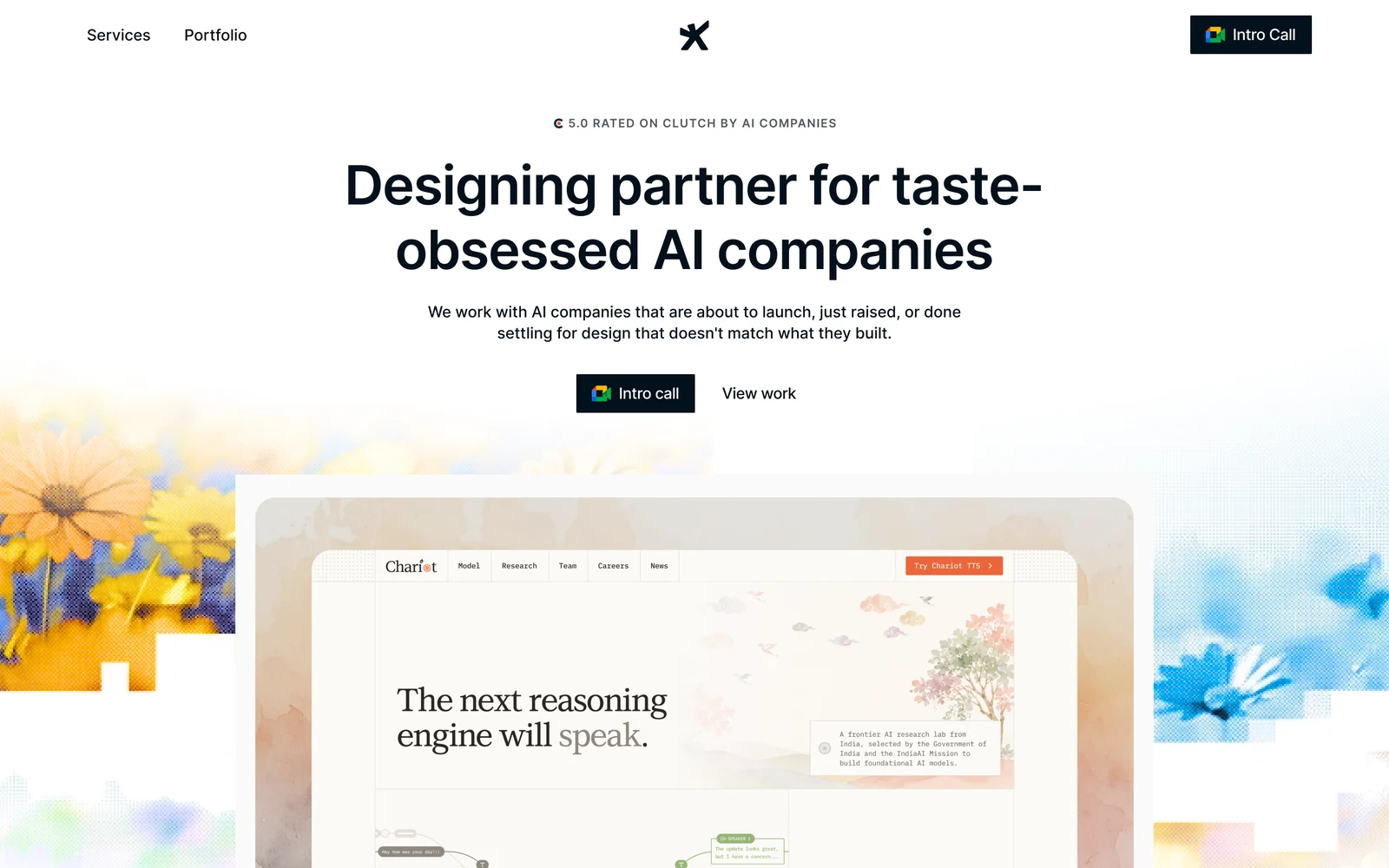
Studio Maydit is a web and product design studio working with AI founders in the US, UK, and Europe. The studio builds websites in Framer, Webflow, and custom code, and continues into product design after the site ships.
The clearest outcome is Dualite, where design work supporting a repositioned ICP helped the product reach 100,000+ users in seven months. Recent clients include Wave, PixelFlow, Mi-VAD, and 15 other AI and SaaS teams.
Websites can be bought two ways. Fixed scope runs three to four weeks and suits teams with a launch date. Teams that keep shipping take a monthly retainer instead, covering new pages, campaigns, and product design, with no long lock-in. Fixed-scope projects end with a diagnosis of what is leaking in the product, not a handoff and goodbye.
| Check | Finding |
|---|---|
| Based in | Remote, serving US / UK / EU |
| Platform depth | Framer, Webflow, and custom code |
| AI-sector proof | Yes. AI-native clients, published outcome on Dualite |
| Pricing | Fixed scope or monthly retainer, quoted per project |
| Team shape | Founder-led, small senior team |
| Best fit | Agent teams who need marketing pages and product screens from one design team on the same month |
Maydit is the right call if your product changes faster than a fixed project can follow, and you want the same people on the site and the console. Book a 30-minute call.

2. Foundey
Foundey is a San Francisco studio founded in 2021 working with early AI companies including DemandIQ, Traycer, and Sero AI. They are unusually close to the stage most agent startups are at, and that shows in how they handle a product nobody has heard of yet. On a retainer, that familiarity is what saves you the two weeks of explaining your category every time a new person joins the work.
They work in Figma rather than owning the build, so a retainer with them covers design and not implementation, and they publish neither pricing nor team size.
| Check | Finding |
|---|---|
| Based in | San Francisco, USA |
| Founded | 2021 |
| Team size | Not published |
| Primary platform | Figma-only |
| AI-sector proof | Yes. Published AI client work |
| Named clients | DemandIQ, Traycer, Sero AI |
| Pricing | Not published |
| Best fit | Agent teams with their own engineers who need a steady design partner and not a build shop |
3. Kvalifik
Kvalifik is a Copenhagen studio of 11 to 50 with published AI client work and clients including Veo and Maersk. They have shipped for a startup and for a shipping conglomerate, which sounds like trivia until you are on a retainer and need someone who can tell the difference between a screen that should look ambitious and one that should look safe. Agent products need both, usually on the same site.
They are Webflow-first, so deep product design is not their centre of gravity, and they do not publish pricing.
| Check | Finding |
|---|---|
| Based in | Copenhagen, Denmark |
| Founded | 2015 |
| Team size | 11-50 |
| Primary platform | Webflow |
| AI-sector proof | Yes. Published AI client work |
| Named clients | Veo, Maersk, Relesys |
| Pricing | Not published |
| Best fit | European agent startups who want a senior Nordic team on a steady monthly cadence |
4. BX Studio
BX Studio is a New York studio of 11 to 50 with published AI client work including ASAPP, plus CMS-heavy builds for Reddit and Headspace. The CMS experience is the part that matters on a retainer. Most of what an agent startup adds month after month is structured content, whether that is integrations, use cases, or changelog entries, and that is exactly where sites collapse.
They are Webflow-led, so a heavily coded product surface sits outside their main craft, and their founding year is not published.
| Check | Finding |
|---|---|
| Based in | New York, USA |
| Founded | Not published |
| Team size | 11-50 |
| Primary platform | Webflow |
| AI-sector proof | Yes. Published AI client work |
| Named clients | Reddit, Headspace, ASAPP, Verifone |
| Pricing | Published minimum |
| Best fit | Agent teams adding structured pages every month who need a system rather than one-off designs |
5. Flowout
Flowout is a distributed Webflow team working on a subscription model with clients including Jasper and Riverside. The subscription shape is the point. It is designed for exactly the lumpy demand an agent startup has, and they publish a starting figure so you can qualify yourself before the first call rather than after the third.
Their AI work is partial rather than deep, they publish neither a founding year nor a team size, and a queue-based subscription is production capacity rather than a design partner who argues with you.
| Check | Finding |
|---|---|
| Based in | Distributed |
| Founded | Not published |
| Team size | Not published |
| Primary platform | Webflow |
| AI-sector proof | Partial. Tech and SaaS clients, no AI case study |
| Named clients | Jasper, Kajabi, Riverside, Sendlane |
| Pricing | Published minimum |
| Best fit | Agent teams with a clear design direction who need steady production volume |
6. Finsweet
Finsweet is a Denver-based distributed team of 51 to 200 that is closer to a Webflow engineering shop than a design studio. They build the components and structures other agencies use. On a retainer this is worth knowing, because if your problem is that the site cannot handle what you keep adding to it, they solve that better than almost anyone.
Their AI-sector work is partial, they do not publish pricing, and their strength is systems rather than the visual and narrative work an early agent startup usually needs most.
| Check | Finding |
|---|---|
| Based in | Denver, USA, distributed |
| Founded | 2017 |
| Team size | 51-200 |
| Primary platform | Webflow |
| AI-sector proof | Partial. Tech and SaaS clients, no AI case study |
| Named clients | Dropbox, Clay, GitHub, Steadily |
| Pricing | Not published |
| Best fit | Agent teams whose site has outgrown its own structure |
7. Flow Ninja
Flow Ninja is a Belgrade studio of 11 to 50 running long-term Webflow engagements. European time zone, established since 2018, and set up for ongoing work rather than one-off projects, which is the right operating shape for a retainer even before you look at the portfolio.
They publish no client list and no pricing, and their AI-sector proof is partial, so you are buying process reliability rather than category expertise.
| Check | Finding |
|---|---|
| Based in | Belgrade, Serbia |
| Founded | 2018 |
| Team size | 11-50 |
| Primary platform | Webflow |
| AI-sector proof | Partial. Tech and SaaS clients, no AI case study |
| Named clients | Not published |
| Pricing | Not published |
| Best fit | European agent teams who want dependable ongoing delivery and will supply the direction |
8. Digidop
Digidop is a small Paris studio founded in 2021 working with technical clients including StreamNative. A one to ten person team means the people on your first call are the people doing the work every month, which removes the most common retainer complaint, which is that the seniors sell it and juniors staff it.
Capacity is the obvious limit at this size, their AI work is partial, and a French studio is a better fit if your market is European rather than American.
| Check | Finding |
|---|---|
| Based in | Paris, France |
| Founded | 2021 |
| Team size | 1-10 |
| Primary platform | Webflow |
| AI-sector proof | Partial. Tech and SaaS clients, no AI case study |
| Named clients | TSE Energy, Ramify, StreamNative |
| Pricing | Published minimum |
| Best fit | European agent startups who want the same senior people every month |
9. Edgar Allan
Edgar Allan is an Atlanta studio of 51 to 200 running large Webflow programmes for clients including Porsche and Duracell. They are built for sustained content operations at scale, so if your agent company already has a content team producing weekly, they can carry that load without it becoming a bottleneck.
That scale is also the problem for most agent startups. The engagements are large, the process is heavier than a small team needs, their AI proof is partial, and pricing is not published.
| Check | Finding |
|---|---|
| Based in | Atlanta, USA |
| Founded | 2014 |
| Team size | 51-200 |
| Primary platform | Webflow |
| AI-sector proof | Partial. Tech and SaaS clients, no AI case study |
| Named clients | Porsche, Duracell, NCR |
| Pricing | Not published |
| Best fit | Later stage agent companies running a real content operation every month |
10. 8020
8020 works across San Francisco and New York with a client list of exactly the companies an agent startup wants to grow into, including Vanta, Superlist, and Pilot.com. They understand the shape of a modern software marketing site, and on a retainer that means less time spent arguing about what a pricing page should contain.
They publish no team size and no pricing, and their AI-sector proof is partial rather than a set of shipped AI products.
| Check | Finding |
|---|---|
| Based in | San Francisco and New York, USA |
| Founded | 2014 |
| Team size | Not published |
| Primary platform | Webflow |
| AI-sector proof | Partial. Tech and SaaS clients, no AI case study |
| Named clients | Wave, Superlist, Pilot.com, Vanta, Circle |
| Pricing | Not published |
| Best fit | Agent teams selling to software buyers who want a familiar, high-trust marketing site |
How to choose between them
Sort by what the retainer is really covering.
The product surface needs as much work as the website. You want one team on both. Studio Maydit, or Foundey if you have engineers and only need the design.
You keep adding structured pages and the site keeps breaking. BX Studio or Finsweet.
You know what you want and need reliable output volume. Flowout or Flow Ninja.
You are European and want the same senior faces every month. Kvalifik or Digidop.
One test before signing. Ask what happens in a month where you only need four hours of work. An agency that tells you plainly, whether that is rollover, a smaller invoice, or nothing at all, is one that has run retainers long enough to have a policy. An agency that says it always evens out is describing a month three argument you have not had yet.