
Summarize with AI


The best design retainer agencies for B2B AI SaaS companies in 2026 are Studio Maydit, Flow Ninja, Edgar Allan, 8020, Finsweet, Flowout, Lighthouse Digital, Clay, Lazarev, and Kvalifik. Studio Maydit and Lazarev lead for B2B teams who need the marketing site and the product covered by the same people. Clay and Edgar Allan are the wrong fit unless you are buying at a scale most SaaS companies reach after Series B.
Count your surfaces before you count agencies.
There is the marketing site. There is the product itself, which is where renewals are actually decided. There is the documentation. There is the onboarding sequence, the in-app empty states, the pricing page, the security page that procurement reads closely, the sales deck, the one-page leave-behind, the partner and integration pages, and the release notes. Eleven surfaces, minimum, and a buyer moving through a six-month evaluation will encounter most of them.
Now ask which of those had a designer near it in the last quarter. For most B2B AI SaaS companies the honest answer is the marketing site, and possibly one product feature. The other nine are being produced by whoever needs them most urgently, in whatever tool they know, and the gap between the best and the worst surface is enormous.
That gap is what your buyer experiences as inconsistency, and inconsistency in a long enterprise sale reads as a small company that might not be around in three years. It is a specific, expensive impression, and it is created by the surfaces nobody owns rather than the one everybody looks at.
A retainer is the only sensible way to cover eleven surfaces. The question is whether the agency you are considering can actually reach past the first one.

How we picked these agencies
This is a teardown, not a directory listing. For each agency we read their own site and their public record, then checked five things you can verify yourself in an afternoon:
- Platform depth. Is this their main craft, or one line on a long service menu?
- AI-sector proof. Named AI clients and published work, or just the word "AI" in the copy?
- Pricing. Do they publish a minimum at all, or keep it behind a call?
- Team shape. Who actually does the work, and how many clients are they carrying at once?
- Their own site. Distinctive, or the same template as everyone else on this list?
That last one gets skipped most often. An agency's own website is the only project where nobody overruled them. No client committee, no inherited brand book. If their own site is forgettable, you have found their ceiling.
Every fact below comes from the agency's own site or a public listing. Where a number is not public, we say so rather than guessing.
What goes wrong across eleven surfaces
Three failures repeat in B2B SaaS retainers, and each one is a coverage problem rather than a quality problem.
The retainer covers acquisition and your losses are in retention. Marketing pages are visible, measurable, and easy to request, so they absorb the whole retainer. Meanwhile the accounts that quietly do not renew are leaving because of something in month two of using the product: a workflow that takes eleven clicks, an admin screen only one person understands, an alert that fires constantly and gets ignored. None of that generates a design request, because nobody inside the company experiences it as a design problem. It shows up in a renewal conversation as they never really adopted it. Look at where your revenue is actually lost before deciding what the retainer covers.
Sales builds its own materials and you end up with two companies. When design has a two-week queue and a deal needs a tailored one-pager by Thursday, an account executive makes it themselves. This is the correct decision for them and it happens at every SaaS company. The result is a parallel design system living in slide decks, built from screenshots of a product version from last spring, with claims nobody in marketing has read. Your most valuable prospects see that material at the highest-intent moment of the entire cycle. The fix is not to forbid it, which never works, but to give sales templates good enough that making something worse takes more effort.
Nobody can say what the retainer changed, so it dies in the first budget review. Design retainers are usually reported as output. Pages delivered, screens shipped, requests closed. That reads as cost, and when the finance conversation arrives, a line item measured in activity is the easiest one to cut. The retainers that survive are tied at the start to two or three numbers somebody already tracks, such as trial to paid conversion, time to first value, or the volume of a specific support ticket. It does not have to be a perfect attribution model. It only has to give the person defending the budget something to say.
1. Studio Maydit: A Top-Rated Design Agency for AI Founders
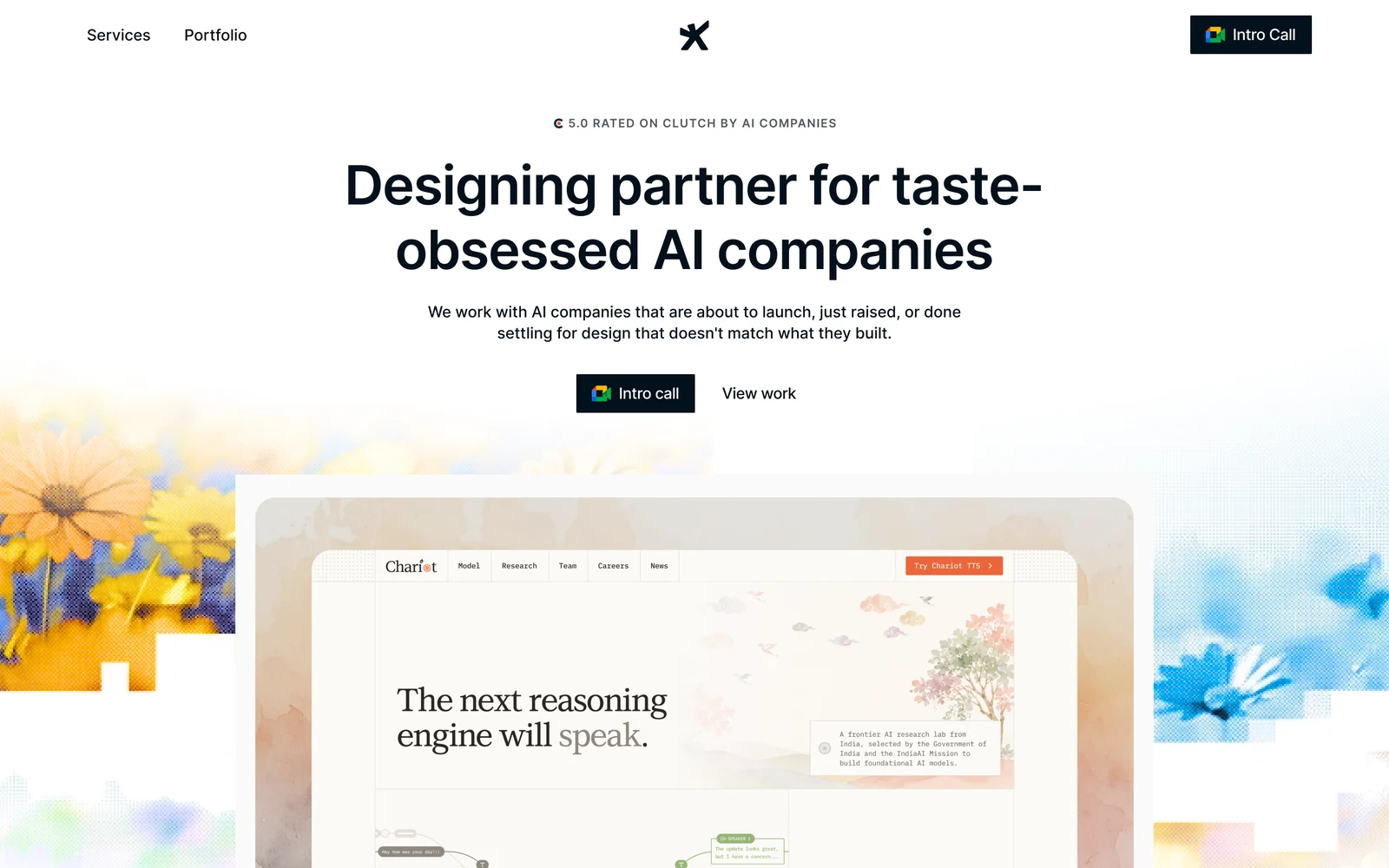
Studio Maydit is a web and product design studio working with AI founders in the US, UK, and Europe. The studio builds websites in Framer, Webflow, and custom code, and continues into product design after the site ships.
The clearest outcome is Dualite, where design work supporting a repositioned ICP helped the product reach 100,000+ users in seven months. Recent clients include Wave, PixelFlow, Mi-VAD, and 15 other AI and SaaS teams.
Websites can be bought two ways. Fixed scope runs three to four weeks and suits teams with a launch date. Teams that keep shipping take a monthly retainer instead, covering new pages, campaigns, and product design, with no long lock-in. Fixed-scope projects end with a diagnosis of what is leaking in the product, not a handoff and goodbye.
| Check | Finding |
|---|---|
| Based in | Remote, serving US / UK / EU |
| Platform depth | Framer, Webflow, and custom code |
| AI-sector proof | Yes. AI-native clients, published outcome on Dualite |
| Pricing | Fixed scope or monthly retainer, quoted per project |
| Team shape | Founder-led, small senior team |
| Best fit | B2B AI SaaS teams whose renewals depend on the product, not the marketing site |
Maydit is the right call if the surfaces losing you money are the ones nobody has been designing. Book a 30-minute call.

2. Flow Ninja
Flow Ninja is a Belgrade studio of 11 to 50 built around ongoing work rather than launches. That size is well matched to a multi-surface retainer, because there is enough of a bench that one person's absence does not stall a month, without the account structure a larger firm brings.
They publish neither client names nor pricing, so you cannot assess fit before speaking to them, and their AI-sector proof is partial.
| Check | Finding |
|---|---|
| Based in | Belgrade, Serbia |
| Founded | 2018 |
| Team size | 11-50 |
| Primary platform | Webflow |
| AI-sector proof | Partial. Enterprise and SaaS clients, no AI case study |
| Named clients | Not published |
| Pricing | Not published |
| Best fit | SaaS teams who want dependable monthly capacity from a mid-sized European team |
3. Edgar Allan
Edgar Allan is an Atlanta team of 51 to 200 working with Porsche, Duracell, and NCR. They think in brand and language before layout, which is the relevant skill when your problem is that eleven surfaces each describe the company slightly differently and nobody has written down which version is correct.
They do not publish pricing, their AI-sector proof is partial, and their engagement scale suits companies considerably larger than most B2B SaaS teams buying a first retainer.
| Check | Finding |
|---|---|
| Based in | Atlanta, USA |
| Founded | 2014 |
| Team size | 51-200 |
| Primary platform | Webflow |
| AI-sector proof | Partial. Enterprise and SaaS clients, no AI case study |
| Named clients | Porsche, Duracell, NCR |
| Pricing | Not published |
| Best fit | Larger SaaS companies whose messaging needs unifying across every surface |
4. 8020
8020 works across San Francisco and New York for Vanta, Pilot.com, and Circle. That is a list of B2B SaaS companies with long, compliance-heavy sales cycles, which means this team has already worked on the security pages, trust centres, and comparison content that a B2B evaluation actually runs through.
They publish neither pricing nor team size, their AI-sector proof is partial, and their published strength is marketing rather than in-product design.
| Check | Finding |
|---|---|
| Based in | San Francisco and New York, USA |
| Founded | 2014 |
| Team size | Not published |
| Primary platform | Webflow |
| AI-sector proof | Partial. Enterprise and SaaS clients, no AI case study |
| Named clients | Wave, Superlist, Pilot.com, Vanta, Circle |
| Pricing | Not published |
| Best fit | B2B SaaS teams whose deals are decided on trust and comparison pages |
5. Finsweet
Finsweet is a distributed team of 51 to 200 out of Denver, as well known for the tooling they publish as for work with Dropbox and GitHub. Their instinct is to leave a system behind, and a system is precisely what eleven surfaces need if they are ever going to look like one company.
They are large, they do not publish pricing, and their depth is in the build rather than in product design or messaging.
| Check | Finding |
|---|---|
| Based in | Denver, USA, distributed |
| Founded | 2017 |
| Team size | 51-200 |
| Primary platform | Webflow |
| AI-sector proof | Partial. Enterprise and SaaS clients, no AI case study |
| Named clients | Dropbox, Clay, GitHub, Steadily |
| Pricing | Not published |
| Best fit | SaaS teams who need one system holding many surfaces together |
6. Flowout
Flowout is a distributed team built around subscription work with clients including Jasper and Sendlane, and they publish a starting figure. For a company with a long queue of defined requests across several surfaces, a volume model at a known monthly price is a reasonable and honest fit.
Their model favours specified work over open problems, their AI-sector proof is partial, and product design sits outside what they publish.
| Check | Finding |
|---|---|
| Based in | Distributed |
| Founded | Not published |
| Team size | Not published |
| Primary platform | Webflow |
| AI-sector proof | Partial. Enterprise and SaaS clients, no AI case study |
| Named clients | Jasper, Kajabi, Riverside, Sendlane |
| Pricing | Published minimum |
| Best fit | SaaS teams with a long queue of well-defined requests each month |
7. Lighthouse Digital
Lighthouse Digital is a London team with published pricing and clients including Freetrade and HelloSelf. Regulated consumer products ship small, exact changes constantly, and a team used to that rhythm handles the steady drip of release notes, help pages, and pricing tweaks a SaaS company generates.
They have no published AI client work, they publish neither team size nor founding year, and their scope is website rather than product.
| Check | Finding |
|---|---|
| Based in | London, UK |
| Founded | Not published |
| Team size | Not published |
| Primary platform | Webflow |
| AI-sector proof | No. No published AI client work |
| Named clients | HelloSelf, Freetrade, IGN |
| Pricing | Published minimum |
| Best fit | UK SaaS teams who want a published monthly figure and steady output |
8. Clay
Clay is a San Francisco studio of 51 to 200 with work for Stripe, Slack, and Coinbase, and they publish a minimum. They cover brand and product in one team, which is the shape a multi-surface retainer needs, and their client list shows they can hold a standard across a very large surface area.
They are expensive, their process assumes a large client, and a mid-sized SaaS company will not command their senior attention every month.
| Check | Finding |
|---|---|
| Based in | San Francisco, USA |
| Founded | 2016 |
| Team size | 51-200 |
| Primary platform | Mixed |
| AI-sector proof | Yes. Published AI client work |
| Named clients | Slack, Stripe, Google, Coinbase, Amazon |
| Pricing | Published minimum |
| Best fit | Well-funded SaaS companies buying brand and product design at scale |
9. Lazarev
Lazarev is a San Francisco team of 51 to 200 with published AI client work including Payoneer. They work across marketing and product, which is the coverage most B2B AI SaaS retainers actually need, and they are practised at making a multi-step product explanation land in sequence rather than all at once.
They publish a minimum but operate at agency scale and cost, and you should confirm the seniority of the people assigned to a monthly arrangement rather than a project.
| Check | Finding |
|---|---|
| Based in | San Francisco, USA |
| Founded | 2015 |
| Team size | 51-200 |
| Primary platform | Mixed |
| AI-sector proof | Yes. Published AI client work |
| Named clients | Payoneer, Peel, Elva, Mozayix |
| Pricing | Published minimum |
| Best fit | SaaS teams who need marketing and product covered by one agency |
10. Kvalifik
Kvalifik is a Copenhagen studio of 11 to 50 with published AI client work including Veo and Relesys. Their strength is making a technical product understandable to non-technical people, which in a B2B sale is the difference between your champion liking the product and their finance director approving it.
They do not publish pricing, and Webflow is the centre of the practice, so extensive in-product work needs checking against your roadmap.
| Check | Finding |
|---|---|
| Based in | Copenhagen, Denmark |
| Founded | 2015 |
| Team size | 11-50 |
| Primary platform | Webflow |
| AI-sector proof | Yes. Published AI client work |
| Named clients | Veo, Maersk, Relesys |
| Pricing | Not published |
| Best fit | European SaaS teams who need the budget holder convinced, not just the user |
How to choose between them
Sort by which surface is costing you the most.
Accounts sign up and never really adopt. Studio Maydit or Lazarev.
Deals stall in security and procurement review. 8020 or Kvalifik.
Every surface describes the company differently. Finsweet, or Edgar Allan if the words are the problem.
There is simply more work than capacity. Flowout or Flow Ninja.
One test before signing. Ask them which of your eleven surfaces they would fix first and what they expect it to change. An agency that picks something in the product, names a number it should move, and explains why has understood that a B2B retainer is a revenue decision. An agency that proposes starting with a homepage refresh has picked the most visible surface rather than the most expensive one.