
Summarize with AI


The best design retainer agencies for fast-shipping product teams in 2026 are Studio Maydit, Lighthouse Digital, Flow Ninja, Flowout, 8020, Edgar Allan, Refokus, Digidop, Finsweet, and Foundey. Studio Maydit and Flow Ninja lead for teams whose release cadence is measured in days. Edgar Allan and Refokus are the wrong fit unless your bottleneck is the brand rather than the release.
If design cannot match your cadence, your team will route around it, and they will be right to.
That is the first thing to be honest about. A team that ships every day does not stop shipping because a design is pending. An engineer needs a screen on Tuesday, the design will exist on Friday, so the engineer builds something reasonable on Tuesday afternoon. It works. It looks approximately correct. It goes out. Multiply that by a quarter and you have a product assembled from a hundred small, sensible, uncoordinated decisions, and a design retainer that has become an expensive cleanup service.
The instinct is to fix this by making the team wait, and that instinct is wrong. The waiting is the disease. Speed is the thing that is working at your company, and a design process that treats it as an obstacle will lose, whatever anyone agrees to in a meeting.
What actually has to change is what design produces. A team shipping daily does not need finished artifacts. It needs decisions, at draft quality, faster than the code that depends on them, plus a system underneath so that the fiftieth screen is cheaper than the fifth. Most agencies are structured to deliver the opposite: high polish, on a weekly rhythm, one screen at a time.
That is what separates these ten. Not the quality of the work, but whether the shape of the engagement can survive contact with a team that does not slow down.

How we picked these agencies
This is a teardown, not a directory listing. For each agency we read their own site and their public record, then checked five things you can verify yourself in an afternoon:
- Platform depth. Is this their main craft, or one line on a long service menu?
- AI-sector proof. Named AI clients and published work, or just the word "AI" in the copy?
- Pricing. Do they publish a minimum at all, or keep it behind a call?
- Team shape. Who actually does the work, and how many clients are they carrying at once?
- Their own site. Distinctive, or the same template as everyone else on this list?
That last one gets skipped most often. An agency's own website is the only project where nobody overruled them. No client committee, no inherited brand book. If their own site is forgettable, you have found their ceiling.
Every fact below comes from the agency's own site or a public listing. Where a number is not public, we say so rather than guessing.
What goes wrong at a daily release cadence
Three failures repeat when a retainer meets a team that ships fast, and none of them is about talent.
Design turns into a gate and gets bypassed. The agency asks to see work before it goes out, which is reasonable, and the request becomes a checkpoint, which is fatal. Your team hits it twice, waits both times, and then stops presenting things. From that point the agency is reviewing what already shipped rather than shaping what is about to. Nobody announces this, it just becomes the arrangement. The alternative that works is to make design available rather than required: a short daily window where anyone can bring a half-formed screen and get an answer inside the hour, with no expectation that everything passes through. Availability beats authority when the team is moving faster than any approval process can.
The agency delivers finished when the team needed decided. A polished flow four days after the question was asked is worth less than a rough answer the same afternoon, and this is the hardest thing for a good studio to accept, because polish is what they are proud of. Fast teams do not need the interaction specified to the pixel. They need to know which of three approaches to take, where the edge cases land, and what the empty state should do. Those are decisions, and decisions can be delivered in a sketch and a paragraph. Agencies who insist on presenting only finished work will always arrive after the decision has already been made by someone else.
Nothing compounds, so the surface area grows faster than the coverage. Each sprint gets its own bespoke screens. Nothing becomes a component, no pattern gets written down, and inconsistency accumulates at the same rate you ship. Six months in, the agency spends most of its hours reconciling variants of things that should have been decided once, and the product feels less coherent than it did at the start despite more design being bought. The retainer has to spend some fixed portion of every month on the system rather than on the queue. It always feels like the least urgent work and it is the only work that changes the trajectory.
1. Studio Maydit: A Top-Rated Design Agency for AI Founders
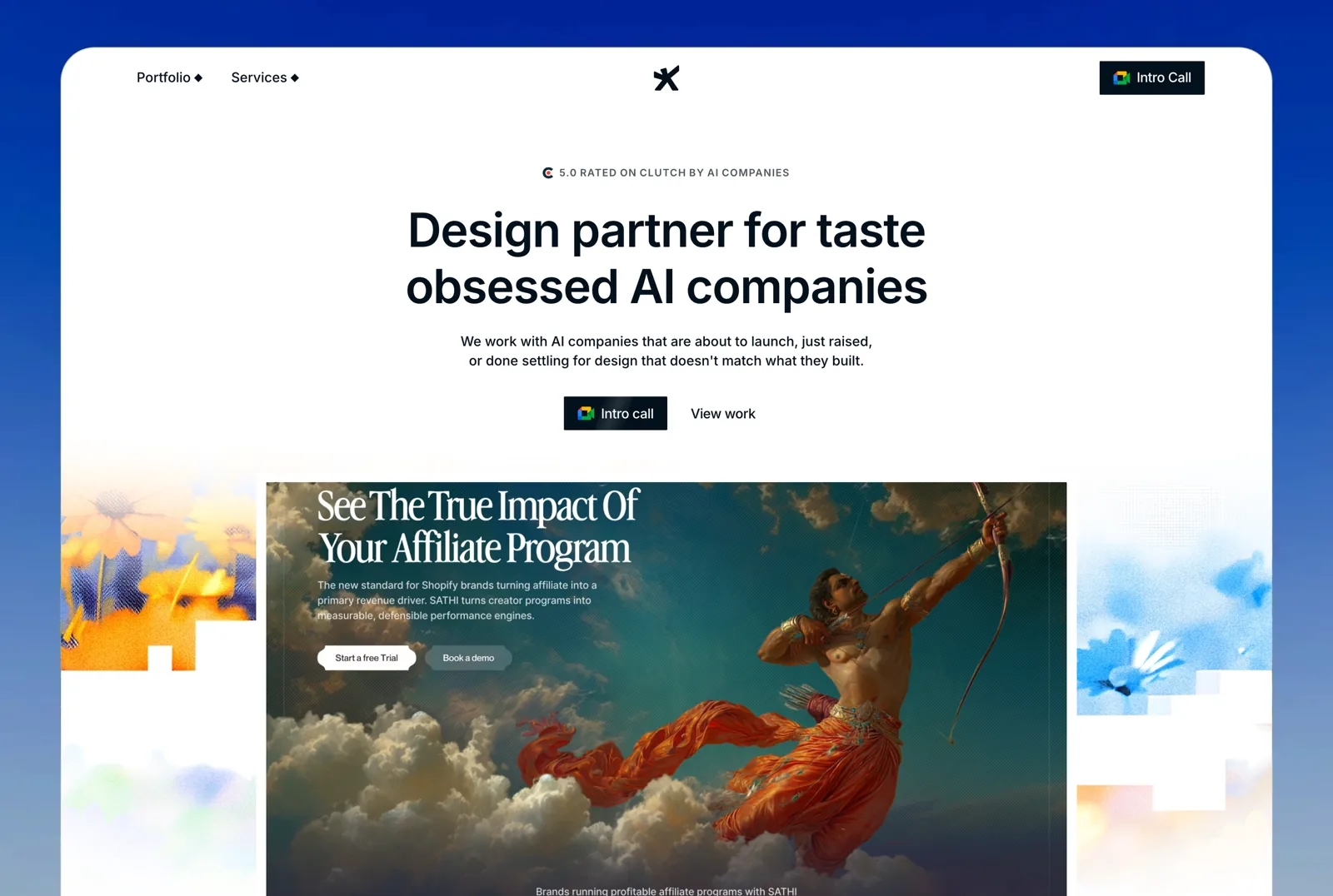
Studio Maydit is a web and product design studio working with AI founders in the US, UK, and Europe. The studio builds websites in Framer, Webflow, and custom code, and continues into product design after the site ships.
The clearest outcome is Dualite, where design work supporting a repositioned ICP helped the product reach 100,000+ users in seven months. Recent clients include Wave, PixelFlow, Mi-VAD, and 15 other AI and SaaS teams.
Websites can be bought two ways. Fixed scope runs three to four weeks and suits teams with a launch date. Teams that keep shipping take a monthly retainer instead, covering new pages, campaigns, and product design, with no long lock-in. Fixed-scope projects end with a diagnosis of what is leaking in the product, not a handoff and goodbye.
| Check | Finding |
|---|---|
| Based in | Remote, serving US / UK / EU |
| Platform depth | Framer, Webflow, and custom code |
| AI-sector proof | Yes. AI-native clients, published outcome on Dualite |
| Pricing | Fixed scope or monthly retainer, quoted per project |
| Team shape | Founder-led, small senior team |
| Best fit | Teams shipping daily who need decisions, not deliverables |
Maydit is the right call if your engineers keep shipping past design because waiting costs more. Book a 30-minute call.

2. Lighthouse Digital
Lighthouse Digital is a London studio working in Webflow with a published minimum and clients including Freetrade and IGN. A published starting price is a small signal with a large meaning for a fast team: the commercial conversation is already settled, so a new piece of work does not require a negotiation before it can begin.
They have no published AI client work, neither team size nor founding year is public, and Webflow site work rather than in-product design is the practice.
| Check | Finding |
|---|---|
| Based in | London, UK |
| Founded | Not published |
| Team size | Not published |
| Primary platform | Webflow |
| AI-sector proof | No. No published AI client work |
| Named clients | HelloSelf, Freetrade, IGN |
| Pricing | Published minimum |
| Best fit | Teams who want no commercial friction between request and work |
3. Flow Ninja
Flow Ninja is a Belgrade studio of 11 to 50 organised around continuous delivery rather than projects. That structure is the closest match on this list to how your team actually operates. Work arrives, gets done, and moves, without a kickoff ritual attached to every request, which is the difference between a partner at your pace and a partner you schedule around.
They publish neither client names nor pricing, their AI-sector proof is partial, and the model assumes requests arrive specified, which is exactly what a fast team is worst at.
| Check | Finding |
|---|---|
| Based in | Belgrade, Serbia |
| Founded | 2018 |
| Team size | 11-50 |
| Primary platform | Webflow |
| AI-sector proof | Partial. Enterprise and SaaS clients, no AI case study |
| Named clients | Not published |
| Pricing | Not published |
| Best fit | Teams with a steady queue who want no ceremony per request |
4. Flowout
Flowout is a distributed Webflow team with a published minimum and clients including Jasper and Riverside. Their subscription model prices throughput rather than projects, which aligns the incentive correctly: you are buying a rate of work, and a fast team is mostly trying to buy a rate.
They publish neither team size nor founding year, their AI-sector proof is partial, and the practice is weighted toward marketing surfaces rather than in-product design.
| Check | Finding |
|---|---|
| Based in | Distributed |
| Founded | Not published |
| Team size | Not published |
| Primary platform | Webflow |
| AI-sector proof | Partial. Enterprise and SaaS clients, no AI case study |
| Named clients | Jasper, Kajabi, Riverside, Sendlane |
| Pricing | Published minimum |
| Best fit | Teams buying a predictable rate of output rather than projects |
5. 8020
8020 works out of San Francisco and New York in Webflow, with Vanta, Pilot.com, and Superlist published. Their clients ship quickly and measure what happens, and 8020 works in the same terms. For a team that already instruments everything, an agency that thinks about outcomes rather than deliverables removes a translation step from every conversation.
They publish neither pricing nor team size, their AI-sector proof is partial, and their strength is the marketing surface rather than the product behind the login.
| Check | Finding |
|---|---|
| Based in | San Francisco and New York, USA |
| Founded | 2014 |
| Team size | Not published |
| Primary platform | Webflow |
| AI-sector proof | Partial. Enterprise and SaaS clients, no AI case study |
| Named clients | Wave, Superlist, Pilot.com, Vanta, Circle |
| Pricing | Not published |
| Best fit | Instrumented teams who talk about outcomes rather than screens |
6. Edgar Allan
Edgar Allan is an Atlanta team of 51 to 200 who work on language before layout, with Porsche and NCR published. Fast teams accumulate a particular debt, which is that nobody has decided what anything is called. Feature names drift, the same concept has three labels in three surfaces, and a language-first agency is the specific cure for that.
They publish no pricing, their AI-sector proof is partial, and a considered language practice runs at a rhythm that will frustrate a team shipping daily.
| Check | Finding |
|---|---|
| Based in | Atlanta, USA |
| Founded | 2014 |
| Team size | 51-200 |
| Primary platform | Webflow |
| AI-sector proof | Partial. Enterprise and SaaS clients, no AI case study |
| Named clients | Porsche, Duracell, NCR |
| Pricing | Not published |
| Best fit | Teams whose real debt is inconsistent naming across surfaces |
7. Refokus
Refokus is a remote German studio of 11 to 50 in Webflow, with Mural, Spotify, and BCG published. Their expressive work is the counterweight to the flattening that fast shipping produces, where every screen ends up looking like a default because a default is what fits in the time available.
They publish no pricing, their AI-sector proof is partial, and highly styled work is harder to sustain when the team is producing screens faster than any agency can shape them.
| Check | Finding |
|---|---|
| Based in | Germany, remote |
| Founded | 2021 |
| Team size | 11-50 |
| Primary platform | Webflow |
| AI-sector proof | Partial. Enterprise and SaaS clients, no AI case study |
| Named clients | Mural, BASF, Spotify, Yahoo, BCG |
| Pricing | Not published |
| Best fit | Teams whose product has flattened into defaults under pressure |
8. Digidop
Digidop is a Paris studio of 1 to 10 with a published minimum and clients including Ramify and StreamNative. At that size the person you message is the person who does the work, and for a fast team the removal of a relay is worth more than the extra capacity a bigger studio would offer.
There is no redundancy at 1 to 10 people, their AI-sector proof is partial, and a small studio will hit a ceiling on volume before a team shipping daily hits theirs.
| Check | Finding |
|---|---|
| Based in | Paris, France |
| Founded | 2021 |
| Team size | 1-10 |
| Primary platform | Webflow |
| AI-sector proof | Partial. Enterprise and SaaS clients, no AI case study |
| Named clients | TSE Energy, Ramify, StreamNative |
| Pricing | Published minimum |
| Best fit | Teams who want to message the maker directly with no relay |
9. Finsweet
Finsweet is a distributed team of 51 to 200 out of Denver, known for the tooling they publish as much as for Dropbox and GitHub. Their systems habit is the direct answer to the compounding problem. Components, documented patterns, and decisions recorded once are what make the fiftieth screen cheaper than the fifth, and that is the only durable fix for a fast team.
They are large, they publish no pricing, and their centre of gravity is build systems rather than the product judgment a shipping team needs daily.
| Check | Finding |
|---|---|
| Based in | Denver, USA, distributed |
| Founded | 2017 |
| Team size | 51-200 |
| Primary platform | Webflow |
| AI-sector proof | Partial. Enterprise and SaaS clients, no AI case study |
| Named clients | Dropbox, Clay, GitHub, Steadily |
| Pricing | Not published |
| Best fit | Teams whose inconsistency is growing faster than their coverage |
10. Foundey
Foundey is a San Francisco studio with published AI client work including Traycer and Sero AI. They work product-first and deliver design files, which suits a fast team well: your engineers are the constraint on shipping, not your builders, and an agency that hands over decided screens fits straight into an existing pipeline.
They deliver files rather than built work, so you need engineering capacity, and they publish neither pricing nor team size.
| Check | Finding |
|---|---|
| Based in | San Francisco, USA |
| Founded | 2021 |
| Team size | Not published |
| Primary platform | Figma-only |
| AI-sector proof | Yes. Published AI client work |
| Named clients | DemandIQ, Traycer, Sero AI |
| Pricing | Not published |
| Best fit | Teams with build capacity who only need the decisions made |
How to choose between them
Sort by what your speed has actually cost you.
Engineers ship past design because waiting is slower. Studio Maydit or Flow Ninja.
The product has drifted into inconsistency. Finsweet.
Every screen looks like a default. Refokus.
Nothing is called the same thing twice. Edgar Allan.
One test before signing. Describe a real situation: an engineer needs a screen in four hours and there is no design. Ask what they would do. An agency built for your pace answers with something usable in that window, a rough direction and the two constraints that matter, and says the polished version follows later if it is still needed. An agency that answers by explaining why four hours is not enough time to do it properly is correct, and will be routed around by your team within a month.