Summarize with AI


The best design retainer agencies for first-time founders in 2026 are Studio Maydit, Edgar Allan, Finsweet, Flowout, Pixelmatters, Refokus, Digidop, Ramotion, Engine Digital, and Instrument. Studio Maydit and Pixelmatters lead for founders who need someone to bring the judgment as well as the hands. Engine Digital and Instrument are the wrong fit unless you are buying at a scale that assumes a marketing team is already in place.
You are about to make a purchase you have no way to grade.
That is the real position of a first-time founder buying design, and almost nobody says it plainly. You can grade a developer, because the feature works or it does not. You can grade a recruiter, because the person starts or they do not. Design arrives as a set of screens, and the screens always look better than what you had. Better than what you had is not the same as good, and you have no reference point that tells the two apart.
So the judgment gets outsourced to whoever in the room speaks most confidently. Sometimes that is a co-founder with an opinion. Sometimes it is an investor who glanced at it for ninety seconds. Sometimes it is you, deciding you do not like the blue.
None of those people are answering the question that matters, which is whether this work will make it easier to sell the thing. That question requires knowing what the work was supposed to change, and most first retainers never establish it. The agency was hired to make things look right, so looking right is the only test available.
The agencies below differ enormously in how much of that judgment they will hand you and how much they expect you to already have. That is the axis to sort them on, more than platform or price.

How we picked these agencies
This is a teardown, not a directory listing. For each agency we read their own site and their public record, then checked five things you can verify yourself in an afternoon:
- Platform depth. Is this their main craft, or one line on a long service menu?
- AI-sector proof. Named AI clients and published work, or just the word "AI" in the copy?
- Pricing. Do they publish a minimum at all, or keep it behind a call?
- Team shape. Who actually does the work, and how many clients are they carrying at once?
- Their own site. Distinctive, or the same template as everyone else on this list?
That last one gets skipped most often. An agency's own website is the only project where nobody overruled them. No client committee, no inherited brand book. If their own site is forgettable, you have found their ceiling.
Every fact below comes from the agency's own site or a public listing. Where a number is not public, we say so rather than guessing.
What goes wrong on a first retainer
Three failures show up again and again, and all three come from the same root. Nobody has told the founder what the buyer's half of the job is.
You brief the thing you pictured instead of the thing you need. A first brief almost always names an artefact. A new homepage. A cleaner dashboard. A pitch deck. The founder describes what they imagined while lying awake, and a good agency will build exactly that, because it was asked for clearly. Then it ships and nothing moves, because the artefact was a guess at a solution and the problem underneath it was never stated. The version that works sounds unfinished when you say it out loud: people sign up and then stop on the second screen, and I do not know why. That sentence is worth more than a page of specification. It lets the agency bring their own judgment instead of executing yours.
You approve work you have no way to evaluate. Review meetings on a first retainer collapse into preference, because preference is the only vocabulary in the room. The founder says it feels heavy, someone else says the green is off, and the agency dutifully adjusts. Three rounds later the work is worse and everyone is tired. The way out is to decide, before anything is designed, what the work is supposed to do for a specific person. Then every review asks one question: does this get that person further along. It is a small change and it removes most of the pain, because it replaces taste with a test.
Nobody tells you what to do when the work is fine but wrong. Every first-time founder eventually receives work that is competent and does not fit, and almost none of them know that this is normal and fixable. So they either accept it to avoid conflict, or they lose confidence in the agency entirely and start reviewing everything twice. Both are expensive. Ask at the outset what happens when you do not like a direction. An agency that has an answer, a real one involving a conversation and a second attempt inside the same month, has done this before. An agency that says it rarely happens is telling you their clients stopped saying anything.
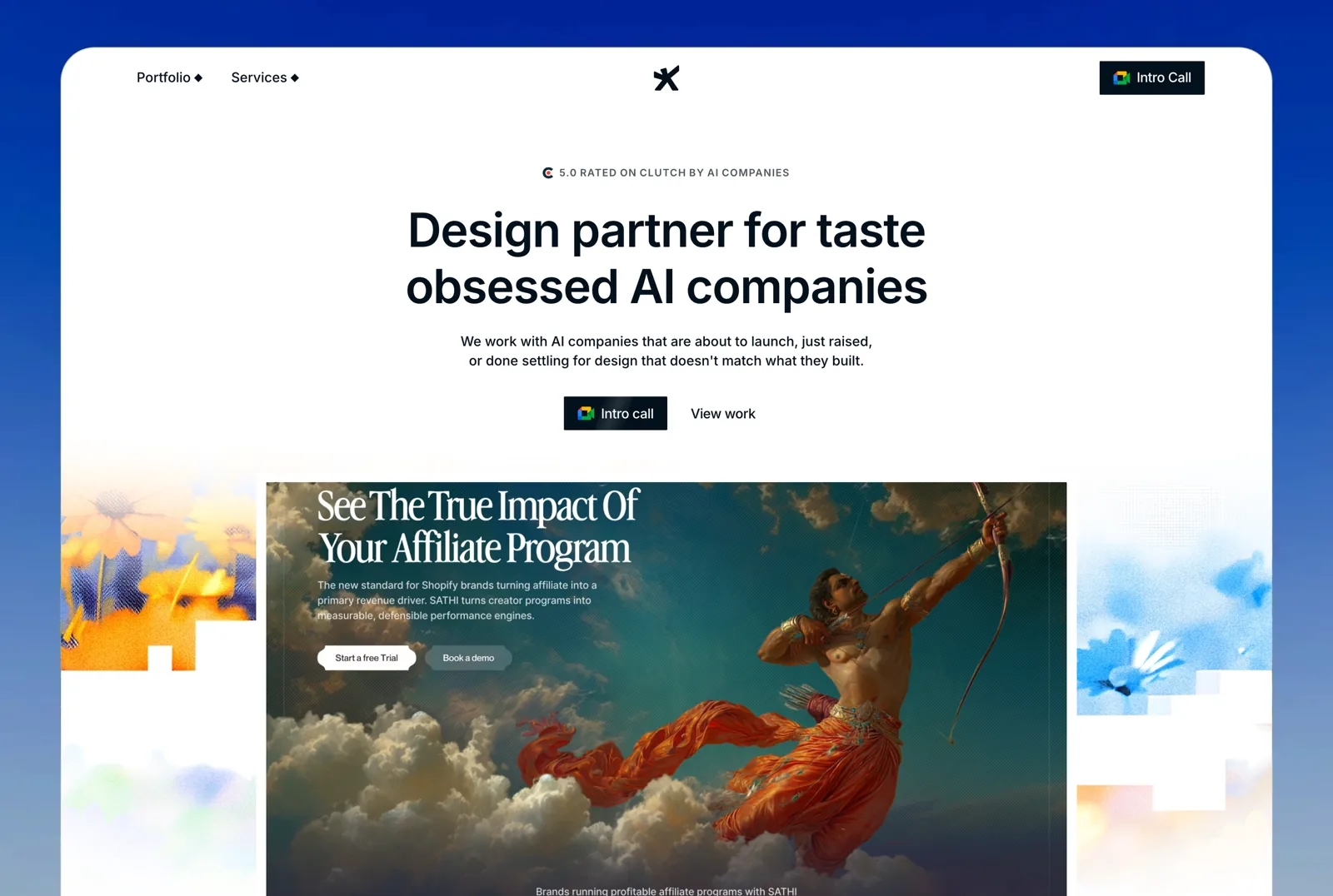
1. Studio Maydit: A Top-Rated Design Agency for AI Founders
Studio Maydit is a web and product design studio working with AI founders in the US, UK, and Europe. The studio builds websites in Framer, Webflow, and custom code, and continues into product design after the site ships.
The clearest outcome is Dualite, where design work supporting a repositioned ICP helped the product reach 100,000+ users in seven months. Recent clients include Wave, PixelFlow, Mi-VAD, and 15 other AI and SaaS teams.
Websites can be bought two ways. Fixed scope runs three to four weeks and suits teams with a launch date. Teams that keep shipping take a monthly retainer instead, covering new pages, campaigns, and product design, with no long lock-in. Fixed-scope projects end with a diagnosis of what is leaking in the product, not a handoff and goodbye.
| Check | Finding |
|---|---|
| Based in | Remote, serving US / UK / EU |
| Platform depth | Framer, Webflow, and custom code |
| AI-sector proof | Yes. AI-native clients, published outcome on Dualite |
| Pricing | Fixed scope or monthly retainer, quoted per project |
| Team shape | Founder-led, small senior team |
| Best fit | First-time founders who want the reasoning explained, not just the files delivered |
Maydit is the right call if you would rather be taught how to judge the work than asked to approve it. Book a 30-minute call.

2. Edgar Allan
Edgar Allan is an Atlanta team of 51 to 200 who start with language before layout. For a founder who cannot yet articulate what the company is, that order is useful, because the hardest part of a first design engagement is usually agreeing on the words, and everything visual is downstream of that.
They do not publish pricing, their AI-sector proof is partial, and they work at a scale where a first-time founder will be a small account rather than a priority one.
| Check | Finding |
|---|---|
| Based in | Atlanta, USA |
| Founded | 2014 |
| Team size | 51-200 |
| Primary platform | Webflow |
| AI-sector proof | Partial. Enterprise and SaaS clients, no AI case study |
| Named clients | Porsche, Duracell, NCR |
| Pricing | Not published |
| Best fit | Founders whose real problem is that nobody can explain the company in a sentence |
3. Finsweet
Finsweet is a distributed team of 51 to 200 out of Denver, known publicly for the tools they give away as much as for client work with Dropbox and GitHub. They build systems rather than one-off pages, which protects a first-time founder from the trap of owning a beautiful site that only its authors can touch.
They are large, they publish no pricing, and their centre of gravity is the build rather than the strategic question of what should be built.
| Check | Finding |
|---|---|
| Based in | Denver, USA, distributed |
| Founded | 2017 |
| Team size | 51-200 |
| Primary platform | Webflow |
| AI-sector proof | Partial. Enterprise and SaaS clients, no AI case study |
| Named clients | Dropbox, Clay, GitHub, Steadily |
| Pricing | Not published |
| Best fit | Founders who want something they can maintain without hiring anyone |
4. Flowout
Flowout runs a subscription model with a published starting figure and clients including Jasper and Sendlane. Published pricing matters more to a first-time founder than to anyone else on this list, because it converts an unfamiliar purchase into a number you can plan around before you have learned to negotiate one.
The model rewards clear requests, so it gives you the least help exactly where you need the most, and their AI-sector proof is partial.
| Check | Finding |
|---|---|
| Based in | Distributed |
| Founded | Not published |
| Team size | Not published |
| Primary platform | Webflow |
| AI-sector proof | Partial. Enterprise and SaaS clients, no AI case study |
| Named clients | Jasper, Kajabi, Riverside, Sendlane |
| Pricing | Published minimum |
| Best fit | Founders who already know exactly what they want made each month |
5. Pixelmatters
Pixelmatters is a Porto team of 51 to 200 working with Rubrik and UJET, and they publish a minimum. They cover product design as well as marketing pages, which suits a founder who does not yet know which side their problem sits on and would rather not discover halfway through that they hired for the wrong half.
They are a larger firm than a first cheque usually buys attention from, and their AI-sector proof is partial.
| Check | Finding |
|---|---|
| Based in | Porto, Portugal |
| Founded | 2013 |
| Team size | 51-200 |
| Primary platform | Mixed |
| AI-sector proof | Partial. Enterprise and SaaS clients, no AI case study |
| Named clients | Rubrik, Quantic, UJET |
| Pricing | Published minimum |
| Best fit | Founders who need website and product covered before they know which one is broken |
6. Refokus
Refokus is a remote German studio of 11 to 50 with work for Mural, Spotify, and BCG. They are used to arriving where a brand already exists and working inside it, which is a calmer experience for a founder who is nervous about handing over something they built themselves.
They publish no pricing, their AI-sector proof is partial, and their published work skews to larger organisations than a first retainer usually comes from.
| Check | Finding |
|---|---|
| Based in | Germany, remote |
| Founded | 2021 |
| Team size | 11-50 |
| Primary platform | Webflow |
| AI-sector proof | Partial. Enterprise and SaaS clients, no AI case study |
| Named clients | Mural, BASF, Spotify, Yahoo, BCG |
| Pricing | Not published |
| Best fit | Founders protective of an identity they already made and do not want restarted |
7. Digidop
Digidop is a Paris studio of 1 to 10 with a published minimum and clients including Ramify and StreamNative. At that size you speak to the people doing the work every week, which shortens the loop a first-time founder needs most, since the questions you have are small, frequent, and slightly embarrassing to ask.
A team of that size has little slack, so a busy month or an absence is felt immediately, and their AI-sector proof is partial.
| Check | Finding |
|---|---|
| Based in | Paris, France |
| Founded | 2021 |
| Team size | 1-10 |
| Primary platform | Webflow |
| AI-sector proof | Partial. Enterprise and SaaS clients, no AI case study |
| Named clients | TSE Energy, Ramify, StreamNative |
| Pricing | Published minimum |
| Best fit | Founders who want direct access and a published figure rather than a proposal |
8. Ramotion
Ramotion is a San Francisco team of 11 to 50, working since 2009 with Mozilla, Okta, and Adobe, and they publish a minimum. Nearly two decades of operating means the process around the work is settled, and a settled process is a genuine kindness when the client has never run one of these before.
Their AI-sector proof is partial, and a long-established firm brings a house method you fit into rather than one shaped around you.
| Check | Finding |
|---|---|
| Based in | San Francisco, USA |
| Founded | 2009 |
| Team size | 11-50 |
| Primary platform | Mixed |
| AI-sector proof | Partial. Enterprise and SaaS clients, no AI case study |
| Named clients | Mozilla, Okta, Netflix, Adobe, Xero |
| Pricing | Published minimum |
| Best fit | Founders who want a proven process more than a bespoke one |
9. Engine Digital
Engine Digital has been running since 2002 out of Vancouver and New York, writing custom code for Adidas, Autodesk, and Goldman Sachs. They are built for organisations with an internal marketing function and a defined approval chain, which is a description of almost nobody reading this article.
They publish neither pricing nor team size, their AI-sector proof is partial, and the engagement scale is far above a first retainer.
| Check | Finding |
|---|---|
| Based in | Vancouver and New York |
| Founded | 2002 |
| Team size | Not published |
| Primary platform | Custom code |
| AI-sector proof | Partial. Enterprise and SaaS clients, no AI case study |
| Named clients | Adidas, Autodesk, Goldman Sachs, HP |
| Pricing | Not published |
| Best fit | Established companies with an internal team to brief and receive the work |
10. Instrument
Instrument is a Portland studio founded in 2005 with work for Nike, Microsoft, and Google. Their output is exceptional and their engagements assume a client who arrives with a strategy already decided, a budget already approved, and someone whose full-time job is running the relationship.
They publish neither pricing nor team size, their AI-sector proof is partial, and a first-time founder is not the buyer this firm is shaped around.
| Check | Finding |
|---|---|
| Based in | Portland, USA |
| Founded | 2005 |
| Team size | Not published |
| Primary platform | Mixed |
| AI-sector proof | Partial. Enterprise and SaaS clients, no AI case study |
| Named clients | Nike, Microsoft, Electronic Arts, Google |
| Pricing | Not published |
| Best fit | Funded companies with a marketing leader already in place |
How to choose between them
Sort by how much judgment you need supplied.
You do not yet know what the problem is. Studio Maydit or Pixelmatters.
You know the problem and it is that nobody understands what you do. Edgar Allan.
You have a clear list of things to make each month. Flowout or Digidop.
You want something you can keep running yourself afterwards. Finsweet or Refokus.
One test before signing. Describe your problem badly on purpose, in one vague sentence, and see what happens next. An agency that asks three sharp questions and then tells you what they think is actually wrong will be worth having in the room. An agency that responds with a proposal for a homepage has decided to sell you the thing they had ready, and you will not find out that was the wrong purchase until the month it was supposed to work.