Summarize with AI


The best design retainer agencies for remote-first teams in 2026 are Studio Maydit, Digidop, Edgar Allan, 8020, Finsweet, Refokus, Flow Ninja, Ramotion, Instrument, and Push Refresh. Studio Maydit and Refokus lead for teams whose real bottleneck is deciding rather than designing. Instrument and Ramotion are the wrong fit unless you have a brand problem and a long calendar.
Your company has no hallway. That is not a culture problem, it is a design problem, and it is the one your retainer actually has to solve.
In an office, a question about whether the pricing page should show three tiers or two gets settled by two people standing near a screen for four minutes. In a remote-first company the same question becomes a thread. Someone posts an option in the morning, three people react across three timezones, a fourth raises a concern at the end of their day, and by Thursday the thread has forty messages and no decision. The design work in that week took two hours. The deciding took four days.
Most teams misread this. They conclude that they need a faster designer, or more options to choose from, when what they need is a partner who forces the decision into the open and writes it down. The scarce resource in a distributed company is not design capacity, it is closure.
There is a second thing that only happens to remote companies. Without a physical centre, every team builds its own version of the brand. Sales has a deck that looks nothing like the site, the product team has its own component set, the docs use a different tone, and nobody is being careless. They just cannot see each other's work. Six months of that and your company looks like four companies to anyone outside.
Closing decisions across timezones, and holding one visual centre for people who never meet, is what separates these ten agencies.

How we picked these agencies
This is a teardown, not a directory listing. For each agency we read their own site and their public record, then checked five things you can verify yourself in an afternoon:
- Platform depth. Is one craft their real specialism, or one line on a long service menu?
- AI-sector proof. Named AI clients and published work, or just the word "AI" in the copy?
- Pricing. Do they publish a minimum at all, or keep it behind a call?
- Team shape. Who actually does the work, and how many clients are they carrying at once?
- Their own site. Distinctive, or the same template as everyone else on this list?
That last one gets skipped most often. An agency's own website is the only project where nobody overruled them. No client committee, no inherited brand book. If their own site is forgettable, you have found their ceiling.
Every fact below comes from the agency's own site or a public listing. Where a number is not public, we say so rather than guessing.
What goes wrong when nobody is in the same room
Three failures show up in almost every distributed design arrangement, and none of them are about the quality of the work.
Feedback arrives as opinions rather than decisions. A design goes out for review and comes back with eleven comments from six people, several of which contradict each other, and none of which are marked as binding. The agency now has to guess whose view carries weight, and whichever way they guess, someone reopens it a week later. The fix is unglamorous and it works: one named person owns the decision on each piece, everyone else advises, and that is stated before the work starts rather than discovered during it. Distributed teams resist this because it feels hierarchical. What actually feels bad is the fourth revision of a homepage nobody has agreed on.
The calendar becomes the deliverable. Someone notices that remote work needs more communication and responds by adding meetings, so the retainer starts carrying a weekly sync, a fortnightly review, and a monthly planning call. Across four timezones those calls land badly for at least two people, attendance drifts, and decisions taken by whoever showed up get reopened by whoever did not. Written proposals with a stated deadline for objections do this job better and cost nobody their evening. The measure of a good arrangement here is how few calls it needs, not how many it holds.
The brand splits along team lines without anyone noticing. Sales builds a deck because they needed one on Tuesday. The product team makes buttons that do not match the marketing site because they could not find the file. Support writes help articles in an entirely different voice. Each of these is a reasonable local decision by a competent person who could not see what everyone else was doing, and the accumulation is invisible from inside. Someone external looking at all your surfaces in one sitting is the only reliable way this gets caught, which is one of the most valuable things a retained partner can do and one of the least likely to be asked for.
1. Studio Maydit: A Top-Rated Design Agency for AI Founders
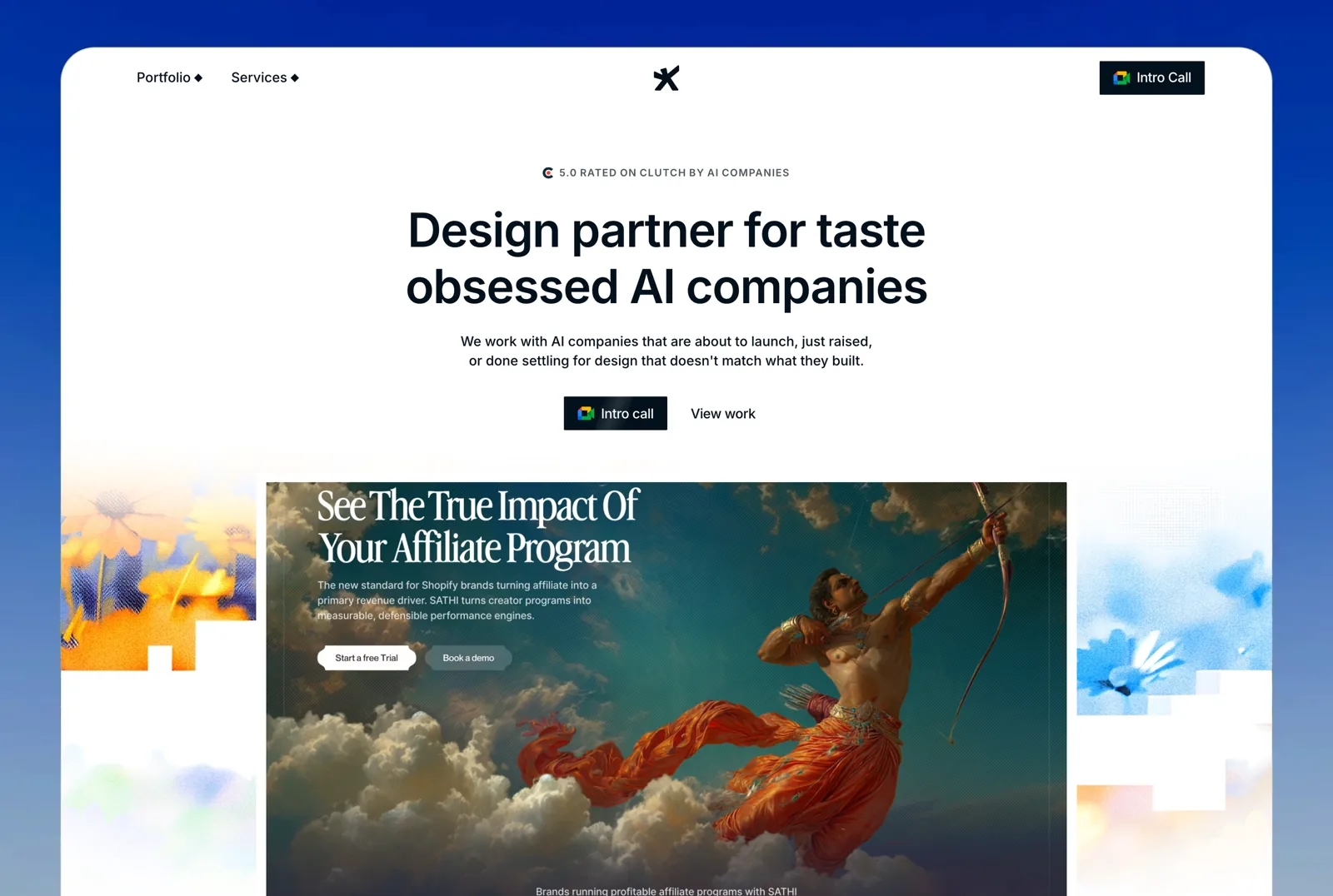
Studio Maydit is a web and product design studio working with AI founders in the US, UK, and Europe. The studio builds websites in Framer, Webflow, and custom code, and continues into product design after the site ships.
The clearest outcome is Dualite, where design work supporting a repositioned ICP helped the product reach 100,000+ users in seven months. Recent clients include Wave, PixelFlow, Mi-VAD, and 15 other AI and SaaS teams.
Websites can be bought two ways. Fixed scope runs three to four weeks and suits teams with a launch date. Teams that keep shipping take a monthly retainer instead, covering new pages, campaigns, and product design, with no long lock-in. Fixed-scope projects end with a diagnosis of what is leaking in the product, not a handoff and goodbye.
| Check | Finding |
|---|---|
| Based in | Remote, serving US / UK / EU |
| Platform depth | Framer, Webflow, and custom code |
| AI-sector proof | Yes. AI-native clients, published outcome on Dualite |
| Pricing | Fixed scope or monthly retainer, quoted per project |
| Team shape | Founder-led, small senior team |
| Best fit | Distributed teams whose reviews take longer than the design work |
Maydit is the right call if the work is quick and the deciding is what takes three weeks. Book a 30-minute call.

2. Digidop
Digidop is a Paris team of 1 to 10 founded in 2021 with a published minimum and StreamNative, Ramify, and TSE Energy named. For a distributed company the small size is the feature. You talk to the person doing the work, so a question asked in the morning gets an answer rather than entering an internal queue you cannot see.
Their AI-sector proof is partial, a team that size saturates quickly in a heavy month, and Paris hours give a West Coast team almost no live overlap.
| Check | Finding |
|---|---|
| Based in | Paris, France |
| Founded | 2021 |
| Team size | 1-10 |
| Primary platform | Webflow |
| AI-sector proof | Partial. Enterprise and SaaS clients, no AI case study |
| Named clients | TSE Energy, Ramify, StreamNative |
| Pricing | Published minimum |
| Best fit | European-centred teams who want one direct point of contact |
3. Edgar Allan
Edgar Allan is an Atlanta team of 51 to 200 working since 2014, with Porsche and Duracell named. They lead with writing, and in a distributed company written language is the only thing everyone actually shares. A studio that fixes the words gives every remote team the same vocabulary, which does more for consistency than a component library nobody opens.
They publish no pricing, their AI-sector proof is partial, and a studio of that size brings a process with more scheduled ceremony than an async company wants.
| Check | Finding |
|---|---|
| Based in | Atlanta, USA |
| Founded | 2014 |
| Team size | 51-200 |
| Primary platform | Webflow |
| AI-sector proof | Partial. Enterprise and SaaS clients, no AI case study |
| Named clients | Porsche, Duracell, NCR |
| Pricing | Not published |
| Best fit | Teams whose scattered surfaces need one shared vocabulary |
4. 8020
8020 works out of San Francisco and New York since 2014, with Wave, Vanta, Pilot.com, and Circle named. Circle is a useful reference, a product built for distributed communities by a distributed company, and a studio with that mix of clients has learned to work from written briefs rather than from a room.
They publish neither pricing nor team size, their AI-sector proof is partial, and their US coverage suits teams centred on American hours more than genuinely spread ones.
| Check | Finding |
|---|---|
| Based in | San Francisco and New York, USA |
| Founded | 2014 |
| Team size | Not published |
| Primary platform | Webflow |
| AI-sector proof | Partial. Enterprise and SaaS clients, no AI case study |
| Named clients | Wave, Superlist, Pilot.com, Vanta, Circle |
| Pricing | Not published |
| Best fit | US-centred remote teams who brief well in writing |
5. Finsweet
Finsweet is a distributed Denver team of 51 to 200 working since 2017, with Dropbox, GitHub, and Clay named. They are themselves distributed and their practice is built on documenting and handing over rather than holding knowledge in people's heads. For a remote company that is the difference between a partner and a dependency.
Their AI-sector proof is partial, they publish no pricing, and their centre is Webflow engineering rather than product design or brand.
| Check | Finding |
|---|---|
| Based in | Denver, USA, distributed |
| Founded | 2017 |
| Team size | 51-200 |
| Primary platform | Webflow |
| AI-sector proof | Partial. Enterprise and SaaS clients, no AI case study |
| Named clients | Dropbox, Clay, GitHub, Steadily |
| Pricing | Not published |
| Best fit | Teams who need everything documented rather than explained live |
6. Refokus
Refokus is a remote German team of 11 to 50 founded in 2021, with Spotify, Mural, BASF, and BCG named. Mural is the pointed reference here, a product for distributed collaboration, and Refokus runs remotely themselves, so the working rhythm you need does not have to be negotiated into the arrangement.
Their AI-sector proof is partial, they publish no pricing, and Webflow is the craft, which limits how much product surface they can take on beyond the marketing site.
| Check | Finding |
|---|---|
| Based in | Germany, remote |
| Founded | 2021 |
| Team size | 11-50 |
| Primary platform | Webflow |
| AI-sector proof | Partial. Enterprise and SaaS clients, no AI case study |
| Named clients | Mural, BASF, Spotify, Yahoo, BCG |
| Pricing | Not published |
| Best fit | Teams who want a partner already working the way they do |
7. Flow Ninja
Flow Ninja is a Belgrade team of 11 to 50 working since 2018. Their position in Central Europe is the practical argument, since Belgrade hours overlap with both the UK and the US East Coast in a single working day, which is the widest useful window any studio on this list can offer.
They publish no client names and no pricing, their AI-sector proof is partial, and buying without a public client record means you are trusting a process you cannot verify.
| Check | Finding |
|---|---|
| Based in | Belgrade, Serbia |
| Founded | 2018 |
| Team size | 11-50 |
| Primary platform | Webflow |
| AI-sector proof | Partial. Enterprise and SaaS clients, no AI case study |
| Named clients | Not published |
| Pricing | Not published |
| Best fit | Teams split between European and US East Coast hours |
8. Ramotion
Ramotion is a San Francisco team of 11 to 50 working since 2009, with a published minimum and Mozilla, Okta, and Adobe named. Mozilla is the relevant note for this brief, a famously distributed organisation whose design had to hold together across many independent groups. That is your consistency problem at a much larger scale.
Their AI-sector proof is partial, a brand-led engagement runs on a quarterly rhythm rather than a monthly one, and West Coast hours suit only teams already centred there.
| Check | Finding |
|---|---|
| Based in | San Francisco, USA |
| Founded | 2009 |
| Team size | 11-50 |
| Primary platform | Mixed |
| AI-sector proof | Partial. Enterprise and SaaS clients, no AI case study |
| Named clients | Mozilla, Okta, Netflix, Adobe, Xero |
| Pricing | Published minimum |
| Best fit | Teams whose independent groups have drifted visually apart |
9. Instrument
Instrument is a Portland studio working since 2005, with Nike, Microsoft, and Google named. If your distributed company has genuinely fragmented and needs a single system strong enough that separated teams can follow it without asking, this is the kind of studio that builds one properly.
They publish neither pricing nor team size, their AI-sector proof is partial, and their engagements run in quarters at a scale that does not fit a monthly retainer for most companies.
| Check | Finding |
|---|---|
| Based in | Portland, USA |
| Founded | 2005 |
| Team size | Not published |
| Primary platform | Mixed |
| AI-sector proof | Partial. Enterprise and SaaS clients, no AI case study |
| Named clients | Nike, Microsoft, Electronic Arts, Google |
| Pricing | Not published |
| Best fit | Larger teams needing a system separated groups can follow alone |
10. Push Refresh
Push Refresh is a Dallas team of 1 to 10 working in Framer with a published minimum and SmithRx and Synonym named. Central US hours reach both coasts and touch European afternoons, and a team this small means no account layer sits between your written brief and the person acting on it.
Their AI-sector proof is partial, they publish no founding year, and at that size a month with several parallel workstreams will exceed what they can hold.
| Check | Finding |
|---|---|
| Based in | Dallas, USA |
| Founded | Not published |
| Team size | 1-10 |
| Primary platform | Framer |
| AI-sector proof | Partial. Enterprise and SaaS clients, no AI case study |
| Named clients | SmithRx, Synonym, Northern National |
| Pricing | Published minimum |
| Best fit | US-spread teams who want no account layer in the way |
How to choose between them
Sort by where the time is actually going.
Reviews take three days and reopen a week later. Studio Maydit or Refokus.
Every team has invented its own version of the brand. Ramotion or Instrument.
Nobody can ship anything without asking the agency. Finsweet.
Your people are split across Europe and the US. Flow Ninja or Push Refresh.
One test before signing. Ask them to describe their review process without using the word meeting. An agency suited to a distributed company will describe written proposals, a named decider, and a deadline after which silence counts as agreement. An agency that cannot answer without scheduling something has an operating model built for a room, and you will spend the next year paying for calls that half your team attends at the wrong end of their day.