

Summarize with AI


The best design retainer agencies for second-time founders in 2026 are Studio Maydit, Finsweet, Engine Digital, Refokus, Digidop, Ramotion, Flow Ninja, Flowout, Edgar Allan, and Pixelmatters. Studio Maydit and Ramotion lead for founders who want a partner willing to argue with them. Engine Digital and Edgar Allan are the wrong fit unless you are selling into large organisations with formal review processes.
The second time you do this, your greatest advantage and your biggest liability are the same fact. You have done it before.
The advantage is obvious and real. You know what a good designer looks like. You know that a rebrand is not a strategy. You will not spend two months choosing a typeface. You can write a brief in twenty minutes that a first-time founder could not write in a week, and you already know which parts of an agency's pitch are theatre.
The liability is quieter. You are carrying a working model of how companies like yours grow, and it was built from exactly one example, in a different market, at a different moment, with a product that made money in a different way. That model is now the thing you trust most and the thing you are least likely to examine. If the last company sold to developers and this one sells to hospital administrators, almost every instinct you sharpened is now slightly wrong, and being confident about it makes the error more expensive rather than less.
This changes what you should buy. A first-time founder needs an agency that supplies judgment they do not have. You need one that will push back on judgment you already have, which is a genuinely different service and one most agencies are commercially reluctant to provide. Finding a partner who will tell an experienced founder they are wrong is what separates these ten.

How we picked these agencies
This is a teardown, not a directory listing. For each agency we read their own site and their public record, then checked five things you can verify yourself in an afternoon:
- Platform depth. Is one craft their real specialism, or one line on a long service menu?
- AI-sector proof. Named AI clients and published work, or just the word "AI" in the copy?
- Pricing. Do they publish a minimum at all, or keep it behind a call?
- Team shape. Who actually does the work, and how many clients are they carrying at once?
- Their own site. Distinctive, or the same template as everyone else on this list?
That last one gets skipped most often. An agency's own website is the only project where nobody overruled them. No client committee, no inherited brand book. If their own site is forgettable, you have found their ceiling.
Every fact below comes from the agency's own site or a public listing. Where a number is not public, we say so rather than guessing.
What goes wrong the second time round
Three failures show up specifically with experienced founders, and every one of them is caused by something that used to work.
The old playbook is applied to a new market. Last time, a plain page with a code sample and a free tier did the job, because developers were evaluating and they wanted to try it in ten minutes. This time the buyer is an operations director who has to justify the purchase to a committee and cares about liability, integration, and what happens when the model is wrong. The mechanics of persuading those two people share almost nothing, but the first playbook is sitting right there, already validated, and it takes real discipline not to run it again. The tell is when a decision gets made by reference to the last company rather than to a customer conversation from this month.
Speed is used instead of a decision. Experienced founders are rightly proud of moving quickly, and the temptation is to compress the awkward stretch where you do not yet know who the buyer is. So the retainer starts immediately and produces good work at a good pace in a direction nobody has verified. Being fast is only an advantage once you are pointed correctly. Before that it just means you reach the wrong place sooner and with more built, and having built more makes turning around harder, because now there is something to defend.
Nobody argues with you any more. Your team joined partly because of your record, and they defer. Your agency wants the relationship and also defers. So reviews get quick and comfortable, everyone leaves agreeing, and the one thing you are actually paying an outside partner for, an opinion formed independently of yours, never arrives. This is the most expensive failure on the list because it is invisible from the inside and feels like things going well. If nobody has disagreed with you in a month, you are not buying judgment. You are buying production, at judgment prices.
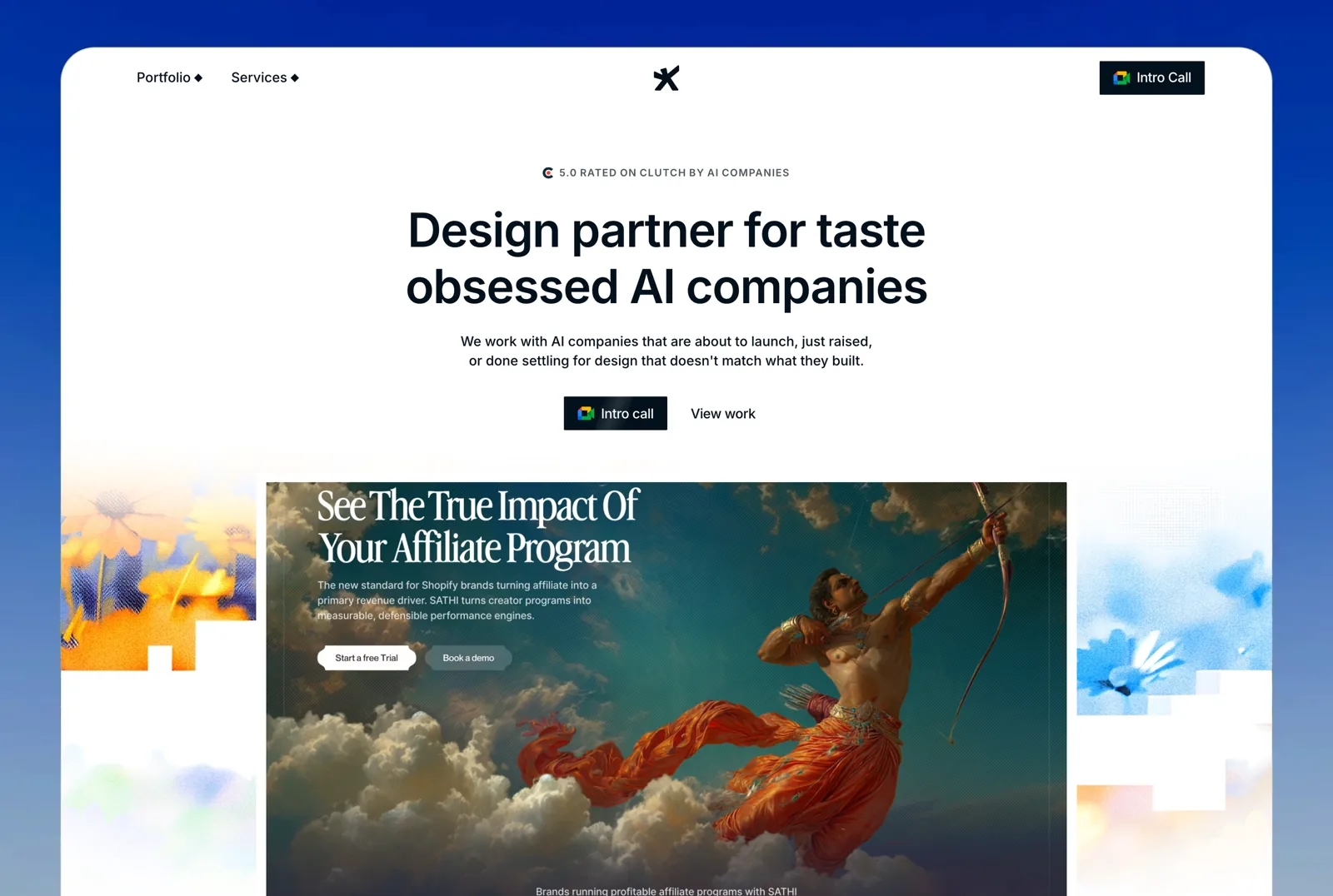
1. Studio Maydit: A Top-Rated Design Agency for AI Founders
Studio Maydit is a web and product design studio working with AI founders in the US, UK, and Europe. The studio builds websites in Framer, Webflow, and custom code, and continues into product design after the site ships.
The clearest outcome is Dualite, where design work supporting a repositioned ICP helped the product reach 100,000+ users in seven months. Recent clients include Wave, PixelFlow, Mi-VAD, and 15 other AI and SaaS teams.
Websites can be bought two ways. Fixed scope runs three to four weeks and suits teams with a launch date. Teams that keep shipping take a monthly retainer instead, covering new pages, campaigns, and product design, with no long lock-in. Fixed-scope projects end with a diagnosis of what is leaking in the product, not a handoff and goodbye.
| Check | Finding |
|---|---|
| Based in | Remote, serving US / UK / EU |
| Platform depth | Framer, Webflow, and custom code |
| AI-sector proof | Yes. AI-native clients, published outcome on Dualite |
| Pricing | Fixed scope or monthly retainer, quoted per project |
| Team shape | Founder-led, small senior team |
| Best fit | Founders who want the last playbook tested rather than repeated |
Maydit is the right call if you want a partner who will tell you the thing that worked last time will not work here. Book a 30-minute call.

2. Finsweet
Finsweet is a distributed team of 51 to 200 out of Denver, founded in 2017, with Dropbox, Clay, GitHub, and Steadily named. Founders who have done this before usually know what they want built and want it built properly, and this studio's strength is the technical end of the platform rather than the discovery around it. If your positioning is genuinely settled, that is the efficient purchase.
They publish no pricing, their AI-sector proof is partial, and a technically-led studio is the least likely on this list to challenge a plan you arrive with, which is the specific risk for you.
| Check | Finding |
|---|---|
| Based in | Denver, USA, distributed |
| Founded | 2017 |
| Team size | 51-200 |
| Primary platform | Webflow |
| AI-sector proof | Partial. Enterprise and SaaS clients, no AI case study |
| Named clients | Dropbox, Clay, GitHub, Steadily |
| Pricing | Not published |
| Best fit | Founders who are certain and want precise execution |
3. Engine Digital
Engine Digital has been working since 2002 out of Vancouver and New York, with Adidas, Autodesk, Goldman Sachs, and HP named. Two decades of client work means they have watched many confident people be wrong, and a studio with that history is more comfortable disagreeing with a founder than a young team competing for the logo. If your second company sells to institutions, they also know that buyer.
They publish neither pricing nor team size, their AI-sector proof is partial, and both their pace and their cost assume a company considerably larger than a new startup.
| Check | Finding |
|---|---|
| Based in | Vancouver and New York |
| Founded | 2002 |
| Team size | Not published |
| Primary platform | Custom code |
| AI-sector proof | Partial. Enterprise and SaaS clients, no AI case study |
| Named clients | Adidas, Autodesk, Goldman Sachs, HP |
| Pricing | Not published |
| Best fit | Founders selling into institutions who want to be argued with |
4. Refokus
Refokus is a remote German team of 11 to 50, founded in 2021, with Mural, BASF, Spotify, Yahoo, and BCG named. That client list is much larger than the team, which usually means a small senior group rather than an agency pyramid. For an experienced founder that shape matters, because you will be talking to people with their own strong opinions rather than an account manager relaying yours.
They publish no pricing, their AI-sector proof is partial, and their references are established companies, so the problem of launching something nobody has heard of is less familiar ground.
| Check | Finding |
|---|---|
| Based in | Germany, remote |
| Founded | 2021 |
| Team size | 11-50 |
| Primary platform | Webflow |
| AI-sector proof | Partial. Enterprise and SaaS clients, no AI case study |
| Named clients | Mural, BASF, Spotify, Yahoo, BCG |
| Pricing | Not published |
| Best fit | Founders who want senior peers rather than an account layer |
5. Digidop
Digidop is a Paris studio of 1 to 10, founded in 2021, with a published minimum and TSE Energy, Ramify, and StreamNative named. A published price is a small thing that tells you something useful, which is that they have decided what they are worth and will not negotiate it based on how your last company did. Experienced founders often find that a relief after a round of pitches priced against their track record.
Their AI-sector proof is partial, the team is very small so capacity is the constraint, and Webflow rather than product design is their centre of gravity.
| Check | Finding |
|---|---|
| Based in | Paris, France |
| Founded | 2021 |
| Team size | 1-10 |
| Primary platform | Webflow |
| AI-sector proof | Partial. Enterprise and SaaS clients, no AI case study |
| Named clients | TSE Energy, Ramify, StreamNative |
| Pricing | Published minimum |
| Best fit | Founders who want a known price and no negotiation theatre |
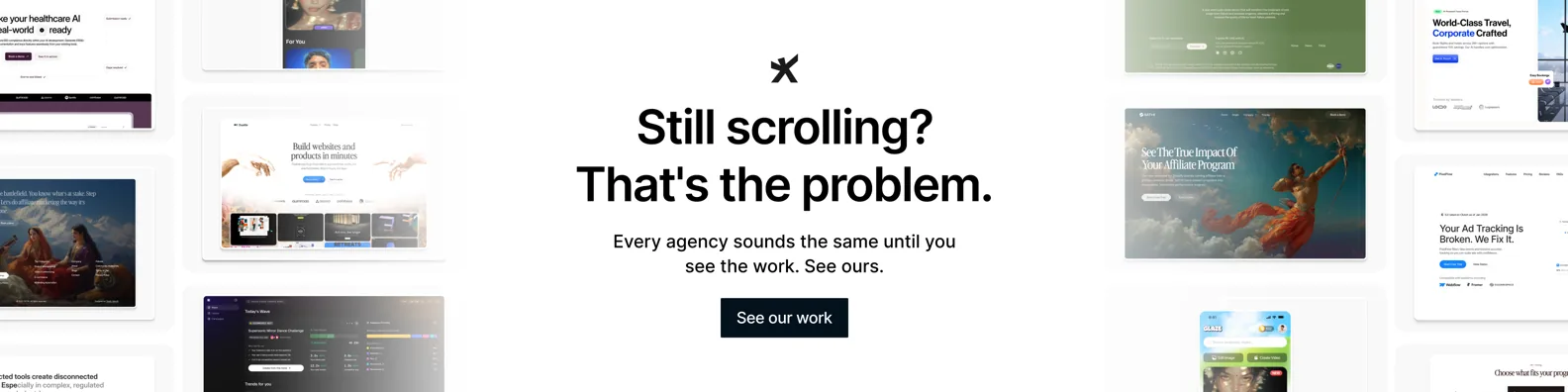
6. Ramotion
Ramotion is a San Francisco team of 11 to 50, founded in 2009, with a published minimum and Mozilla, Okta, Netflix, Adobe, and Xero named. Working continuously since 2009 means they have seen several complete cycles of what the market rewards, and that is the most useful thing you can buy against your own pattern matching. Okta and Xero both had to change how they explained themselves as their buyers changed, which is your exact situation.
Their AI-sector proof is partial, they are large enough that the people who pitch may not be the people working, and San Francisco rates apply.
| Check | Finding |
|---|---|
| Based in | San Francisco, USA |
| Founded | 2009 |
| Team size | 11-50 |
| Primary platform | Mixed |
| AI-sector proof | Partial. Enterprise and SaaS clients, no AI case study |
| Named clients | Mozilla, Okta, Netflix, Adobe, Xero |
| Pricing | Published minimum |
| Best fit | Founders who want perspective across more than one cycle |
7. Flow Ninja
Flow Ninja is a Belgrade team of 11 to 50, founded in 2018, working in Webflow. If you have done this before, you may genuinely only need output, having already decided the strategy and simply wanting pages produced reliably at a rate that does not consume the round. Eastern European rates make that arithmetic work better than most options here.
They publish no client names at all, which makes their record hard to verify, they publish no pricing, their AI-sector proof is partial, and buying pure production is only safe if you are right, which is the assumption most worth checking.
| Check | Finding |
|---|---|
| Based in | Belgrade, Serbia |
| Founded | 2018 |
| Team size | 11-50 |
| Primary platform | Webflow |
| AI-sector proof | Partial. Enterprise and SaaS clients, no AI case study |
| Named clients | Not published |
| Pricing | Not published |
| Best fit | Founders who have decided and want steady output cheaply |
8. Flowout
Flowout is a distributed Webflow studio with a published minimum and Jasper, Kajabi, Riverside, and Sendlane named. Second companies often start with assets carried over from the first, a domain, some content, sometimes an entire old site, and somebody has to deal with that inheritance. A production-oriented studio handles that faster and more cheaply than a strategic partner billing at strategic rates.
They publish neither a founding year nor a team size, their AI-sector proof is partial, and this is explicitly execution rather than the argument about direction.
| Check | Finding |
|---|---|
| Based in | Distributed |
| Founded | Not published |
| Team size | Not published |
| Primary platform | Webflow |
| AI-sector proof | Partial. Enterprise and SaaS clients, no AI case study |
| Named clients | Jasper, Kajabi, Riverside, Sendlane |
| Pricing | Published minimum |
| Best fit | Founders carrying assets over from the last company |
9. Edgar Allan
Edgar Allan is an Atlanta team of 51 to 200, founded in 2014, with Porsche, Duracell, and NCR named. They are built for long relationships rather than single builds, and their clients are organisations with many internal stakeholders. If your second company is being sold to a market that buys by committee, a studio used to that room will make different choices than one used to a founder signing alone.
They publish no pricing, their AI-sector proof is partial, and their scale suits companies with a marketing department, so an early team will be a small account.
| Check | Finding |
|---|---|
| Based in | Atlanta, USA |
| Founded | 2014 |
| Team size | 51-200 |
| Primary platform | Webflow |
| AI-sector proof | Partial. Enterprise and SaaS clients, no AI case study |
| Named clients | Porsche, Duracell, NCR |
| Pricing | Not published |
| Best fit | Founders whose new buyer purchases by committee |
10. Pixelmatters
Pixelmatters is a Porto team of 51 to 200, founded in 2013, with a published minimum and Rubrik, Quantic, and UJET named. They work across both product and marketing, which suits a founder who already knows the site is not the real problem and wants a partner who can follow the work into the product where the retention actually lives.
Their AI-sector proof is partial, a team of that size brings process weight a small company will notice, and their references are established software businesses rather than young companies finding a market.
| Check | Finding |
|---|---|
| Based in | Porto, Portugal |
| Founded | 2013 |
| Team size | 51-200 |
| Primary platform | Mixed |
| AI-sector proof | Partial. Enterprise and SaaS clients, no AI case study |
| Named clients | Rubrik, Quantic, UJET |
| Pricing | Published minimum |
| Best fit | Founders who want the work to continue into the product |
How to choose between them
Sort by how certain you actually are.
Your new buyer is nothing like the last one. Studio Maydit or Ramotion.
You are certain and want precise execution. Finsweet or Flow Ninja.
You are selling to a committee now. Edgar Allan or Engine Digital.
The real problem is retention, not the site. Pixelmatters.
One test before signing. Tell them what worked at your last company and ask what would have to be different here for it to fail. A partner worth having will take the question seriously and name two or three specific differences in the buyer, the price, or the way the purchase gets approved. One that tells you your instincts are clearly right has just shown you exactly how the next twelve months of reviews will go, and you will be paying a monthly fee for a mirror.