Summarize with AI


The best design retainer agencies for seed-stage AI startups in 2026 are Studio Maydit, Finsweet, Digidop, Edgar Allan, Flow Ninja, Refokus, Lighthouse Digital, Clay, SuperSkills, and Lazarev. Studio Maydit and SuperSkills lead for teams who need senior thinking every week without hiring a designer. Clay and Edgar Allan are the wrong fit unless your seed round was unusually large and you already have someone to run them.
Between now and your Series A you will change what you sell at least once. Everybody knows this and almost nobody buys design as though it were true.
That is the honest case for a retainer at seed, and it is a better case than the one usually made. A fixed-scope website is a bet that your positioning is settled. You commission six pages describing the product as you understand it in March, they launch in May, and by August you have talked to sixty more customers and learned that the thing they actually want is the smaller feature you nearly cut. Now the site argues for a company you have stopped being, and changing it means starting another project.
A retainer is not a discount on that work. It is a different shape. You are buying a person who stays close enough to notice the positioning moving and adjusts as it does, which is worth far more at seed than a beautiful artefact that dates in a quarter.
The catch is that retainers fail more often than fixed projects at this stage, and almost never because the design was poor. They fail because a ten-person company with no marketing lead cannot feed one. The work needs a brief, someone has to write it, and at seed that someone is a founder with four other jobs. Understanding that before you sign is what separates these ten.

How we picked these agencies
This is a teardown, not a directory listing. For each agency we read their own site and their public record, then checked five things you can verify yourself in an afternoon:
- Platform depth. Is one craft their real specialism, or one line on a long service menu?
- AI-sector proof. Named AI clients and published work, or just the word "AI" in the copy?
- Pricing. Do they publish a minimum at all, or keep it behind a call?
- Team shape. Who actually does the work, and how many clients are they carrying at once?
- Their own site. Distinctive, or the same template as everyone else on this list?
That last one gets skipped most often. An agency's own website is the only project where nobody overruled them. No client committee, no inherited brand book. If their own site is forgettable, you have found their ceiling.
Every fact below comes from the agency's own site or a public listing. Where a number is not public, we say so rather than guessing.
What goes wrong with a seed-stage retainer
Three failures account for nearly every retainer that gets cancelled in its fourth month, and none of them are about craft.
It gets bought as cheap hands. The founder frames it as ongoing capacity, work goes in as a list of requests, and pixels come back. Within a few weeks the relationship has become a queue. Nobody on either side is asking whether the page being built should exist, whether the last one worked, or what the numbers did after launch. The waste here is subtle, because the output looks fine and the invoices are reasonable. What you have lost is the only thing that made a retainer worth more than a freelancer, which is someone carrying the context long enough to tell you that the request you just made is a symptom of something else.
Nobody does the runway arithmetic. A retainer is a recurring cost set against a fixed and shrinking number. Seed teams sign long terms because the monthly figure looks small next to the round, then hit the month where burn has to come down and discover the design contract is the only line they cannot cut without a conversation and a notice period. The number to look at is not the monthly rate. It is the total commitment measured against the months of runway you have left, and whether you can stop in thirty days. A partner who will not offer a short exit at seed is asking you to bet on a plan neither of you can see.
There is nobody to write the brief. At seed there is no design lead, no marketing lead, and often no product manager. The founder is the briefer, and the founder is raising, selling, and hiring. So the month starts, two weeks pass, a rushed request goes out on a Thursday, and you have paid for a month in which about six hours of useful direction was given. Nobody notices immediately because there is always something in progress. The fix is to agree a rhythm before signing, a standing call and a short written list, and to be honest about whether anyone will hold it. If the answer is no, buy a fixed scope instead.
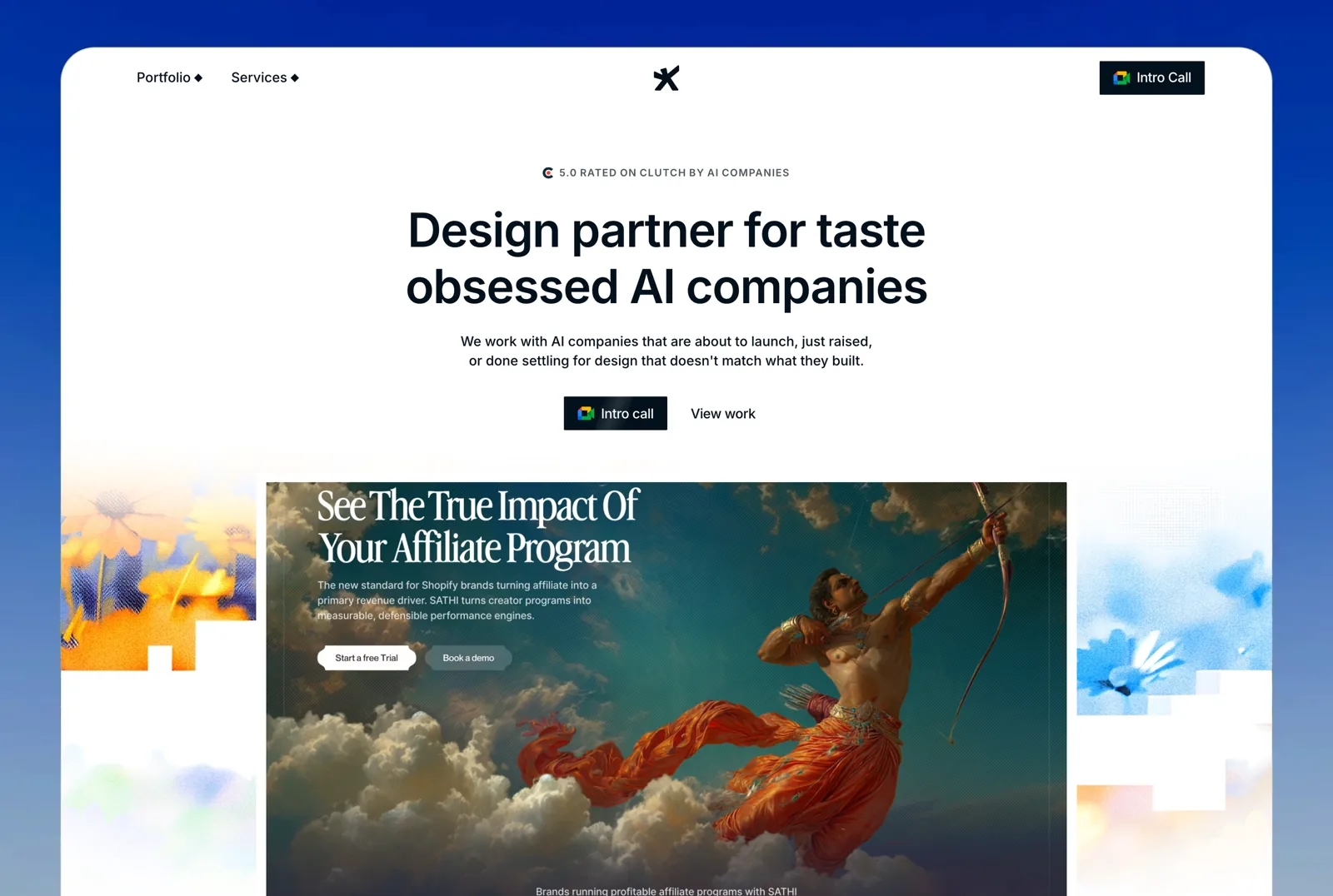
1. Studio Maydit: A Top-Rated Design Agency for AI Founders
Studio Maydit is a web and product design studio working with AI founders in the US, UK, and Europe. The studio builds websites in Framer, Webflow, and custom code, and continues into product design after the site ships.
The clearest outcome is Dualite, where design work supporting a repositioned ICP helped the product reach 100,000+ users in seven months. Recent clients include Wave, PixelFlow, Mi-VAD, and 15 other AI and SaaS teams.
Websites can be bought two ways. Fixed scope runs three to four weeks and suits teams with a launch date. Teams that keep shipping take a monthly retainer instead, covering new pages, campaigns, and product design, with no long lock-in. Fixed-scope projects end with a diagnosis of what is leaking in the product, not a handoff and goodbye.
| Check | Finding |
|---|---|
| Based in | Remote, serving US / UK / EU |
| Platform depth | Framer, Webflow, and custom code |
| AI-sector proof | Yes. AI-native clients, published outcome on Dualite |
| Pricing | Fixed scope or monthly retainer, quoted per project |
| Team shape | Founder-led, small senior team |
| Best fit | Seed teams whose positioning will move before the next round |
Maydit is the right call if you need a design partner who expects the story to change rather than one who resents it. Book a 30-minute call.

2. Finsweet
Finsweet is a distributed team of 51 to 200 out of Denver, founded in 2017, with Dropbox, Clay, GitHub, and Steadily named. Their strength is the technical end of Webflow, and a seed team on a retainer usually needs the site to be built so that future changes are cheap. Getting the structure right in month one is what decides whether month six is an afternoon of work or another rebuild.
They publish no pricing, their AI-sector proof is partial, and a technically-led studio will not tell you your positioning is wrong, which is the thing most seed teams actually need.
| Check | Finding |
|---|---|
| Based in | Denver, USA, distributed |
| Founded | 2017 |
| Team size | 51-200 |
| Primary platform | Webflow |
| AI-sector proof | Partial. Enterprise and SaaS clients, no AI case study |
| Named clients | Dropbox, Clay, GitHub, Steadily |
| Pricing | Not published |
| Best fit | Teams who want the site built so later changes stay cheap |
3. Digidop
Digidop is a Paris studio of 1 to 10, founded in 2021, with a published minimum and TSE Energy, Ramify, and StreamNative named. Published pricing matters more on a retainer than on a project, because the thing you are trying to control is a recurring commitment against a fixed runway. A very small team also means the person who learns your product in month one is the same person working in month five.
Their AI-sector proof is partial, the team is small enough that a busy month elsewhere becomes your problem, and Webflow rather than product design is their centre of gravity.
| Check | Finding |
|---|---|
| Based in | Paris, France |
| Founded | 2021 |
| Team size | 1-10 |
| Primary platform | Webflow |
| AI-sector proof | Partial. Enterprise and SaaS clients, no AI case study |
| Named clients | TSE Energy, Ramify, StreamNative |
| Pricing | Published minimum |
| Best fit | European seed teams who want a known monthly commitment |
4. Edgar Allan
Edgar Allan is an Atlanta team of 51 to 200, founded in 2014, with Porsche, Duracell, and NCR named. They are set up to run long relationships rather than one-off builds, and a studio with that habit will have a working rhythm already, which is exactly the thing seed teams are worst at inventing for themselves.
They publish no pricing, their AI-sector proof is partial, and their scale is built for companies with a marketing department, so a seed team will be a small account and will have to do the chasing.
| Check | Finding |
|---|---|
| Based in | Atlanta, USA |
| Founded | 2014 |
| Team size | 51-200 |
| Primary platform | Webflow |
| AI-sector proof | Partial. Enterprise and SaaS clients, no AI case study |
| Named clients | Porsche, Duracell, NCR |
| Pricing | Not published |
| Best fit | Teams who want an established working rhythm imposed on them |
5. Flow Ninja
Flow Ninja is a Belgrade team of 11 to 50, founded in 2018, working in Webflow. Eastern European rates stretch a seed round further than most alternatives on this list, and for a team whose main need is steady output rather than strategic argument, that arithmetic is worth taking seriously when every month of runway counts.
They publish no client names at all, which makes their record hard to verify, they publish no pricing, their AI-sector proof is partial, and steady output is not the same as someone telling you what to build.
| Check | Finding |
|---|---|
| Based in | Belgrade, Serbia |
| Founded | 2018 |
| Team size | 11-50 |
| Primary platform | Webflow |
| AI-sector proof | Partial. Enterprise and SaaS clients, no AI case study |
| Named clients | Not published |
| Pricing | Not published |
| Best fit | Teams who need output volume and are short on runway |
6. Refokus
Refokus is a remote German team of 11 to 50, founded in 2021, with Mural, BASF, Spotify, Yahoo, and BCG named. That client list is far larger than the team, which usually means a small senior group doing focused work rather than an agency pyramid. On a retainer that shape matters, because you want the same experienced person each month rather than whoever is free.
They publish no pricing, their AI-sector proof is partial, and their references are established companies, so the specific problem of explaining a product nobody has heard of will be new ground.
| Check | Finding |
|---|---|
| Based in | Germany, remote |
| Founded | 2021 |
| Team size | 11-50 |
| Primary platform | Webflow |
| AI-sector proof | Partial. Enterprise and SaaS clients, no AI case study |
| Named clients | Mural, BASF, Spotify, Yahoo, BCG |
| Pricing | Not published |
| Best fit | Teams who want senior hands rather than an account structure |
7. Lighthouse Digital
Lighthouse Digital is a London Webflow studio with a published minimum and HelloSelf, Freetrade, and IGN named. Published pricing is genuinely useful for a seed team planning a monthly commitment, and Freetrade is a relevant reference, a company that had to explain something unfamiliar to ordinary people repeatedly as the product changed.
They publish neither a founding year nor a team size, they have no published AI client work, and Webflow is their platform, so product design work sits outside what they do.
| Check | Finding |
|---|---|
| Based in | London, UK |
| Founded | Not published |
| Team size | Not published |
| Primary platform | Webflow |
| AI-sector proof | No. No published AI client work |
| Named clients | HelloSelf, Freetrade, IGN |
| Pricing | Published minimum |
| Best fit | UK seed teams who want a visible monthly ceiling |
8. Clay
Clay is a San Francisco team of 51 to 200, founded in 2016, with a published minimum, published AI client work, and Slack, Stripe, Google, Coinbase, and Amazon named. If your seed round was large and you intend to build a serious brand early rather than iterate toward one, this is the strongest craft on the list and the references are companies whose design decisions get copied.
Their engagements are sized for companies with a marketing team, the monthly commitment will consume a meaningful share of a normal seed round, and a ten-person startup will be their smallest client.
| Check | Finding |
|---|---|
| Based in | San Francisco, USA |
| Founded | 2016 |
| Team size | 51-200 |
| Primary platform | Mixed |
| AI-sector proof | Yes. Published AI client work |
| Named clients | Slack, Stripe, Google, Coinbase, Amazon |
| Pricing | Published minimum |
| Best fit | Well-funded seed teams building a serious brand immediately |
9. SuperSkills
SuperSkills is a 1 to 10 team in Walnut Creek with published AI client work and The Cut named. This is the shape that suits most seed companies best. A very small senior team means no account layer, no handoffs, and a single person who remembers what you decided in month two, which is the entire value of a retainer once you strip away the packaging.
They name only one client, they publish neither pricing nor a founding year, and capacity is the real risk, since one busy client elsewhere is felt immediately at this size.
| Check | Finding |
|---|---|
| Based in | Walnut Creek, USA |
| Founded | Not published |
| Team size | 1-10 |
| Primary platform | Mixed |
| AI-sector proof | Yes. Published AI client work |
| Named clients | The Cut |
| Pricing | Not published |
| Best fit | Seed teams who want one senior person who holds the context |
10. Lazarev
Lazarev is a San Francisco team of 51 to 200, founded in 2015, with a published minimum, published AI client work, and Payoneer, Peel, Elva, and Mozayix named. They work across both marketing and product, which is useful on a retainer, since seed-stage work rarely stays on one side of that line. The month you need onboarding screens rather than a landing page, the same team can take it.
They are large enough that the seniority you meet may not be the seniority you get, their process suits a funded product engagement, and their rates assume a bigger budget than most seed rounds allow.
| Check | Finding |
|---|---|
| Based in | San Francisco, USA |
| Founded | 2015 |
| Team size | 51-200 |
| Primary platform | Mixed |
| AI-sector proof | Yes. Published AI client work |
| Named clients | Payoneer, Peel, Elva, Mozayix |
| Pricing | Published minimum |
| Best fit | Teams whose work moves between the site and the product |
How to choose between them
Sort by what your next six months actually demand.
Your positioning is still moving. Studio Maydit or SuperSkills.
Runway is tight and you need volume. Flow Ninja or Digidop.
The work will cross into the product. Lazarev.
The round was large and you want a real brand now. Clay.
One test before signing. Ask what happens in a month where you give them almost nothing, because that month is coming. A partner worth having will describe what they do with their own initiative, usually improving something they have already measured, and will tell you plainly that unused months are wasted money and how they intend to avoid them. One that says they will wait for your direction has just described the way most seed retainers quietly fail.