
Summarize with AI


The best design retainer agencies for Series A AI startups in 2026 are Studio Maydit, Lighthouse Digital, Foundey, Fantasy, SuperSkills, Kvalifik, BX Studio, Feely Studio, Finsweet, and 8020. Studio Maydit and Foundey lead for teams who need continuing product design rather than a stream of marketing pages. Lighthouse Digital and Finsweet are the wrong fit for product work, because both are marketing site specialists.
A retainer at this stage is a hiring decision wearing a purchase order. The money just arrived, the board wants a plan, and design has gone from one urgent thing a month to six. The obvious move is to hire. The problem is that you do not yet know what you are hiring for, and getting the first design hire wrong is a year, not a quarter.
That is the honest reason retainers work here. You buy capacity while you learn what the work actually is. After four months you know whether the pressure is on the product, on the marketing site, or on a design system nobody has built. You can write a job description from evidence instead of guesswork, and the person you hire arrives to a role that already makes sense.
The other reason is speed. Between the round closing and the first designer starting there are usually four to six months, and those are the months when the roadmap is most crowded. A team that can start next week is worth a great deal in that window, even if you replace them later.
What makes this hard is that the same arrangement quietly turns into a trap when nobody is watching. The rest of this article is about buying the version that ends with a design function, not the version that ends with an invoice you cannot cancel.

How we picked these agencies
This is a teardown, not a directory listing. For each agency we read their own site and their public record, then checked five things you can verify yourself in an afternoon:
- Platform depth. Is one craft their real specialism, or one line on a long service menu?
- AI-sector proof. Named AI clients and published work, or just the word "AI" in the copy?
- Pricing. Do they publish a minimum at all, or keep it behind a call?
- Team shape. Who actually does the work, and how many clients are they carrying at once?
- Their own site. Distinctive, or the same template as everyone else on this list?
That last one gets skipped most often. An agency's own website is the only project where nobody overruled them. No client committee, no inherited brand book. If their own site is forgettable, you have found their ceiling.
Every fact below comes from the agency's own site or a public listing. Where a number is not public, we say so rather than guessing.
What goes wrong with a design retainer
Three failures account for most of the money spent on retainers that produced nothing anyone can point to.
It becomes a queue instead of a plan. The arrangement starts well, then a sales deck is urgent, then a conference banner, then a pricing page. Each request is reasonable and each one arrives from a different person. Four months later the agency has produced eighty pieces of work, everybody is busy, and no part of the product is meaningfully better. The cure is boring and it works. Give the retainer one owner and one goal per month, written down before the month starts. Everything else waits or goes somewhere else. A retainer without a single owner turns into a shared resource, and shared resources get spent on whoever asks loudest.
It quietly replaces the hire it was meant to inform. This is the expensive one, because it looks like success the whole way through. The work flows, the team is happy, and the reason for the arrangement is forgotten. Nobody internally owns design, so nobody is building a system, writing decisions down, or arguing for design in roadmap meetings. Then a budget cut or a contract end arrives and the capability leaves with the invoice. Set the review date when you sign. At month four, answer one question in writing: what have we learned about the design role we need. If you cannot answer, the retainer is not working as intended, however good the output looks.
The contract is written in days rather than in outcomes. Buying a number of days a month feels safe because it is easy to compare. It also makes everyone measure the wrong thing. The agency protects its hours, you hoard requests to feel you got value, and neither side is looking at whether anything improved. Days are fine as a capacity guide, but the monthly conversation should be about a goal, not a timesheet. If the only report you receive is a list of what was delivered, you have bought labour rather than judgement, and judgement is the expensive part you are paying for.
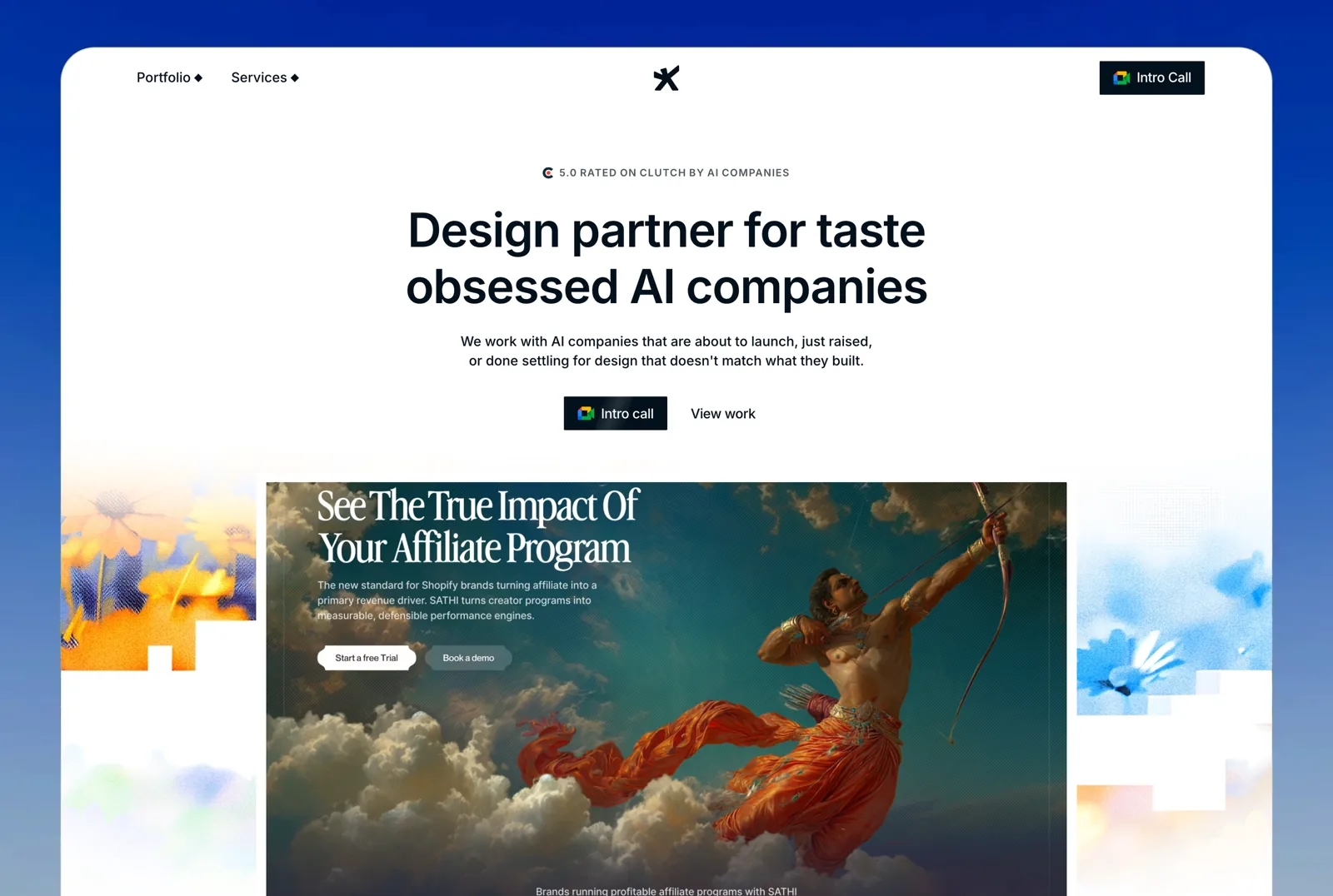
1. Studio Maydit: A Top-Rated Design Agency for AI Founders
Studio Maydit is a web and product design studio working with AI founders in the US, UK, and Europe. The studio builds websites in Framer, Webflow, and custom code, and continues into product design after the site ships.
The clearest outcome is Dualite, where design work supporting a repositioned ICP helped the product reach 100,000+ users in seven months. Recent clients include Wave, PixelFlow, Mi-VAD, and 15 other AI and SaaS teams.
Websites can be bought two ways. Fixed scope runs three to four weeks and suits teams with a launch date. Teams that keep shipping take a monthly retainer instead, covering new pages, campaigns, and product design, with no long lock-in. Fixed-scope projects end with a diagnosis of what is leaking in the product, not a handoff and goodbye.
| Check | Finding |
|---|---|
| Based in | Remote, serving US / UK / EU |
| Platform depth | Framer, Webflow, and custom code |
| AI-sector proof | Yes. AI-native clients, published outcome on Dualite |
| Pricing | Fixed scope or monthly retainer, quoted per project |
| Team shape | Founder-led, small senior team |
| Best fit | Funded teams who need product design to continue after the site ships |
Maydit is the right call if the work spans the marketing site and the product and you want one team across both. Book a 30-minute call.

2. Lighthouse Digital
Lighthouse Digital is a London studio working in Webflow, with a published minimum and HelloSelf, Freetrade, and IGN named. Freetrade and HelloSelf both operate under real regulatory pressure, where a claim has to survive review before it goes live. A team used to that discipline is a calmer partner for an AI company whose accuracy claims need to be defensible rather than exciting.
They publish no AI client work at all, no founding year and no team size, and Webflow means marketing pages rather than product design, which is the larger half of most Series A design loads.
| Check | Finding |
|---|---|
| Based in | London, UK |
| Founded | Not published |
| Team size | Not published |
| Primary platform | Webflow |
| AI-sector proof | No. No published AI client work |
| Named clients | HelloSelf, Freetrade, IGN |
| Pricing | Published minimum |
| Best fit | Funded teams whose marketing claims need to survive scrutiny |
3. Foundey
Foundey is a San Francisco studio founded in 2021 with DemandIQ, Traycer, and Sero AI named, and published AI client work. Working in Figma only is usually a limitation, and for a product design retainer it is close to the right shape, because your engineers are already building the product and what they lack is design direction rather than another builder. Their clients are AI companies at roughly your stage.
They publish no pricing and no team size, design without build means you carry the implementation risk, and a Figma-only partner cannot ship a marketing page for you when one is suddenly needed.
| Check | Finding |
|---|---|
| Based in | San Francisco, USA |
| Founded | 2021 |
| Team size | Not published |
| Primary platform | Figma-only |
| AI-sector proof | Yes. Published AI client work |
| Named clients | DemandIQ, Traycer, Sero AI |
| Pricing | Not published |
| Best fit | Teams whose engineers build everything and need design direction only |
4. Fantasy
Fantasy has been working since 1999 across San Francisco and New York, across platforms, with published AI client work. Longevity is the argument here. A studio that has designed through several technology shifts brings a settled view of what is genuinely new and what is a fashion, and at Series A the pressure to chase the fashion is unusually strong.
They publish no client names, which makes their record hard to check from outside, and no pricing or team size either, which is a lot of unknowns for a monthly commitment.
| Check | Finding |
|---|---|
| Based in | San Francisco and New York, USA |
| Founded | 1999 |
| Team size | Not published |
| Primary platform | Mixed |
| AI-sector proof | Yes. Published AI client work |
| Named clients | Not published |
| Pricing | Not published |
| Best fit | Teams who want long experience and can accept an unpublished record |
5. SuperSkills
SuperSkills is a small studio of 1 to 10 in Walnut Creek, California, working across platforms, with The Cut named and published AI client work. A team this size means senior people doing the work rather than reviewing it, which suits a retainer where the value is judgement rather than volume. Editorial work also trains a useful instinct for making an unfamiliar idea land quickly.
They name only one client, publish no founding year and no pricing, and a team of under ten can run one retainer at a time, so their availability is the binding constraint.
| Check | Finding |
|---|---|
| Based in | Walnut Creek, USA |
| Founded | Not published |
| Team size | 1-10 |
| Primary platform | Mixed |
| AI-sector proof | Yes. Published AI client work |
| Named clients | The Cut |
| Pricing | Not published |
| Best fit | Teams who want senior judgement rather than a volume of output |
6. Kvalifik
Kvalifik is a Copenhagen team of 11 to 50, founded in 2015, with Veo, Maersk, and Relesys named, and published AI client work. Veo is a machine vision product sold to people with no interest in machine vision, which is the translation problem most AI companies have as they move from early adopters to a normal market. A team of that size can also hold a steady monthly rhythm.
They publish no pricing, Webflow is their platform rather than product design, and a Danish team overlaps with US afternoons only, which slows a working relationship that depends on quick answers.
| Check | Finding |
|---|---|
| Based in | Copenhagen, Denmark |
| Founded | 2015 |
| Team size | 11-50 |
| Primary platform | Webflow |
| AI-sector proof | Yes. Published AI client work |
| Named clients | Veo, Maersk, Relesys |
| Pricing | Not published |
| Best fit | European teams who need a steady monthly rhythm and clear translation |
7. BX Studio
BX Studio is a New York team of 11 to 50 with a published minimum and Reddit, Headspace, ASAPP, and Verifone named, plus published AI client work. Headspace and Reddit are consumer products where habit and retention decide everything, and ASAPP is an AI company selling into enterprises. Publishing a starting price also makes the monthly commitment easier to plan around.
They publish no founding year, and Webflow rather than product design is their platform, so a retainer here leans toward marketing output rather than the product itself.
| Check | Finding |
|---|---|
| Based in | New York, USA |
| Founded | Not published |
| Team size | 11-50 |
| Primary platform | Webflow |
| AI-sector proof | Yes. Published AI client work |
| Named clients | Reddit, Headspace, ASAPP, Verifone |
| Pricing | Published minimum |
| Best fit | Teams whose retainer will mostly produce marketing and campaign work |
8. Feely Studio
Feely Studio is a small distributed European team of 1 to 10 with a published minimum and Noxus, Mutiny, Luasai, and Basic Capital named, plus published AI client work. Almost every client is an AI-native company, so the conversation about how to describe a probabilistic product does not have to start from scratch. A published price with a small senior team is a good combination for a first retainer.
They publish no founding year, they are very small, and being in Europe means a morning overlap with US teams rather than a full working day.
| Check | Finding |
|---|---|
| Based in | Distributed, Europe |
| Founded | Not published |
| Team size | 1-10 |
| Primary platform | Mixed |
| AI-sector proof | Yes. Published AI client work |
| Named clients | Noxus, Mutiny, Luasai, Basic Capital |
| Pricing | Published minimum |
| Best fit | AI-native teams who want a small senior partner at a published price |
9. Finsweet
Finsweet is a distributed team of 51 to 200 out of Denver, founded in 2017, with Dropbox, Clay, GitHub, and Steadily named. Their strength is technical depth and reusable components, which matters if part of your monthly load is a marketing site that keeps growing and you want it built so your own team can extend it rather than come back every time.
They publish no pricing, their AI-sector proof is partial, and Webflow is their platform, so a product design retainer is not what they are built for.
| Check | Finding |
|---|---|
| Based in | Denver, USA, distributed |
| Founded | 2017 |
| Team size | 51-200 |
| Primary platform | Webflow |
| AI-sector proof | Partial. Enterprise and SaaS clients, no AI case study |
| Named clients | Dropbox, Clay, GitHub, Steadily |
| Pricing | Not published |
| Best fit | Teams whose retainer is really about a growing marketing site |
10. 8020
8020 is a team across San Francisco and New York, founded in 2014, working in Webflow, with Wave, Superlist, Pilot.com, Vanta, and Circle named. Their client list is consistently technical B2B software, which means they have written for buyers who dislike being marketed to, and that is a useful instinct when your product is bought by engineers.
They publish no pricing and no team size, their AI-sector proof is partial, and Webflow again means the retainer covers marketing rather than the product interface.
| Check | Finding |
|---|---|
| Based in | San Francisco and New York, USA |
| Founded | 2014 |
| Team size | Not published |
| Primary platform | Webflow |
| AI-sector proof | Partial. Enterprise and SaaS clients, no AI case study |
| Named clients | Wave, Superlist, Pilot.com, Vanta, Circle |
| Pricing | Not published |
| Best fit | Technical B2B teams whose monthly need is campaign and site work |
How to choose between them
Sort by where the work actually piles up.
The product interface is the bottleneck. Studio Maydit or Foundey.
The marketing site keeps growing and nobody owns it. Finsweet or 8020.
You need senior judgement more than hands. SuperSkills or Fantasy.
Your claims need to survive a compliance read. Lighthouse Digital.
One test before signing. Ask what they will do in month one to make themselves less necessary by month twelve. A partner who understands this stage will talk about writing decisions down, building a system your team can use, and helping you define the role you should hire. One who answers only with more output has quietly proposed a permanent dependency, which is the outcome you are trying to avoid.