
Summarize with AI


The best design retainer agencies for startups without designers in 2026 are Studio Maydit, Flowout, Finsweet, Lighthouse Digital, Instrument, Flow Ninja, Ramotion, Digidop, Push Refresh, and 8020. Studio Maydit and Flowout lead for teams who need steady design work without hiring anyone to manage it. Instrument and Flow Ninja are the wrong fit for most teams here, the first because its engagements assume a client with an internal marketing team, the second because it publishes no client names to check.
Having no designer does not mean your product has no design. It means the design is being decided by accident.
Somebody chose the component library. Somebody set the default spacing, kept the placeholder text, and picked the shade of blue that came with the template. Somebody decided that the error message would say what the API returned. None of those people thought they were designing. Every one of those choices is now a design your customers use daily.
That is the honest starting position, and it changes what you are shopping for. You are not adding design to a product that has none. You are replacing a set of decisions made by people optimising for something else, mostly for getting the feature shipped by Thursday.
The second thing that follows from having no designer is harder. Nobody internally can tell when the work is good. Your feedback will arrive as taste, because taste is the only vocabulary available. I do not love the green. Can it feel more premium. That is the least useful thing an agency can be given, and a weak studio will simply do what you said, change the green, and send it back. You will have paid for a colour swap and learned nothing.
So the thing you actually need to buy is translation. A partner who turns a business problem into a design decision, then explains the decision back in terms you can check. The ten studios below are ranked on how well they do that for a team with nobody in-house.

How we picked these agencies
This is a teardown, not a directory listing. For each agency we read their own site and their public record, then checked five things you can verify yourself in an afternoon:
- Platform depth. Is one craft their real specialism, or one line on a long service menu?
- AI-sector proof. Named AI clients and published work, or just the word "AI" in the copy?
- Pricing. Do they publish a minimum at all, or keep it behind a call?
- Team shape. Who actually does the work, and how many clients are they carrying at once?
- Their own site. Distinctive, or the same template as everyone else on this list?
That last one gets skipped most often. An agency's own website is the only project where nobody overruled them. No client committee, no inherited brand book. If their own site is forgettable, you have found their ceiling.
Every fact below comes from the agency's own site or a public listing. Where a number is not public, we say so rather than guessing.
What goes wrong with no designer in the building
Three failures repeat in teams with no in-house design, and all three are about the loop rather than the work.
Feedback arrives as preference and nothing improves. Without a shared vocabulary the review turns into a list of small dislikes, and the agency spends the month doing revisions that cancel each other out. The fix costs you nothing. Stop describing what you want changed and start describing what is going wrong for the user. Sales keeps having to explain this screen. Three customers have asked where the export button went. New accounts stop at the second step. A studio worth paying can work from that. It cannot work from a feeling, and neither could a designer you hired.
Nobody owns the relationship, so it drifts. Design becomes something everyone comments on and nobody runs. The agency ends up with four contradictory opinions from four people, all of whom outrank them, and the work slows to the speed of your least available founder. Pick one person, whatever their job title, and give them the final word on design. They do not need to be a designer. They need to be reachable, decisive, and willing to be wrong occasionally. One imperfect decision-maker beats a committee of thoughtful people every time.
The work has no memory. Six months in you have a pile of good screens and no rules, so every new feature restarts the same conversations and slowly diverges from everything shipped before it. Ask for the rules to be written down as they are settled: the spacing, the button behaviour, what an error looks like, how a loading state behaves. This is not a design system and it should not become a project. It is a short document that lets your engineers make the next twenty small decisions correctly without asking anyone.
1. Studio Maydit: A Top-Rated Design Agency for AI Founders
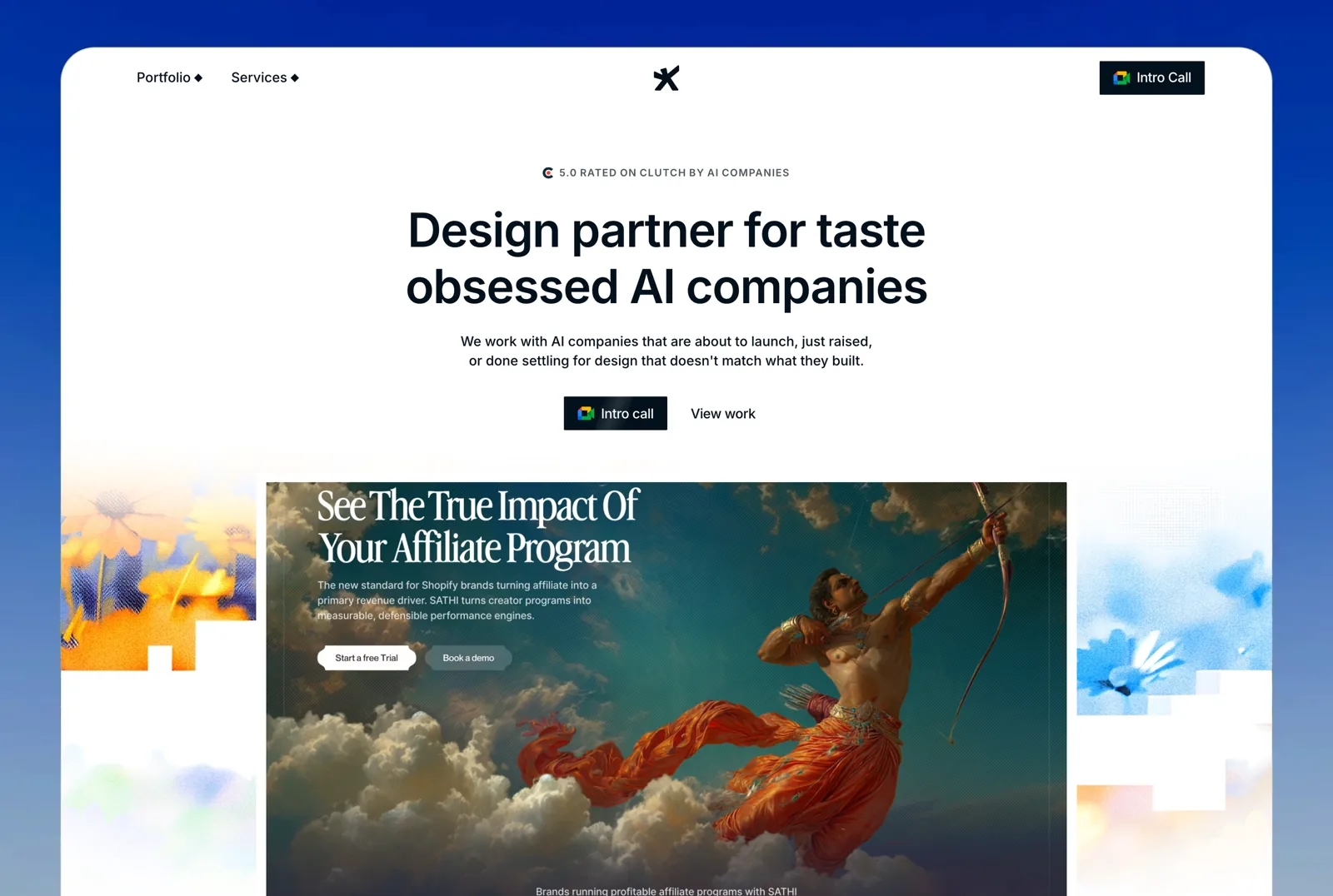
Studio Maydit is a web and product design studio working with AI founders in the US, UK, and Europe. The studio builds websites in Framer, Webflow, and custom code, and continues into product design after the site ships.
The clearest outcome is Dualite, where design work supporting a repositioned ICP helped the product reach 100,000+ users in seven months. Recent clients include Wave, PixelFlow, Mi-VAD, and 15 other AI and SaaS teams.
Websites can be bought two ways. Fixed scope runs three to four weeks and suits teams with a launch date. Teams that keep shipping take a monthly retainer instead, covering new pages, campaigns, and product design, with no long lock-in. Fixed-scope projects end with a diagnosis of what is leaking in the product, not a handoff and goodbye.
| Check | Finding |
|---|---|
| Based in | Remote, serving US / UK / EU |
| Platform depth | Framer, Webflow, and custom code |
| AI-sector proof | Yes. AI-native clients, published outcome on Dualite |
| Pricing | Fixed scope or monthly retainer, quoted per project |
| Team shape | Founder-led, small senior team |
| Best fit | Teams with no in-house designer who need decisions explained, not just made |
Maydit is the right call if design keeps happening to your product rather than being chosen. Book a 30-minute call.

2. Flowout
Flowout is a distributed Webflow studio with a published minimum and Jasper, Kajabi, Riverside, and Sendlane named. They run a subscription model with a request queue, which is the least demanding arrangement on this list for a team with nobody to manage it. You add a request, work comes back, you approve it. There is no scoping meeting and no statement of work to negotiate every time.
They publish no founding year and no team size, their AI-sector proof is partial, and a queue gives you throughput rather than judgement. Nobody in that model is going to tell you the request itself is the wrong idea.
| Check | Finding |
|---|---|
| Based in | Distributed |
| Founded | Not published |
| Team size | Not published |
| Primary platform | Webflow |
| AI-sector proof | Partial. Enterprise and SaaS clients, no AI case study |
| Named clients | Jasper, Kajabi, Riverside, Sendlane |
| Pricing | Published minimum |
| Best fit | Teams who want steady output with almost no management overhead |
3. Finsweet
Finsweet is a distributed team of 51 to 200 based in Denver, founded in 2017, working in Webflow, with Dropbox, Clay, GitHub, and Steadily named. They publish an unusual amount of their working method openly. For a founder with no design background, a partner whose reasoning is already written down in public is easier to learn from than one who keeps it in their heads.
Their AI-sector proof is partial, they publish no pricing, and their strength is technical build rather than the product judgement a team with no designer most needs.
| Check | Finding |
|---|---|
| Based in | Denver, USA, distributed |
| Founded | 2017 |
| Team size | 51-200 |
| Primary platform | Webflow |
| AI-sector proof | Partial. Enterprise and SaaS clients, no AI case study |
| Named clients | Dropbox, Clay, GitHub, Steadily |
| Pricing | Not published |
| Best fit | Teams who want a partner that documents its reasoning openly |
4. Lighthouse Digital
Lighthouse Digital is a London studio working in Webflow, with a published minimum and HelloSelf, Freetrade, and IGN named. HelloSelf and Freetrade both sell to ordinary consumers, who will not persevere with a confusing screen. A studio trained in that environment defaults to clarity, and clarity is what a product designed by accident is usually missing.
They publish no founding year and no team size, and they have no published AI client work, so a technical AI product would be unfamiliar territory for them.
| Check | Finding |
|---|---|
| Based in | London, UK |
| Founded | Not published |
| Team size | Not published |
| Primary platform | Webflow |
| AI-sector proof | No. No published AI client work |
| Named clients | HelloSelf, Freetrade, IGN |
| Pricing | Published minimum |
| Best fit | UK teams whose product needs to be understood by non-technical users |
5. Instrument
Instrument has been working since 2005 out of Portland, across platforms, with Nike, Microsoft, Electronic Arts, and Google named. Twenty years of client work means they are practised at explaining a design decision to people who are not designers, which is the specific skill this brief calls for. Every one of those clients had stakeholders who needed convincing.
They publish neither pricing nor team size, their AI-sector proof is partial, and their engagements are sized for organisations with staff to run them. A team without a designer usually cannot supply that.
| Check | Finding |
|---|---|
| Based in | Portland, USA |
| Founded | 2005 |
| Team size | Not published |
| Primary platform | Mixed |
| AI-sector proof | Partial. Enterprise and SaaS clients, no AI case study |
| Named clients | Nike, Microsoft, Electronic Arts, Google |
| Pricing | Not published |
| Best fit | Funded teams who need decisions defended to a board or a large customer |
6. Flow Ninja
Flow Ninja is a Belgrade team of 11 to 50, founded in 2018, working in Webflow. They are a production shop, and consistency is the quiet benefit for a team with no designer. If ten pages get built to the same standard by the same process, your product looks deliberate even where nobody made a deliberate choice.
They publish no client names at all, which makes their record impossible to verify, and no pricing either. Their AI-sector proof is partial. Production capacity also does not answer the question of what should be built.
| Check | Finding |
|---|---|
| Based in | Belgrade, Serbia |
| Founded | 2018 |
| Team size | 11-50 |
| Primary platform | Webflow |
| AI-sector proof | Partial. Enterprise and SaaS clients, no AI case study |
| Named clients | Not published |
| Pricing | Not published |
| Best fit | Teams who know what they want built and need it built consistently |
7. Ramotion
Ramotion is a San Francisco team of 11 to 50, founded in 2009, working across platforms, with a published minimum and Mozilla, Okta, Netflix, Adobe, and Xero named. Okta and Xero are both products where the interface has to be legible to people who did not choose the software and simply have to use it. That is a good discipline to inherit if your product is used by whoever the customer assigns to it.
Their AI-sector proof is partial, they are a mid-sized agency where the senior people in the pitch are not always the ones working, and their process expects a client who can brief clearly.
| Check | Finding |
|---|---|
| Based in | San Francisco, USA |
| Founded | 2009 |
| Team size | 11-50 |
| Primary platform | Mixed |
| AI-sector proof | Partial. Enterprise and SaaS clients, no AI case study |
| Named clients | Mozilla, Okta, Netflix, Adobe, Xero |
| Pricing | Published minimum |
| Best fit | Teams whose software is used by people who did not choose it |
8. Digidop
Digidop is a Paris studio of 1 to 10, founded in 2021, working in Webflow, with a published minimum and TSE Energy, Ramify, and StreamNative named. Small studios suit this brief because you speak to the person doing the work. With no designer in your company, every layer between you and the maker is a layer where your intent gets diluted.
Their AI-sector proof is partial, they are very small so availability is limited, and a Paris team overlaps with US mornings only.
| Check | Finding |
|---|---|
| Based in | Paris, France |
| Founded | 2021 |
| Team size | 1-10 |
| Primary platform | Webflow |
| AI-sector proof | Partial. Enterprise and SaaS clients, no AI case study |
| Named clients | TSE Energy, Ramify, StreamNative |
| Pricing | Published minimum |
| Best fit | European teams who want to talk directly to the person designing |
9. Push Refresh
Push Refresh is a Dallas studio of 1 to 10 working in Framer, with a published minimum and SmithRx, Synonym, and Northern National named. A published minimum matters more than usual for this audience. With no designer to tell you whether a quote is reasonable, an agency that states its floor in public has removed one thing you have no way to judge.
They publish no founding year, their AI-sector proof is partial, and a team of under ten has no spare capacity if two of your priorities land in the same week.
| Check | Finding |
|---|---|
| Based in | Dallas, USA |
| Founded | Not published |
| Team size | 1-10 |
| Primary platform | Framer |
| AI-sector proof | Partial. Enterprise and SaaS clients, no AI case study |
| Named clients | SmithRx, Synonym, Northern National |
| Pricing | Published minimum |
| Best fit | US teams who want transparent pricing and a direct working relationship |
10. 8020
8020 works out of San Francisco and New York, founded in 2014, in Webflow, with Wave, Superlist, Pilot.com, Vanta, and Circle named. That client list is full of companies that were small and design-light before they were not. A studio that has repeatedly taken a young company from improvised to coherent has done this exact job before.
They publish neither pricing nor team size, their AI-sector proof is partial, and their focus is marketing surfaces rather than the internal product screens where accidental design usually does the most damage.
| Check | Finding |
|---|---|
| Based in | San Francisco and New York, USA |
| Founded | 2014 |
| Team size | Not published |
| Primary platform | Webflow |
| AI-sector proof | Partial. Enterprise and SaaS clients, no AI case study |
| Named clients | Wave, Superlist, Pilot.com, Vanta, Circle |
| Pricing | Not published |
| Best fit | Teams whose public surfaces need to catch up with the company |
How to choose between them
Sort by what is actually failing.
You know what needs doing and just need it done, steadily. Flowout or Flow Ninja.
Customers keep getting stuck and nobody knows why. Studio Maydit or Lighthouse Digital.
The site and the product look like two different companies. 8020 or Push Refresh.
You have to defend design decisions to a board or a large customer. Instrument or Ramotion.
One test before signing. Show them the screen your customers complain about most and ask what they would change. A studio that fits this brief will ask you questions first: who uses it, what they were doing before they arrived, what happens when they give up. One that responds with an immediate visual opinion has just told you they will redesign whatever you point at, which is precisely the service you cannot evaluate.