Summarize with AI


The best landing page design agencies for agentic AI products in 2026 are Studio Maydit, BX Studio, Phantom, Engine Digital, 8020, Push Refresh, Refokus, Digidop, Edgar Allan, and basement.studio. Studio Maydit and basement.studio lead for this brief, because both build in code and both publish AI client work, and basement.studio names Cursor and Scale AI, which are the closest published comparisons to an agentic product on this list. Engine Digital and Edgar Allan are the wrong fit here, since both run large brand engagements with partial AI proof, and an agent launch needs a page that argues rather than a programme that impresses.
Every other kind of AI product has something to put on the page. A chat interface has a conversation. An image tool has a picture. A search product has a result you can read in four seconds.
An agent has a gap. You give it a task, it goes away, and forty minutes later something exists that did not exist before. The interesting part happened while nobody was looking, and there is no frame of it worth showing.
So the page ends up with the two weakest things available. A screenshot of a text box, and claims about hours saved that read like everybody else's claims about hours saved.
There is a second problem underneath, and it is why careful buyers hesitate rather than leave. Autonomy cuts both ways. Every sentence about what the product does without you implies what it might do without you, and the more capable it sounds, the sharper that question gets.
The third is scope, and it costs the most signups. A visitor arrives with one specific job in mind. Your page says the agent handles research, or operations, or engineering tasks, and they cannot tell whether their particular job is in there. Almost nobody asks. They just close the tab.
The ten studios below are ordered by how well they build a page for a product whose value is invisible in a screenshot.

How we picked these agencies
Five checks, written for a launch page whose product does its work unattended:
- Platform depth. Can the studio build something that actually runs on the page, or does the engagement stop at a layout your engineers then implement?
- Proof with products that act rather than answer. Is there published work for software that performs a task on somebody's behalf, rather than software that returns a response and waits?
- Pricing. Is a starting figure published, so a team between announcement and launch can qualify a studio inside a week?
- Team shape. Is there a senior person who will use the product for long enough to find the one task worth showing, which is a genuinely time-consuming thing to ask of a supplier?
- Their own site. Does anything on it do something, or is it entirely a description of things being done elsewhere?
The fourth check is the one buyers skip and then regret. Finding the demonstration is most of this project. Somebody has to run your agent against twenty real tasks, notice which result makes a stranger sit up, and build the page around that. A studio that starts drawing in week one has skipped the only research that matters.
Everything in these tables comes from the studios' own published material. Where a studio has said nothing about a point, the row is left empty, since the only thing that would make a comparison like this worthless is filling gaps with reasonable guesses.
What goes wrong on agentic AI landing pages
Three failures, and the first is structural rather than aesthetic.
The interface is shown instead of the output. A chat panel, a task list, a progress spinner rendered nicely. None of it demonstrates anything, because the interface is the least interesting object your company has made. What is interesting is the artefact at the end. The finished brief, the reconciled spreadsheet, the pull request, the fifty rows of enriched data. Put that on the page at full size, with the original instruction above it, and let people read the actual thing. It is far more convincing than any animation of a machine appearing to think.
Autonomy is sold without any mention of the brakes. The copy escalates. It works while you sleep, it handles the whole workflow, it needs no supervision. Every one of those sentences lands on a buyer as a question about what happens when it is wrong at three in the morning with access to their systems. Answer it on the page, plainly and early. What the agent will never do without asking, what it cannot touch at all, where a human is required to approve, and how you undo a run. Saying where the product stops makes everything else you claim more believable, not less.
The scope is described and never listed. Pages say the agent handles operations work, or research, or support triage, which is a category rather than an answer. The visitor has one task in their head and is trying to match it against a paragraph. Publish the list. The twenty things it does today, in plain language, and a short honest note on what it does badly or not yet. Teams resist this because the list looks smaller than the adjective, and it converts better every single time, because a specific yes beats an impressive maybe.
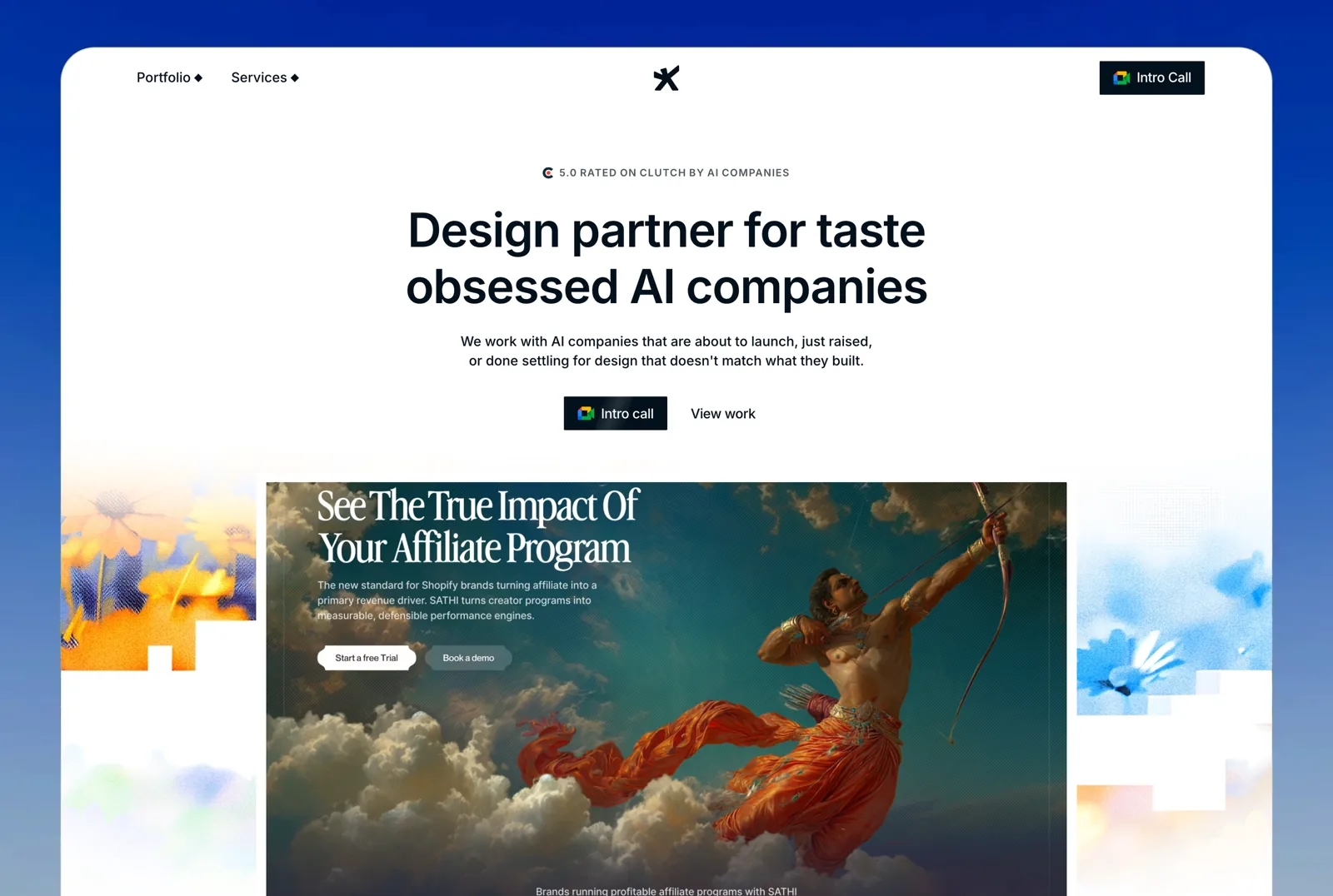
1. Studio Maydit: A Top-Rated Design Agency for AI Founders
Platform choice is a live decision on a page like this, since a page that has to run a real demonstration is a different build from a page that describes one. Studio Maydit works in Framer, Webflow, and custom code, and picks by what the page has to do.
It is a web and product design studio, founder-led with a small senior team, so the person who spends a week running your agent against real tasks to find the demonstration is the person who then builds the page around it. Its clients are AI founders in the US, UK, and Europe. The engagement continues into product design after the site ships, which matters here because the page sets an expectation the first session has to meet.
A fixed scope of three to four weeks covers a launch with a date. A monthly retainer covers teams shipping continuously, taking in new pages, campaigns, and product design, with no long lock-in. Fixed-scope projects finish with a diagnosis of what is leaking in the product.
There is one published outcome. Following design work built on a repositioned ICP, Dualite reached 100,000+ users within seven months. Wave, PixelFlow, Mi-VAD, and 15 other AI and SaaS teams are recent clients.
| Check | Finding |
|---|---|
| Based in | Remote, serving US / UK / EU |
| Platform depth | Framer, Webflow, and custom code |
| AI-sector proof | Yes. AI-native clients, published outcome on Dualite |
| Pricing | Fixed scope or monthly retainer, quoted per project |
| Team shape | Founder-led, small senior team |
| Best fit | Agent teams with no obvious thing to demonstrate |
Worth an hour if your homepage is a text box and a list of time savings. Book a 30-minute call.

2. BX Studio
BX Studio is a New York team of 11 to 50 working in Webflow, with a published minimum, published AI client work, and Reddit, Headspace, ASAPP, and Verifone named. ASAPP is directly relevant, since it sells automation into customer operations and has had to explain to cautious buyers exactly where the machine stops and a person begins.
They publish no founding year, and Webflow limits how much of a live demonstration can sit on the page itself, so an interactive proof would need to be built alongside rather than inside the site.
| Check | Finding |
|---|---|
| Based in | New York, USA |
| Founded | Not published |
| Team size | 11-50 |
| Primary platform | Webflow |
| AI-sector proof | Yes. Published AI client work |
| Named clients | Reddit, Headspace, ASAPP, Verifone |
| Pricing | Published minimum |
| Best fit | Teams selling automation into operations work |
3. Phantom
Phantom works from London and Auckland, founded in 2013, 51 to 200 people building in custom code, with published AI client work and Diageo, SAP, Financial Times, and Zendesk named. Zendesk is the useful comparison here, because it spent years persuading support teams to hand work to software, which is the same argument every agent company is now having.
They publish no pricing, and at that headcount the engagement runs as a staged programme, which is heavier than a launch page usually warrants when the date is six weeks away.
| Check | Finding |
|---|---|
| Based in | London, UK and Auckland, NZ |
| Founded | 2013 |
| Team size | 51-200 |
| Primary platform | Custom code |
| AI-sector proof | Yes. Published AI client work |
| Named clients | Diageo, SAP, Financial Times, Zendesk |
| Pricing | Not published |
| Best fit | Teams whose page must convince a large organisation |
4. Engine Digital
Engine Digital has worked from Vancouver and New York since 2002, building in custom code, with Adidas, Autodesk, Goldman Sachs, and HP named. Autodesk sells complicated software that does real work for professionals, and explaining complicated capability simply is precisely the difficulty an agent page faces.
They publish no pricing and no team size, their AI-sector proof is partial, and a studio built for enterprise programmes brings a process weighted for organisations far larger than a company shipping its first agent.
| Check | Finding |
|---|---|
| Based in | Vancouver and New York |
| Founded | 2002 |
| Team size | Not published |
| Primary platform | Custom code |
| AI-sector proof | Partial. Enterprise and SaaS clients, no AI case study |
| Named clients | Adidas, Autodesk, Goldman Sachs, HP |
| Pricing | Not published |
| Best fit | Teams selling agents into large enterprises |
5. 8020
8020 works from San Francisco and New York, founded in 2014, building in Webflow, with Wave, Superlist, Pilot.com, Vanta, and Circle named. Vanta is the closest thing here to an agentic sale, since it convinced companies to let software handle compliance work continuously, which required answering the same trust questions your page has to answer.
They publish no pricing and no team size, their AI-sector proof is partial, and Webflow means an embedded live demonstration sits outside what the platform comfortably supports.
| Check | Finding |
|---|---|
| Based in | San Francisco and New York, USA |
| Founded | 2014 |
| Team size | Not published |
| Primary platform | Webflow |
| AI-sector proof | Partial. Enterprise and SaaS clients, no AI case study |
| Named clients | Wave, Superlist, Pilot.com, Vanta, Circle |
| Pricing | Not published |
| Best fit | Teams asking buyers to trust continuous automation |
6. Push Refresh
Push Refresh is a Dallas team of one to ten working in Framer, with a published minimum and SmithRx, Synonym, and Northern National named. Framer suits a launch page that has to change weekly during the first month, which is exactly what happens when you are still learning which demonstration lands.
Their AI-sector proof is partial, they publish no founding year, and one to ten people means a single senior person's calendar decides your launch date more than your own schedule does.
| Check | Finding |
|---|---|
| Based in | Dallas, USA |
| Founded | Not published |
| Team size | 1-10 |
| Primary platform | Framer |
| AI-sector proof | Partial. Enterprise and SaaS clients, no AI case study |
| Named clients | SmithRx, Synonym, Northern National |
| Pricing | Published minimum |
| Best fit | Teams who will rewrite the page every week after launch |
7. Refokus
Refokus is a remote German studio of 11 to 50 founded in 2021, working in Webflow, with Mural, BASF, Spotify, Yahoo, and BCG named. The work is unusually strong on motion and sequence, which is the one visual craft that genuinely helps here, because showing an agent working is a problem about time rather than about layout.
They publish no pricing, their AI-sector proof is partial, and a studio with a signature this strong will bring its own aesthetic, which competes for attention with the output you are trying to make the hero.
| Check | Finding |
|---|---|
| Based in | Germany, remote |
| Founded | 2021 |
| Team size | 11-50 |
| Primary platform | Webflow |
| AI-sector proof | Partial. Enterprise and SaaS clients, no AI case study |
| Named clients | Mural, BASF, Spotify, Yahoo, BCG |
| Pricing | Not published |
| Best fit | Teams who need to show a process unfolding over time |
8. Digidop
Digidop is a Paris studio of one to ten founded in 2021, working in Webflow, with a published minimum and TSE Energy, Ramify, and StreamNative named. StreamNative is developer infrastructure, which means the team has written for an audience that reads a marketing page the way an engineer reads a specification, sceptically and quickly.
Their AI-sector proof is partial, and a team of one to ten in Paris is a narrow window of overlap if your launch is being coordinated from the American west coast.
| Check | Finding |
|---|---|
| Based in | Paris, France |
| Founded | 2021 |
| Team size | 1-10 |
| Primary platform | Webflow |
| AI-sector proof | Partial. Enterprise and SaaS clients, no AI case study |
| Named clients | TSE Energy, Ramify, StreamNative |
| Pricing | Published minimum |
| Best fit | European teams selling agents to technical buyers |
9. Edgar Allan
Edgar Allan is an Atlanta studio of 51 to 200 founded in 2014, building in Webflow, with Porsche, Duracell, and NCR named. Long-established consumer brands hold a standard of finish most software companies never reach, and in a category full of rough launch pages that is a real differentiator.
They publish no pricing, their AI-sector proof is partial, and a studio serving brands of that age tends to produce reassurance rather than argument, which is the wrong register for a product nobody has heard of yet.
| Check | Finding |
|---|---|
| Based in | Atlanta, USA |
| Founded | 2014 |
| Team size | 51-200 |
| Primary platform | Webflow |
| AI-sector proof | Partial. Enterprise and SaaS clients, no AI case study |
| Named clients | Porsche, Duracell, NCR |
| Pricing | Not published |
| Best fit | Teams who want consumer-grade finish on a launch |
10. basement.studio
basement.studio works from Mar del Plata and Los Angeles, founded in 2018, 11 to 50 people in custom code, with a published minimum and Vercel, Cursor, ElevenLabs, Harvey AI, and Scale AI named. Cursor and Scale AI are the two closest published comparisons on this list, and a team building in code can put a genuinely live demonstration on the page rather than a recording of one.
The published minimum sits above what a first launch page usually costs, and a studio working repeatedly in this sector produces a recognisable register, which is a problem in a category where every page already looks the same.
| Check | Finding |
|---|---|
| Based in | Mar del Plata, Argentina and Los Angeles, USA |
| Founded | 2018 |
| Team size | 11-50 |
| Primary platform | Custom code |
| AI-sector proof | Yes. Published AI client work |
| Named clients | Vercel, Cursor, ElevenLabs, Harvey AI, Scale AI |
| Pricing | Published minimum |
| Best fit | Teams who want a real running demo on the page |
How to choose between them
Sort by what the page cannot currently do.
There is nothing convincing to show. Studio Maydit or basement.studio.
Buyers are worried about what it does unsupervised. BX Studio or 8020.
Your customer is a large organisation with a committee. Phantom or Engine Digital.
Showing the work happening over time is the hard part. Refokus or Edgar Allan.
One test before you sign. Ask a candidate what they would put in the first screen if animation and stock imagery were both forbidden. A studio that understands this category will reach for a real task and its real result, and start asking which of your outputs is most surprising. A studio that has not thought about it will describe a hero section, which is the page you already have and the reason nobody is signing up.
Where the landing page stops and the product starts
A landing page for an agentic product has an unusual job. It has to show a thing that runs on its own, which means the page is often the first place anyone sees your interface conventions. If the page promises an agent that plans and acts, and the product then opens on a chat box with a send button, the gap does the damage. That is a design system question more than a marketing one. We keep a separate shortlist of agencies working on agentic UI patterns for teams whose problem is the product surface rather than the page in front of it.
If you are not certain which of the two you are buying, book a 30 minute call and we will say which one your launch actually needs.