
Summarize with AI


Ranked by fit for an AI cybersecurity startup that needs a campaign or demo landing page, the ten studios are Studio Maydit, Ramotion, basement.studio, Clay, Trueform, Lazarev, Push Refresh, Engine Digital, SuperSkills, and Foundey. Ramotion and basement.studio lead the outside nine. Ramotion has worked since 2009, shows a starting price, and counts Okta, an identity security company, as a client. basement.studio writes custom code for Vercel, Cursor, and Scale AI, tools that engineers use every day. SuperSkills and Foundey fit this brief worst. SuperSkills names one client and no price. Foundey hands over Figma files, so someone on your team still has to build the page before the show.
A startup that uses AI to sort cloud security alerts has a booth at Black Hat in August. Its banner carries a QR code. The code points to one landing page, finished the week before the flight to Las Vegas.
A detection engineer from a regional bank scans it between two talks. The headline says the product stops 99% of threats with autonomous AI. She has heard that number in every aisle of the show floor. She scrolls to find how it was measured and finds a glowing padlock instead.
She still wants the benchmark report. It sits behind a form with eleven fields, including her phone number and her company's annual revenue. She closes the tab. Her manager, who signs the budget, never hears the company's name.
Security buyers are paid to doubt vendors. A campaign page for them has to show its work: what was tested, against what, and where the product still misses. It also has to be live and correct during the one week when the whole market is paying attention. The studios below are ranked on how well they can deliver both, on a date that will not move. Most founders only learn which kind of studio they hired when the booth opens.

How we ranked studios for a security landing page
We scored every studio on five tests. Each one can be run from public pages in an afternoon.
- Platform depth. A page for RSA or Black Hat keeps changing until the doors open. A benchmark gets updated, a talk moves rooms, a booth number is confirmed. We rated Framer and Webflow higher when a marketer must make those edits alone. Custom code earned credit only when the page has to run a live product demo.
- Security-sector proof. This test mattered most, and the public record is thin. Only one of the nine lists a security company: Okta, on Ramotion's client page. After that we credited clients whose own customers audit them, such as banks and payments firms, plus direct AI work. Your page has to explain a model to readers who distrust the word AI.
- Pricing transparency. Conference budgets are set months ahead. A published starting price tells a marketing lead whether a studio fits before the sponsorship invoice arrives.
- Team shape. A trade show page has a date that cannot slip. We noted team size and asked a simple question. If one designer is sick in the final week, does the page still ship?
- The studio's own website. Read it the way a detection engineer reads a vendor page. Count the claims backed by a named client or a number. Then count the ones held up only by adjectives.
Test two carried the most weight, and test five settled ties. A studio that praises itself in vague words will write your headline the same way, and a practitioner will close the tab.
Every row in the tables comes from the studio's own public pages, copied as the studio states it. We did not use review sites or rankings. When a cell reads Not published, we looked for that detail and the studio has chosen not to share it.
What goes wrong with AI security campaign pages
The benchmark has no method next to it. The hero says 94% fewer false positives. There is no dataset, no date, no baseline, and no link to how the test was run. A practitioner screenshots the claim and shares it in a private channel as a joke. The number was probably real, but nobody could check it, so it counted for nothing. Worse, it made every other claim on the page look doubtful too. Put the method beside the figure: which data, how many alerts, compared with what, and when.
The gate costs more than the content is worth. A two-page solution brief sits behind a form asking for phone number, revenue, and job level. Security people guard their details, so they type fake ones or leave. Sales gets a list of junk leads and calls people who never asked to be called. Show a real summary in the open, gate only the full report, ask for a work email and role, and say what happens next.
The page expires when the show ends. It says visit booth 2140 and offers demo slots that stop on Thursday. The printed QR code keeps getting scanned for months, and every scan lands on a dead event. Plan the after-show version before you fly. Swap the booth block for a recorded demo and keep the same URL.
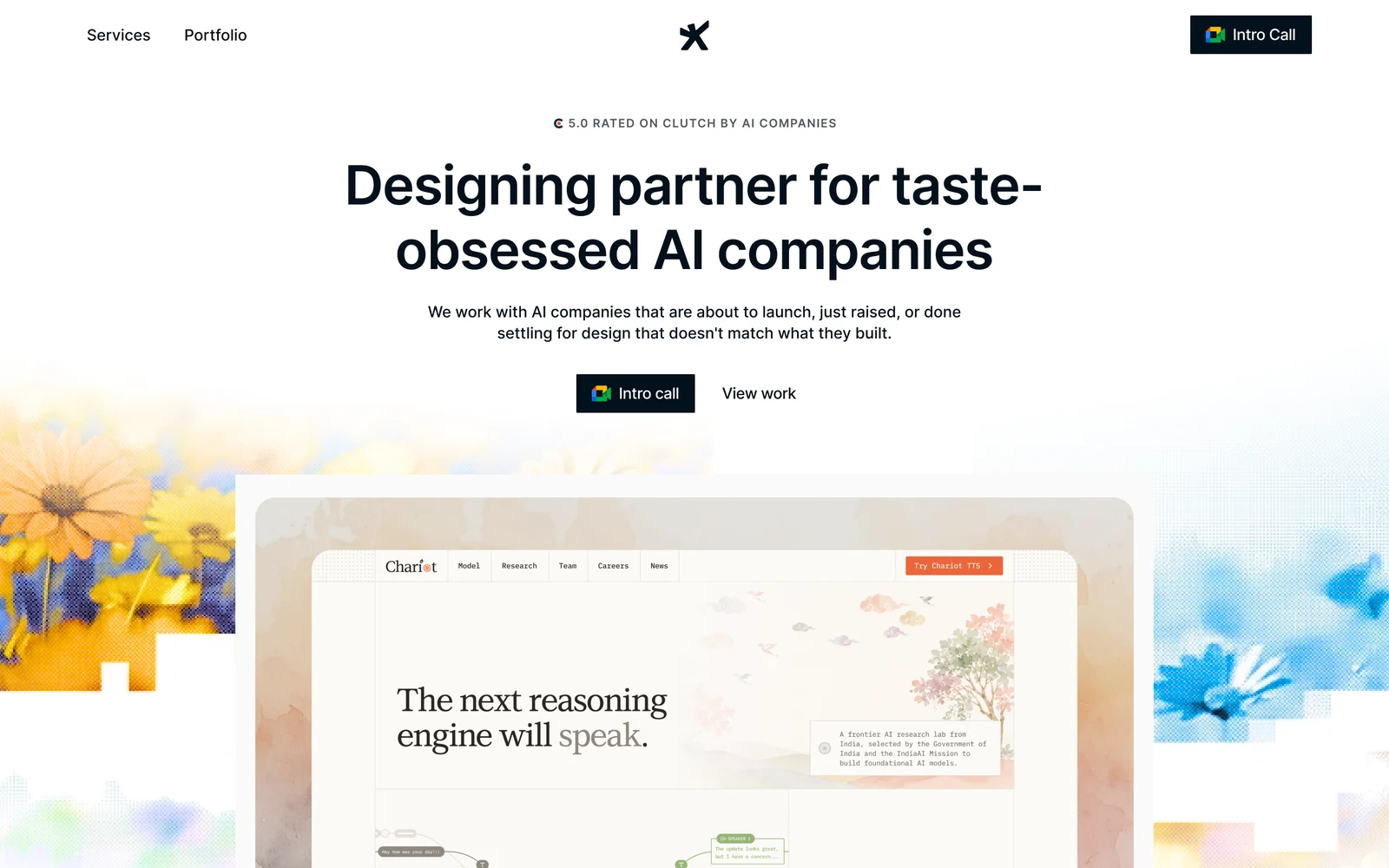
1. Studio Maydit: A Top-Rated Design Agency for AI Founders
RSA and Black Hat never move their dates, so a security launch page is a deadline before it is a design. That is the kind of brief Studio Maydit takes on. It is a web and product design studio. Its clients are AI founders. They build companies in the US, UK, and Europe.
A conference launch usually fits fixed scope. It runs three to four weeks, which sits neatly between booking a booth and landing at the show. The last step is a diagnosis of what is leaking in the product, such as trial users who connect one cloud account and never add a second. Teams that return to the show floor every quarter often choose a monthly retainer, with no long lock-in. It covers new pages, campaigns for the next event, and product design.
The page is built where it will be changed. In Framer, a marketer can swap a benchmark chart the night before doors open. In Webflow, a library of reports and advisories can sit behind one short form. In custom code, the page can run an interactive demo of the product at work. Since an engineer who books a demo meets the product next, the work often continues into product design.
Security buyers first ask whether a product was built for someone like them. That same question sat at the center of the Dualite project. Design work built around a repositioned ICP helped the product reach 100,000+ users in seven months. Wave, PixelFlow, and Mi-VAD are recent clients too, along with 15 other AI and SaaS teams.
| Check | Finding |
|---|---|
| Based in | Remote, serving US / UK / EU |
| Platform depth | Framer, Webflow, and custom code |
| AI-sector proof | Yes. AI-native clients, published outcome on Dualite |
| Pricing | Fixed scope or monthly retainer, quoted per project |
| Team shape | Founder-led, small senior team |
| Best fit | AI security teams launching a demo or report page before a major conference |
Send us the claim your sales team repeats most, and we will tell you the first question a doubtful engineer asks about it. Book a 30-minute call.

2. Ramotion
Ramotion has worked from San Francisco since 2009, with eleven to fifty people across several platforms and a published starting price. Its clients are Mozilla, Okta, Netflix, Adobe, and Xero. Okta sells identity security to the same IT and security teams you want to reach, so Ramotion has built for a company whose buyers think like yours. Mozilla adds a brand known for caring about privacy.
The weakness is AI depth. Its AI-sector proof is only partial, so your team will have to explain what the model does and where it fails. It is also a premium studio for one campaign page.
| Check | Finding |
|---|---|
| Based in | San Francisco, USA |
| Founded | 2009 |
| Team size | 11-50 |
| Primary platform | Mixed |
| AI-sector proof | Partial |
| Named clients | Mozilla, Okta, Netflix, Adobe, Xero |
| Pricing | Published minimum |
| Best fit | AI security startups selling to IT and identity teams |
3. basement.studio
basement.studio works from Mar del Plata and Los Angeles. It was founded in 2018, has eleven to fifty people writing custom code, and publishes a starting price. Its direct AI proof is strong: Vercel, Cursor, ElevenLabs, Harvey AI, and Scale AI. Security practitioners are engineers first. A studio used to winning over developers can build a demo that shows the product finding a real problem, not a page that only describes it.
The weakness is edit speed. A benchmark change the night before the show may need a developer, and its client list includes no security company.
| Check | Finding |
|---|---|
| Based in | Mar del Plata, Argentina and Los Angeles, USA |
| Founded | 2018 |
| Team size | 11-50 |
| Primary platform | Custom code |
| AI-sector proof | Yes |
| Named clients | Vercel, Cursor, ElevenLabs, Harvey AI, Scale AI |
| Pricing | Published minimum |
| Best fit | Developer-first security tools that want a live demo on the page |
4. Clay
Clay is a San Francisco studio founded in 2016, with fifty-one to two hundred people, direct AI proof, and a published starting price. Stripe and Coinbase are on its client list. Both hold customer money and pass tough reviews, so Clay knows how to make a company look safe to the executive who signs. That matters when a CISO has to defend your purchase to a board.
The weakness is scale and tone. Clay is shaped for large brand programs, so one campaign page is small work for it, and heavy polish can make a practitioner more suspicious.
| Check | Finding |
|---|---|
| Based in | San Francisco, USA |
| Founded | 2016 |
| Team size | 51-200 |
| Primary platform | Mixed |
| AI-sector proof | Yes |
| Named clients | Slack, Stripe, Google, Coinbase, Amazon |
| Pricing | Published minimum |
| Best fit | Later-stage security companies whose page must also win the executive buyer |
5. Trueform
Trueform is a Framer studio in Wil, Switzerland, founded in 2022, with direct AI proof and a published starting price. Its clients include Miro, Morning Brew, Bilt Rewards, and Gather. Framer suits a show page that changes until the last minute, because your marketer can publish a new talk time or chart without a ticket.
The weakness is sector and hours. None of its named clients sell security, team size is not published, and a US launch team shares few working hours with Switzerland during show week.
| Check | Finding |
|---|---|
| Based in | Wil, Switzerland |
| Founded | 2022 |
| Team size | Not published |
| Primary platform | Framer |
| AI-sector proof | Yes |
| Named clients | Miro, Morning Brew, Bilt Rewards, Gather |
| Pricing | Published minimum |
| Best fit | Security teams whose marketer edits the page right up to the event |
6. Lazarev
Lazarev has worked from San Francisco since 2015, with fifty-one to two hundred people, direct AI-sector proof, and a published starting price. Payoneer, one of its clients, moves money between countries and answers to bank compliance teams. A studio of that size can carry several audience pages at once, which helps when one show has to reach practitioners, managers, and partners.
The weakness is weight. A large premium studio can bring more process than a short campaign needs, and it names no security clients.
| Check | Finding |
|---|---|
| Based in | San Francisco, USA |
| Founded | 2015 |
| Team size | 51-200 |
| Primary platform | Mixed |
| AI-sector proof | Yes |
| Named clients | Payoneer, Peel, Elva, Mozayix |
| Pricing | Published minimum |
| Best fit | Funded security startups launching pages for several audiences at one show |
7. Push Refresh
Push Refresh is a Dallas Framer studio of one to ten people with a published starting price. Its clients include SmithRx, Synonym, and Northern National. SmithRx works in health benefits, where buyers ask about data handling early. With a team this small, the person who designs your page is likely the person you message the night before a launch.
The weakness is depth and slack. Its AI proof is partial, no security client or founding date is published, and two launches in one week would stretch it.
| Check | Finding |
|---|---|
| Based in | Dallas, USA |
| Founded | Not published |
| Team size | 1-10 |
| Primary platform | Framer |
| AI-sector proof | Partial |
| Named clients | SmithRx, Synonym, Northern National |
| Pricing | Published minimum |
| Best fit | Seed-stage security teams that need one Framer page quickly |
8. Engine Digital
Engine Digital works from Vancouver and New York and has built in custom code since 2002. Its clients are Adidas, Autodesk, Goldman Sachs, and HP. Goldman Sachs is a bank known for strict vendor checks, and a New York office sits near financial buyers. Its AI proof is partial.
The weakness is campaign fit. Custom code slows quick edits in show week, and team size and pricing are not published, so there is nothing to compare before a call.
| Check | Finding |
|---|---|
| Based in | Vancouver and New York |
| Founded | 2002 |
| Team size | Not published |
| Primary platform | Custom code |
| AI-sector proof | Partial |
| Named clients | Adidas, Autodesk, Goldman Sachs, HP |
| Pricing | Not published |
| Best fit | Security startups selling to large banks that want an enterprise build |
9. SuperSkills
SuperSkills is a Walnut Creek studio of one to ten people working across platforms, with direct AI-sector proof. A small team can turn one page around quickly and keep the founder close to every line of copy.
The weakness is evidence. It names only The Cut as a client and publishes no price or founding date. That leaves little to verify, which is an awkward match for a page whose whole job is proving claims.
| Check | Finding |
|---|---|
| Based in | Walnut Creek, USA |
| Founded | Not published |
| Team size | 1-10 |
| Primary platform | Mixed |
| AI-sector proof | Yes |
| Named clients | The Cut |
| Pricing | Not published |
| Best fit | Early teams happy to judge a studio on a portfolio call |
10. Foundey
Foundey is a San Francisco studio founded in 2021 with direct AI proof and clients such as DemandIQ, Traycer, and Sero AI. It works with very young AI products, which helps a security startup still deciding whether to lead with detection or response.
The weakness is delivery. Foundey designs in Figma only, so an engineer must build the page, and every show-week change waits on that person. Team size and pricing are not published.
| Check | Finding |
|---|---|
| Based in | San Francisco, USA |
| Founded | 2021 |
| Team size | Not published |
| Primary platform | Figma-only |
| AI-sector proof | Yes |
| Named clients | DemandIQ, Traycer, Sero AI |
| Pricing | Not published |
| Best fit | Security startups with a front-end engineer free to build from Figma |
How to choose between them
Look at where your last campaign page lost people, then pick the studio built to fix that spot.
Engineers left before scrolling. basement.studio, with a working demo in place of claims.
IT and identity teams are your main buyers. Ramotion.
The executive who signs needs to feel safe. Clay, or Lazarev for several audience pages.
The page will change every day until the show. Trueform or Push Refresh, both on Framer.
One test before you sign. Send each studio your headline and your best benchmark, and ask what a doubtful detection engineer would say first. A strong studio asks how the number was measured. A weak one suggests a darker color scheme.