
Summarize with AI


The best landing page design agencies for AI devtools in 2026 are Studio Maydit, basement.studio, Clay, Trueform, Kvalifik, Feels Like, SuperSkills, Foundey, BX Studio, and Lazarev. Studio Maydit and basement.studio lead for this brief, because both build the page rather than hand over a design, and basement.studio has shipped work for Vercel, Cursor, and ElevenLabs, which are the pages every other AI devtool gets compared against. Kvalifik and SuperSkills are the wrong fit here, since one is a European Webflow studio whose published work is operational software and the other names a single client, and neither has developer-facing marketing on show.
Your landing page has a strange job, because it is usually not where the decision happens.
Somebody posts a link. A few thousand developers arrive inside two hours, most of them from a phone, most of them mildly sceptical, none of them looking for a narrative. They give the page about eleven seconds. Then they either open your documentation, open your repository, or close the tab. The page is a doorway, and it is being judged on how quickly it can get out of the way.
That is a genuinely different problem from a normal software landing page, and the usual playbook works against you. A long scroll with a story arc assumes patience nobody has spent. Testimonials from titles rather than engineers read as marketing. An abstract hero render, however beautiful, tells a developer nothing about whether this thing will work in their stack.
There is a second complication. The page frequently has two readers at once. The developer who found it on their own, and the person who will eventually approve the spend, who is more senior and asks different questions. Trying to satisfy both with the same block of copy produces a page that satisfies neither, and it is the most common failure in this category.
The third thing is trust, and developers audit it. Any benchmark you print will be checked. Any comparison table naming a competitor will be posted somewhere and argued about. Any claim that cannot be reproduced becomes the thread rather than your product. A page that overstates by ten percent can cost more attention than it buys, and the correction never travels as far as the original.
The ten studios below are ranked on how well they build a page for readers who arrived through a link and are already halfway to leaving.

How we picked these agencies
Five checks, each verifiable from published work before a single call:
- Platform depth. Does the studio ship a working page, or produce a design that your engineers then have to build?
- Proof on developer-facing pages. Is there published marketing work aimed at engineers, not just at companies that employ engineers?
- Pricing. Is a starting figure available in public, or does it take a discovery call to reach one?
- Team shape. Is there a senior person who will read your documentation, or a team who will work from your brief?
- Their own site. Time how long it takes to understand what they do. That number is roughly what your visitors will get.
The fifth one is doing real work in this article. A studio that needs four scrolls to explain itself will build you a page that needs four scrolls, and your audience will not be there for the second one.
Everything in the tables is taken from public material published by each studio. Where a studio has not said something, that is recorded rather than filled in.
What goes wrong on AI devtool landing pages
Three failures come up repeatedly here, and each one is a mismatch between who wrote the page and who reads it.
The page addresses the buyer while the visitor is the developer. Copy talks about reducing engineering overhead and accelerating delivery, which is language written for somebody with a budget. The person actually on the page wants to know what it does, what it costs them in effort, and whether it fits what they already run. Those two readers can share a page, but not the same first screen. Answer the developer above the fold, in their terms, and put the business framing further down where the approver will find it. Reversing that order loses the reader who would have championed you internally.
There is no code anywhere on the page. For this audience a snippet is not decoration, it is evidence. An install line, a short example of real usage, and the shape of the output tell a developer more in five seconds than three paragraphs of description. When the page has none, the visitor leaves to find the repository, and everything you built after the hero goes unread. Put the smallest honest example high on the page, make it copyable, and make sure it actually runs, because someone will paste it within the first minute.
Claims are printed without the workings. A speed multiple, an accuracy figure, or a comparison table with a competitor in it. Developers treat these as invitations to check. If the methodology is not linked, the number gets read as marketing and the whole page loses credit, including the parts that were true. Publish the conditions, the version you tested against, and the case where your tool is the wrong choice. Naming a weakness is the cheapest trust you can buy with this audience, and almost nobody does it.
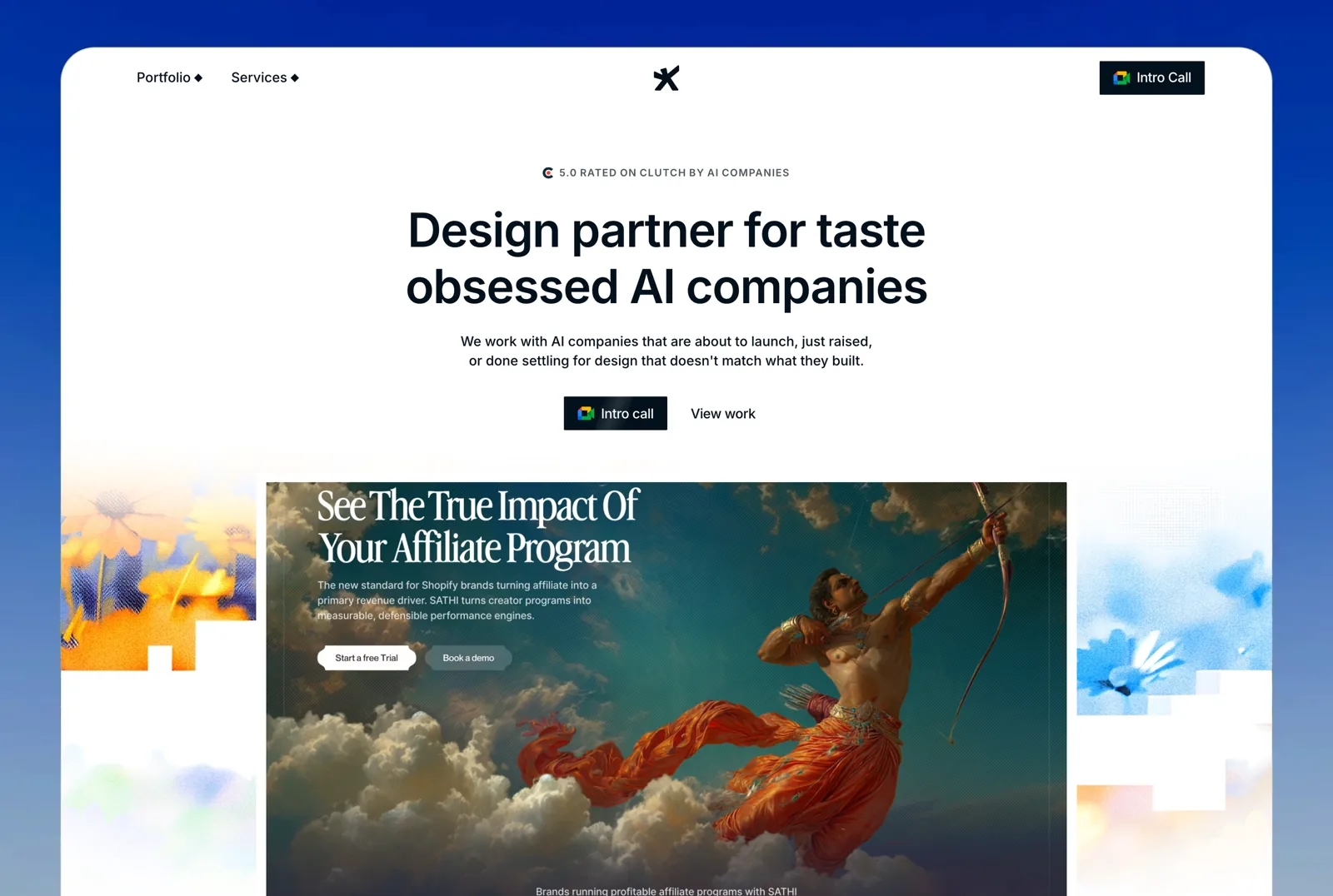
1. Studio Maydit: A Top-Rated Design Agency for AI Founders
For a page that has to survive a link post, the useful thing is a team that builds as well as designs. Studio Maydit works in Framer, Webflow, and custom code, so the page ships rather than waiting in a queue behind product work. It is a web and product design studio. The clients are AI founders, spread across the US, UK, and Europe. The engagement continues into product design after the site is live, which keeps the promise on the page connected to the first real session in the tool.
Ask about Dualite. A repositioned ICP, design work built to match it, and seven months later the product counted 100,000+ users. Wave, PixelFlow, Mi-VAD, and 15 other AI and SaaS teams are on the recent list.
The commercial side is simple. Fixed scope runs three to four weeks and suits a page tied to a release date. Teams shipping constantly use a monthly retainer instead, covering new pages, campaigns, and product design, with no long lock-in, which fits a devtool where every feature wants a page of its own. A fixed-scope engagement finishes with a diagnosis of what is leaking in the product, and for a devtool that is nearly always somewhere between the install and the first successful run.
| Check | Finding |
|---|---|
| Based in | Remote, serving US / UK / EU |
| Platform depth | Framer, Webflow, and custom code |
| AI-sector proof | Yes. AI-native clients, published outcome on Dualite |
| Pricing | Fixed scope or monthly retainer, quoted per project |
| Team shape | Founder-led, small senior team |
| Best fit | Devtools whose traffic arrives in spikes from shared links |
Worth a call if launch day sends thousands of people to a page nobody scrolls. Book a 30-minute call.

2. basement.studio
basement.studio works from Mar del Plata and Los Angeles, founded in 2018, at 11 to 50 people, building in custom code, with a published minimum and Vercel, Cursor, ElevenLabs, Harvey AI, and Scale AI named. That is the most directly relevant client list available for this brief. Vercel and Cursor are developer tools whose pages set the standard this audience unconsciously measures you against.
Custom code means the page is built for them rather than by you afterwards, and their expressive style can overshoot for a tool whose audience rewards restraint over spectacle.
| Check | Finding |
|---|---|
| Based in | Mar del Plata, Argentina and Los Angeles, USA |
| Founded | 2018 |
| Team size | 11-50 |
| Primary platform | Custom code |
| AI-sector proof | Yes. Published AI client work |
| Named clients | Vercel, Cursor, ElevenLabs, Harvey AI, Scale AI |
| Pricing | Published minimum |
| Best fit | Devtools who want the page to look like the category leaders |
3. Clay
Clay is a San Francisco studio of 51 to 200, founded in 2016, working across platforms, with a published minimum and Slack, Stripe, Google, Coinbase, and Amazon named. Stripe is the reference every developer-facing company quietly copies, and a studio with that experience understands that clarity is the aesthetic rather than an absence of one.
A firm of that size expects a client with design leadership in place, and its process assumes a longer engagement than a single launch page.
| Check | Finding |
|---|---|
| Based in | San Francisco, USA |
| Founded | 2016 |
| Team size | 51-200 |
| Primary platform | Mixed |
| AI-sector proof | Yes. Published AI client work |
| Named clients | Slack, Stripe, Google, Coinbase, Amazon |
| Pricing | Published minimum |
| Best fit | Funded teams building a full developer marketing site |
4. Trueform
Trueform is a Swiss studio founded in 2022 working in Framer, with a published minimum and Miro, Morning Brew, Bilt Rewards, and Gather named. Framer is a strong choice for this job because a devtool launches features constantly, and a page that marketing can update the same afternoon beats a better page that needs a pull request.
They publish no team size, and their portfolio is product and consumer brands rather than developer tools, so the tone for a technical reader would be new ground.
| Check | Finding |
|---|---|
| Based in | Wil, Switzerland |
| Founded | 2022 |
| Team size | Not published |
| Primary platform | Framer |
| AI-sector proof | Yes. Published AI client work |
| Named clients | Miro, Morning Brew, Bilt Rewards, Gather |
| Pricing | Published minimum |
| Best fit | Teams shipping a new feature page most weeks |
5. Kvalifik
Kvalifik is a Copenhagen team of 11 to 50, founded in 2015, working in Webflow, with Veo, Maersk, and Relesys named and published AI client work. Their strength is software that carries real operational weight, which means they are unlikely to design something that looks impressive and says nothing.
Their published work is operational and enterprise rather than developer-facing, they publish no pricing, and European hours are a poor match for a launch that peaks in American afternoons.
| Check | Finding |
|---|---|
| Based in | Copenhagen, Denmark |
| Founded | 2015 |
| Team size | 11-50 |
| Primary platform | Webflow |
| AI-sector proof | Yes. Published AI client work |
| Named clients | Veo, Maersk, Relesys |
| Pricing | Not published |
| Best fit | European teams whose buyer is an operator, not a developer |
6. Feels Like
Feels Like is a Los Angeles studio founded in 2023 building in custom code, with Google, Nike, LVMH, and Suno AI named. Suno AI is a generative product that had to explain something genuinely new on a page, which is the harder half of an AI devtool launch, and the custom code capability means an interactive demo is achievable rather than aspirational.
They publish no pricing and no team size, the studio is young, and their reference work is consumer brand craft, which is a different register from a page aimed at engineers.
| Check | Finding |
|---|---|
| Based in | Los Angeles, USA |
| Founded | 2023 |
| Team size | Not published |
| Primary platform | Custom code |
| AI-sector proof | Yes. Published AI client work |
| Named clients | Google, Nike, LVMH, Suno AI |
| Pricing | Not published |
| Best fit | Launches that need a live demo rather than a screenshot |
7. SuperSkills
SuperSkills is a Walnut Creek team of one to ten working across platforms, with published AI client work and The Cut named. At that size the senior person is the person doing the work, and a launch page benefits from one experienced mind holding the whole argument rather than a team assembling sections.
Only one client is named, no founding year and no pricing are published, and a one to ten person studio has little capacity if your launch date moves.
| Check | Finding |
|---|---|
| Based in | Walnut Creek, USA |
| Founded | Not published |
| Team size | 1-10 |
| Primary platform | Mixed |
| AI-sector proof | Yes. Published AI client work |
| Named clients | The Cut |
| Pricing | Not published |
| Best fit | Small teams wanting one senior person on one page |
8. Foundey
Foundey is a San Francisco studio founded in 2021 working Figma-first, with DemandIQ, Traycer, and Sero AI named. Traycer is a developer tool, so there is direct evidence of designing for this reader, and a product design practice tends to produce pages that describe how something actually works rather than how it feels.
Figma-only means the build is somebody else's problem, which on a launch page usually means your own engineers, and they publish neither pricing nor team size.
| Check | Finding |
|---|---|
| Based in | San Francisco, USA |
| Founded | 2021 |
| Team size | Not published |
| Primary platform | Figma-only |
| AI-sector proof | Yes. Published AI client work |
| Named clients | DemandIQ, Traycer, Sero AI |
| Pricing | Not published |
| Best fit | Teams with in-house engineers ready to build the page |
9. BX Studio
BX Studio is a New York team of 11 to 50 working in Webflow, with a published minimum and Reddit, Headspace, ASAPP, and Verifone named. Reddit is an audience that punishes marketing language faster than almost any other, and a studio that has worked there has met the tone problem this article is about.
They publish no founding year, and Webflow as the primary platform makes an interactive or code-heavy hero harder than a custom build would.
| Check | Finding |
|---|---|
| Based in | New York, USA |
| Founded | Not published |
| Team size | 11-50 |
| Primary platform | Webflow |
| AI-sector proof | Yes. Published AI client work |
| Named clients | Reddit, Headspace, ASAPP, Verifone |
| Pricing | Published minimum |
| Best fit | Teams wanting a plain, fast page with a public price |
10. Lazarev
Lazarev is a San Francisco firm of 51 to 200, founded in 2015, working across platforms, with a published minimum and Payoneer, Peel, Elva, and Mozayix named. They handle marketing and product design together, which is useful when the page has to describe an experience the product must then deliver without a gap.
Their AI work is published but their portfolio centres on financial and consumer software rather than developer tools, and a firm that size assigns a team rather than a named designer.
| Check | Finding |
|---|---|
| Based in | San Francisco, USA |
| Founded | 2015 |
| Team size | 51-200 |
| Primary platform | Mixed |
| AI-sector proof | Yes. Published AI client work |
| Named clients | Payoneer, Peel, Elva, Mozayix |
| Pricing | Published minimum |
| Best fit | Teams buying the page and the product flow together |
How to choose between them
Sort by what the page is failing to do.
Developers arrive and leave without opening the docs. Studio Maydit or basement.studio.
The idea needs to be shown, not described. Feels Like or Clay.
You ship a new feature page every week. Trueform or BX Studio.
Nobody senior is available to hold the argument together. SuperSkills or Foundey.
One test before you sign. Show a candidate your page for eleven seconds, then take it away and ask what the tool does and what it costs to try. A studio that understands this audience will tell you exactly what they retained and what they guessed. A studio that asks to look again has just demonstrated the problem you are trying to fix.