Reading time:
13 min read
Last updated:
10 Best Landing Page Design Agencies for AI Healthtech Startups - September 2026
Need a landing page design agency for an AI healthtech startup? See which studios can handle clinical evidence, compliance copy, and review rounds.

Not one of the nine competitor studios here publishes healthcare work, so this ranking for AI healthtech landing pages rests on review capacity, AI experience, and openness. Best fit first, the ten are Studio Maydit, Lazarev, Pixelmatters, Clay, Foundey, Engine Digital, basement.studio, SuperSkills, Feels Like, and Fantasy. Call Lazarev and Pixelmatters first. Each runs fifty-one to two hundred people and shows a starting price. Lazarev adds direct AI proof from San Francisco, where it has worked since 2015. Pixelmatters has built web and product work from Porto since 2013 for clients like Rubrik and UJET. Feels Like and Fantasy suit this buyer least. One is known for Nike and LVMH, the other names no clients at all, and neither publishes a price.
Here is how an AI healthtech page really gets read. A nurse manager at a 400-bed hospital finds an ambient documentation tool on LinkedIn. The headline says "Cut charting time by 70 percent." She likes it and forwards the link to the chief medical information officer.
He reads the same page with different eyes. His first question is where the 70 percent came from. Which study, how many clinicians, which specialties, over how many weeks? The page does not say, so the number starts to look like marketing, and every other line loses trust with it.
Next the link reaches privacy and IT security. They want plain answers on patient data: whether the company signs a business associate agreement, where recordings are stored, and whether they train the model. A small "HIPAA compliant" badge in the footer answers none of that, so the review stalls and a call gets booked just to begin.
That is three readers, and the clinician is the easy one. Every claim on the page needs its source close by, and every compliance line has to be true today.

How we ranked the nine studios
A healthtech founder can test each studio against these five points using only its public website.
How fast can the page change after a reviewer objects? A clinical advisor or privacy lead will ask for wording changes late in the project, and again after launch. We preferred Framer, Webflow, or a well-structured build where a line can be corrected in minutes, not queued for a sprint.
Has the studio worked in health or another heavily reviewed field? This is the check that matters most here, and the honest result is that none of the nine publishes a healthcare client. So we looked at the next signals down: direct AI work, and clients whose own buyers run long security or procurement reviews. Treat every studio here as someone who will learn your clinical context from you.
Is a starting price public? Healthtech rounds often have to stretch to a pilot result. A visible minimum tells you early whether a studio fits that budget.
Can the team absorb extra review rounds? Clinical, legal, and security sign-off can add two or three passes to a normal project. We recorded team size because a very small studio may stall while it waits on you.
Does the studio's own site make careful claims? Read how it describes its results. A studio that backs its own numbers with names is more likely to do the same for yours.
Expect the page a studio builds for you to land at or below the standard of its own homepage.
For this list, the only source was what each studio says about itself in public. Missing details stay missing, marked Not published, rather than being estimated.
What goes wrong with AI healthtech pages
The page sells to the clinician who cannot sign. Physicians and nurses love the demo video, so the whole page speaks to them. The person who approves the purchase is often a CMIO, a CFO, or a director of revenue cycle. They want the implementation timeline, the EHR integrations such as Epic, and the cost of doing nothing. Give each buyer role its own section, or its own page, with the proof that role needs.
The evidence is locked behind a form. The validation study exists, but it sits behind a "Download the white paper" button that asks for a work email and phone number. A clinical reviewer will not fill out a sales form to check a claim. Put a short study summary on the page: setting, sample size, outcome measured, and limits. Link the full paper without a gate.
The visuals promise more than the product does. A glowing brain, a doctor tapping a hologram, and verbs like "diagnoses" or "detects" suggest a clinical decision tool. If the product only drafts notes, a reviewer flags the page as overclaiming, and trust drops everywhere else. Show the real screen, and have a regulatory advisor read every verb before launch.
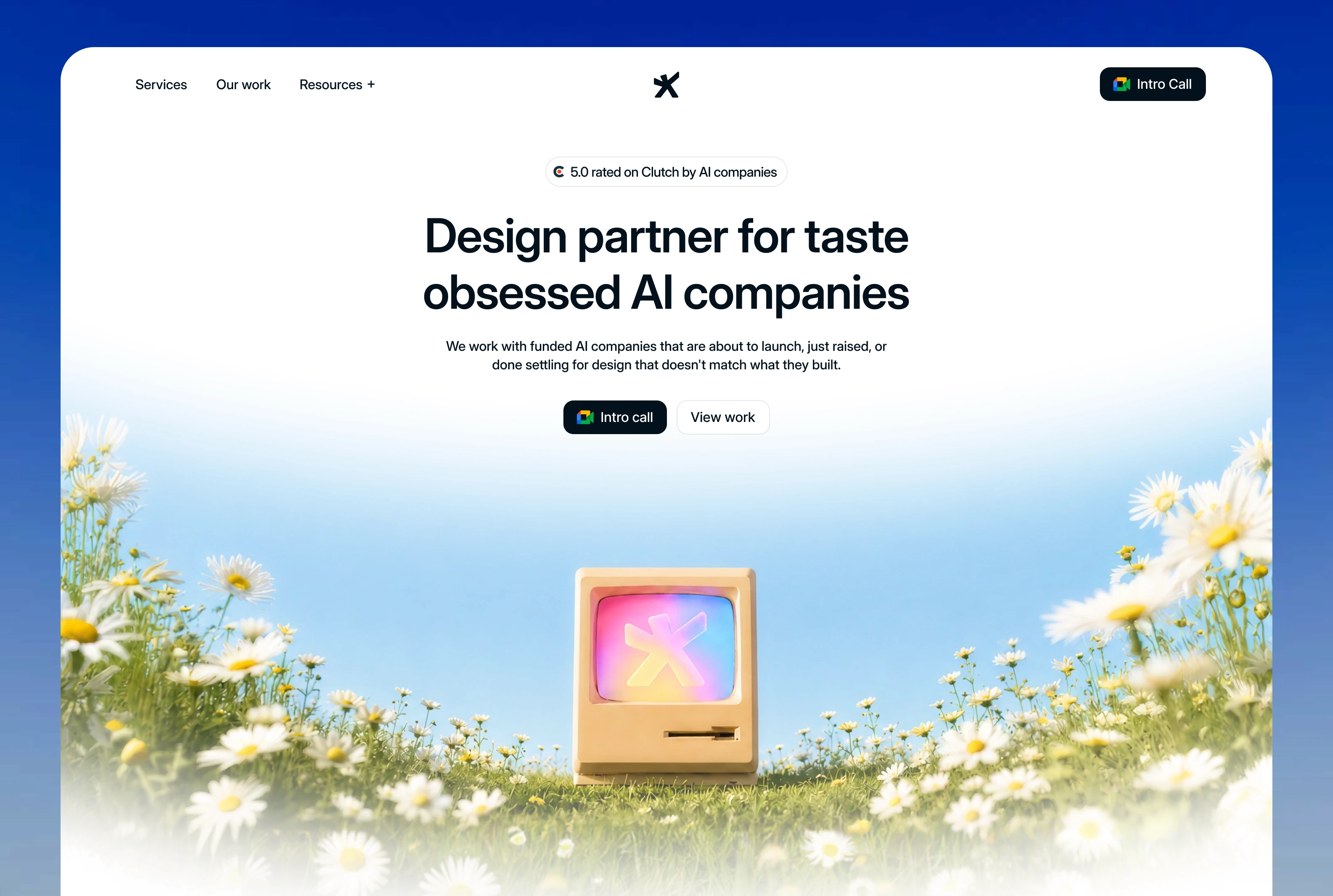
1. Studio Maydit: A Top-Rated Design Agency for AI Founders
A hospital reviewer checks every sentence, so Studio Maydit starts an AI healthtech page by splitting the claims into two lists: the ones with a source, and the ones that come out. That is the working habit of a web and product design studio. Its clients are AI founders, building companies in the US, UK, and Europe.
The platform follows the review burden. Framer suits an early team that updates its evidence section after each pilot site reports back. Webflow suits a company growing a library of pages for each buyer role, from CMIO to CFO. Custom code suits a page that pulls a live, de-identified product demo from the app itself. The work can then move into product design, since a hospital pilot is judged inside the product by clinicians with ten minutes between patients.
Narrowing the buyer is what a health sale demands, and Dualite is the published example of that move. Design work supporting a repositioned ICP helped the product reach 100,000+ users in seven months. Other recent clients are Wave, PixelFlow, Mi-VAD, and 15 other AI and SaaS teams.
Health sales cycles are long, and each new hospital asks for something new, so a monthly retainer tends to fit best. It covers new pages, campaigns, and product design as reviewers and pilot sites raise them, with no long lock-in. A team building toward a single date, such as a conference booth, can choose fixed scope instead. That runs three to four weeks and ends with a diagnosis of what is leaking in the product before clinicians start using it.
Check | Finding |
|---|---|
Based in | Remote, serving US / UK / EU |
Platform depth | Framer, Webflow, and custom code |
AI-sector proof | Yes. AI-native clients, published outcome on Dualite |
Pricing | Fixed scope or monthly retainer, quoted per project |
Team shape | Founder-led, small senior team |
Best fit | AI healthtech teams whose page stalls in clinical or privacy review |
Bring the one claim on your page that a reviewer questioned last, and we will start there. Book a 30-minute call.

2. Lazarev
Lazarev is a San Francisco studio founded in 2015, with fifty-one to two hundred people and direct AI-sector proof. It works across platforms, publishes a starting price, and lists Payoneer, Peel, Elva, and Mozayix as clients. For a healthtech page, the team size is the point. A studio this large can carry the extra clinical, legal, and security review rounds without the project going quiet.
The weakness is that no healthcare client is published, so your team supplies the clinical context. It also sits at the premium end of this list.
Check | Finding |
|---|---|
Based in | San Francisco, USA |
Founded | 2015 |
Team size | 51-200 |
Primary platform | Mixed |
AI-sector proof | Yes |
Named clients | Payoneer, Peel, Elva, Mozayix |
Pricing | Published minimum |
Best fit | Funded AI healthtech teams facing many review rounds |
3. Pixelmatters
Pixelmatters is a Porto studio founded in 2013 with fifty-one to two hundred people, working across web and product design. It publishes a starting price. Clients include Rubrik, Quantic, and UJET. Rubrik sells data security, so the studio has worked for a company whose own buyers run long, detailed reviews, which is close to what a hospital vendor process feels like.
The weakness is AI depth, which is only partial, and a Porto base means US hospital teams get less shared working time.
Check | Finding |
|---|---|
Based in | Porto, Portugal |
Founded | 2013 |
Team size | 51-200 |
Primary platform | Mixed |
AI-sector proof | Partial |
Named clients | Rubrik, Quantic, UJET |
Pricing | Published minimum |
Best fit | Healthtech teams that want a structured, documented process |
4. Clay
Clay is a San Francisco studio founded in 2016 with fifty-one to two hundred people and direct AI-sector proof. Its clients include Slack, Stripe, Google, Coinbase, and Amazon, and it publishes a starting price. Hospital IT teams already trust tools from several of those names, and a page with that level of finish can make a young company look ready for enterprise.
The weakness is fit for a first page. Clay is sized for big brand programs, and it publishes no healthcare work.
Check | Finding |
|---|---|
Based in | San Francisco, USA |
Founded | 2016 |
Team size | 51-200 |
Primary platform | Mixed |
AI-sector proof | Yes |
Named clients | Slack, Stripe, Google, Coinbase, Amazon |
Pricing | Published minimum |
Best fit | Later-stage healthtech companies moving into enterprise health systems |
5. Foundey
Foundey is a San Francisco studio founded in 2021 that works with early AI companies, including DemandIQ, Traycer, and Sero AI. Its AI-sector proof is direct. A pre-seed healthtech team still shaping its first pilot may find that stage match useful, since the studio is used to products whose story changes month to month.
The weakness is delivery. Foundey designs in Figma only, so an engineer has to build and update the page, and pricing and team size are not published.
Check | Finding |
|---|---|
Based in | San Francisco, USA |
Founded | 2021 |
Team size | Not published |
Primary platform | Figma-only |
AI-sector proof | Yes |
Named clients | DemandIQ, Traycer, Sero AI |
Pricing | Not published |
Best fit | Pre-seed healthtech teams with an engineer who can build |

6. Engine Digital
Engine Digital works from Vancouver and New York, was founded in 2002, and builds in custom code. Its clients include Adidas, Autodesk, Goldman Sachs, and HP. Two decades of complex builds for large companies mean the team is used to strict sign-off chains, which a health system's procurement process resembles.
The weakness is scale and openness. AI-sector proof is partial, team size and pricing are not published, and the studio is sized for corporations rather than a startup's first page.
Check | Finding |
|---|---|
Based in | Vancouver and New York |
Founded | 2002 |
Team size | Not published |
Primary platform | Custom code |
AI-sector proof | Partial |
Named clients | Adidas, Autodesk, Goldman Sachs, HP |
Pricing | Not published |
Best fit | Well-funded health companies needing a complex custom build |
7. basement.studio
basement.studio has offices in Mar del Plata and Los Angeles, was founded in 2018, and has eleven to fifty people writing custom code. Its AI clients are among the strongest anywhere on this list: Vercel, Cursor, ElevenLabs, Harvey AI, and Scale AI. It publishes a starting price. Harvey AI sells to lawyers, another cautious professional buyer.
The weakness is tone and editing. Much of its work speaks to developers, a clinical buyer may want something calmer, and custom code slows quick wording fixes after a review.
Check | Finding |
|---|---|
Based in | Mar del Plata, Argentina and Los Angeles, USA |
Founded | 2018 |
Team size | 11-50 |
Primary platform | Custom code |
AI-sector proof | Yes |
Named clients | Vercel, Cursor, ElevenLabs, Harvey AI, Scale AI |
Pricing | Published minimum |
Best fit | Technical healthtech products sold to data or engineering teams |
8. SuperSkills
SuperSkills is a Walnut Creek, California studio of one to ten people using a mix of platforms, with direct AI-sector proof and The Cut as its named client. A founder preparing a single pilot page would work directly with the designer, which keeps clinical feedback from getting lost between people. For a first page tied to one hospital pilot, that closeness can matter more than size.
The weakness is capacity and evidence. One named client, no published pricing, and a very small team make it hard to trust with several review rounds at once.
Check | Finding |
|---|---|
Based in | Walnut Creek, USA |
Founded | Not published |
Team size | 1-10 |
Primary platform | Mixed |
AI-sector proof | Yes |
Named clients | The Cut |
Pricing | Not published |
Best fit | Very early teams needing one simple pilot page |
9. Feels Like
Feels Like is a Los Angeles studio founded in 2023 that builds in custom code. Clients include Google, Nike, LVMH, and Suno AI, and its AI-sector proof is direct. Its consumer brand strength could suit an AI wellness app sold straight to patients rather than to hospitals.
The weakness is tone for this buyer. Fashion and sport energy reads as risky to a clinical reviewer, and it is the youngest studio here, with no published size or pricing.
Check | Finding |
|---|---|
Based in | Los Angeles, USA |
Founded | 2023 |
Team size | Not published |
Primary platform | Custom code |
AI-sector proof | Yes |
Named clients | Google, Nike, LVMH, Suno AI |
Pricing | Not published |
Best fit | Direct-to-patient AI apps with a consumer brand |
10. Fantasy
Fantasy works from San Francisco and New York and was founded in 1999, one of the longest histories in this pool. It works across platforms and has direct AI-sector proof. That long experience with digital products gives it range, and a studio that has lasted this many market cycles is unlikely to disappear halfway through a hospital pilot.
The weakness puts it last for healthtech. It publishes no clients and no pricing, so a buyer who expects evidence for every claim has nothing to check before the first call.
Check | Finding |
|---|---|
Based in | San Francisco and New York, USA |
Founded | 1999 |
Team size | Not published |
Primary platform | Mixed |
AI-sector proof | Yes |
Named clients | Not published |
Pricing | Not published |
Best fit | Teams willing to vet a studio entirely through calls |
How to choose between them
Look at where your deals actually stall, then pick for that. A beautiful page does not help if the sale dies in a privacy questionnaire.
Security or privacy review stops the sale. Lazarev or Pixelmatters, both large enough to handle many rounds.
Your evidence exists but nobody finds it. Pixelmatters or Clay, to structure proof pages clearly.
You sell directly to patients. Feels Like, with a clinical advisor checking every claim.
You are pre-seed with an engineer on staff. Foundey for the design, built in-house.
A quick test. Send each studio one claim from your current page and ask how they would present it. A good partner asks for your source first. A poor fit offers a bolder adjective.

Need more info?
Can't find your answer? Book a call and let's talk.
Continue Reading
10 Best Framer Design Agencies for AI Agent Startups - September 2026
Ten Framer studios that have shipped for AI agent companies, with the demo and trust patterns those products need. Checked on platform depth, pricing and team.

Siddarth Ponangi
10 Best Framer Design Agencies for Newly Funded Startups - September 2026
Your funding announcement is the biggest traffic day you will have all year. We checked 10 Framer agencies on five public criteria to see which can hit that date.
Siddarth Ponangi
10 Best Custom Code Website Development Agencies for AI Agent Startups - September 2026
AI web development agencies for agent startups. Which teams build custom coded sites a small team can still update weekly after launch.
Siddarth Ponangi