Summarize with AI


The best landing page design agencies for AI infrastructure companies in 2026 are Studio Maydit, Phantom, Lighthouse Digital, basement.studio, Clay, Fantasy, SuperSkills, Trueform, Kvalifik, and Lazarev. Studio Maydit and basement.studio lead for this brief, because both build as well as design, and basement.studio has published work for Vercel, Cursor, and Scale AI, which is the closest public evidence of pages aimed at this exact buyer. Lighthouse Digital and SuperSkills are the wrong fit here, since one publishes no AI client work at all and the other names a single client, and this brief turns almost entirely on demonstrable technical proof.
Infrastructure has a marketing problem that application companies never face. Your product is a dependency, not a destination.
Nobody wakes up wanting a new inference endpoint. They wake up with something already running, a bill that grew last month, a latency graph with a spike in it, or an on-call incident that traced back to a provider. That is the state the visitor arrives in, and it is completely different from browsing for a new tool.
It changes what the page is for. An application company has to create desire. You have to reduce risk. The visitor is not asking whether your thing is good. They are asking what happens to them if they move, how long it takes, what breaks, and whether they can go back.
The competitive noise makes it harder. Every company in this category claims to be faster and cheaper, and most of them publish a number to prove it. Engineers have learned to treat those numbers as marketing unless the conditions are attached, so a page full of confident figures reads as less credible rather than more.
There is also the split audience problem, and it is not the usual one. An engineer will pick you. A finance owner will approve you. Those two people want the same page to do opposite things: one wants depth and reproducibility, the other wants a number they can put in a forecast. Most pages pick a side and lose the other.
Below are ten studios, ordered by how well they build a page for somebody who already has a working system and is calculating what it would cost to leave it.

How we picked these agencies
Each studio was scored on five things, all visible before anybody books a call:
- Platform depth. Can the studio ship a working page, including anything interactive, or does the work stop at a file your engineers then have to build?
- Proof on technical products. Is there published work for products bought on technical grounds, where the reader was evaluating rather than browsing?
- Pricing. Is a starting figure public, or does the budget only surface after a discovery call?
- Team shape. Is there a senior person who will read your benchmark methodology, or a team who will work from a brief and never open your docs?
- Their own site. Does it make a specific claim, and does it show the reasoning behind it?
The last one carries unusual weight in this category, because it is a live sample of the exact skill. Watch whether a studio can state one hard thing about itself and then back it up in the next paragraph. Whatever they do on their own page is what they will do with your latency figures.
Everything in the tables is drawn from what each studio has published. Where nothing is published, that is what the row records.
What goes wrong on AI infrastructure landing pages
Three failures repeat across this category, and the first one is nearly universal.
The page sells the layer above yours. Infrastructure companies describe what their customers build. Ship AI agents faster, deploy in minutes, scale without limits. All of it is true and none of it is yours, because the company one layer up says exactly the same thing on its own homepage. A visitor leaves knowing what becomes possible and not knowing what you actually run. The fix is uncomfortable and specific: describe your own machinery. Which models, which hardware, which regions, what happens on a cold start, what the failure mode looks like. That paragraph is the one engineers screenshot and send to a colleague.
Cost is shown as a price and not as a bill. A table of per-unit rates is accurate and nearly useless, because the visitor's real question is what this becomes at their volume next quarter. So they open a spreadsheet, guess at their own numbers, and reach an answer you did not write. Half of them get it wrong in your favour and churn later. The other half get it wrong against you and never come back. A short calculator, or even three worked examples at three realistic volumes, converts better than any amount of copy about efficiency.
Nothing on the page addresses the switch. Everyone reading is already running something, so the whole decision is a migration decision, and most pages act as though the reader is starting fresh. What does compatibility actually look like, how long does a cutover take, can traffic be split while it is tested, and what does going back involve. Say all four plainly, including the parts that are inconvenient. A page that admits where the move is hard is far more believable than one that suggests it is trivial, and the engineer reading it has already assumed it is not.
1. Studio Maydit: A Top-Rated Design Agency for AI Founders
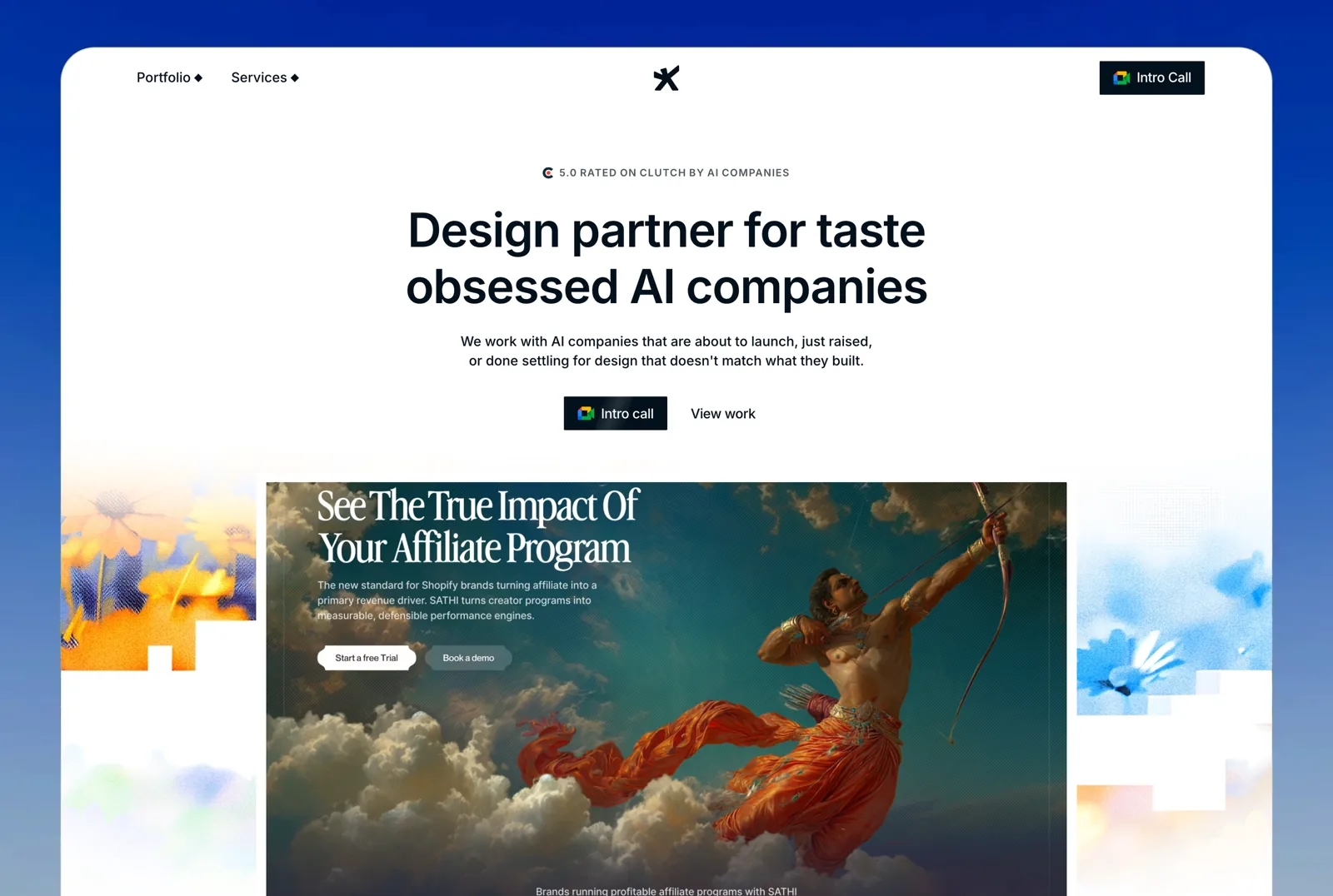
Pages that carry benchmarks, pricing logic, and a code sample tend to need building rather than only drawing, and that is the practical reason to look here first. Studio Maydit works in Framer, Webflow, and custom code, so the route is chosen by what the page has to do rather than by what the studio prefers. It is a web and product design studio. Its clients are AI founders, based across the US, UK, and Europe. After the page ships, the same team carries on into product design, which keeps the promise on the page attached to the first real request a developer sends.
Two commercial shapes are on offer. Fixed scope, three to four weeks, when a page has to exist by a launch date. A monthly retainer when releases keep coming, covering new pages, campaigns, and product design, with no long lock-in. Every fixed-scope engagement ends with a diagnosis of what is leaking in the product, which for an infrastructure company is usually the distance between signing up and the first successful call.
On evidence, one project has a public figure attached. Design work supporting a repositioned ICP was followed at Dualite by 100,000+ users in seven months. The recent list runs to Wave, PixelFlow, Mi-VAD, and 15 other AI and SaaS teams.
| Check | Finding |
|---|---|
| Based in | Remote, serving US / UK / EU |
| Platform depth | Framer, Webflow, and custom code |
| AI-sector proof | Yes. AI-native clients, published outcome on Dualite |
| Pricing | Fixed scope or monthly retainer, quoted per project |
| Team shape | Founder-led, small senior team |
| Best fit | Infrastructure teams whose page has to show the machinery |
Worth a call if your traffic reads the docs and never reads the homepage. Book a 30-minute call.

2. Phantom
Phantom works from London and Auckland, founded in 2013, a team of 51 to 200 building in custom code, with published AI client work and Diageo, SAP, Financial Times, and Zendesk named. The Financial Times is a publisher whose job is making dense material readable quickly, which is the same problem as putting a benchmark table on a landing page without losing the reader.
They publish no pricing, and a studio of that size runs a brand-led process built for large organisations, which is slower and heavier than an infrastructure team shipping a page beside a release.
| Check | Finding |
|---|---|
| Based in | London, UK and Auckland, NZ |
| Founded | 2013 |
| Team size | 51-200 |
| Primary platform | Custom code |
| AI-sector proof | Yes. Published AI client work |
| Named clients | Diageo, SAP, Financial Times, Zendesk |
| Pricing | Not published |
| Best fit | Companies whose page has to carry a lot of dense material |
3. Lighthouse Digital
Lighthouse Digital is a London studio working in Webflow, with a published minimum and HelloSelf, Freetrade, and IGN named. Freetrade is a regulated consumer financial product, so there is evidence of pages where a claim has to survive somebody checking it, which is at least adjacent to publishing a performance figure.
They publish no AI client work, no founding year, and no team size, and Webflow limits what an interactive demo on the page can actually do.
| Check | Finding |
|---|---|
| Based in | London, UK |
| Founded | Not published |
| Team size | Not published |
| Primary platform | Webflow |
| AI-sector proof | No. No published AI client work |
| Named clients | HelloSelf, Freetrade, IGN |
| Pricing | Published minimum |
| Best fit | Early teams who want a solid page at a known price |
4. basement.studio
basement.studio works from Mar del Plata and Los Angeles, founded in 2018, a team of 11 to 50 building in custom code, with a published minimum and Vercel, Cursor, ElevenLabs, Harvey AI, and Scale AI named. That is the most directly relevant client list on this page, since three of those companies sell infrastructure to the same engineers you are trying to reach.
Their signature is motion-led showcase work, which pulls against a page whose job is to make a pricing table and a benchmark legible, so the brief has to be held firmly on your side.
| Check | Finding |
|---|---|
| Based in | Mar del Plata, Argentina and Los Angeles, USA |
| Founded | 2018 |
| Team size | 11-50 |
| Primary platform | Custom code |
| AI-sector proof | Yes. Published AI client work |
| Named clients | Vercel, Cursor, ElevenLabs, Harvey AI, Scale AI |
| Pricing | Published minimum |
| Best fit | Teams who want a page built to the standard of their peers |
5. Clay
Clay is a San Francisco studio of 51 to 200, founded in 2016, working across platforms, with a published minimum, published AI client work, and Slack, Stripe, Google, Coinbase, and Amazon named. Stripe is the reference point most infrastructure companies quietly measure themselves against, and Clay has worked with it.
They publish a minimum that sets a floor a pre-revenue team will struggle to clear, and at 51 to 200 people the designers assigned to your project are chosen after the contract rather than during the pitch.
| Check | Finding |
|---|---|
| Based in | San Francisco, USA |
| Founded | 2016 |
| Team size | 51-200 |
| Primary platform | Mixed |
| AI-sector proof | Yes. Published AI client work |
| Named clients | Slack, Stripe, Google, Coinbase, Amazon |
| Pricing | Published minimum |
| Best fit | Funded companies who want a page at the category standard |
6. Fantasy
Fantasy works from San Francisco and New York, founded in 1999, across platforms, with published AI client work. A firm that has survived since 1999 has redesigned around several technology shifts, and the current one is the reason this article exists.
They name no clients, publish no pricing, and publish no team size, so on a brief that rests on checkable proof there is very little public evidence to work from.
| Check | Finding |
|---|---|
| Based in | San Francisco and New York, USA |
| Founded | 1999 |
| Team size | Not published |
| Primary platform | Mixed |
| AI-sector proof | Yes. Published AI client work |
| Named clients | Not published |
| Pricing | Not published |
| Best fit | Companies who will run a full evaluation before deciding |
7. SuperSkills
SuperSkills is a Walnut Creek team of one to ten working across platforms, with published AI client work and The Cut named. At that size one senior person holds the whole page, which suits a technical brief where the argument matters more than the production, and where a handoff between three people usually loses the detail.
They name a single client, publish no founding year, and publish no pricing, and a one to ten person studio cannot run a page and a launch campaign at the same time.
| Check | Finding |
|---|---|
| Based in | Walnut Creek, USA |
| Founded | Not published |
| Team size | 1-10 |
| Primary platform | Mixed |
| AI-sector proof | Yes. Published AI client work |
| Named clients | The Cut |
| Pricing | Not published |
| Best fit | Teams who want one senior person on one focused page |
8. Trueform
Trueform is a Swiss studio founded in 2022 working in Framer, with a published minimum and Miro, Morning Brew, Bilt Rewards, and Gather named. Framer matters more here than it looks, because infrastructure numbers change monthly, and a page your own marketing person can update the day a new benchmark lands beats a better page that needs a developer.
They publish no team size, they are young, and Framer sets a ceiling on genuinely interactive demonstrations, which some infrastructure pages need.
| Check | Finding |
|---|---|
| Based in | Wil, Switzerland |
| Founded | 2022 |
| Team size | Not published |
| Primary platform | Framer |
| AI-sector proof | Yes. Published AI client work |
| Named clients | Miro, Morning Brew, Bilt Rewards, Gather |
| Pricing | Published minimum |
| Best fit | Teams whose figures change faster than their release notes |
9. Kvalifik
Kvalifik is a Copenhagen team of 11 to 50, founded in 2015, working in Webflow, with published AI client work and Veo, Maersk, and Relesys named. Veo is a computer vision product sold to sports clubs, which means the studio has explained a genuinely technical system to buyers who did not want the technical explanation.
They publish no pricing, Webflow constrains what can run live on the page, and Copenhagen hours overlap poorly with a launch schedule set on the American west coast.
| Check | Finding |
|---|---|
| Based in | Copenhagen, Denmark |
| Founded | 2015 |
| Team size | 11-50 |
| Primary platform | Webflow |
| AI-sector proof | Yes. Published AI client work |
| Named clients | Veo, Maersk, Relesys |
| Pricing | Not published |
| Best fit | European teams explaining a technical product simply |
10. Lazarev
Lazarev is a San Francisco studio of 51 to 200, founded in 2015, working across platforms, with a published minimum, published AI client work, and Payoneer, Peel, Elva, and Mozayix named. Payoneer moves money across borders at volume, so there is evidence of work where reliability is the actual product being sold.
Their published work leans towards conversion-led SaaS marketing rather than infrastructure, their AI proof is not infrastructure specific, and at 51 to 200 people the team is assigned after signature.
| Check | Finding |
|---|---|
| Based in | San Francisco, USA |
| Founded | 2015 |
| Team size | 51-200 |
| Primary platform | Mixed |
| AI-sector proof | Yes. Published AI client work |
| Named clients | Payoneer, Peel, Elva, Mozayix |
| Pricing | Published minimum |
| Best fit | Teams who want a conversion-focused page and reporting |
How to choose between them
Sort by what the page currently fails to do.
Nobody can tell what you actually run. Studio Maydit or basement.studio.
The numbers on the page change every month. Trueform or Studio Maydit.
There is too much to say and no room to say it. Phantom or Clay.
You need something solid quickly at a price you can see. Lighthouse Digital or Lazarev.
One test before signing. Send a candidate your benchmark page and ask what they would cut. A studio worth hiring comes back asking what hardware the numbers were run on and whether the comparison is current, because that is what an engineer will ask within four seconds of reading it. A studio that replies with layout suggestions is treating your strongest evidence as decoration.