Reading time:
14 min read
Last updated:
10 Best Landing Page Design Agencies for AI Martech Startups - September 2026
Landing page agencies for AI martech startups: ten studios compared on editable builds, AI client work, team size, and who publishes a price.


An AI martech startup whose buyers grade landing pages for a living should talk to these ten studios, in this order: Studio Maydit, Trueform, BX Studio, Clay, basement.studio, SuperSkills, Foundey, Feels Like, Phantom, and Fantasy. Trueform and BX Studio are the strongest outside picks. Trueform builds in Framer from Wil, Switzerland, publishes a starting price, and counts Miro and Morning Brew as clients. BX Studio is a New York Webflow team of 11 to 50 people that also publishes a price and has worked with Reddit and Headspace. Phantom and Fantasy fit this brief least. Phantom writes custom code and keeps its pricing private, so every test your growth team wants waits on an engineer. Fantasy publishes neither a price nor a client list, which leaves a marketer nothing to check.
Selling software to marketers is an odd job. Your visitor has probably written more landing pages than your whole team. They know what a hero section is for, and they spot a vague headline in the first second.
That turns your page into a product demo before anyone clicks sign up. If your tool promises better conversion and your own page converts badly, the visitor draws the obvious line and closes the tab.
AI adds a second layer. Every martech tool now says it uses AI. Your page has to show what the model does to a real campaign, in words a lifecycle or paid media lead would use, not in the words your engineers use.
And the page never stays finished. Martech teams ship features, integrations, and webinars every few weeks. A page your marketers cannot edit on a Tuesday afternoon turns into a bottleneck by month two.
So the order below favours studios that can build a page marketers respect, and that your own team can keep changing after launch.

How this list was built
Five tests, each one something you can check from a laptop in under an hour.
Platform depth. Your growth team will want to change headlines, swap proof, and spin up campaign variants without filing a ticket. Framer and Webflow let a marketer do that. Custom code usually does not, and a Figma-only studio hands you a design that someone else still has to build.
Proof with AI and marketing buyers. This is the audience test. Has the studio shipped pages for AI products, and for companies that sell to marketers or grow through self-serve signups? A studio that has only designed for consumer brands can produce a lovely page that a demand gen lead still finds thin.
Pricing transparency. Does the studio publish a starting price at all? Marketers plan budgets by channel and by quarter. A public floor tells you in one visit whether a studio belongs in this quarter's plan.
Team shape. A small team puts senior people on your page. A large team can absorb a busy launch calendar. Martech startups usually need the first and sometimes the second, so size cuts both ways.
The studio's own website. Read it the way your buyers will read yours. Is the promise clear in five seconds? Is there proof near the top? Is the next step obvious? A studio whose own page fails that test will not pass it for you.
Tests one and two carried the most weight, because your buyers will judge the page and your team will need to keep changing it. Pricing and team shape broke ties between close studios.
Every row in the tables below comes from what the studio says about itself on its own site. Where a studio stays silent, the table says Not published instead of filling the gap with a guess.
What goes wrong when an AI martech startup buys a landing page
The page argues against your product. Your tool promises sharper campaigns and better conversion. Then a marketer lands on a page with a slow hero video, a headline that could fit any AI tool, and three buttons fighting for attention. They have audited hundreds of pages like it. They decide the product will be about as careful as its page, and they leave before the demo. Ask each studio how the page itself will prove the claim you sell.
The AI claim floats free of the workflow. The word AI sits in the headline, and nothing below it shows what changes on Monday morning for an email or paid media lead. Marketers want the before and after: the brief that took a day and now takes ten minutes, the audience segment the model found on its own. A studio that designs around the label instead of the job gives you a page that sounds like every other launch this month.
Your team cannot ship the next page. Martech startups launch a new integration, a comparison page, or a webinar page nearly every month. If each one needs the studio, your launch calendar now runs on the studio's calendar. Ask to see the component library you will inherit, and have a marketer on your team build a test page in it before sign-off.
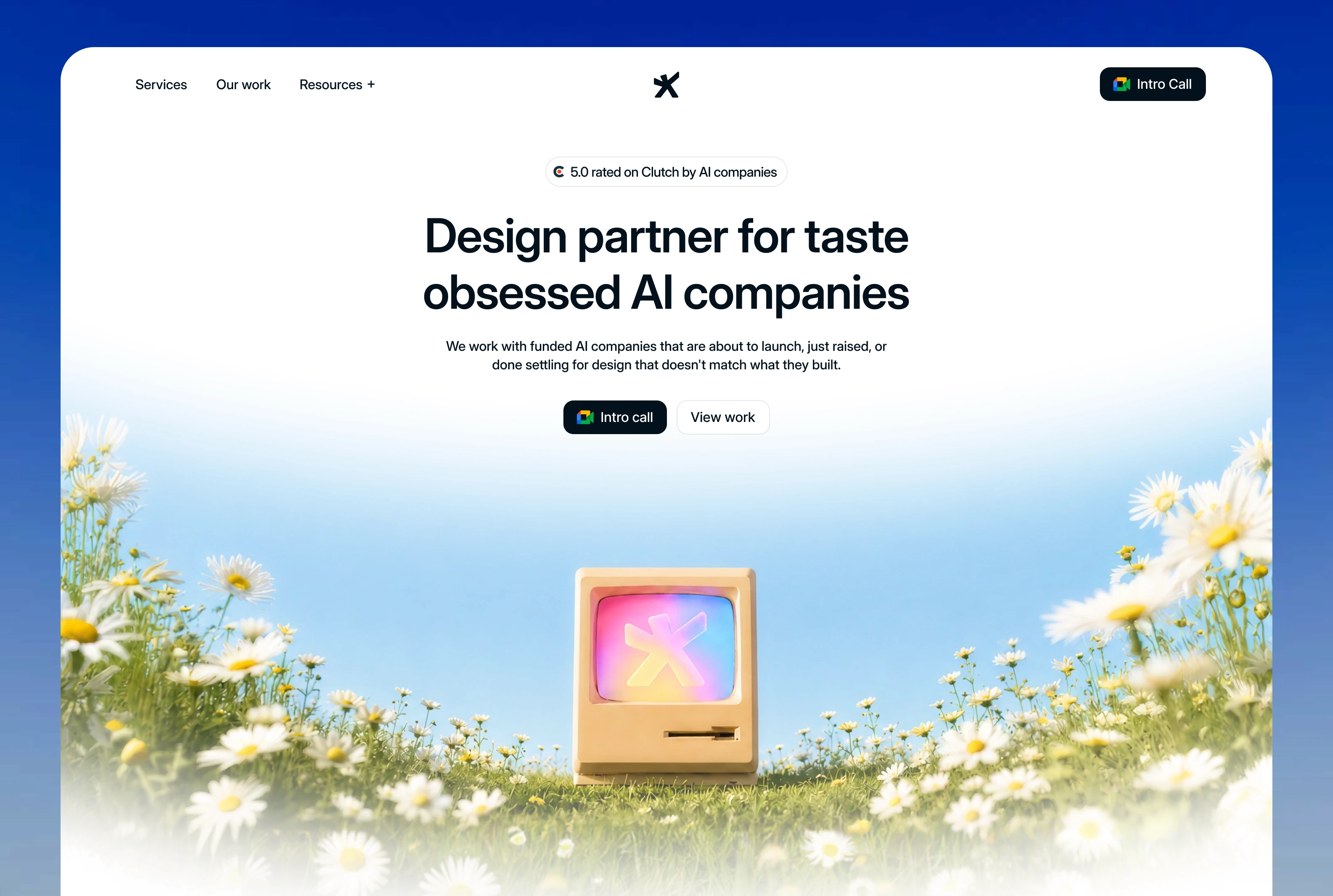
1. Studio Maydit: A Top-Rated Design Agency for AI Founders
Marketers read your page more critically than any other audience, so the studio behind it has to read it the same way. Studio Maydit is built for that job. It is a web and product design studio. Its clients are AI founders, and most of them sell into the US, UK, and Europe.
Most martech teams do not buy one page and stop. The monthly retainer suits them best, since it covers new pages, campaigns, and product design as the launch calendar fills, with no long lock-in. A team with a single launch date can take fixed scope instead. That runs three to four weeks and closes with a diagnosis of what is leaking in the product, so the next campaign starts from evidence.
Framer is the usual pick here, because a marketer can edit and duplicate pages without help. Webflow suits teams that already run a large content library. Custom code is for pages that share live parts with the product, such as an interactive demo. Once the page is live, the same designers move into product design, so the promise on the page matches what users see after signup.
Seven months is the number to remember from Dualite. The studio's design work supported a repositioned ICP, and Dualite passed 100,000+ users in that time. For a martech founder that is the whole point: a page aimed at the right buyer changes who signs up. Recent clients include Wave, PixelFlow, and Mi-VAD, along with 15 other AI and SaaS teams.
Check | Finding |
|---|---|
Based in | Remote, serving US / UK / EU |
Platform depth | Framer, Webflow, and custom code |
AI-sector proof | Yes. AI-native clients, published outcome on Dualite |
Pricing | Fixed scope or monthly retainer, quoted per project |
Team shape | Founder-led, small senior team |
Best fit | Martech teams that ship campaign pages monthly and want to edit them in-house |
Share your highest-traffic page and we will point to the section your buyers skim past. Book a 30-minute call.

2. Trueform
Trueform has built in Framer from Wil, Switzerland, since 2022. It publishes a starting price and lists Miro, Morning Brew, Bilt Rewards, and Gather as clients. Miro and Morning Brew both win users through sharp marketing pages, which is close to the bar your buyers will set. Framer also means your growth team can clone and edit pages without calling anyone.
The weakness is capacity you cannot see. It is premium tier and does not publish a headcount, so ask how many launches it can run at once. Swiss hours also leave a gap for teams on the US west coast.
Check | Finding |
|---|---|
Based in | Wil, Switzerland |
Founded | 2022 |
Team size | Not published |
Primary platform | Framer |
AI-sector proof | Yes |
Named clients | Miro, Morning Brew, Bilt Rewards, Gather |
Pricing | Published minimum |
Best fit | Martech teams that want Framer pages their marketers can run |
3. BX Studio
BX Studio is a New York Webflow team of 11 to 50 people, and it publishes a starting price. Reddit, Headspace, ASAPP, and Verifone are on its client list. Reddit sells advertising to marketers and ASAPP sells AI software, so the studio has seen both halves of your problem. Webflow's CMS also suits martech teams that publish integration and comparison pages in bulk.
The weakness is a thinner public record. No founding date is published, and its best known clients are large companies, so ask who on the team would handle a seed-stage page.
Check | Finding |
|---|---|
Based in | New York, USA |
Founded | Not published |
Team size | 11-50 |
Primary platform | Webflow |
AI-sector proof | Yes |
Named clients | Reddit, Headspace, ASAPP, Verifone |
Pricing | Published minimum |
Best fit | Martech startups building a large library of Webflow pages |
4. Clay
Clay has worked from San Francisco since 2016, has 51 to 200 people, and publishes a starting price. Slack, Stripe, Google, Coinbase, and Amazon are clients. Stripe and Slack set a standard that many marketers copy, so a page from this team will hold up under a demanding eye. Its size also lets it handle brand, site, and launch in one project.
The weakness is fit for an early team. Premium tier suggests a floor above a single page budget, and the platform is mixed, so confirm your marketers can edit whatever ships.
Check | Finding |
|---|---|
Based in | San Francisco, USA |
Founded | 2016 |
Team size | 51-200 |
Primary platform | Mixed |
AI-sector proof | Yes |
Named clients | Slack, Stripe, Google, Coinbase, Amazon |
Pricing | Published minimum |
Best fit | Funded martech teams rebuilding brand and site together |
5. basement.studio
basement.studio has written custom code from Mar del Plata and Los Angeles since 2018. It has 11 to 50 people, publishes a starting price, and works with Vercel, Cursor, ElevenLabs, Harvey AI, and Scale AI. Few studios anywhere show a deeper AI client list, and its pages carry a level of craft that technical and marketing buyers both notice.
The weakness is the build itself. Custom code means your marketers will likely need an engineer for each new variant, which slows the testing rhythm martech teams live on.
Check | Finding |
|---|---|
Based in | Mar del Plata, Argentina and Los Angeles, USA |
Founded | 2018 |
Team size | 11-50 |
Primary platform | Custom code |
AI-sector proof | Yes |
Named clients | Vercel, Cursor, ElevenLabs, Harvey AI, Scale AI |
Pricing | Published minimum |
Best fit | AI martech teams with engineers who can own the page |

6. SuperSkills
SuperSkills is a Walnut Creek studio of one to ten people, with AI-sector proof and The Cut as a named client. It sits in the budget tier, which suits a seed-stage martech team testing positioning before a bigger rebuild. A team that small means the person on your call is the person designing your page.
The weakness is how little you can verify. There is no published price or founding date, one named client is thin proof for a buyer who studies pages closely, and the mixed platform leaves editing rights as an open question.
Check | Finding |
|---|---|
Based in | Walnut Creek, USA |
Founded | Not published |
Team size | 1-10 |
Primary platform | Mixed |
AI-sector proof | Yes |
Named clients | The Cut |
Pricing | Not published |
Best fit | Seed-stage martech teams testing a first positioning |
7. Foundey
Foundey has worked from San Francisco since 2021 and lists DemandIQ, Traycer, and Sero AI as clients, all AI companies. Its work is Figma-only, so its strength is the thinking behind a page: the order of the message, where the proof sits, and how the layout guides a skeptical reader.
The weakness is the missing build. Someone else has to turn the design into a live page, which adds a handoff and a second vendor. It publishes no price and no headcount.
Check | Finding |
|---|---|
Based in | San Francisco, USA |
Founded | 2021 |
Team size | Not published |
Primary platform | Figma-only |
AI-sector proof | Yes |
Named clients | DemandIQ, Traycer, Sero AI |
Pricing | Not published |
Best fit | Martech teams with an in-house web developer |
8. Feels Like
Feels Like is a Los Angeles studio founded in 2023 that builds in custom code. Google, Nike, LVMH, and Suno AI are clients. The work leans toward bold, brand-led pages, which can help a martech startup that needs to stand apart in a crowded category.
The weakness is the direction of that work. Custom code and a brand-heavy list point away from the quick, test-driven pages martech teams need, and neither a price nor a team size is published.
Check | Finding |
|---|---|
Based in | Los Angeles, USA |
Founded | 2023 |
Team size | Not published |
Primary platform | Custom code |
AI-sector proof | Yes |
Named clients | Google, Nike, LVMH, Suno AI |
Pricing | Not published |
Best fit | Martech brands that want a launch moment more than a test bed |
9. Phantom
Phantom has worked from London and Auckland since 2013, with 51 to 200 people. Diageo, SAP, Financial Times, and Zendesk are clients, and Zendesk is a software company selling to business teams. The studio brings scale and long experience with complex builds.
The weakness is speed and cost for this buyer. It writes custom code, sits in the premium tier, and publishes no price. For a startup that wants to change pages every week, that is a slow and expensive mix.
Check | Finding |
|---|---|
Based in | London, UK and Auckland, NZ |
Founded | 2013 |
Team size | 51-200 |
Primary platform | Custom code |
AI-sector proof | Yes |
Named clients | Diageo, SAP, Financial Times, Zendesk |
Pricing | Not published |
Best fit | Large software companies with engineers assigned to the site |
10. Fantasy
Fantasy has worked from San Francisco and New York since 1999, which makes it the oldest studio on this list, and it shows AI-sector proof. That length of practice means it has seen many cycles of web design come and go.
The weakness is that a marketer has nothing to check. It publishes no price, no team size, and no named clients. Premium tier and a mixed platform add two more open questions before the first call.
Check | Finding |
|---|---|
Based in | San Francisco and New York, USA |
Founded | 1999 |
Team size | Not published |
Primary platform | Mixed |
AI-sector proof | Yes |
Named clients | Not published |
Pricing | Not published |
Best fit | Established companies that buy through a formal pitch |
How to choose between them
Start with what is actually broken this quarter, not with the portfolio you liked most.
Your marketers cannot ship pages without help. Trueform, and ask for a walkthrough of the Framer components before you sign.
You publish integration and comparison pages in bulk. BX Studio, with the CMS structure agreed in week one.
Your brand and your site both look dated next to rivals. Clay, if the budget allows it.
Your page needs live product parts, and you have engineers. basement.studio, with a plan for who edits copy after launch.
The one-line test: ask each studio which section of your current page it would cut first, and why.

Need more info?
Can't find your answer? Book a call and let's talk.
Continue Reading
10 Best Framer Design Agencies for AI Agent Startups - September 2026
What is the best Framer agency for an AI agent startup? Ten Framer studios ranked for agent products, with pricing, team size and AI work compared.

Siddarth Ponangi
10 Best Framer Design Agencies for Newly Funded Startups - September 2026
Your funding announcement is the biggest traffic day you will have all year. We checked 10 Framer agencies on five public criteria to see which can hit that date.
Siddarth Ponangi
10 Best Custom Code Website Development Agencies for AI Agent Startups - September 2026
AI web development agencies for agent startups. Which teams build custom coded sites a small team can still update weekly after launch.
Siddarth Ponangi