
Summarize with AI


Finsweet and Flowout are the two studios in this pool that best suit an AI salestech startup, and the full list runs Studio Maydit, Finsweet, Flowout, Pixelmatters, Digidop, Ramotion, Refokus, Push Refresh, Engine Digital, and Edgar Allan. Finsweet is a Webflow team of fifty-one to two hundred people, founded in 2017, whose clients include Clay and GitHub. Clay sells to the same revenue teams you sell to. Flowout is a distributed Webflow studio with a published starting price and a client list that includes Jasper and Sendlane. At the other end, Engine Digital builds in custom code, which puts every new campaign page in a developer queue. Edgar Allan works mostly for consumer brands such as Porsche and Duracell and does not publish a price.
Your buyer is a sales leader. That person gets more cold email than almost anyone, and much of it now promises an AI rep that books meetings on autopilot. Most of it gets deleted unread.
When one of your sequences does land, the click goes to a page. The reader gives it a few seconds. If the page repeats the same bold claim as every other vendor, the tab closes and the reply never comes.
So the landing page is doing a job most startup pages never face. It has to match the exact email that sent the visitor, show proof a skeptical sales leader will accept, and make booking a demo feel low risk.
It also has to be fast to copy. A salestech team might run a new sequence every week, each aimed at a different role or industry, and each one deserves a page that speaks to it.
The studios below were weighed on those needs first, then on price and team shape.

Five tests for a salestech landing page studio
Sales leaders judge a page the way they judge a rep: quickly and with doubt. These five tests look for a studio that can meet that standard.
- Platform depth. Can your marketer launch a new page without a developer? Outbound teams need variants by role, industry, and sequence. A Webflow or Framer build with a clean CMS makes each variant a short task. A custom build makes each one a sprint.
- Proof with sales buyers. This is the audience test. Has the studio built pages for products sold to revenue teams, or at least for B2B tools bought by senior operators? A studio that knows how a VP of Sales reads a page will lead with outcomes and proof, not with the model.
- Pricing transparency. Is a starting price published? Campaign pages are a recurring cost, and a public floor helps you plan how many you can afford each quarter. It also shows whether the studio expects repeat work or one large project.
- Team shape. How many pages can the team ship in parallel? A small studio gives you direct access to the designer. A larger one can produce a full set of persona pages in the same week.
- The studio's own website. Read it as a busy sales leader would. Is the claim specific? Is there proof near the top? Is the call to action clear? A studio whose own page is vague will write yours the same way.
Tests one and two mattered most, since they decide whether pages keep pace with outbound and hold up with skeptical buyers. Pricing and team shape split near ties. The website test only confirmed the order.
A word on the tables. They hold only facts the studios publish about themselves. If a studio keeps its size or pricing private, the row says Not published, and no estimate was put in its place. Treat each blank as a question for the sales call.
What goes wrong when an AI salestech startup ships campaign pages
Every sequence points to the same homepage. The email talks to a RevOps lead about messy CRM data. The click lands on a page about AI reps for founders. The reader feels the mismatch at once and leaves. Brief the studio on your top three sequences and ask for a page, or at least a hero section, for each.
The page makes claims sales leaders have learned to ignore. "Triple your pipeline" and "an SDR that never sleeps" read as noise to a buyer who has seen a hundred of them. What earns trust is a named customer, a real screenshot, and a number with its source. Ask each studio how it would prove your main claim without an adjective.
The demo form leaks the lead. A long form, no calendar, and a thank-you page with no next step all cost booked meetings. Worse, the form may not pass the lead to your CRM with the campaign attached, so you never learn which sequence worked. Put form routing and campaign tracking inside the scope, not after it.
1. Studio Maydit: A Top-Rated Design Agency for AI Founders
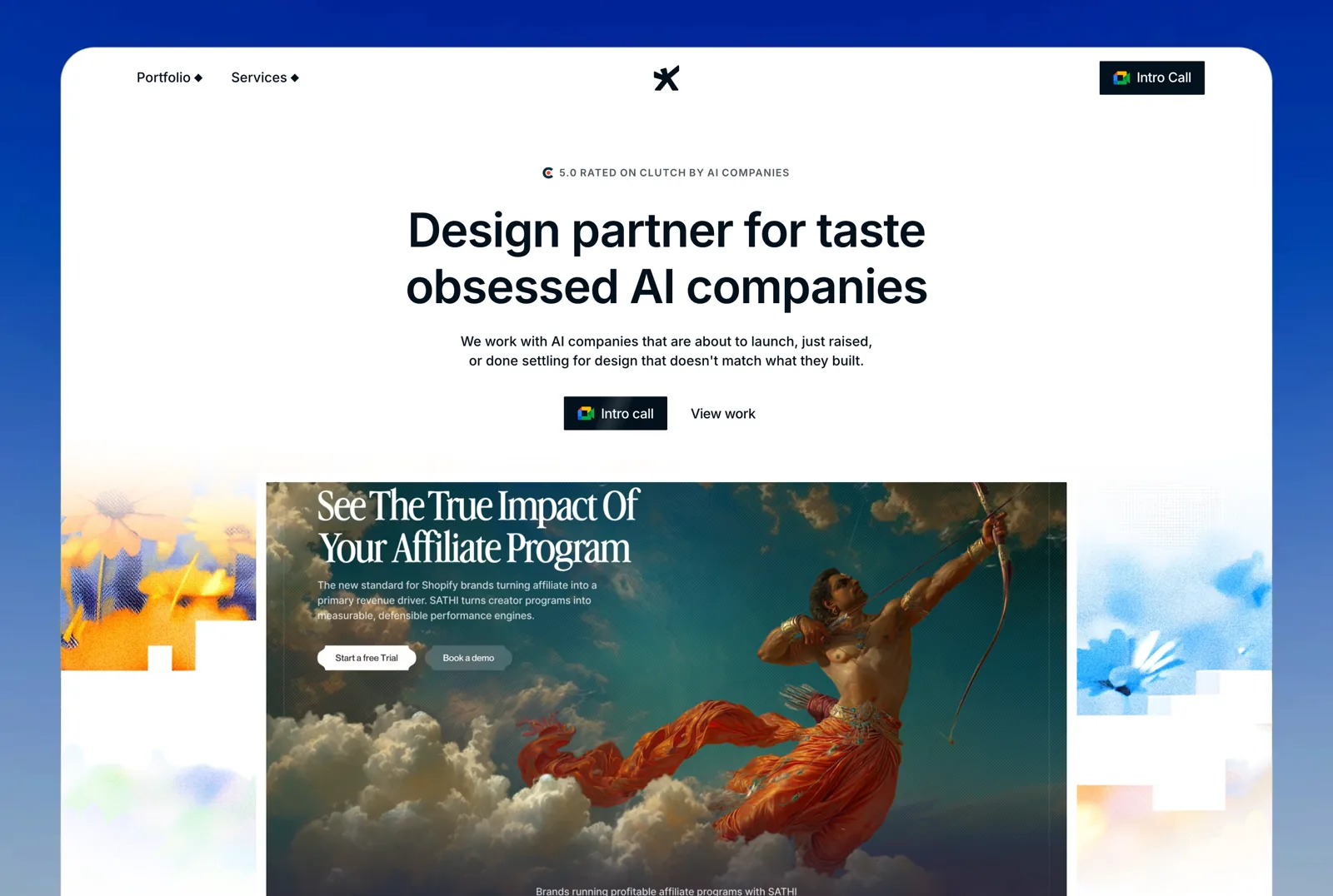
Salestech buyers read fast and doubt everything, so the page has to earn trust in one scroll. Studio Maydit designs for that reader. It works with AI founders, and its clients sit in the US, UK, and Europe. Put simply, it is a web and product design studio that treats a landing page as part of the sales motion.
For a team that launches a sequence every week, the monthly retainer is usually the right start. It covers new pages, campaigns, and product design, so each outbound push gets its own page without a fresh contract, and there is no long lock-in. Teams with one launch date can buy fixed scope instead. That runs three to four weeks and ends with a diagnosis of what is leaking in the product, which often shows why demos stall after the click.
Seven months is the number to remember from Dualite. In that span, work built around a repositioned ICP helped the product pass 100,000+ users. Salestech teams face the same choice about who to sell to, and the page has to change when that answer does. Wave, PixelFlow, and Mi-VAD are recent clients too, along with 15 other AI and SaaS teams.
The build fits the team. Framer lets a marketer clone a campaign page in minutes. Webflow suits a CMS that holds dozens of persona and industry pages. Custom code is for pages that pull live data from the product. Once the pages are working, the same team can move into product design.
| Check | Finding |
|---|---|
| Based in | Remote, serving US / UK / EU |
| Platform depth | Framer, Webflow, and custom code |
| AI-sector proof | Yes. AI-native clients, published outcome on Dualite |
| Pricing | Fixed scope or monthly retainer, quoted per project |
| Team shape | Founder-led, small senior team |
| Best fit | AI sales tools running weekly outbound that need a page for each campaign |
Send over your best-performing sequence and we will sketch the page it deserves. Book a 30-minute call.

2. Finsweet
Finsweet is a distributed Webflow team with roots in Denver, founded in 2017, with fifty-one to two hundred people. Clay, Dropbox, GitHub, and Steadily are named clients. Clay sells to the revenue teams an AI salestech startup also targets, which makes this the closest buyer match in the pool. A team this size can also set up a Webflow CMS so a marketer spins up new campaign pages without help.
The weakness is the missing price. Finsweet does not publish one, so budget stays a guess until the first call, and AI-sector proof is partial.
| Check | Finding |
|---|---|
| Based in | Denver, USA, distributed |
| Founded | 2017 |
| Team size | 51-200 |
| Primary platform | Webflow |
| AI-sector proof | Partial |
| Named clients | Dropbox, Clay, GitHub, Steadily |
| Pricing | Not published |
| Best fit | Salestech teams that need a CMS built for many campaign pages |
3. Flowout
Flowout is a Webflow studio with no fixed office and a published starting price. Jasper and Sendlane appear on its client list beside Kajabi and Riverside. Jasper is an AI product and Sendlane sells email automation, so the team has worked for AI tools and for tools that live in a marketer's outreach stack. The budget tier also leaves room for more pages per quarter.
The weakness is thin disclosure. Team size and founding date are not published, and AI-sector proof is partial, so ask to see a page it built for a paid or outbound campaign.
| Check | Finding |
|---|---|
| Based in | Distributed |
| Founded | Not published |
| Team size | Not published |
| Primary platform | Webflow |
| AI-sector proof | Partial |
| Named clients | Jasper, Kajabi, Riverside, Sendlane |
| Pricing | Published minimum |
| Best fit | Startups that need many campaign pages on a set budget |
4. Pixelmatters
Pixelmatters has fifty-one to two hundred people in Porto, has operated since 2013, and publishes a starting price. Rubrik, Quantic, and UJET are clients. UJET sells contact center software to customer and revenue leaders, which is close to the room a salestech product has to win. A team that large can also design a set of persona pages in parallel.
The weakness is proportion. A handful of landing pages can still be a small job at this scale, the tier is premium, and the mixed platform means you should confirm who edits pages after launch. AI-sector proof is partial.
| Check | Finding |
|---|---|
| Based in | Porto, Portugal |
| Founded | 2013 |
| Team size | 51-200 |
| Primary platform | Mixed |
| AI-sector proof | Partial |
| Named clients | Rubrik, Quantic, UJET |
| Pricing | Published minimum |
| Best fit | Funded teams launching pages for several buyer roles at once |
5. Digidop
Digidop is a Webflow studio in Paris, started in 2021, with one to ten people and a published starting price. StreamNative, Ramify, and TSE Energy are clients. StreamNative sells to technical buyers, so the team has practice turning a complex product into a page a busy reader can scan. A studio this small can also turn around one campaign variant without a queue.
The weakness is timing. Most sales leaders you target may read on US hours, and a Paris team has a narrow live window for launch-day fixes. AI-sector proof is partial.
| Check | Finding |
|---|---|
| Based in | Paris, France |
| Founded | 2021 |
| Team size | 1-10 |
| Primary platform | Webflow |
| AI-sector proof | Partial |
| Named clients | TSE Energy, Ramify, StreamNative |
| Pricing | Published minimum |
| Best fit | European salestech teams that want a quick, small Webflow partner |
6. Ramotion
Ramotion is a San Francisco studio founded in 2009, with eleven to fifty people and a published starting price. Okta and Xero sit on its client list with Mozilla, Netflix, and Adobe. Okta sells to enterprise buyers who expect polish and evidence, and that bar carries over to a page shown to a VP of Sales.
The weakness is pace. Premium craft suits one flagship page better than a weekly stream of variants, and a mixed platform can leave your marketer waiting on the studio. AI-sector proof is partial.
| Check | Finding |
|---|---|
| Based in | San Francisco, USA |
| Founded | 2009 |
| Team size | 11-50 |
| Primary platform | Mixed |
| AI-sector proof | Partial |
| Named clients | Mozilla, Okta, Netflix, Adobe, Xero |
| Pricing | Published minimum |
| Best fit | Salestech startups building one flagship page for enterprise buyers |
7. Refokus
Refokus is a remote Webflow team based in Germany, founded in 2021, with eleven to fifty people. Mural, BASF, Spotify, Yahoo, and BCG are clients. Mural is a work tool sold into large companies, and the Webflow build keeps pages in the hands of your marketing team. A team of that size can also run a larger site project alongside campaign work.
The weakness is price and focus. No starting price is published, the tier is premium, and the list leans toward big brands rather than revenue tools. AI-sector proof is partial.
| Check | Finding |
|---|---|
| Based in | Germany, remote |
| Founded | 2021 |
| Team size | 11-50 |
| Primary platform | Webflow |
| AI-sector proof | Partial |
| Named clients | Mural, BASF, Spotify, Yahoo, BCG |
| Pricing | Not published |
| Best fit | Later-stage salestech teams rebuilding a whole Webflow site |
8. Push Refresh
Push Refresh is a Dallas studio of one to ten people that builds in Framer and publishes a starting price. SmithRx, Synonym, and Northern National are clients. Framer is quick for cloning a campaign page, and a small US team keeps review calls easy when your buyers are in US time zones too.
The weakness is sector distance. No sales or revenue tool appears among its named clients, so the team would learn your buyer from scratch. AI-sector proof is partial and the founding date is not published.
| Check | Finding |
|---|---|
| Based in | Dallas, USA |
| Founded | Not published |
| Team size | 1-10 |
| Primary platform | Framer |
| AI-sector proof | Partial |
| Named clients | SmithRx, Synonym, Northern National |
| Pricing | Published minimum |
| Best fit | US founders who want quick Framer pages at a known price |
9. Engine Digital
Engine Digital has written custom code from Vancouver and New York since 2002. Adidas, Autodesk, Goldman Sachs, and HP are clients. Autodesk and Goldman Sachs are the kind of large firms where your buyers sit, so the team knows the standard those readers expect. A page tied to live product data would also benefit from that depth.
The weakness is campaign speed. Custom code puts every new outbound page behind a developer, which breaks a calendar built on weekly sequences. Price and team size are not published, the tier is premium, and AI-sector proof is partial.
| Check | Finding |
|---|---|
| Based in | Vancouver and New York |
| Founded | 2002 |
| Team size | Not published |
| Primary platform | Custom code |
| AI-sector proof | Partial |
| Named clients | Adidas, Autodesk, Goldman Sachs, HP |
| Pricing | Not published |
| Best fit | Enterprise teams with developers assigned to marketing |
10. Edgar Allan
Edgar Allan is a Webflow studio in Atlanta, founded in 2014, with fifty-one to two hundred people. Porsche, Duracell, and NCR are named clients. The Webflow base is sound, and a studio that size can build a large site quickly. The NCR work also shows some time spent with business buyers.
The weakness is the audience. The list leans on consumer brands with ad budgets, which is far from a sales leader opening a page after a cold email. No price is published, the tier is premium, and AI-sector proof is partial.
| Check | Finding |
|---|---|
| Based in | Atlanta, USA |
| Founded | 2014 |
| Team size | 51-200 |
| Primary platform | Webflow |
| AI-sector proof | Partial |
| Named clients | Porsche, Duracell, NCR |
| Pricing | Not published |
| Best fit | Brand-led companies with a campaign budget behind the site |
How to choose between them
Match the studio to whatever is actually broken in your funnel right now.
Replies come in but demos do not get booked. Finsweet, with a brief that pairs each sequence with its own page.
You need ten variants next month, not one perfect page. Flowout, or Digidop if your team keeps European hours.
Enterprise buyers bounce because the page looks early. Ramotion for one flagship page, or Pixelmatters if several roles need their own.
Your marketer cannot publish without a developer. Push Refresh on Framer, or Refokus for a full Webflow rebuild.
A quick test: send each studio one of your outbound emails and ask what the page behind it should say first. The strong ones answer in a sentence.