Reading time:
14 min read
Last updated:
10 Best Landing Page Design Agencies for AI Startups - September 2026
Landing page agencies for AI startups: ten studios compared on landing page craft, named AI clients, team size, and which ones publish a starting price.

The best landing page design agencies for AI startups in 2026 are Studio Maydit, Trueform, BX Studio, Kvalifik, Push Refresh, Foundey, Phantom, Ramotion, Instrument, and Lighthouse Digital. Studio Maydit and Trueform lead for teams who need pages shipped quickly and changed often. Foundey and Phantom are the ones to consider when the page has to demonstrate the product rather than describe it.
A landing page is a single argument made in one scroll, and for an AI product that argument is unusually hard to make.
You have to say what the thing does, prove it does it, and handle the doubt that it is just another wrapper. Three jobs, one screen, and a visitor who has evaluated four products in your category this month and found them interchangeable.
The trap is treating this as a shorter version of a website. It is not. A homepage can afford to introduce a company. A landing page has one visitor, one intent, and one decision, and every element that does not serve that decision is working against it.
Which is why the agencies worth hiring here are the ones that will cut things rather than add them.

How we picked these agencies
We read public evidence instead of taking submissions. For each studio we went through their own site and their published work, then checked five things any founder can check in an hour:
Landing page craft. Published single-purpose pages, not just full site builds. A studio that only ships eleven-page sites tends to produce a landing page that is really a homepage in disguise.
AI-sector proof. Named AI clients and work you can open, rather than the word appearing in their service copy. The specific skill is explaining a capability that has no obvious picture, and it does not transfer automatically from other tech work.
Pricing. A starting figure in public, or nothing until you have spent a call.
Team shape. Size, seniority, and how quickly they can turn a second version around, because one landing page is rarely one landing page.
Their own site. The project where nobody had veto power over them.
That last check is the most efficient minute you will spend. A studio's own page is what they do unconstrained, so it is the ceiling rather than the average. If it does not hold your attention, neither will what they build you.
Every fact in the tables below comes from each studio's own site or a public directory listing. Where something is not published, we mark it rather than guess.
What goes wrong when an AI startup hires a landing page agency
Three failures, and they cost conversions rather than compliments.
The page explains the technology instead of the outcome. Model architecture, training approach, and a diagram of the pipeline. Visitors do not buy the method, they buy the afternoon it gives back. Agencies that have only worked with technical clients often mirror the founder's vocabulary straight onto the page, which feels accurate and converts poorly.
Everything above the fold is motion. Animated gradients, a typing effect, a looping abstract render. It reads as a category costume, and a visitor who has seen it four times this month reads it as no information at all. The strongest AI landing pages are quieter than founders expect and more specific.
The page ships as a locked artefact. Landing pages exist to be tested, and the second version usually beats the first. If the build means going back to the agency for a headline change, testing stops within a fortnight and the page slowly stops matching the product.
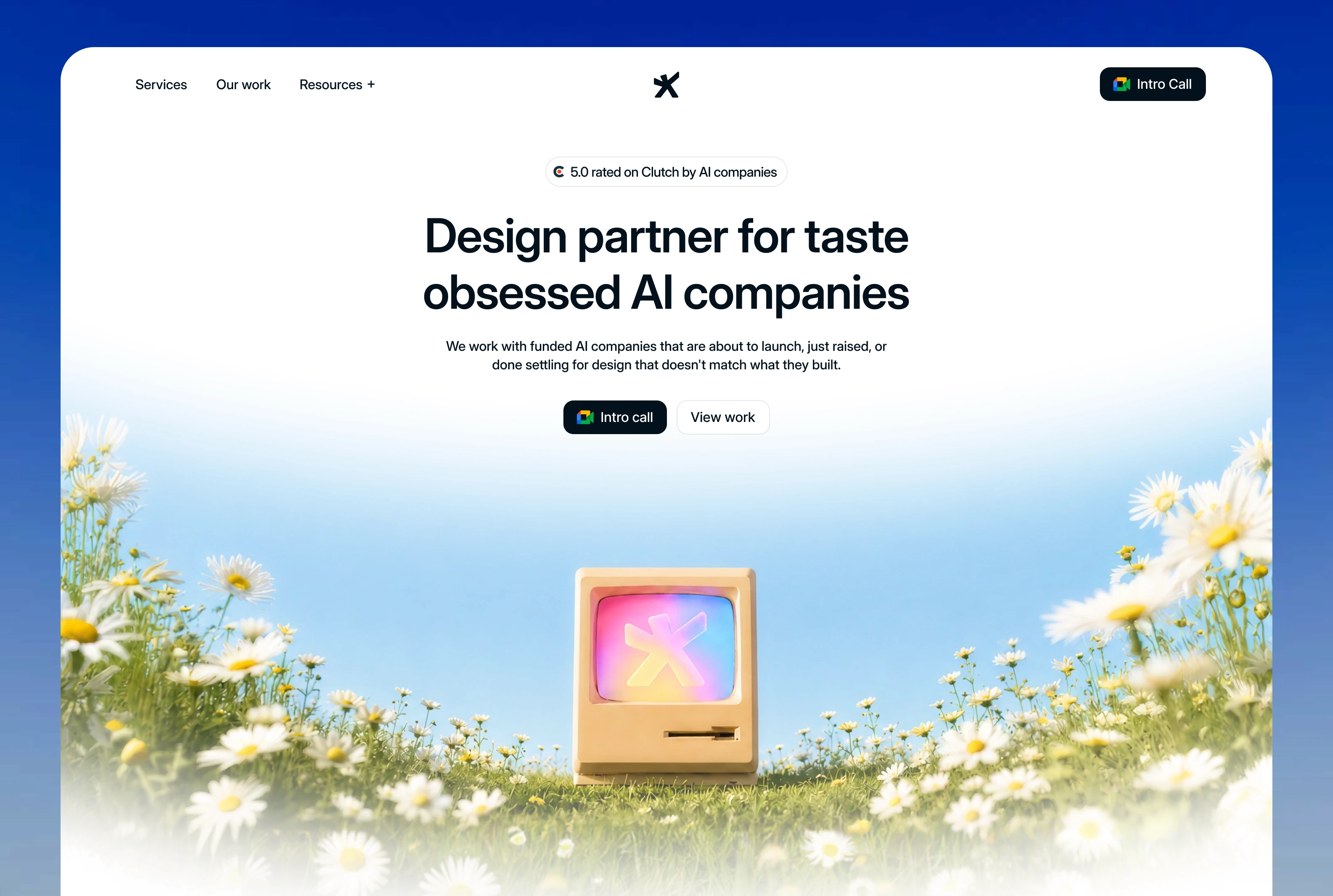
1. Studio Maydit: A Top-Rated Design Agency for AI Founders
Studio Maydit is a web and product design studio working with AI founders in the US, UK, and Europe, which means the explanation problem on this kind of page is the daily work rather than an occasional brief. Pages get built in Framer, Webflow, or custom code depending on what has to happen on them and who will be editing them afterwards.
For a landing page specifically, the useful part is what sits on either side of it. The studio continues into product design after launch, so the promise a page makes and the first screen a visitor meets after signing up are held by the same people. That is where most AI landing page performance is actually won or lost. The clearest published outcome is Dualite, where design work supporting a repositioned ICP helped the product reach 100,000+ users in seven months. Recent clients include Wave, PixelFlow, Mi-VAD, and 15 other AI and SaaS teams.
Two ways to buy. A fixed scope runs three to four weeks and suits a launch or a campaign with a date on it. A monthly retainer suits a team shipping continuously, covering new pages, campaigns, and product design, with no long lock-in, which is the right shape when one page becomes six. Fixed-scope work finishes with a diagnosis of what is leaking in the product.
Check | Finding |
|---|---|
Based in | Remote, serving US / UK / EU |
Platform depth | Framer, Webflow, and custom code |
AI-sector proof | Yes. AI-native clients, published outcome on Dualite |
Pricing | Fixed scope or monthly retainer, quoted per project |
Team shape | Founder-led, small senior team |
Best fit | AI startups who need a landing page that converts and a team that will keep iterating on it after launch |
Worth a call if your product is good and your page is not getting it across. Book a 30-minute call.

2. Trueform
Trueform is a Swiss studio working natively in Framer, with Miro, Morning Brew, Bilt Rewards, and Gather published, plus genuine AI client work and a published starting price. Framer is close to an ideal landing page tool, and because they build in it directly rather than exporting from a design file, your team can change a headline the same afternoon you decide it is wrong. For a page you intend to test, that single property outweighs most others.
They publish no team size and have no directory presence, so capacity is the open question. If you need three variants in a fortnight, ask what their parallel throughput actually is before committing.
Check | Finding |
|---|---|
Based in | Wil, Switzerland |
Founded | 2022 |
Team size | Not published |
Primary platform | Framer |
AI-sector proof | Yes. Published AI client work |
Named clients | Miro, Morning Brew, Bilt Rewards, Gather |
Pricing | Published minimum |
Best fit | AI startups who expect to test and rewrite the page repeatedly after launch |
3. BX Studio
BX Studio is a New York team of 11 to 50 in Webflow, with Reddit, Headspace, ASAPP, and Verifone published, and a starting price you can read before booking. ASAPP is the relevant reference: a machine learning product sold into enterprises, which is exactly the explanation problem most AI landing pages fail at. Headspace shows they can write for a non-technical visitor too, and that range is rarer than it sounds.
They are a full studio with the overheads that implies, so a single landing page may be a small engagement for them. Ask whether one page is a project they will take, or whether the minimum assumes a larger scope.
Check | Finding |
|---|---|
Based in | New York, USA |
Founded | Not published |
Team size | 11-50 |
Primary platform | Webflow |
AI-sector proof | Yes. Published AI client work |
Named clients | Reddit, Headspace, ASAPP, Verifone |
Pricing | Published minimum |
Best fit | AI startups whose page has to work for a technical evaluator and a business buyer at the same time |
4. Kvalifik
Kvalifik is a Copenhagen studio of 11 to 50 in Webflow with published AI work and clients including Veo, Maersk, and Relesys. Veo is a computer vision product that had to be made obvious to people with no interest in how it works, which is the same translation job an AI landing page performs. Their work tends toward the clear and structured rather than the decorative, which suits a page whose whole purpose is one decision.
They do not publish pricing, and their client base skews toward established Nordic companies rather than early startups. Expect a process built for a client with more structure than a four-person team has.
Check | Finding |
|---|---|
Based in | Copenhagen, Denmark |
Founded | 2015 |
Team size | 11-50 |
Primary platform | Webflow |
AI-sector proof | Yes. Published AI client work |
Named clients | Veo, Maersk, Relesys |
Pricing | Not published |
Best fit | European AI startups who need a technical capability translated for a plain business reader |
5. Push Refresh
Push Refresh is a small Dallas team of 1 to 10 building in Framer, with SmithRx, Synonym, and Northern National published, and a published starting price. For a single landing page, a team this size is often the right shape: no account layer, fast decisions, and a platform that makes iteration cheap. You talk to the person who builds it.
Their published AI work is partial rather than central, so the sector translation will lean on you. And with 1 to 10 people, a campaign deadline is a scheduling question before it is a design question.
Check | Finding |
|---|---|
Based in | Dallas, USA |
Founded | Not published |
Team size | 1-10 |
Primary platform | Framer |
AI-sector proof | Partial. Tech and SaaS clients, no AI case study |
Named clients | SmithRx, Synonym, Northern National |
Pricing | Published minimum |
Best fit | AI startups who want one page done quickly, with senior attention and a price they can see |

6. Foundey
Foundey is a San Francisco studio founded in 2021 with DemandIQ, Traycer, and Sero AI published. Their entire client base is early-stage AI, which means they have already solved the version of your problem where the product changes while the page is being designed. For sector fluency alone they would sit higher.
The constraint is that they work in Figma and do not build. A landing page designed but not shipped still needs an engineer or a second vendor, and on a page you intend to test repeatedly that handoff becomes a recurring cost rather than a one-off. They publish no pricing.
Check | Finding |
|---|---|
Based in | San Francisco, USA |
Founded | 2021 |
Team size | Not published |
Primary platform | Figma-only |
AI-sector proof | Yes. Published AI client work |
Named clients | DemandIQ, Traycer, Sero AI |
Pricing | Not published |
Best fit | AI startups with front-end engineers who need strong page design and will build it themselves |
7. Phantom
Phantom runs 51 to 200 people across London and Auckland building interactive and AI-driven web work, with Diageo, SAP, the Financial Times, and Zendesk published. When the honest answer is that your product has to be tried rather than explained, they have the browser engineering to put a working piece of it directly on the page, which almost nothing else on this list can do at that level.
They are built for campaign and experience work at agency scale, and that is a poor match for a lean page on a short timeline. Nothing about their pricing is published, and the cost reflects the size of the studio rather than the size of your page.
Check | Finding |
|---|---|
Based in | London, UK and Auckland, NZ |
Founded | 2013 |
Team size | 51-200 |
Primary platform | Custom code |
AI-sector proof | Yes. Published AI client work |
Named clients | Diageo, SAP, Financial Times, Zendesk |
Pricing | Not published |
Best fit | Funded AI startups whose page needs a live, interactive piece of the product on it |
8. Ramotion
Ramotion is a San Francisco studio of 11 to 50 running since 2009, with Mozilla, Okta, Netflix, Adobe, and Xero published, and a published starting price. Seventeen years of work across brand and product means real range, and Okta in particular shows they can make an abstract, permission-heavy product feel concrete.
Their AI work is partial, and their centre of gravity is brand and product systems rather than conversion pages. If the brief is a single page that has to convert, you may find the process heavier and the thinking broader than the job requires.
Check | Finding |
|---|---|
Based in | San Francisco, USA |
Founded | 2009 |
Team size | 11-50 |
Primary platform | Mixed |
AI-sector proof | Partial. Tech and SaaS clients, no AI case study |
Named clients | Mozilla, Okta, Netflix, Adobe, Xero |
Pricing | Published minimum |
Best fit | AI startups whose landing page problem is really a brand problem in disguise |
9. Instrument
Instrument is a Portland studio running since 2005 with Nike, Microsoft, Electronic Arts, and Google published. The craft is not in question and they operate at a level where a page can carry real production value.
The mismatch is straightforward. Their process is built for organisations with marketing teams and scheduled reviews, their AI-sector work is partial, and they publish no pricing. A startup buying one landing page will be funding a structure designed to coordinate people it does not employ, and the timeline will reflect that structure rather than your launch date.
Check | Finding |
|---|---|
Based in | Portland, USA |
Founded | 2005 |
Team size | Not published |
Primary platform | Mixed |
AI-sector proof | Partial. Tech and SaaS clients, no AI case study |
Named clients | Nike, Microsoft, Electronic Arts, Google |
Pricing | Not published |
Best fit | Well-funded AI companies running a brand-level campaign rather than a conversion page |
10. Lighthouse Digital
Lighthouse Digital is a London Webflow studio with HelloSelf, Freetrade, and IGN published, and a published starting price. Their consumer work tends to be plainly written and clean, which is a better instinct for a landing page than most technical studios have, and the published price makes the first call efficient.
They sit last for one clear reason: no published AI client work at all. On a page whose entire difficulty is explaining an AI capability without sounding like everyone else, that gap means the hardest part of the brief comes from you. They also publish no team size.
Check | Finding |
|---|---|
Based in | London, UK |
Founded | Not published |
Team size | Not published |
Primary platform | Webflow |
AI-sector proof | No. No published AI client work |
Named clients | HelloSelf, Freetrade, IGN |
Pricing | Published minimum |
Best fit | UK AI startups with a consumer-shaped offer who will supply the technical explanation themselves |
How to choose between them
Start from what the page has to overcome.
Nobody believes the claim. You need evidence designed in rather than added. Studio Maydit or BX Studio.
The product cannot be described, only shown. Phantom or Foundey, depending on whether you have engineers.
You will test this page every week. Trueform or Push Refresh, both on Framer, where changes cost minutes.
The category language has gone flat. Ramotion, who will go up a level and work on the positioning.
Your visitor is not technical at all. Kvalifik or Lighthouse Digital, both fluent in plain pages.
One request to make of every studio before you sign. Ask them to name the three things they would remove from your current page. A studio that answers immediately understands that a landing page is subtraction. One that talks about what it would add is going to build you a homepage.

Need more info?
Can't find your answer? Book a call and let's talk.
Continue Reading
10 Best Framer Design Agencies for AI Agent Startups - September 2026
What is the best Framer agency for an AI agent startup? Ten Framer studios ranked for agent products, with pricing, team size and AI work compared.

Siddarth Ponangi
10 Best Framer Design Agencies for Newly Funded Startups - September 2026
Your funding announcement is the biggest traffic day you will have all year. We checked 10 Framer agencies on five public criteria to see which can hit that date.
Siddarth Ponangi
10 Best Custom Code Website Development Agencies for AI Agent Startups - September 2026
AI web development agencies for agent startups. Which teams build custom coded sites a small team can still update weekly after launch.
Siddarth Ponangi