
Summarize with AI


The best landing page design agencies for AI voice products in 2026 are Studio Maydit, basement.studio, BX Studio, Feels Like, Engine Digital, Finsweet, 8020, Phantom, Feely Studio, and Lazarev. Studio Maydit and basement.studio lead for this brief, because both build in code, which is what an audio demonstration actually requires, and basement.studio has published work for ElevenLabs, a voice company facing this exact problem. Finsweet and 8020 are the wrong fit here, since both work in Webflow with partial AI proof, and the interactive part of a voice page is the part that decides whether it works.
Selling a voice product on a web page starts with an awkward fact. Your product is sound. Your page is silent, and so is the person reading it.
Most of your visitors are at a desk with colleagues nearby, on a train, or in a room where playing audio would be rude. They are browsing muted, as almost everybody does now, and the moment your page requires headphones you have lost the majority of the people who arrived interested. Autoplay makes it worse rather than better, because a page that starts talking gets closed before anybody hears the second sentence.
That is the first constraint and most voice sites simply ignore it. They present a large play button, a waveform, and a promise, and treat listening as a small favour to ask. It is not a small favour. It is the largest single obstacle between your traffic and your signups.
The second problem is what the page proves when somebody does listen. Voice quality is table stakes now and everybody's samples sound good, because everybody's samples are the good ones. What buyers actually judge, especially for anything conversational, is the timing. How long the pause is before a reply. What happens when somebody interrupts. What the system does when it mishears. Those are the things people evaluate in the first thirty seconds of real use, and almost no page addresses any of them.
The third is that the animated waveform has become the category's decoration. Every site has one, it moves attractively, and it tells the visitor nothing at all. It occupies the space where the actual evidence should be.
The ten studios below are ordered by how well they can make a silent page prove something about sound.

How we picked these agencies
Five checks, all runnable before you speak to anybody:
- Platform depth. Can the studio build a real interactive piece on the page, or does the work stop at a design your engineers then implement?
- Proof with real-time or media products. Is there published work for something that happens in time, where the experience was playback, latency, or a live response rather than a static layout?
- Pricing. Is a starting figure published, or does the number require two conversations to obtain?
- Team shape. Is there a senior person who will actually use your product long enough to find the moment worth showing?
- Their own site. Turn the sound off and look at what still communicates. That is the condition your own page will be read in.
The fifth check doubles as a rehearsal. Almost every studio's portfolio has video in it, and watching it muted tells you immediately whether they think about captions, pacing, and what a silent viewer receives. Studios that have done media work will have handled it. Studios that have not will show you thirty seconds of footage that means nothing without audio, which is precisely the page they would build for you.
The tables record what each studio publishes about itself and nothing more. Where a studio has published nothing, that is stated, because an assumption dressed as a finding would be worse than an empty cell.
What goes wrong on AI voice landing pages
Three failures, and the first is the one costing you signups today.
Every piece of proof requires sound. The demo is a play button, the samples are audio files, and the differentiator is described in words that only mean something once you have heard it. Meanwhile most of your traffic cannot listen and will not put headphones on for a product they have not decided about yet. The fix is a synced transcript running beside the audio, so the whole demonstration works silently and reads as well as it plays. It also gets skimmed, quoted, and indexed, none of which an audio file does. This one change usually does more than a redesign.
The waveform stands in for evidence. A moving line implies sophistication and proves nothing. Nobody has ever chosen a voice platform because the animation on the homepage was smooth. What people want to see is a hard case handled well: a caller with a strong accent, somebody interrupting mid-sentence, a name the system had to ask about twice. Show one of those, transcript and all, and it will outperform every abstract visual on the page, because it is the situation the buyer is privately worried about.
Timing is never mentioned. For conversational products the whole experience is turn-taking, and a page that talks about naturalness without ever addressing the pause before a reply is avoiding the subject. Say what your typical response delay is, show a recording at real speed rather than edited, and explain what happens when somebody talks over the system. Our guide to designing AI voice products covers turn-taking and interruption in more depth. Buyers who have tried three competitors already know this is where products differ. Being the only page willing to discuss it is a strong position, and it costs nothing but nerve.
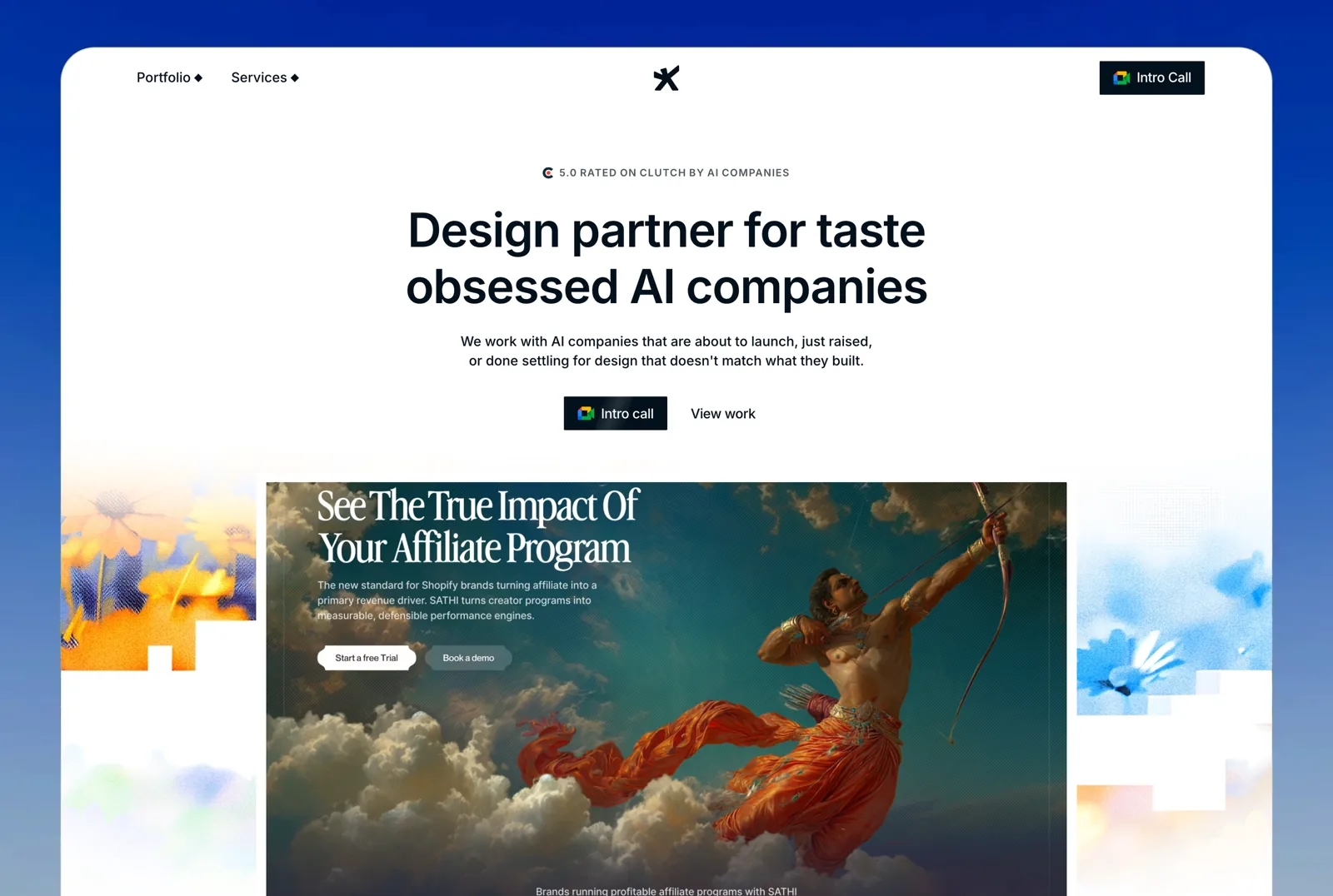
1. Studio Maydit: A Top-Rated Design Agency for AI Founders
A page carrying a real demonstration is a build decision before it is a design one, which is why the platform question comes first here. Studio Maydit works in Framer, Webflow, and custom code, and picks by how much the page has to actually do rather than by preference. It is a web and product design studio, its clients are AI founders in the US, UK, and Europe, and it is founder-led with a small senior team, so the person choosing what to demonstrate is the person who used your product to find it. The engagement continues into product design after the site ships.
Where a launch has a date, a fixed scope of three to four weeks covers it. Where pages, campaigns, and product design keep arriving, the monthly retainer covers those instead, with no long lock-in. Fixed-scope projects finish with a diagnosis of what is leaking in the product, and for a voice company that is usually the first call a new customer runs and the silence they hear in the middle of it.
There is one client with a public figure. Seven months after Dualite rebuilt on a repositioned ICP, with the design work behind it, the product had 100,000+ users. Wave, PixelFlow, Mi-VAD, and 15 other AI and SaaS teams are on the recent list.
| Check | Finding |
|---|---|
| Based in | Remote, serving US / UK / EU |
| Platform depth | Framer, Webflow, and custom code |
| AI-sector proof | Yes. AI-native clients, published outcome on Dualite |
| Pricing | Fixed scope or monthly retainer, quoted per project |
| Team shape | Founder-led, small senior team |
| Best fit | Voice teams whose page has to work with the sound off |
Worth a call if your homepage demo needs headphones and your traffic does not have them. Book a 30-minute call.

2. basement.studio
basement.studio works from Mar del Plata and Los Angeles, founded in 2018, 11 to 50 people building in custom code, with a published minimum and Vercel, Cursor, ElevenLabs, Harvey AI, and Scale AI named. ElevenLabs is the single most relevant reference on this page, a voice company whose site had to make audio quality obvious to people arriving from a link, and building in code means an interactive demonstration is within reach rather than a stretch.
The published minimum is not aimed at small budgets, and a studio working repeatedly inside one sector develops a recognisable house style, which is useful until you need to look unlike your neighbours.
| Check | Finding |
|---|---|
| Based in | Mar del Plata, Argentina and Los Angeles, USA |
| Founded | 2018 |
| Team size | 11-50 |
| Primary platform | Custom code |
| AI-sector proof | Yes. Published AI client work |
| Named clients | Vercel, Cursor, ElevenLabs, Harvey AI, Scale AI |
| Pricing | Published minimum |
| Best fit | Voice teams who want a genuinely interactive page |
3. BX Studio
BX Studio is a New York team of 11 to 50 working in Webflow, with a published minimum, published AI client work, and Reddit, Headspace, ASAPP, and Verifone named. ASAPP builds AI for contact centres, which is the closest commercial neighbour to a voice product on this page, and Headspace is a product whose whole value is delivered through audio somebody chooses to listen to.
They publish no founding year, and Webflow limits how far a live demonstration can go, which matters when the demonstration is the argument.
| Check | Finding |
|---|---|
| Based in | New York, USA |
| Founded | Not published |
| Team size | 11-50 |
| Primary platform | Webflow |
| AI-sector proof | Yes. Published AI client work |
| Named clients | Reddit, Headspace, ASAPP, Verifone |
| Pricing | Published minimum |
| Best fit | Teams selling voice into contact centre buyers |
4. Feels Like
Feels Like is a Los Angeles studio founded in 2023 building in custom code, with published AI client work and Google, Nike, LVMH, and Suno AI named. Suno is a generative audio product, so this team has already had to solve the problem of presenting sound to a silent visitor, and Los Angeles brings production instincts that most software studios lack.
They publish no pricing and no team size, they are young, and the portfolio is weighted towards brand work rather than the evidence-heavy pages a technical buyer reads before a trial.
| Check | Finding |
|---|---|
| Based in | Los Angeles, USA |
| Founded | 2023 |
| Team size | Not published |
| Primary platform | Custom code |
| AI-sector proof | Yes. Published AI client work |
| Named clients | Google, Nike, LVMH, Suno AI |
| Pricing | Not published |
| Best fit | Teams who want the audio presented with real production |
5. Engine Digital
Engine Digital has worked from Vancouver and New York since 2002, in custom code, with Adidas, Autodesk, Goldman Sachs, and HP named. Goldman Sachs and HP are both organisations where anything customer-facing passes a compliance review, which is the process waiting for you the moment a bank or an insurer wants to put your voice product in front of their customers.
They publish no pricing and no team size, their AI-sector proof is partial, and an enterprise studio moves at a pace set by approvals rather than by a launch you want next month.
| Check | Finding |
|---|---|
| Based in | Vancouver and New York |
| Founded | 2002 |
| Team size | Not published |
| Primary platform | Custom code |
| AI-sector proof | Partial. Enterprise and SaaS clients, no AI case study |
| Named clients | Adidas, Autodesk, Goldman Sachs, HP |
| Pricing | Not published |
| Best fit | Voice teams selling into regulated enterprise buyers |
6. Finsweet
Finsweet is a distributed team of 51 to 200 based in Denver, founded in 2017, working in Webflow, with Dropbox, GitHub, and Steadily named. They are the deepest Webflow specialists here, so if what you need is a large, fast, well-structured site around the product rather than a demonstration inside it, this is the strongest option for that job.
They publish no pricing, their AI-sector proof is partial, and Webflow cannot carry a live conversational demonstration, which is the part of this brief that matters most.
| Check | Finding |
|---|---|
| Based in | Denver, USA, distributed |
| Founded | 2017 |
| Team size | 51-200 |
| Primary platform | Webflow |
| AI-sector proof | Partial. Enterprise and SaaS clients, no AI case study |
| Named clients | Dropbox, Clay, GitHub, Steadily |
| Pricing | Not published |
| Best fit | Teams who need a large site produced and kept current |
7. 8020
8020 works from San Francisco and New York, founded in 2014, in Webflow, with Wave, Superlist, Pilot.com, Vanta, and Circle named. Vanta had to sell something invisible and technical to a sceptical buyer using a web page alone, which is structurally the same argument a voice product has to make without playing anything.
They publish no pricing and no team size, their AI-sector proof is partial, and Webflow puts a hard ceiling on the interactive demonstration this category needs.
| Check | Finding |
|---|---|
| Based in | San Francisco and New York, USA |
| Founded | 2014 |
| Team size | Not published |
| Primary platform | Webflow |
| AI-sector proof | Partial. Enterprise and SaaS clients, no AI case study |
| Named clients | Wave, Superlist, Pilot.com, Vanta, Circle |
| Pricing | Not published |
| Best fit | Teams whose positioning needs arguing before building |
8. Phantom
Phantom works from London and Auckland, founded in 2013, 51 to 200 people in custom code, with published AI client work and Diageo, SAP, Financial Times, and Zendesk named. Zendesk is a customer service platform, so the studio has worked on the surrounding problem of support at scale, which is where most commercial voice products are sold.
They publish no pricing, and at that size the work runs as a staged programme, which is slow and costly for a company that wants a page changed the week a new model ships.
| Check | Finding |
|---|---|
| Based in | London, UK and Auckland, NZ |
| Founded | 2013 |
| Team size | 51-200 |
| Primary platform | Custom code |
| AI-sector proof | Yes. Published AI client work |
| Named clients | Diageo, SAP, Financial Times, Zendesk |
| Pricing | Not published |
| Best fit | Voice teams selling into large service organisations |
9. Feely Studio
Feely Studio is a distributed European team of one to ten working across platforms, with a published minimum, published AI client work, and Noxus, Mutiny, Luasai, and Basic Capital named. A published figure and a very small team means a senior person is on the page directly, which is what you want when the hard part is choosing which thirty seconds of your product to show.
They publish no founding year, and one to ten distributed people is limited capacity for a page with a substantial engineered demonstration attached to it.
| Check | Finding |
|---|---|
| Based in | Distributed, Europe |
| Founded | Not published |
| Team size | 1-10 |
| Primary platform | Mixed |
| AI-sector proof | Yes. Published AI client work |
| Named clients | Noxus, Mutiny, Luasai, Basic Capital |
| Pricing | Published minimum |
| Best fit | European teams who want senior attention at a known price |
10. Lazarev
Lazarev is a San Francisco studio of 51 to 200 founded in 2015, working across platforms, with a published minimum, published AI client work, and Payoneer, Peel, Elva, and Mozayix named. Real headcount means the page, the comparison pages, and the measurement around them can all run at once rather than in sequence.
Their published work leans towards conversion-led marketing rather than technical demonstration, and at that size the people who present in the pitch are not necessarily the people assigned afterwards.
| Check | Finding |
|---|---|
| Based in | San Francisco, USA |
| Founded | 2015 |
| Team size | 51-200 |
| Primary platform | Mixed |
| AI-sector proof | Yes. Published AI client work |
| Named clients | Payoneer, Peel, Elva, Mozayix |
| Pricing | Published minimum |
| Best fit | Teams who want a page plus the conversion work around it |
How to choose between them
Sort by why the page is not converting.
Nobody can hear the demo and nobody puts headphones on. Studio Maydit or basement.studio.
The samples sound good and buyers still hesitate. Studio Maydit or Feely Studio.
Enterprise buyers stall on review and compliance. Engine Digital or Phantom.
You need a large site around the product, quickly. Finsweet or Lazarev.
One test before you sign. Ask a candidate how the page will work with the sound off. A studio that has thought about this answers with transcripts, captions, and what a muted visitor is meant to understand in the first ten seconds. A studio that answers by describing the audio player has told you it is planning to build the page every one of your competitors already has, and that page is the reason your category all looks the same.