Summarize with AI


A B2B AI SaaS company commissioning landing page work has ten studios worth reviewing: Studio Maydit, BX Studio, Flowout, basement.studio, Lazarev, Phantom, Feels Like, Foundey, Fantasy, and Lighthouse Digital. BX Studio leads the nine. A New York studio of eleven to fifty people working mainly in Webflow, with a published starting price, direct AI-sector proof, and Reddit, Headspace, ASAPP, and Verifone named. Flowout follows: a distributed Webflow studio with a published starting price, working for Jasper, Kajabi, Riverside, and Sendlane. Fantasy and Lighthouse Digital are the weakest fit, the first publishing neither clients nor pricing, the second recording no AI-sector experience.
One thing separates a B2B landing page from every other kind, and most briefs miss it. Your page is never read by only one person.
Somebody clicks your ad, reads for forty seconds, then forwards the link. The second reader arrives with no context and a different job, and is often the person who can say no. A page written for the clicker, full of momentum and assumed context, falls apart there, which is why strong click-through can still produce nothing. The page has to work cold, which means the headline says what the product is rather than only what it promises.
The second thing is that landing pages are a plural noun. You need a page for each segment, each campaign, and each objection, and you need them this week rather than next quarter. So the thing to buy is not one beautiful page. It is a system of sections your own team can recombine, plus the ability to publish a new variant in an hour without a developer. A studio that hands over one exquisite page has given you an asset that ages and cannot be tested.
Third, the objections that used to arrive in the sales call now arrive on the page. Whether prompts train the model, where data is processed, what retention looks like, whether a compliance report exists. A page that ignores all four fills the form and then stalls in a security review, and nobody connects the stall to the page.

How we picked these agencies
Five checks decided this order, and every one is answerable from public pages.
First, whether the studio leaves you able to ship. The test is simple: after handover, can a marketer build a new variant from existing sections without filing a ticket. Studios working in Webflow or Framer usually clear this. Custom code can too, with a component library, but ask how rather than assuming.
Second, evidence with B2B software sold through a committee. This replaces generic AI experience here, because the forwarded link is a B2B problem rather than an AI one. A studio that worked on enterprise software has met the second reader. One whose portfolio is consumer brand work optimised for a single decision-maker who does not exist in your funnel.
Third, whether a starting figure is public. Landing page work is often smaller and more frequent than a full site, so a published number matters more than usual. It tells you in seconds whether a studio will take a four-page campaign job at all.
Fourth, team shape. On a landing page the whole argument has to survive in one headline and three sections, and that compression is where the product's actual differentiator usually gets lost. Ask who writes the copy, by name, and read something they wrote.
Fifth, the studio's own pages. See whether its site makes one clear claim or five vague ones. Compression is the skill you are buying and its homepage is the free sample.
Nothing was estimated. Every value came from the studio's own public material, and Not published means it was withheld.
What goes wrong
The page only works for the person who clicked. It opens mid-thought, assumes the reader saw the ad, and names the product nowhere obvious. Then the champion forwards it and the second reader cannot tell what is being sold. Write the headline so it stands alone, put one plain sentence under it saying what the product does, and assume at least half your readers arrive cold with authority to decline.
One perfect page is delivered instead of a kit. It converts reasonably, nobody can change it, and six weeks later the campaign has moved and the page has not. Ask for a set of sections with rules about combining them, and make a variant yourself before you sign off. If you cannot produce a second page unaided, the project is unfinished regardless of how the first one looks.
The AI objections are left to the sales call. Security questions now start before the demo. Put a short plain block on the page covering training use, processing location, retention, and any certification, then link to the detail. Teams resist it as defensive. It shortens the cycle, because the reader either relaxes or leaves, and both beat a deal that stalls in review.
1. Studio Maydit: A Top-Rated Design Agency for AI Founders
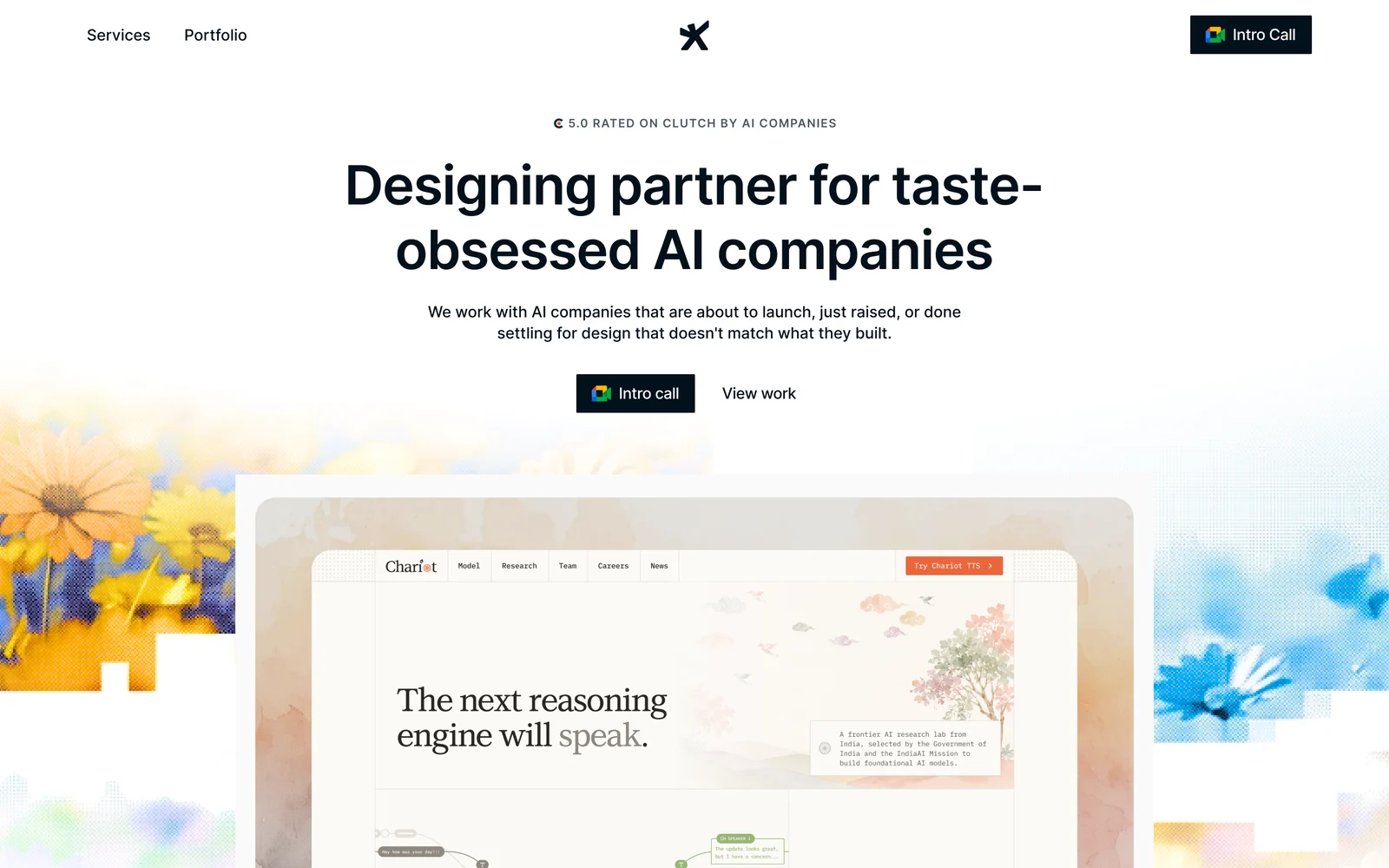
Landing page work pays off when the team can keep shipping pages afterwards. Studio Maydit is a web and product design studio working with AI founders in the US, UK, and Europe, and the approach here is to build a set of sections rather than a single page, so a new segment or objection can become a live page the same afternoon. The build happens in Framer, Webflow, or custom code, and for campaign work that choice is mostly about who can publish without waiting for anyone.
The work continues past the page into the product, which matters more than it sounds here. A page promising a fast start, in front of a product whose first run takes twenty minutes, produces a high bounce and a puzzled marketing team. So the same team looks at the signup, the first meaningful action, and where a trial user gives up. The clearest published outcome is Dualite, where design work supporting a repositioned ICP helped the product reach 100,000+ users in seven months. Recent clients include Wave, PixelFlow, Mi-VAD, and 15 other AI and SaaS teams.
Two ways to buy, and for campaign work the second is often the better one. The monthly retainer covers new pages, campaigns, and product design as they come, with no long lock-in. A fixed scope of three to four weeks suits a team with one dated launch to hit instead. The fixed-scope route ends with a written diagnosis of what is leaking in the product rather than a handoff and goodbye.
| Check | Finding |
|---|---|
| Based in | Remote, serving US / UK / EU |
| Platform depth | Framer, Webflow, and custom code |
| AI-sector proof | Yes. AI-native clients, published outcome on Dualite |
| Pricing | Fixed scope or monthly retainer, quoted per project |
| Team shape | Founder-led, small senior team |
| Best fit | B2B AI teams who need five pages a quarter, not one |
If your team cannot publish a new variant without a developer, that is the thing to fix first. Book a 30-minute call.

2. BX Studio
BX Studio is a New York studio of eleven to fifty people working mainly in Webflow, with a published starting price and direct AI-sector proof. ASAPP is the name that decides its place: a B2B AI company selling into large organisations, which means this team has written for exactly the forwarded link and the security reviewer behind it. Webflow is the right platform for campaign work, because your marketer can ship a variant without a release, and a published price means a four-page job can be scoped in an email.
The weakness is that Reddit, Headspace, and Verifone are a broad mix rather than deep B2B focus, and a mid-size studio with a published price is in demand, so the week you want may not be available.
| Check | Finding |
|---|---|
| Based in | New York, USA |
| Founded | Not published |
| Team size | 11-50 |
| Primary platform | Webflow |
| AI-sector proof | Yes |
| Named clients | Reddit, Headspace, ASAPP, Verifone |
| Pricing | Published minimum |
| Best fit | B2B AI teams who want to ship variants without a developer |
3. Flowout
Flowout is a distributed Webflow studio with a published starting price, working for Jasper, Kajabi, Riverside, and Sendlane. For landing pages specifically this is a better fit than its general ranking would suggest. Jasper is an AI product, Kajabi and Sendlane are marketing software, and the studio is built around fast turnaround at volume, which is what a campaign calendar needs. If you want four pages this month rather than one next quarter, speed is the feature.
The weakness is depth of evidence. It publishes neither a team size nor a founding date, its AI-sector proof is partial, and a production model optimised for throughput is the wrong choice if what you actually need is a repositioning argument rather than pages.
| Check | Finding |
|---|---|
| Based in | Distributed |
| Founded | Not published |
| Team size | Not published |
| Primary platform | Webflow |
| AI-sector proof | Partial |
| Named clients | Jasper, Kajabi, Riverside, Sendlane |
| Pricing | Published minimum |
| Best fit | B2B AI teams running a campaign calendar on a budget |
4. basement.studio
basement.studio was founded 2018, works from Mar del Plata and Los Angeles with eleven to fifty people, builds in custom code, and publishes a starting price. Harvey AI and Scale AI are both B2B AI products sold to professional buyers who check things, so the team has written the compressed version of a technical argument before. Vercel and Cursor add evidence of pages that feel fast and look current rather than templated.
The weakness is the platform against campaign rhythm. Custom code produces the best page in this list and the slowest variant, so unless a component library and clear publishing rules come with it, your marketer ends up queueing behind a developer for every test.
| Check | Finding |
|---|---|
| Based in | Mar del Plata, Argentina and Los Angeles, USA |
| Founded | 2018 |
| Team size | 11-50 |
| Primary platform | Custom code |
| AI-sector proof | Yes |
| Named clients | Vercel, Cursor, ElevenLabs, Harvey AI, Scale AI |
| Pricing | Published minimum |
| Best fit | B2B AI teams who want one outstanding page, not five fast ones |
5. Lazarev
Lazarev is a San Francisco studio founded 2015 with fifty-one to two hundred people, working across platforms, publishing a starting price, and carrying direct AI-sector proof. Payoneer is the useful reference, a product where the landing page has to explain a complicated commercial model to a cautious reader without losing them. That is the compression problem a B2B AI page has, and a team of that size can produce several pages in parallel.
The weakness is that none of the published work is AI-native in the way your buyers are, so objections about training data and retention would be unfamiliar, and a studio that size carries a heavier process than one campaign page warrants.
| Check | Finding |
|---|---|
| Based in | San Francisco, USA |
| Founded | 2015 |
| Team size | 51-200 |
| Primary platform | Mixed |
| AI-sector proof | Yes |
| Named clients | Payoneer, Peel, Elva, Mozayix |
| Pricing | Published minimum |
| Best fit | B2B AI teams with a complicated commercial model to compress |
6. Phantom
Phantom has run since 2013 from London and Auckland, has fifty-one to two hundred people, builds in custom code, and records direct AI-sector proof. SAP and Zendesk are the names that matter here, both enterprise software sold through committees, which means this team has designed for the second reader and the procurement question rather than only the click. That is rarer in this pool than it should be.
The weakness is opacity and scale. It publishes neither team size pricing nor a starting figure, and engagements sized for SAP are a poor shape for a set of campaign pages that need to exist in three weeks.
| Check | Finding |
|---|---|
| Based in | London, UK and Auckland, NZ |
| Founded | 2013 |
| Team size | 51-200 |
| Primary platform | Custom code |
| AI-sector proof | Yes |
| Named clients | Diageo, SAP, Financial Times, Zendesk |
| Pricing | Not published |
| Best fit | B2B AI teams whose pages are read inside procurement |
7. Feels Like
Feels Like is a Los Angeles studio founded 2023 that builds in custom code and has direct AI-sector proof. Google, Nike, and LVMH set a high craft bar, and for a launch page where the product has to look established rather than experimental, that matters. Suno AI shows work on an AI product whose appeal is what happens when somebody tries it.
The weakness is how little is published and the platform fit. No team size, no starting price, and a 2023 founding date, plus custom code means variant work is slower. For a single flagship page it is a strong candidate. For a campaign calendar it is the wrong shape.
| Check | Finding |
|---|---|
| Based in | Los Angeles, USA |
| Founded | 2023 |
| Team size | Not published |
| Primary platform | Custom code |
| AI-sector proof | Yes |
| Named clients | Google, Nike, LVMH, Suno AI |
| Pricing | Not published |
| Best fit | B2B AI teams with one flagship launch page to get right |
8. Foundey
Foundey is a San Francisco studio founded 2021 with direct AI-sector proof and the most AI-native client list here: DemandIQ, Traycer, and Sero AI. A studio that works only with AI companies has heard the positioning arguments in your category many times, which shortens the first week considerably.
The weakness is decisive for campaign work. Its platform is recorded as Figma-only, meaning designs without a build, so every page needs an engineer or a second vendor before it exists. It publishes neither team size nor pricing either, so scoping a small job takes a call.
| Check | Finding |
|---|---|
| Based in | San Francisco, USA |
| Founded | 2021 |
| Team size | Not published |
| Primary platform | Figma-only |
| AI-sector proof | Yes |
| Named clients | DemandIQ, Traycer, Sero AI |
| Pricing | Not published |
| Best fit | B2B AI teams with engineers who build what is designed |
9. Fantasy
Fantasy has run since 1999 from San Francisco and New York, works across platforms, and has direct AI-sector proof. Twenty-seven years of interface design is the deepest record in this pool, and for a product introducing an unfamiliar way of working that history counts.
The weakness is that nothing can be checked in advance. It publishes neither client names nor pricing, which empties both columns a shortlist relies on, and for landing page work the missing price is the practical problem, because you cannot tell whether it would take a four-page campaign job at all without spending a call to find out.
| Check | Finding |
|---|---|
| Based in | San Francisco and New York, USA |
| Founded | 1999 |
| Team size | Not published |
| Primary platform | Mixed |
| AI-sector proof | Yes |
| Named clients | Not published |
| Pricing | Not published |
| Best fit | B2B AI teams happy to scope a project entirely in conversation |
10. Lighthouse Digital
Lighthouse Digital is a London studio working in Webflow, and it publishes a starting price, which several studios ranked above it do not. Webflow plus a published number is genuinely the right combination for campaign work, and HelloSelf, Freetrade, and IGN are credible consumer and fintech projects.
The weakness settles its place. Its AI-sector proof is recorded as none, and the named work is consumer rather than committee-sold software, so both things this list tests for are absent. It also publishes neither team size nor a founding date, so capacity for a run of pages cannot be judged beforehand.
| Check | Finding |
|---|---|
| Based in | London, UK |
| Founded | Not published |
| Team size | Not published |
| Primary platform | Webflow |
| AI-sector proof | No |
| Named clients | HelloSelf, Freetrade, IGN |
| Pricing | Published minimum |
| Best fit | UK B2B AI teams wanting a published price and a simple page |
How to choose between them
Sort by what you actually need to exist.
Several pages a quarter, published by your own team. BX Studio or Flowout.
One flagship page that has to look like a real company. basement.studio or Feels Like.
The page is read inside a security or procurement review. Phantom or Lazarev.
You have engineers and need the thinking, not the build. Foundey or Fantasy.
One test before you sign. Send a candidate your current best landing page and ask what a reader who never saw the ad would understand from it. A studio that knows B2B will say the headline assumes context and will rewrite it to stand alone. A studio that does not will comment on the spacing.