Reading time:
12 min read
Last updated:
10 Best Landing Page Design Agencies for European AI Startups - September 2026
Landing page design agencies for European AI startups: ten studios compared on EU market proof, AI Act trust messaging, team size, and published pricing.


European AI startups hiring for landing page work should weigh ten studios: Studio Maydit, Kvalifik, Feely Studio, Pixelmatters, Digidop, Phantom, Refokus, Lighthouse Digital, Lazarev, and Flow Ninja. Kvalifik takes the top competitor spot. The Copenhagen team has been working since 2015, numbers eleven to fifty, builds in Webflow, and brings direct AI proof alongside Veo and Maersk, though it keeps its rates private. Feely Studio is a close second: a distributed European team of one to ten with AI clients such as Noxus and Mutiny and a starting price anyone can see. Lazarev and Flow Ninja close the list. Lazarev has strong AI work but sits in San Francisco, far from EU buyers, and Flow Ninja in Belgrade publishes no clients to check.
For many European AI startups, the most persuasive sentence available is "your data stays in the EU." Most of them put it in the footer.
European founders often design their pages to look American. The reasoning is understandable: the United States is the largest software market, and American pages set the visual standard. But a large share of early revenue for a European AI company usually comes from European buyers, and those buyers are asking questions American pages do not answer. Where is the model hosted? Who can see our data? How does this fit the AI Act?
That regulation changes the page more than people think. A buyer at a German insurer or a Dutch bank now has to show that the AI tools they bring in are transparent about what they do. A startup that explains its risk level, human oversight, and data handling in plain language on the landing page saves that buyer weeks of internal work.
Europe is also not one market. Proof that works in Paris may not move a buyer in Stockholm, and a single page trying to serve every country often ends up speaking to none of them clearly.

How we picked these agencies
We ranked the nine studios on five checks that any founder can complete from public information.
Who can edit after launch. European startups often run pages for several markets. We favored Webflow and Framer builds where a marketer can clone a page for a new country and adjust proof, pricing currency, and language without calling the studio back.
Proof of European companies selling across borders. For this article, that is a better test than general AI experience. We gave weight to named clients like Maersk, Rubrik, or StreamNative, whose buyers span several countries, because a studio that has handled that already knows how proof and tone shift between markets.
Whether pricing is visible. European seed rounds are often smaller than American ones, so budgets are tighter. A studio that shows a starting figure lets you rule it in or out quickly.
How the team is shaped. Small studios usually give senior attention to copy, which matters when the message must work in English for non-native readers. Larger studios can run several market pages at once.
The studio's own site. Check whether it explains itself plainly in English that a non-native reader would follow. That is the standard your page needs to meet across Europe.
Treat a studio's own homepage as the best it will do for you, not the worst.
The tables list only publicly stated details. Where a studio discloses nothing, the table says Not published.
What goes wrong
The page hides that the company is European. Founders remove the city, host outside the EU for speed, and copy the look of San Francisco competitors. European enterprise buyers then treat them like any other foreign vendor and ask for the same long security review. Say where you are and where data lives, near the top.
The AI Act is treated as a legal PDF. Compliance lives in a document linked from the footer, written for lawyers. Buyers who need to justify the purchase internally cannot find the answer they need. Add a short, plain section covering what the AI does, where a person stays in control, and what risk category applies.
One page tries to sell to every country. The customer logos are all French, the case study is Spanish, and prices appear only in dollars. A buyer in Denmark sees nothing that looks like them. Pick your two strongest markets and give each its own proof, even if the layout is shared.
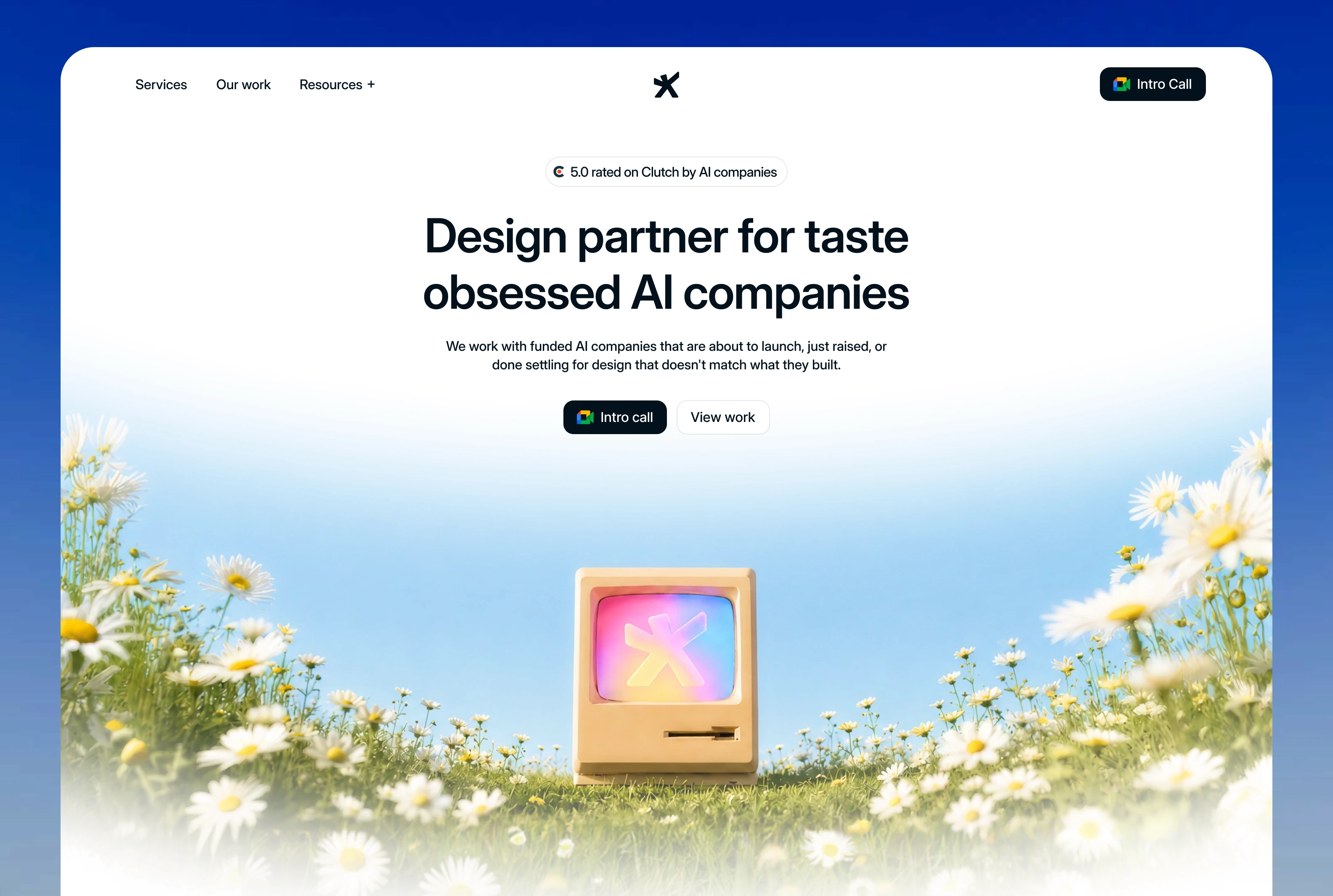
1. Studio Maydit: A Top-Rated Design Agency for AI Founders
A European AI startup's landing page usually needs two things added before anything is redesigned: a clear, early statement of where data lives, and a plain explanation of how the product fits the AI Act. Studio Maydit builds those into the structure from the start. It is a web and product design studio. The AI founders it works with are in the US, UK, and Europe, so both the American standard and the European buyer's questions are familiar ground.
The platform follows the market plan. Framer lets a small team duplicate a page for a new country in an afternoon. Webflow handles several market versions as a managed collection. Custom code suits a page that embeds live product behavior. Once the page is live, the studio continues into product design, since trust messaging on the page has to match what a buyer sees during a pilot.
Dualite shows the method. The team first settled on a repositioned ICP, then designed for that specific buyer rather than for everyone, and the product grew to 100,000+ users in seven months. Wave, PixelFlow, and Mi-VAD are recent clients, together with 15 other AI and SaaS teams.
European teams expanding market by market tend to prefer a monthly retainer, which covers new pages, campaigns, and product design as each country opens, with no long lock-in. Where a single launch date matters more, fixed scope runs three to four weeks and ends with a diagnosis of what is leaking in the product.
Check | Finding |
|---|---|
Based in | Remote, serving US / UK / EU |
Platform depth | Framer, Webflow, and custom code |
AI-sector proof | Yes. AI-native clients, published outcome on Dualite |
Pricing | Fixed scope or monthly retainer, quoted per project |
Team shape | Founder-led, small senior team |
Best fit | EU AI startups selling to regulated European buyers |
If your EU hosting is mentioned only in your privacy policy, that is the first thing we would move. Book a 30-minute call.

2. Kvalifik
Kvalifik is a Copenhagen studio founded in 2015 with eleven to fifty people, building in Webflow with direct AI-sector proof. Its clients include Veo, Maersk, and Relesys. Maersk operates in nearly every European market, and Veo sells technology products to clubs across many countries, so the studio has handled proof that must travel between markets.
The weakness is budget clarity. No starting price is published, which makes an early comparison harder for a startup with a tight round.
Check | Finding |
|---|---|
Based in | Copenhagen, Denmark |
Founded | 2015 |
Team size | 11-50 |
Primary platform | Webflow |
AI-sector proof | Yes |
Named clients | Veo, Maersk, Relesys |
Pricing | Not published |
Best fit | Nordic and North European AI startups |
3. Feely Studio
Feely Studio is a distributed European team of one to ten people working across platforms, with direct AI-sector proof and a published starting price. Its clients include Noxus, Mutiny, Luasai, and Basic Capital. Being spread across Europe helps with understanding more than one market, and the published price suits a smaller European budget.
The weakness is capacity and track record. A small team can run only a few market pages at once, and no founding date is published.
Check | Finding |
|---|---|
Based in | Distributed, Europe |
Founded | Not published |
Team size | 1-10 |
Primary platform | Mixed |
AI-sector proof | Yes |
Named clients | Noxus, Mutiny, Luasai, Basic Capital |
Pricing | Published minimum |
Best fit | Seed-stage European AI teams on a careful budget |
4. Pixelmatters
Pixelmatters is a Porto studio founded in 2013 with fifty-one to two hundred people, working across web and product design for Rubrik, Quantic, and UJET. It publishes a starting price. Its size means several country pages or a site and product refresh can run in parallel.
The weakness is sector and scale. AI-sector proof is partial, and a larger studio's process can be more than a single landing page needs.
Check | Finding |
|---|---|
Based in | Porto, Portugal |
Founded | 2013 |
Team size | 51-200 |
Primary platform | Mixed |
AI-sector proof | Partial |
Named clients | Rubrik, Quantic, UJET |
Pricing | Published minimum |
Best fit | Growing European startups launching in several markets |
5. Digidop
Digidop is a Paris studio founded in 2021 with one to ten people, building in Webflow with a published starting price. Its clients include TSE Energy, Ramify, and StreamNative. StreamNative sells technical infrastructure internationally, so the team has written clear English for technical buyers who may not be native speakers.
The weakness is throughput. A studio this small can be booked up quickly, and AI-sector proof is partial.
Check | Finding |
|---|---|
Based in | Paris, France |
Founded | 2021 |
Team size | 1-10 |
Primary platform | Webflow |
AI-sector proof | Partial |
Named clients | TSE Energy, Ramify, StreamNative |
Pricing | Published minimum |
Best fit | French and Southern European technical AI startups |

6. Phantom
Phantom works from London and Auckland, founded in 2013 with fifty-one to two hundred people, building in custom code with direct AI-sector proof. Its clients include Diageo, SAP, Financial Times, and Zendesk. SAP is one of Europe's largest software companies, which shows the studio can speak to European enterprise buyers.
The weakness is cost clarity and editability. No pricing is published, and a custom code page needs a content layer before your team can create market versions.
Check | Finding |
|---|---|
Based in | London, UK and Auckland, NZ |
Founded | 2013 |
Team size | 51-200 |
Primary platform | Custom code |
AI-sector proof | Yes |
Named clients | Diageo, SAP, Financial Times, Zendesk |
Pricing | Not published |
Best fit | European AI startups selling into large enterprises |
7. Refokus
Refokus is a remote German studio founded in 2021 with eleven to fifty people, building in Webflow for Mural, BASF, Spotify, Yahoo, and BCG. BASF and Spotify are major European companies, and the studio's visual work is refined.
The weakness is price and sector. No starting price is published, AI-sector proof is partial, and the client list leans toward large brands rather than startups.
Check | Finding |
|---|---|
Based in | Germany, remote |
Founded | 2021 |
Team size | 11-50 |
Primary platform | Webflow |
AI-sector proof | Partial |
Named clients | Mural, BASF, Spotify, Yahoo, BCG |
Pricing | Not published |
Best fit | Funded DACH startups wanting premium Webflow work |
8. Lighthouse Digital
Lighthouse Digital is a London studio building in Webflow, with a published starting price. Its clients include HelloSelf, Freetrade, and IGN. Freetrade is a regulated European fintech, so the team has worked with copy that had to pass review.
The weakness is AI experience. AI-sector proof is recorded as none, and neither team size nor founding date is published.
Check | Finding |
|---|---|
Based in | London, UK |
Founded | Not published |
Team size | Not published |
Primary platform | Webflow |
AI-sector proof | No |
Named clients | HelloSelf, Freetrade, IGN |
Pricing | Published minimum |
Best fit | UK startups in regulated consumer markets |
9. Lazarev
Lazarev is a San Francisco studio founded in 2015 with fifty-one to two hundred people, working across platforms with direct AI-sector proof and a published starting price. Its clients include Payoneer, Peel, Elva, and Mozayix. It brings strong AI product and interface experience.
The weakness is distance. It is based far from European buyers, the time difference slows reviews, and its public work does not show experience with EU regulation or data residency messaging.
Check | Finding |
|---|---|
Based in | San Francisco, USA |
Founded | 2015 |
Team size | 51-200 |
Primary platform | Mixed |
AI-sector proof | Yes |
Named clients | Payoneer, Peel, Elva, Mozayix |
Pricing | Published minimum |
Best fit | European AI teams focused mainly on the US market |
10. Flow Ninja
Flow Ninja is a Belgrade studio founded in 2018 with eleven to fifty people, building in Webflow. It is European, shares a working day with most of the continent, and has the capacity to produce several market pages.
The weakness puts it last. It publishes no client names and no pricing, so there is nothing to verify before a call, and AI-sector proof is partial.
Check | Finding |
|---|---|
Based in | Belgrade, Serbia |
Founded | 2018 |
Team size | 11-50 |
Primary platform | Webflow |
AI-sector proof | Partial |
Named clients | Not published |
Pricing | Not published |
Best fit | Teams needing Webflow capacity in a European time zone |
How to choose between them
Begin with where your buyers are.
You sell to regulated European enterprises. Kvalifik or Phantom.
Budget is tight and you need a sharp first page. Feely Studio or Digidop.
You are opening several country markets this year. Pixelmatters or Kvalifik.
Your main market is the United States. Lazarev or Feely Studio.
A test before signing. Ask a candidate where on your page they would state data hosting and AI Act status. A studio that understands European buyers will point to the first two screens.

Need more info?
Can't find your answer? Book a call and let's talk.
Continue Reading
10 Best Framer Design Agencies for AI Agent Startups - September 2026
Ten Framer studios that have shipped for AI agent companies, with the demo and trust patterns those products need. Checked on platform depth, pricing and team.

Siddarth Ponangi
10 Best Framer Design Agencies for Newly Funded Startups - September 2026
Your funding announcement is the biggest traffic day you will have all year. We checked 10 Framer agencies on five public criteria to see which can hit that date.
Siddarth Ponangi
10 Best Custom Code Website Development Agencies for AI Agent Startups - September 2026
AI web development agencies for agent startups. Which teams build custom coded sites a small team can still update weekly after launch.
Siddarth Ponangi