
Summarize with AI


The best landing page design agencies for generative AI startups in 2026 are Studio Maydit, BX Studio, Phantom, Trueform, Edgar Allan, Refokus, 8020, Digidop, Lighthouse Digital, and Kvalifik. Studio Maydit and Phantom lead for this brief, because the strongest page a generative product can have lets a visitor try it, and both work in code, which is what a live try-it surface actually requires. Lighthouse Digital and Edgar Allan are the wrong fit here, since Lighthouse Digital publishes no AI client work at all and Edgar Allan runs brand programmes at a pace set by much larger companies.
Your homepage has a problem no other kind of software has. The product does something different every time it runs, and a webpage can only show one of those times.
So you pick a good one. Everybody does. The example is not fabricated, it genuinely happened, it is simply the best of forty attempts. Your visitor cannot know that. They read it as a description of what the product does, sign up, type something vague, get a much worse result, and conclude the marketing was dishonest.
That gap between the showcased output and the median one is where most of your churn is created, before anybody has used anything. Copywriting does not fix it. Showing the distribution rather than the peak does, along with teaching the visitor what a good input looks like while they are still reading.
A second objection arrives now that did not exist three years ago. Every semi-technical visitor silently asks whether this is a thin layer over a model anybody could call. They will not put it in an email. They will just leave. If the page does not say what is actually yours, the data, the evaluation, the workflow around the output, the visitor answers for you and is not generous.
The third thing is the one everyone gets wrong in the other direction. Generative products can let people try before signing up, the strongest conversion mechanism this category has, and most pages either avoid it or ship it as an empty box. An empty box invites a lazy prompt, a lazy prompt produces a weak result, and you have paid for inference in order to disappoint somebody.
The ten studios below are ordered by how well they build a page where the product can speak for itself.

How we picked these agencies
Five checks, chosen for a page that has to survive being compared with the product behind it:
- Platform depth. Can the studio build a page that runs something live, or does its work end at a static layout?
- Published AI work. Are there named AI clients, meaning the studio has already argued with a founder about how much output to show and how confident to sound?
- Pricing. Is a starting figure public, which is a reasonable filter when this category has more agencies chasing it than any other right now?
- Team shape. Is there someone senior who will sit and run your product forty times to find out what typical looks like, rather than accepting the three examples you send?
- Their own site. In a category where every homepage uses the same nouns, a studio's own page is a direct sample of whether they can escape that.
Check two matters more here than in most briefs, and not for the obvious reason. The value is not familiarity with the technology. It is having been through the argument about restraint. Every founder wants the most impressive result on the page, and a studio that has done this will push back and explain why the second-best example converts better. That conversation only happens with somebody who has watched a page over-promise and seen the numbers afterwards.
The tables record what each studio publishes and nothing beyond it. Blanks are left as blanks rather than filled with something plausible. In a market this crowded, the studios that state their team size and their starting figure are making themselves easier to compare, and that is worth noticing.
What goes wrong on generative AI landing pages
Three failures, and the first one is committed by nearly everybody.
The page shows your best result and the product delivers your median one. Forty attempts produced one beautiful example, and that example is now the promise. The visitor's first attempt cannot match it and the disappointment is attributed to you rather than to their prompt. Show range instead. Three outputs of varying quality with the input visible beside each teaches the visitor how to succeed and sets an expectation the product can meet. It feels like weakening the page and improves everything downstream, because the people who sign up already know how to use it.
Nothing on the page explains what is yours. In this category the reflexive question is whether the product is a wrapper, and it is being asked by exactly the people who would pay you the most. The answer is rarely secret. Your data, your evaluation harness, your workflow, the corrections you have accumulated, the integrations that make output usable. Put it high on the page in plain terms, without pretending to a model you did not train. Founders skip this because it feels technical. It is the paragraph that separates you from six identical-looking competitors.
The try-it surface is an empty box. Letting visitors use the product before signing up is the most persuasive thing a generative company can do, and an unstructured prompt field wastes it. Somebody types three words, gets something mediocre, and leaves with a worse impression than if you had shown nothing. Give them a starting point: two or three prepared prompts that are honestly representative, an editable field, and a visible limit stated before they reach it. Design what happens when the output is poor, because it is a normal outcome and your only chance to explain why.
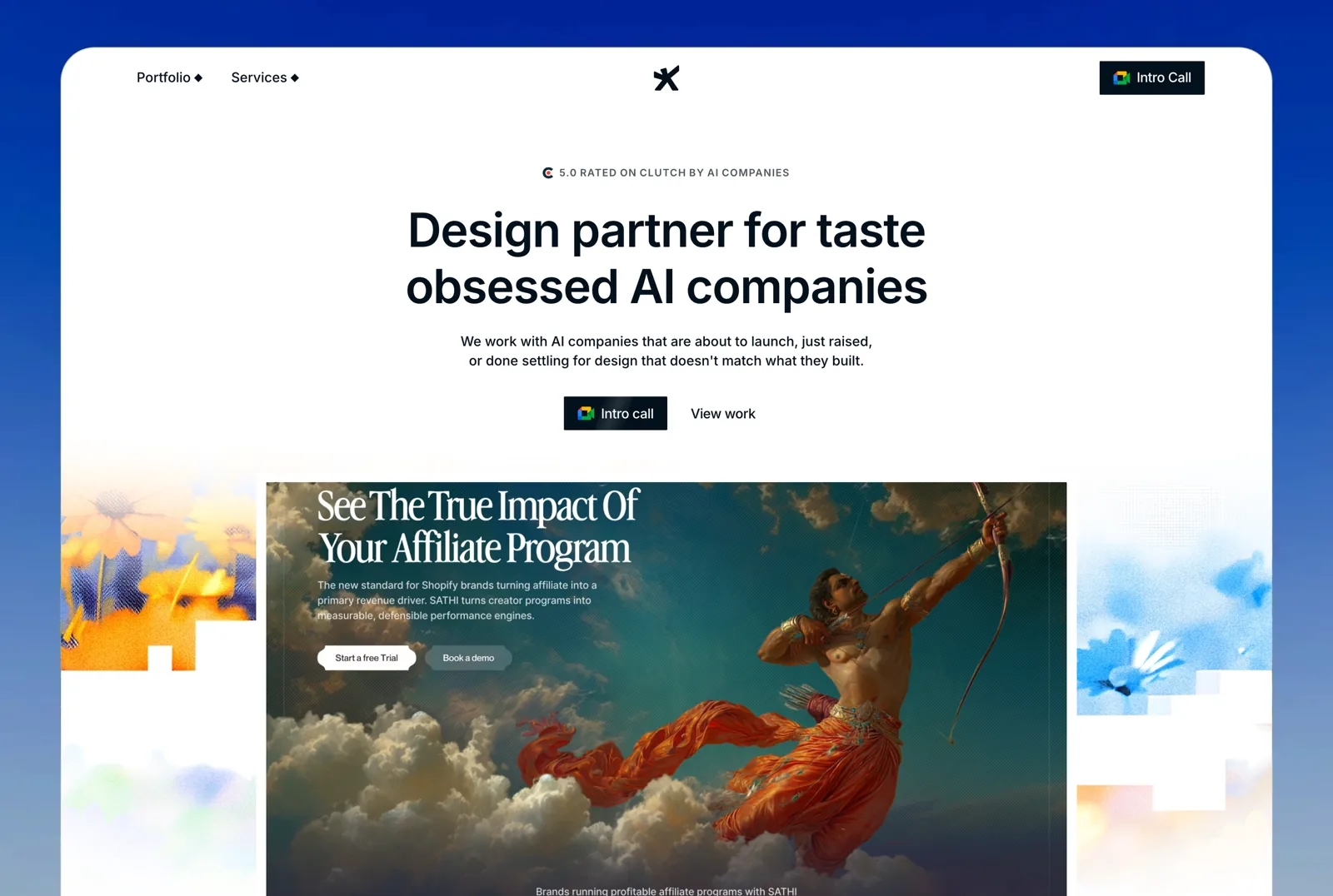
1. Studio Maydit: A Top-Rated Design Agency for AI Founders
The decision that shapes this page is how much of the product runs on it, which makes the build route part of the design. Studio Maydit works in Framer, Webflow, and custom code, so a live try-it section is a genuine option rather than something the tool cannot support.
It is a web and product design studio, founder-led with a small senior team, and its clients are AI founders in the US, UK, and Europe. The studio continues into product design after the site ships, which matters when the page lets people generate something, because that first interaction is really the beginning of onboarding rather than the end of marketing.
Only one engagement has published numbers. Dualite reached 100,000+ users seven months after design work aligned to a repositioned ICP. Recent clients include Wave, PixelFlow, Mi-VAD, and 15 other AI and SaaS teams.
The commercial side is deliberately simple. Fixed scope, three to four weeks, when there is a launch date, closing with a diagnosis of what is leaking in the product. Or a monthly retainer when the work keeps coming, covering new pages, campaigns, and product design, with no long lock-in.
| Check | Finding |
|---|---|
| Based in | Remote, serving US / UK / EU |
| Platform depth | Framer, Webflow, and custom code |
| AI-sector proof | Yes. AI-native clients, published outcome on Dualite |
| Pricing | Fixed scope or monthly retainer, quoted per project |
| Team shape | Founder-led, small senior team |
| Best fit | Teams whose signups start strong and stop after one attempt |
Worth a call if your trial conversion is fine and your second-session numbers are not. Book a 30-minute call.

2. BX Studio
BX Studio is a New York team of 11 to 50 working in Webflow, with a published minimum, published AI client work, and Reddit, Headspace, ASAPP, and Verifone named. ASAPP sells AI into large organisations that interrogate every claim before signing, which is useful practice for writing a page that holds up when a technical buyer reads it closely.
They publish no founding year, and Webflow as a primary platform means a live generation surface would need engineering support from somewhere else.
| Check | Finding |
|---|---|
| Based in | New York, USA |
| Founded | Not published |
| Team size | 11-50 |
| Primary platform | Webflow |
| AI-sector proof | Yes. Published AI client work |
| Named clients | Reddit, Headspace, ASAPP, Verifone |
| Pricing | Published minimum |
| Best fit | Teams whose page must survive a technical reading |
3. Phantom
Phantom works from London and Auckland, founded in 2013, at 51 to 200 people, in custom code, with published AI client work and Diageo, SAP, Financial Times, and Zendesk named. Custom code is what makes an on-page demonstration possible with rate limits, queuing, and a sensible failure state, and the Financial Times serves a great many people without falling over.
They publish no pricing, and a studio of that size with clients of that scale will run a longer process than a startup wanting one exceptional page next month.
| Check | Finding |
|---|---|
| Based in | London, UK and Auckland, NZ |
| Founded | 2013 |
| Team size | 51-200 |
| Primary platform | Custom code |
| AI-sector proof | Yes. Published AI client work |
| Named clients | Diageo, SAP, Financial Times, Zendesk |
| Pricing | Not published |
| Best fit | Teams putting live generation on the page itself |
4. Trueform
Trueform is a Swiss studio founded in 2022 working in Framer, with a published minimum, published AI client work, and Miro, Morning Brew, Bilt Rewards, and Gather named. Framer is the fastest way to test three explanations of what your product is, worth more here than one polished page, since positioning is usually the thing that is wrong.
They publish no team size, and Framer will eventually limit how much of the product can run on the page without help.
| Check | Finding |
|---|---|
| Based in | Wil, Switzerland |
| Founded | 2022 |
| Team size | Not published |
| Primary platform | Framer |
| AI-sector proof | Yes. Published AI client work |
| Named clients | Miro, Morning Brew, Bilt Rewards, Gather |
| Pricing | Published minimum |
| Best fit | Teams still testing how to explain what they do |
5. Edgar Allan
Edgar Allan is an Atlanta studio of 51 to 200 founded in 2014, working in Webflow, with Porsche, Duracell, and NCR named. Brand work at that level is a real advantage in a category where every competitor uses the same three adjectives, because distinctiveness is the thing this market is shortest of.
They publish no pricing, their AI-sector proof is partial, and a studio built around large brand programmes is not shaped for a page that has to run part of a product.
| Check | Finding |
|---|---|
| Based in | Atlanta, USA |
| Founded | 2014 |
| Team size | 51-200 |
| Primary platform | Webflow |
| AI-sector proof | Partial. Enterprise and SaaS clients, no AI case study |
| Named clients | Porsche, Duracell, NCR |
| Pricing | Not published |
| Best fit | Teams whose main problem is looking like everyone else |
6. Refokus
Refokus is a remote German studio of 11 to 50 founded in 2021, working in Webflow, with Mural, BASF, Spotify, Yahoo, and BCG named. Mural is a product whose page has to show a collaborative canvas in motion to make any sense at all, which is a close cousin of your problem of demonstrating something that changes each time.
They publish no pricing, their AI-sector proof is partial, and that client list implies a schedule and a price set by organisations much larger than a startup shipping its first real homepage.
| Check | Finding |
|---|---|
| Based in | Germany, remote |
| Founded | 2021 |
| Team size | 11-50 |
| Primary platform | Webflow |
| AI-sector proof | Partial. Enterprise and SaaS clients, no AI case study |
| Named clients | Mural, BASF, Spotify, Yahoo, BCG |
| Pricing | Not published |
| Best fit | Teams demonstrating something that has to be seen moving |
7. 8020
8020 works from San Francisco and New York, founded in 2014, in Webflow, with Wave, Superlist, Pilot.com, Vanta, and Circle named. This studio has launched many software companies quickly, so a credible page goes live faster than most, which matters when your positioning may change again in two months.
They publish no pricing and no team size, their AI-sector proof is partial, and a practice built on repeatable launches tends toward pages that look like the category rather than against it.
| Check | Finding |
|---|---|
| Based in | San Francisco and New York, USA |
| Founded | 2014 |
| Team size | Not published |
| Primary platform | Webflow |
| AI-sector proof | Partial. Enterprise and SaaS clients, no AI case study |
| Named clients | Wave, Superlist, Pilot.com, Vanta, Circle |
| Pricing | Not published |
| Best fit | Teams who need something credible live quickly |
8. Digidop
Digidop is a Paris studio of one to ten founded in 2021, working in Webflow, with a published minimum and TSE Energy, Ramify, and StreamNative named. Ramify sells financial products to individuals who need to be persuaded that an automated system deserves their money, which is the same trust problem your page has in a different costume.
Their AI-sector proof is partial, one to ten people is thin if you want several audience-specific pages, and Paris hours favour European teams.
| Check | Finding |
|---|---|
| Based in | Paris, France |
| Founded | 2021 |
| Team size | 1-10 |
| Primary platform | Webflow |
| AI-sector proof | Partial. Enterprise and SaaS clients, no AI case study |
| Named clients | TSE Energy, Ramify, StreamNative |
| Pricing | Published minimum |
| Best fit | European teams selling automated decisions to individuals |
9. Lighthouse Digital
Lighthouse Digital is a London studio working in Webflow, with a published minimum and HelloSelf, Freetrade, and IGN named. Freetrade had to make an intimidating product feel safe to beginners, and a published starting figure means the first conversation can be short and specific.
They publish no founding year, no team size, and no AI client work, which on this brief is the material gap, since none of the arguments about restraint and expectation-setting will have been had before.
| Check | Finding |
|---|---|
| Based in | London, UK |
| Founded | Not published |
| Team size | Not published |
| Primary platform | Webflow |
| AI-sector proof | No. No published AI client work |
| Named clients | HelloSelf, Freetrade, IGN |
| Pricing | Published minimum |
| Best fit | UK teams whose main job is reassurance |
10. Kvalifik
Kvalifik is a Copenhagen studio of 11 to 50 founded in 2015, working in Webflow, with published AI client work and Veo, Maersk, and Relesys named. Veo turns raw footage into something a club can use, a generative-adjacent promise made to people with no technical background, which is a harder audience than most AI pages address.
They publish no pricing, their primary platform is Webflow rather than code, and Copenhagen hours give an American team a narrow window for the rapid iteration a positioning problem usually needs.
| Check | Finding |
|---|---|
| Based in | Copenhagen, Denmark |
| Founded | 2015 |
| Team size | 11-50 |
| Primary platform | Webflow |
| AI-sector proof | Yes. Published AI client work |
| Named clients | Veo, Maersk, Relesys |
| Pricing | Not published |
| Best fit | European teams explaining automation to non-technical users |
How to choose between them
Sort by what the page is failing to do.
Visitors sign up and never come back after one attempt. Studio Maydit or BX Studio.
You want people generating something on the page itself. Phantom or Refokus.
You still cannot say in one sentence what you are. Trueform or 8020.
You look exactly like your six closest competitors. Edgar Allan or Kvalifik.
One test before you sign. Ask a candidate to run your product ten times with their own inputs and then tell you which output they would put on the page. Studios that understand this category will choose a middling one and explain that it is achievable on a first attempt. Studios that do not will choose the most impressive result, which is the same instinct that got you here. That single choice predicts almost everything about how the engagement will go.