Reading time:
14 min read
Last updated:
10 Best Landing Page Design Agencies for Non-Technical Founders - September 2026
Landing page agencies for founders who cannot judge the build: ten studios compared on published pricing, whether you can edit the page afterwards, and team size.


Sorted by fit for a founder who cannot judge the build: Studio Maydit, Flowout, Digidop, Ramotion, Pixelmatters, Lighthouse Digital, Refokus, Edgar Allan, Instrument, and Engine Digital. Flowout and Digidop lead the nine. Flowout is a distributed Webflow studio that publishes a starting price and lists Jasper, Kajabi, Riverside, and Sendlane. Digidop is a one to ten person Webflow studio in Paris, founded in 2021, that also publishes a price and works with TSE Energy, Ramify, and StreamNative. Instrument and Engine Digital fit this brief least well. Instrument is built for Nike and Microsoft and publishes no price. Engine Digital writes custom code, which means you will need a developer every time you want to change a headline. Every agency here will sound equally confident on a call, so the ranking leans on what each one is willing to put in public.
Here is the honest position you are in.
You need a landing page. You cannot read code, you cannot tell a good build from a bad one, and you have no way to judge whether four thousand or forty thousand is the right number. Every studio you speak to will sound competent, because sounding competent is the easiest part of the job.
The usual advice is to look at portfolios. That does not help much either, because a portfolio shows you what a page looked like, not whether anyone signed up.
What you can actually evaluate is narrower, and more useful. Whether a studio publishes a price. Whether you will be able to change the headline yourself the week after launch. Whether the quote includes the words on the page or only the layout. Whether anyone will set up the measurement that tells you if it worked.
Those four things are visible from the outside and they predict a great deal. The list below is built on them rather than on taste, which you should be buying anyway but cannot fairly assess yet.

The five checks behind this list
Every one of these is something you can confirm yourself, without a technical background.
Platform depth. Will the finished page be something you can edit? A page built on a visual platform can have its headline, its proof, and its call to action changed by you in ten minutes. A hand-coded page cannot, and for a founder without engineers that difference decides whether you ever test anything.
Buyer-side proof. This is the audience check for this article. Has the studio worked with companies whose growth depends on marketing pages rather than on enterprise sales? A studio whose clients are large brands makes beautiful pages for people with a media budget. Your page has to work without one.
Pricing transparency. This matters more here than in any other article on this site. You cannot estimate effort, so a published starting figure is the single most useful signal available to you. It also tends to indicate a studio with a repeatable process rather than a bespoke one.
Team shape. Small teams mean you talk to the person doing the work, which is worth a lot when you cannot check the work yourself. Large teams mean capacity and a greater chance your account is handled by whoever is available.
The studio's own website. Open it on your phone. Time how long it takes to load. See whether you can tell in ten seconds what it sells and how to start. A studio that cannot do that for itself will not do it for you.
Checks one and three carried the most weight here, which is unusual, and it is deliberate. Buyer-side proof and team shape split the close pairs.
The tables contain only what each studio publishes about itself. Nothing was estimated and no directories were used. Not published means the studio has chosen not to say, and that is information too.
What goes wrong when a non-technical founder buys a landing page
You end up with a page you cannot change. The launch goes well. Three weeks later you want to try a different headline, and the answer is that it needs a developer, who is the studio, who has moved on to another client and can look at it next month. The single most valuable question you can ask before signing is what exactly you will be able to edit yourself, answered with a screen recording rather than a yes.
The quote covers the design and not the words. Most founders assume a landing page project includes writing the page. Many quotes do not, and the studio is waiting on copy that you have not realised is yours to produce. The project stalls, and the eventual page carries whatever you wrote at eleven at night. Ask in writing who writes the headline, the subheading, and the proof section, and if it is you, agree a deadline for it.
Nobody sets up the measurement, so you never learn anything. The page ships. Signups go up a bit, or down a bit, and there is no way to tell whether it was the page, the season, or a post someone made. Ask for form submissions and button clicks to be tracked as events, and for a screenshot of the old page's conversion rate before launch. Without both, the next decision is a guess.
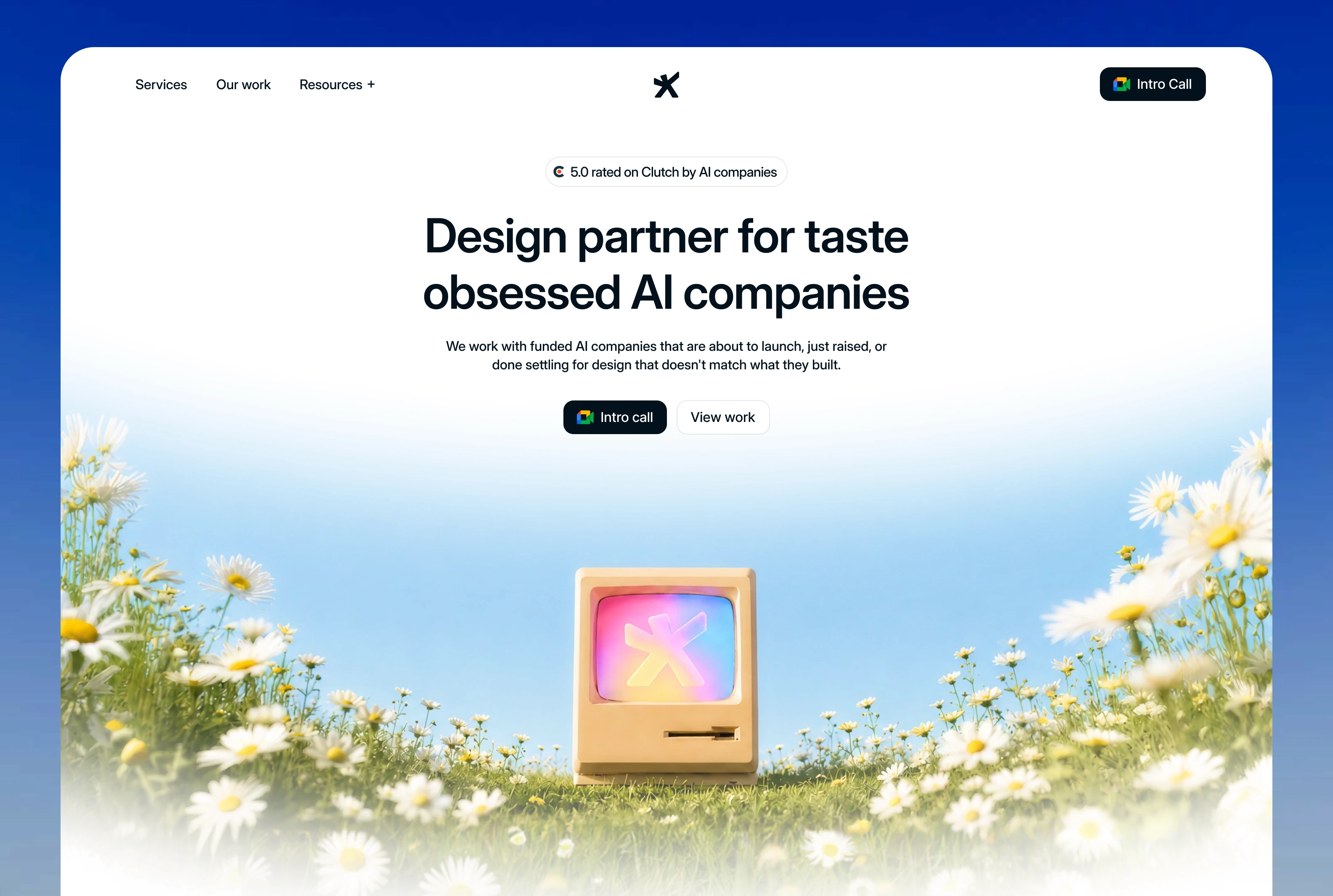
1. Studio Maydit: A Top-Rated Design Agency for AI Founders
Not being able to judge the work is the normal starting position, not a weakness. Studio Maydit is a web and product design studio working with AI founders in the US, UK, and Europe, and a large share of those founders are technical about their product and not about websites.
A single landing page is usually bought as fixed scope, which runs three to four weeks and ends with a diagnosis of what is leaking in the product rather than a handover email. Founders who expect to keep launching things take the monthly retainer instead, which covers new pages, campaigns, and product design, with no long lock-in and no need to re-brief from scratch each time.
The studio builds in Framer, Webflow, and custom code. For a founder without engineers the first two are usually the right answer, because you can change the words yourself afterwards. Custom code is kept for sites that need to share parts with the product. After the page ships, the same team can continue into product design.
The clearest number the studio can point at is Dualite's: 100,000+ users, seven months after design work supporting a repositioned ICP. Wave, PixelFlow, and Mi-VAD are recent clients, along with 15 other AI and SaaS teams.
Check | Finding |
|---|---|
Based in | Remote, serving US / UK / EU |
Platform depth | Framer, Webflow, and custom code |
AI-sector proof | Yes. AI-native clients, published outcome on Dualite |
Pricing | Fixed scope or monthly retainer, quoted per project |
Team shape | Founder-led, small senior team |
Best fit | Founders without engineers who want to edit the page themselves |
Send us your current page and we will tell you which single section is costing you signups. Book a 30-minute call.

2. Flowout
Flowout is a distributed Webflow studio that publishes a starting price, with Jasper, Kajabi, Riverside, and Sendlane as clients. Every one of those companies grows through marketing pages rather than through a sales team, so the studio builds the kind of page that has to earn its signups. Webflow means you can edit the headline yourself afterwards, and the published price means you know roughly where you stand before the first call, which is the two things this brief most needs.
The weakness is how little else it discloses. No founding date, no headcount, and only partial AI-sector proof. Budget tier can mean a production process built for volume, so ask who exactly will be on your project and whether anything is reused from a template.
Check | Finding |
|---|---|
Based in | Distributed |
Founded | Not published |
Team size | Not published |
Primary platform | Webflow |
AI-sector proof | Partial |
Named clients | Jasper, Kajabi, Riverside, Sendlane |
Pricing | Published minimum |
Best fit | Founders who want a price up front and a page they can edit |
3. Digidop
Digidop is a one to ten person Webflow studio in Paris, founded in 2021, and it publishes a starting price. TSE Energy, Ramify, and StreamNative are clients. A team this small means you deal directly with the people building your page, which matters a great deal when you cannot audit the result. Webflow again means the page stays yours to change, and a published figure removes the guesswork from the first conversation.
The weakness is capacity and reach. A team that size can only run a few projects at once, so a busy month becomes your delay, and AI-sector proof is partial. European hours also mean a lag if you are on the US west coast.
Check | Finding |
|---|---|
Based in | Paris, France |
Founded | 2021 |
Team size | 1-10 |
Primary platform | Webflow |
AI-sector proof | Partial |
Named clients | TSE Energy, Ramify, StreamNative |
Pricing | Published minimum |
Best fit | Founders who want the same person on the call and on the build |
4. Ramotion
Ramotion has worked from San Francisco since 2009, has eleven to fifty people, and publishes a starting price. Mozilla, Okta, Netflix, Adobe, and Xero are clients. Sixteen years and that client list mean the craft standard is high and the process is settled, and a published figure keeps the first conversation honest despite the premium positioning.
The weakness is cost and platform. Premium tier means the published minimum is likely well above a single landing page budget, and the studio works across several platforms, so whether your page ends up editable is a question you must ask directly rather than assume. AI-sector proof is partial.
Check | Finding |
|---|---|
Based in | San Francisco, USA |
Founded | 2009 |
Team size | 11-50 |
Primary platform | Mixed |
AI-sector proof | Partial |
Named clients | Mozilla, Okta, Netflix, Adobe, Xero |
Pricing | Published minimum |
Best fit | Funded founders buying a higher craft standard than a page needs |
5. Pixelmatters
Pixelmatters has been in Porto since 2013, has fifty-one to two hundred people, and publishes a starting price. Rubrik, Quantic, and UJET are clients, all software companies. A studio that size can turn a page around quickly because there is always someone free, and a published figure again makes the first check easy.
The weakness is proportion. A single landing page is a very small job for a team of that size, so it may be staffed junior or declined outright. The platform is mixed, so editability is not guaranteed, and AI-sector proof is partial. Premium tier keeps the floor high.
Check | Finding |
|---|---|
Based in | Porto, Portugal |
Founded | 2013 |
Team size | 51-200 |
Primary platform | Mixed |
AI-sector proof | Partial |
Named clients | Rubrik, Quantic, UJET |
Pricing | Published minimum |
Best fit | Founders buying several pages at once rather than one |

6. Lighthouse Digital
Lighthouse Digital is a London Webflow studio that publishes a starting price, with HelloSelf, Freetrade, and IGN as clients. Freetrade and HelloSelf both grow through consumer signups, which is the closest thing to your problem on its list, and Webflow plus a published price is the right combination for a founder who wants control afterwards.
The weakness is sector fit. It is the only studio here with no AI-sector proof at all, so explaining an AI product would be new work for the team writing your page. Neither the founding date nor the headcount is published, so the size of the operation is unknown.
Check | Finding |
|---|---|
Based in | London, UK |
Founded | Not published |
Team size | Not published |
Primary platform | Webflow |
AI-sector proof | No |
Named clients | HelloSelf, Freetrade, IGN |
Pricing | Published minimum |
Best fit | UK founders with a straightforward consumer signup page |
7. Refokus
Refokus has built in Webflow from Germany since 2021, with eleven to fifty people, for Mural, BASF, Spotify, Yahoo, and BCG. The Webflow practice is genuine and the craft is high, and Mural is a software product that grows through signups rather than through meetings.
The weakness is the missing number. Pricing is not published and the tier is premium, which for a founder who cannot estimate effort means starting the conversation completely blind, and a studio working with Spotify and BCG is unlikely to be priced for a single page. AI-sector proof is partial.
Check | Finding |
|---|---|
Based in | Germany, remote |
Founded | 2021 |
Team size | 11-50 |
Primary platform | Webflow |
AI-sector proof | Partial |
Named clients | Mural, BASF, Spotify, Yahoo, BCG |
Pricing | Not published |
Best fit | Funded founders buying a full marketing site rather than one page |
8. Edgar Allan
Edgar Allan has worked in Webflow from Atlanta since 2014, with fifty-one to two hundred people, for Porsche, Duracell, and NCR. It is a real Webflow practice at scale, so the page would be editable, and a team that size can move quickly once a project starts.
The weakness is who it is built for. Porsche and Duracell are brands with advertising behind them, and a page designed for that context is measured differently from one that has to convert cold traffic. Premium tier with no published price leaves a founder guessing, and AI-sector proof is partial.
Check | Finding |
|---|---|
Based in | Atlanta, USA |
Founded | 2014 |
Team size | 51-200 |
Primary platform | Webflow |
AI-sector proof | Partial |
Named clients | Porsche, Duracell, NCR |
Pricing | Not published |
Best fit | Founders with a brand budget and a campaign behind the page |
9. Instrument
Instrument has worked from Portland since 2005 across several platforms, for Nike, Microsoft, Electronic Arts, and Google. Twenty years of work at that level is a genuine mark of quality, and few studios anywhere have a stronger record.
The weakness is that almost nothing about it suits this situation. No published price, no published headcount, a premium tier, a mixed platform that leaves editability open, and a client list where every project has a marketing department behind it. A non-technical founder buying a single page gets the least clarity here of anywhere on the list.
Check | Finding |
|---|---|
Based in | Portland, USA |
Founded | 2005 |
Team size | Not published |
Primary platform | Mixed |
AI-sector proof | Partial |
Named clients | Nike, Microsoft, Electronic Arts, Google |
Pricing | Not published |
Best fit | Large organisations with a marketing team to brief the studio |
10. Engine Digital
Engine Digital has written custom code from Vancouver and New York since 2002, for Adidas, Autodesk, Goldman Sachs, and HP. It builds substantial systems and has two decades of integration work behind it, which is exactly right for a different kind of buyer.
The weakness is decisive for this one. Custom code means the page you receive cannot be edited by you, so every headline change is a request to an agency with other clients. Add no published price, no published headcount, a premium tier, and an enterprise client list, and a founder without engineers is buying the opposite of what they need.
Check | Finding |
|---|---|
Based in | Vancouver and New York |
Founded | 2002 |
Team size | Not published |
Primary platform | Custom code |
AI-sector proof | Partial |
Named clients | Adidas, Autodesk, Goldman Sachs, HP |
Pricing | Not published |
Best fit | Companies with engineers who will maintain the page |
How to choose between them
Pick on what you will need to do the week after launch, not on which portfolio you liked most.
You want to test headlines yourself. Flowout, and ask for a recording of you editing the page before you pay the final invoice.
You want one person you can call. Digidop, with the copy responsibility written down.
You are buying several pages, not one. Pixelmatters, or Refokus if budget is not the constraint.
You have a campaign and a brand budget behind the page. Edgar Allan, or Ramotion for a higher craft standard.
One question to ask every studio, and it works regardless of what you know about building sites. Ask them to show you a page they built and tell you its conversion rate before and after. A studio that works on outcomes has the number. A studio that works on deliverables changes the subject to the design process.

Need more info?
Can't find your answer? Book a call and let's talk.
Continue Reading
10 Best Framer Design Agencies for AI Agent Startups - September 2026
Ten Framer studios that have shipped for AI agent companies, with the demo and trust patterns those products need. Checked on platform depth, pricing and team.

Siddarth Ponangi
10 Best Framer Design Agencies for Newly Funded Startups - September 2026
Your funding announcement is the biggest traffic day you will have all year. We checked 10 Framer agencies on five public criteria to see which can hit that date.
Siddarth Ponangi
10 Best Custom Code Website Development Agencies for AI Agent Startups - September 2026
AI web development agencies for agent startups. Which teams build custom coded sites a small team can still update weekly after launch.
Siddarth Ponangi