
Summarize with AI


The best landing page design agencies for YC-backed AI startups in 2026 are Studio Maydit, Fantasy, Push Refresh, 8020, Refokus, Instrument, Finsweet, Flowout, Flow Ninja, and Digidop. Studio Maydit and 8020 lead for this brief, because both work on the commercial pages of early software companies, and 8020 has built for Wave, Vanta, Pilot.com, and Circle, which are exactly the companies a batch startup is benchmarked against a year later. Instrument and Fantasy are the wrong fit here, since both are long-established brand firms built for large programmes, one names no clients at all, and neither publishes a starting price.
There is a version of your website that is completely correct for about four months, and then quietly starts costing you money.
You know the one. A short headline, a clear sentence about what it does, a button, and almost nothing else. That page is good advice while you are still finding out what you are selling. It ships in an afternoon, it does not lie, and it lets you change direction on a Tuesday without throwing away work.
The trouble starts when the audience changes and the page does not. During the batch the readers are investors, batchmates, and a handful of friendly design partners who already understand the context. After the batch the readers are buyers who have never heard of you, arriving cold, comparing you against a competitor who raised eighteen months earlier and has a real site.
Two specific things go wrong at that point. The first is sameness. A few hundred companies come out of the same window with pages built from the same defaults, and to somebody evaluating five of you in an afternoon, they blur. Not because any one page is bad, but because none of them is distinguishable.
The second is that the page is still pitching. Copy that talks about the size of the market, the team's background, or the inevitability of the category was written for a room full of investors. A buyer reading that is looking for what it does and whether it works with what they already have, and finding neither.
There is also a timing question nobody warns you about. Building a serious site too early is genuinely wasteful, because AI companies in this cohort change what they do more than once. The skill is knowing when the position has stopped moving enough to be worth building on, and that moment usually arrives before founders notice it.
The ten studios below are ranked on how well they handle a company whose story is now settled but whose website still belongs to an earlier one.

How we picked these agencies
Five checks, all answerable in a browser before anyone sends a calendar link:
- Platform depth. Does the studio ship a live page, or hand over a file for your one engineer to build?
- Proof with early companies. Is there published work for startups that were still changing direction, or is the portfolio all established brands?
- Pricing. Is a starting number public, which matters when the budget is a slice of a seed round?
- Team shape. Will a senior person do the work, or supervise somebody junior doing it?
- Their own site. Does it say something specific, or does it read like every other studio in the category? That is the exact problem you are hiring them to solve.
The second check earns its place here. A studio used to established companies will ask for brand guidelines, an approved message architecture, and a stakeholder map. You have none of those, and you are not going to have them by Friday.
The tables record only what each studio publishes about itself. Where something has never been made public, the row says so rather than guessing at it.
What goes wrong after the batch ends
Three failures show up in almost every one of these companies, and they all come from the page serving an audience that has moved on.
The site is still pitching investors. Market size, category inevitability, and the founders' backgrounds sit above the fold, because that copy was written for a room where those things mattered. A buyer reads it as a company talking about itself. Rewrite the first screen for somebody who has a problem right now, and move the story about why this category is huge to a place where an investor will still find it. The team page can do more work for you than a paragraph about ambition ever will.
Everything looks like everything else. The same section order, the same gradient, the same three-card feature row, because the whole cohort reached for the same defaults under the same time pressure. On its own each page is fine. Side by side they are interchangeable, and a buyer comparing four options will remember the one that looked like a real company. The fix is not more decoration. It is usually one genuinely specific thing: a real screenshot instead of an abstraction, a named customer, a number you can defend, a sentence nobody else could write.
The sharpest sentence you own is not on the page. Batch companies get drilled into a one-line description that is clear, concrete, and memorable, and then the website opens with something vaguer, because a headline felt like it should sound bigger. That one line is the most tested piece of copy you have. Put it where the visitor lands, unedited. Founders resist this because the sentence feels too plain to them after saying it two hundred times. It is not plain to somebody hearing it once.
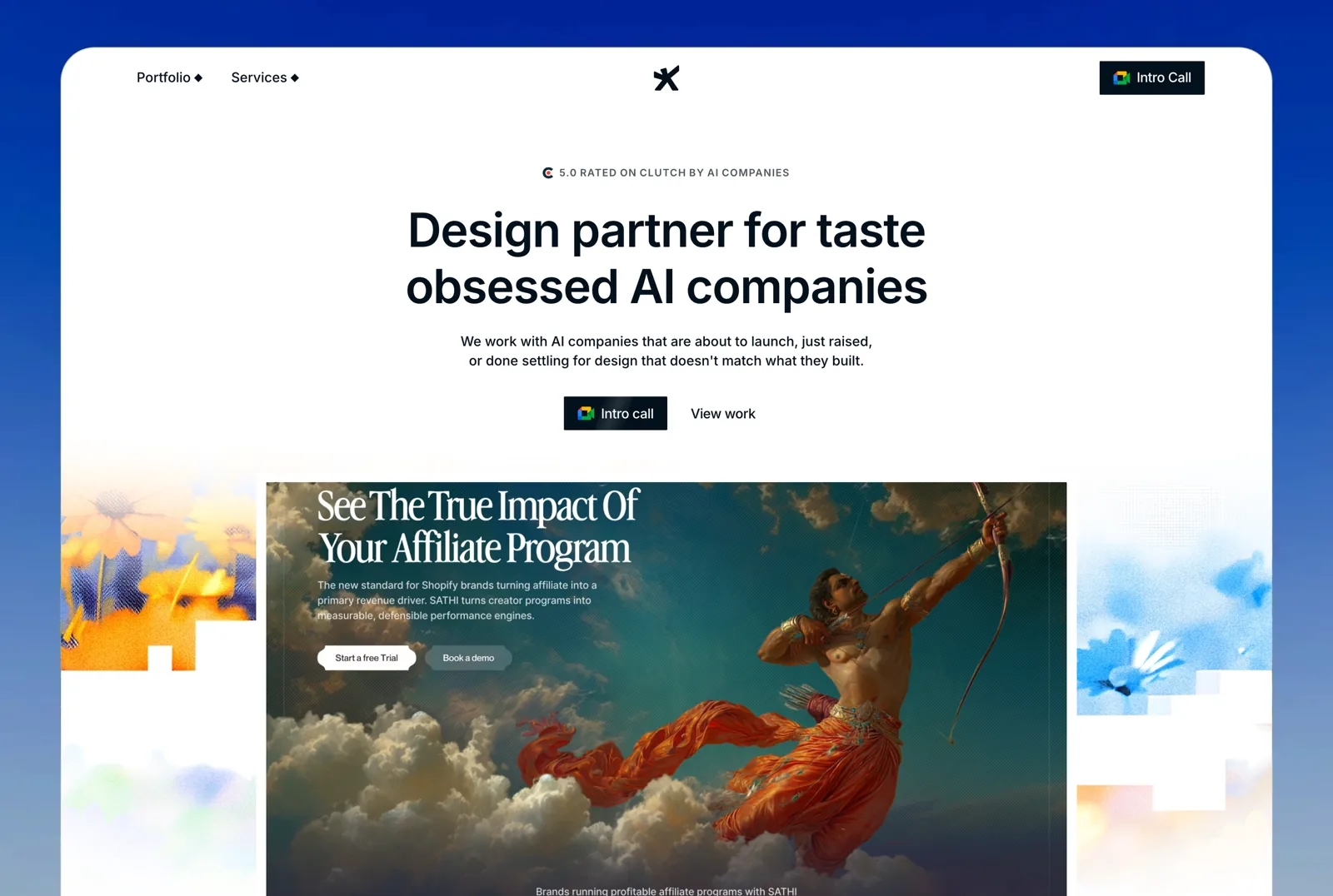
1. Studio Maydit: A Top-Rated Design Agency for AI Founders
A company coming out of a batch usually needs one thing built quickly and well, not a long programme. That is what the fixed scope is for at Studio Maydit: three to four weeks, sized for a team with a date rather than a roadmap. Teams that keep shipping afterwards move to a monthly retainer instead, covering new pages, campaigns, and product design, with no long lock-in. Every fixed-scope project ends with a diagnosis of what is leaking in the product, which for a young company is usually the gap between what the page promises and what the first session delivers.
It is a web and product design studio. The clients are AI founders, based in the US, UK, and Europe. Builds happen in Framer, Webflow, and custom code, so the page can be handed to a non-technical founder to edit or built properly in code, depending on who will own it. The work continues into product design after the site ships.
Dualite is the relevant case for anyone whose position has just changed. Design work built around a repositioned ICP was followed by 100,000+ users inside seven months. Wave, PixelFlow, Mi-VAD, and 15 other AI and SaaS teams appear on the recent list.
| Check | Finding |
|---|---|
| Based in | Remote, serving US / UK / EU |
| Platform depth | Framer, Webflow, and custom code |
| AI-sector proof | Yes. AI-native clients, published outcome on Dualite |
| Pricing | Fixed scope or monthly retainer, quoted per project |
| Team shape | Founder-led, small senior team |
| Best fit | Batch companies whose site still speaks to investors |
Worth a call if the page has not changed since the position did. Book a 30-minute call.

2. Fantasy
Fantasy works from San Francisco and New York, founded in 1999, across platforms, with published AI client work. Nearly three decades of building interfaces means the strategic conversation is unusually well informed, and a founder who cannot articulate what makes their product different will get a serious answer rather than a mood board.
They publish no client names, no team size, and no pricing, which leaves a young company with almost nothing to evaluate and a firm of that vintage priced well beyond most seed budgets.
| Check | Finding |
|---|---|
| Based in | San Francisco and New York, USA |
| Founded | 1999 |
| Team size | Not published |
| Primary platform | Mixed |
| AI-sector proof | Yes. Published AI client work |
| Named clients | Not published |
| Pricing | Not published |
| Best fit | Later-stage teams funding a long brand programme |
3. Push Refresh
Push Refresh is a Dallas team of one to ten working in Framer, with a published minimum and SmithRx, Synonym, and Northern National named. Framer plus a published price is a practical combination straight after a batch, because the page ships fast and a non-technical founder can keep editing it without asking an engineer for help.
They publish no founding year, their AI-sector proof is partial, and a one to ten person studio has limited room if your launch collides with another client's.
| Check | Finding |
|---|---|
| Based in | Dallas, USA |
| Founded | Not published |
| Team size | 1-10 |
| Primary platform | Framer |
| AI-sector proof | Partial. Enterprise and SaaS clients, no AI case study |
| Named clients | SmithRx, Synonym, Northern National |
| Pricing | Published minimum |
| Best fit | Founders who will edit the page themselves afterwards |
4. 8020
8020 works from San Francisco and New York, founded in 2014, in Webflow, with Wave, Superlist, Pilot.com, Vanta, and Circle named. Every one of those was a young software company that had to look established before it was, which is the specific transition this article is about, and the results are public enough to study.
They publish no pricing and no team size, and their AI-sector proof is partial, so the AI-specific framing will come from you rather than from their existing portfolio.
| Check | Finding |
|---|---|
| Based in | San Francisco and New York, USA |
| Founded | 2014 |
| Team size | Not published |
| Primary platform | Webflow |
| AI-sector proof | Partial. Enterprise and SaaS clients, no AI case study |
| Named clients | Wave, Superlist, Pilot.com, Vanta, Circle |
| Pricing | Not published |
| Best fit | Startups who need to look funded before they look old |
5. Refokus
Refokus is a remote German team of 11 to 50, founded in 2021, working in Webflow, with Mural, BASF, Spotify, Yahoo, and BCG named. If the sameness problem is what is hurting you, this is the studio in the list most likely to produce a page that does not resemble the rest of your cohort.
Their AI-sector proof is partial, they publish no pricing, and a highly expressive page can work against a young company whose main job is to be understood quickly.
| Check | Finding |
|---|---|
| Based in | Germany, remote |
| Founded | 2021 |
| Team size | 11-50 |
| Primary platform | Webflow |
| AI-sector proof | Partial. Enterprise and SaaS clients, no AI case study |
| Named clients | Mural, BASF, Spotify, Yahoo, BCG |
| Pricing | Not published |
| Best fit | Teams whose page is indistinguishable from their cohort |
6. Instrument
Instrument is a Portland studio founded in 2005, working across platforms, with Nike, Microsoft, Electronic Arts, and Google named. Twenty years of positioning work at that level means a founder gets a genuine strategic partner, and the questions asked in week one tend to be the ones nobody internally wanted to raise.
They publish no pricing and no team size, their AI-sector proof is partial, and the engagement is built for organisations with a marketing function rather than three people and a deadline.
| Check | Finding |
|---|---|
| Based in | Portland, USA |
| Founded | 2005 |
| Team size | Not published |
| Primary platform | Mixed |
| AI-sector proof | Partial. Enterprise and SaaS clients, no AI case study |
| Named clients | Nike, Microsoft, Electronic Arts, Google |
| Pricing | Not published |
| Best fit | Funded companies rebuilding brand and site together |
7. Finsweet
Finsweet is a Denver-based distributed team of 51 to 200, founded in 2017, working in Webflow, with Dropbox, GitHub, and Steadily named. They push Webflow well past its defaults, which is how you get a page that does not look like the rest of the batch while still being editable by a founder on a Sunday.
Their AI-sector proof is partial, they publish no pricing, and their centre of gravity is technical Webflow craft rather than the positioning argument a post-batch company usually needs settled first.
| Check | Finding |
|---|---|
| Based in | Denver, USA, distributed |
| Founded | 2017 |
| Team size | 51-200 |
| Primary platform | Webflow |
| AI-sector proof | Partial. Enterprise and SaaS clients, no AI case study |
| Named clients | Dropbox, Clay, GitHub, Steadily |
| Pricing | Not published |
| Best fit | Teams who know the message and want it built properly |
8. Flowout
Flowout is a distributed Webflow studio with a published minimum and Jasper, Kajabi, Riverside, and Sendlane named. The subscription model suits a company that will change its page several times in a year, which describes almost every AI startup in the first eighteen months after a batch.
They publish no founding year and no team size, their AI-sector proof is partial, and a throughput-based arrangement gives you production capacity rather than someone senior challenging the message.
| Check | Finding |
|---|---|
| Based in | Distributed |
| Founded | Not published |
| Team size | Not published |
| Primary platform | Webflow |
| AI-sector proof | Partial. Enterprise and SaaS clients, no AI case study |
| Named clients | Jasper, Kajabi, Riverside, Sendlane |
| Pricing | Published minimum |
| Best fit | Teams expecting several page changes over the next year |
9. Flow Ninja
Flow Ninja is a Belgrade team of 11 to 50, founded in 2018, working in Webflow. Building in Webflow keeps the page in the founders' hands afterwards, and a team of that size can take on a full site rather than only a single page.
They publish no client names and no pricing, so a company that needs to make a fast, evidence-based decision has very little to work from before the first call.
| Check | Finding |
|---|---|
| Based in | Belgrade, Serbia |
| Founded | 2018 |
| Team size | 11-50 |
| Primary platform | Webflow |
| AI-sector proof | Partial. Enterprise and SaaS clients, no AI case study |
| Named clients | Not published |
| Pricing | Not published |
| Best fit | Teams wanting a full site rather than one landing page |
10. Digidop
Digidop is a Paris team of one to ten, founded in 2021, working in Webflow, with a published minimum and TSE Energy, Ramify, and StreamNative named. StreamNative is technical infrastructure, so there is evidence of explaining a complicated product plainly, and the small team means the same people from first call to launch.
Their AI-sector proof is partial, one to ten people caps capacity, and European hours add a day to every round of feedback with a San Francisco team.
| Check | Finding |
|---|---|
| Based in | Paris, France |
| Founded | 2021 |
| Team size | 1-10 |
| Primary platform | Webflow |
| AI-sector proof | Partial. Enterprise and SaaS clients, no AI case study |
| Named clients | TSE Energy, Ramify, StreamNative |
| Pricing | Published minimum |
| Best fit | European teams who want a published price and one team |
How to choose between them
Sort by what is actually holding the page back.
The copy is still aimed at investors. Studio Maydit or 8020.
You look identical to everyone in your cohort. Refokus or Finsweet.
Nobody technical is free to build it. Push Refresh or Digidop.
The page will change four times this year. Flowout or Flow Ninja.
One test before you sign. Give a candidate ninety seconds with your current page and ask who they think it was written for. A studio that understands post-batch companies will say investors, and then point at the exact sentences that gave it away. A studio that answers with your target market has repeated your brief back to you and learned nothing from the page itself.
Once the shortlist is down to three and the proposals land, the next problem is that most of them will name no price at all. Our guide on comparing design agencies with no public prices reduces any proposal to the five lines you can put side by side.