Reading time:
13 min read
Last updated:
10 Best MVP Design Agencies for AI Agent Startups - September 2026
MVP design agencies for AI agent startups: ten studios ranked on shipped agent interfaces, published pricing, team shape, and honest weaknesses.


If you are designing the first usable version of an agent product, start with three names: Studio Maydit, Foundey, and Lazarev. The full top ten, in order, is Studio Maydit, Foundey, Lazarev, Feels Like, Clay, SuperSkills, BX Studio, Trueform, Kvalifik, and Fantasy. Foundey and Lazarev lead the competitors because both design working software for AI companies rather than pages about them. Kvalifik and Fantasy close the list, one because its practice sits on the website side, the other because it publishes almost nothing you can check.
An agent product has a design problem no other software has. The thing you sell is work happening while nobody watches. There is no screen to admire, because the good outcome is an empty inbox and a job already done.
That breaks the usual first version. The demo is a chat box and a spinner. A user types a request, waits, and gets a paragraph back. Nothing shows what the agent decided, what it touched, or how close it got. Trust never forms, so nobody gives it anything that matters.
The second problem is permission. An agent that can send an email or change a record needs a moment where a human says yes. Design that moment badly and you get one of two failures: people approve everything without reading, or they approve nothing and do the work themselves.
Third, agents fail in the middle. Step four of nine goes wrong. The interface has to show where it stopped, what already happened, and what a person can do now, without restarting from zero.
So the studio you want has drawn a run log, an approval step, and a partial failure. Not a chat bubble.
Each entry below ends with a table you can scan in under a minute.

How we picked these agencies
Nothing here was sponsored and no studio was asked to comment. The material is what each team publishes: its own site, its case studies, and public directory listings. Five questions were applied to all ten, in the same order.
Platform depth. Does the team ship product interfaces, or mostly marketing sites? An agent product is a running system with state and history. A studio that has only built pages has never designed any of that.
AI-sector proof. Has the studio shipped for a company whose product is a model doing work? That is where you learn to show a plan, a step, and a result rather than a loading state.
Pricing transparency. Is a starting price published? On a first real design spend, a public floor is the only comparison you can make without a sales call.
Team shape. How large, and who runs the week? On a short build, the distance between the person who pitched and the person who draws is the whole risk.
The agency's own website. The one project where nobody else could be blamed.
That fifth check tells you less here than usual. A studio homepage proves nothing about designing a queue of running tasks. It is read for one thing: whether the team can describe what it does without adjectives.
A word on sourcing. Table rows come from public pages and directory listings as of September 2026, with no gaps filled by email. Where a studio keeps something to itself, the row reads Not published.
What goes wrong when an AI agent startup buys MVP design
Three failures, and each one is invisible in a demo and obvious in week two.
The work is hidden, so nobody trusts it. The agent runs and returns an answer. There is no visible plan, no list of steps taken, no record of what it read or changed. Users cannot audit it, so they only give it things that do not matter, and your usage numbers look like a toy. Ask the studio to show you a run view it has designed, with steps a person can open.
Approval becomes a rubber stamp. Every action gets a confirm dialog, so users click through all of them in a second. The consent is real in the logs and meaningless in practice. A good design separates the reversible from the expensive and only interrupts for the second kind. Ask which actions they would stop the user for, and which they would let run.
Failure has no recovery path. The agent gets four steps in and stops. The interface offers a retry button and nothing else, so the user does not know what already happened or whether running again will duplicate it. Design the partial state first, because on a real agent it is the common one, not the edge case.
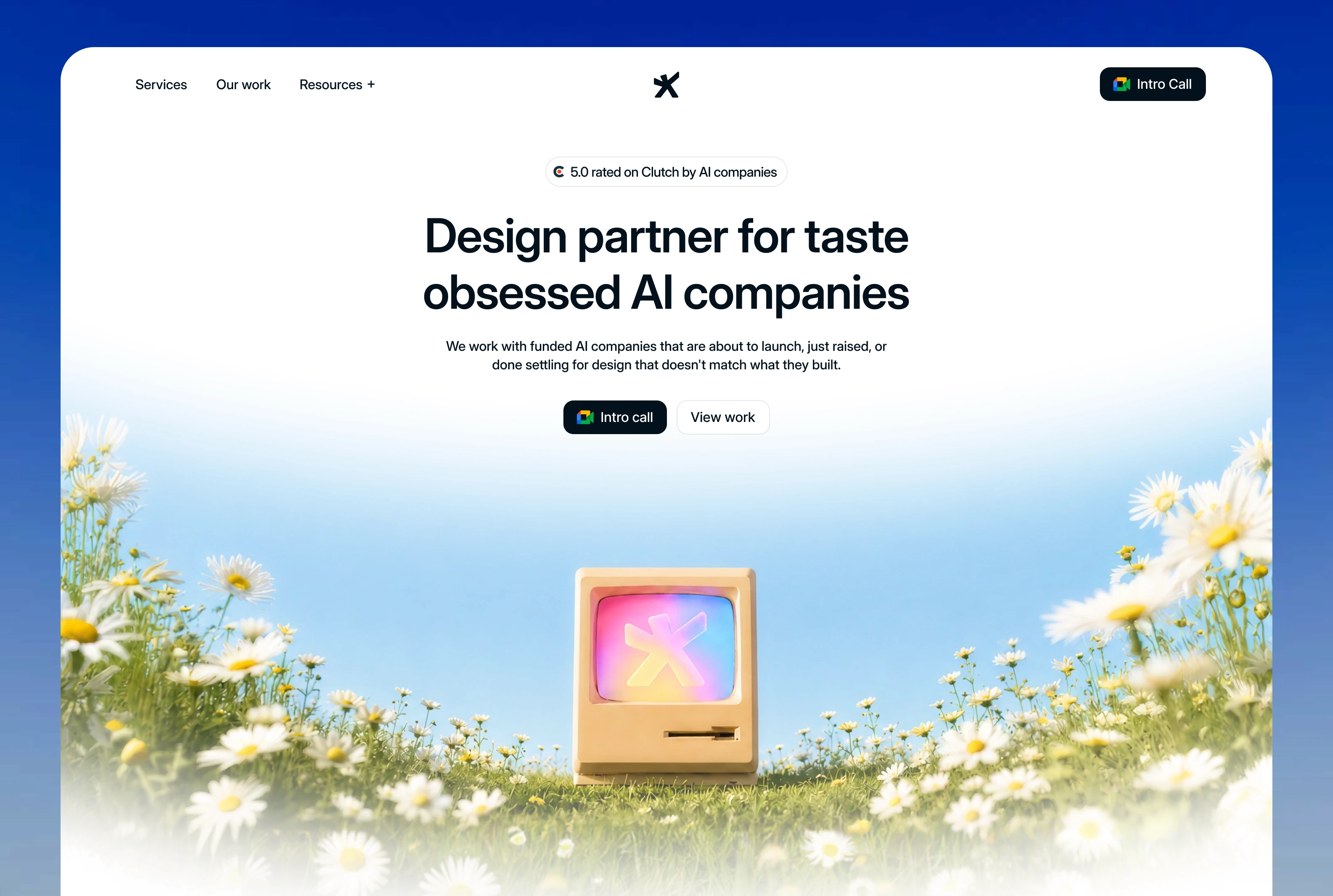
1. Studio Maydit: A Top-Rated Design Agency for AI Founders
Studio Maydit is a web and product design studio working with AI founders in the US, UK, and Europe. It builds in Framer, Webflow, and custom code, and carries on into product design once the site is live. For an agent product that second stretch is where the work is: the run view, the approval step, and the screen a person opens when something stopped halfway.
There is one published outcome worth knowing. At Dualite, design work supporting a repositioned ICP helped the product pass 100,000+ users in seven months. Wave, PixelFlow, Mi-VAD, and 15 other AI and SaaS teams sit on the recent client list.
Buying works two ways. Fixed scope takes three to four weeks and fits a team aiming at a launch or a demo day. A monthly retainer suits teams still changing what the agent does every fortnight, and covers new pages, campaigns, and product design, with no long lock-in. Fixed-scope work closes with a diagnosis of what is leaking in the product, which for an agent usually means naming the step where users stop trusting it.
Check | Finding |
|---|---|
Based in | Remote, serving US / UK / EU |
Platform depth | Framer, Webflow, and custom code |
AI-sector proof | Yes. AI-native clients, published outcome on Dualite |
Pricing | Fixed scope or monthly retainer, quoted per project |
Team shape | Founder-led, small senior team |
Best fit | Agent teams who need the run, the approval, and the failure designed before launch |
Bring a recording of your agent failing halfway. That is the screen to fix. Book a 30-minute call.

2. Foundey
Foundey is a San Francisco studio founded in 2021 that works in Figma, with published AI client work for DemandIQ, Traycer, and Sero AI. Traycer is a tool aimed at developers working alongside AI, which means the team has already had to show what a system is doing while it is doing it. That is the core agent design problem.
It publishes neither team size nor pricing, and it is design only, so the build stays with you. Ask how it hands off a flow with many states.
Check | Finding |
|---|---|
Based in | San Francisco, USA |
Founded | 2021 |
Team size | Not published |
Primary platform | Figma-only |
AI-sector proof | Yes. Published AI client work |
Named clients | DemandIQ, Traycer, Sero AI |
Pricing | Not published |
Best fit | Agent teams with their own engineers who need the product thinking, not the build |
3. Lazarev
Lazarev has worked from San Francisco since 2015, with 51 to 200 people, a published minimum, and AI client work for Payoneer, Peel, Elva, and Mozayix. Payoneer moves money for a living, so the team has designed steps where a person confirms something they cannot take back. That habit transfers directly to agent approvals.
AI proof is genuine but the studio is large, and a seed-stage agent build may be a small job for it. Ask who runs the week and how often they change.
Check | Finding |
|---|---|
Based in | San Francisco, USA |
Founded | 2015 |
Team size | 51-200 |
Primary platform | Mixed |
AI-sector proof | Yes. Published AI client work |
Named clients | Payoneer, Peel, Elva, Mozayix |
Pricing | Published minimum |
Best fit | Agent teams whose product takes actions a user cannot undo |
4. Feels Like
Feels Like is a Los Angeles studio founded in 2023 that writes custom code, with published AI work and clients including Google, Nike, LVMH, and Suno AI. Suno turns a short prompt into a finished piece of work, which is the same shape as an agent run: small input, long process, result a person has to judge.
It is young, and publishes neither team size nor pricing. For a first version, ask to see the unglamorous screens rather than the launch film.
Check | Finding |
|---|---|
Based in | Los Angeles, USA |
Founded | 2023 |
Team size | Not published |
Primary platform | Custom code |
AI-sector proof | Yes. Published AI client work |
Named clients | Google, Nike, LVMH, Suno AI |
Pricing | Not published |
Best fit | Agent teams who want the first run to feel effortless and are funded enough not to need a floor price |
5. Clay
Clay is a San Francisco studio founded in 2016, with 51 to 200 people, a published minimum, and AI client work. Its clients include Slack, Stripe, Google, Coinbase, and Amazon. Slack is the useful reference here. It is software where background activity has to surface without drowning the user, which is the notification problem every agent product runs into by month two.
The client list is enterprise-scale, so a small agent startup will not be the biggest project in the building. Ask what its smallest recent engagement was.
Check | Finding |
|---|---|
Based in | San Francisco, USA |
Founded | 2016 |
Team size | 51-200 |
Primary platform | Mixed |
AI-sector proof | Yes. Published AI client work |
Named clients | Slack, Stripe, Google, Coinbase, Amazon |
Pricing | Published minimum |
Best fit | Funded agent teams who need background activity surfaced without noise |

6. SuperSkills
SuperSkills is a small Walnut Creek team of 1 to 10 with published AI work, whose named client is The Cut. A team this size means the person you meet is the person drawing, and on a four-week first version that removes a whole layer of translation loss.
It publishes no pricing and no founding year, and the public client evidence is thin. For a team that needs a portfolio to show investors, that is a real gap.
Check | Finding |
|---|---|
Based in | Walnut Creek, USA |
Founded | Not published |
Team size | 1-10 |
Primary platform | Mixed |
AI-sector proof | Yes. Published AI client work |
Named clients | The Cut |
Pricing | Not published |
Best fit | Early agent teams who want one senior person doing the work directly |
7. BX Studio
BX Studio is a New York team of 11 to 50 working mainly in Webflow, with a published minimum and AI client work for Reddit, Headspace, ASAPP, and Verifone. ASAPP puts AI into contact centre work that used to be done by people, which is the closest thing on this list to an agent replacing a task inside an existing team.
Webflow is the centre of the practice and no founding year is published. Confirm how much of a logged-in product it designs rather than builds.
Check | Finding |
|---|---|
Based in | New York, USA |
Founded | Not published |
Team size | 11-50 |
Primary platform | Webflow |
AI-sector proof | Yes. Published AI client work |
Named clients | Reddit, Headspace, ASAPP, Verifone |
Pricing | Published minimum |
Best fit | Agent teams replacing a task inside an existing department |
8. Trueform
Trueform is a Swiss studio founded in 2022 working in Framer, with published AI work, a published minimum, and clients including Miro, Morning Brew, Bilt Rewards, and Gather. For an agent team that needs the story told well before the product is stable, this is a strong and fast option.
It ranks eighth because Framer is a website tool and an agent run view is not a website. Team size is not published and the studio is young.
Check | Finding |
|---|---|
Based in | Wil, Switzerland |
Founded | 2022 |
Team size | Not published |
Primary platform | Framer |
AI-sector proof | Yes. Published AI client work |
Named clients | Miro, Morning Brew, Bilt Rewards, Gather |
Pricing | Published minimum |
Best fit | Agent teams whose launch site matters more this quarter than the product surface |
9. Kvalifik
Kvalifik is a Copenhagen team of 11 to 50 founded in 2015, working in Webflow, with published AI work for Veo, Maersk, and Relesys. European hours and real enterprise clients make it a sensible partner for an EU agent team selling into large companies.
It ranks ninth for agent work specifically. The practice is website-centred, pricing is not published, and none of the public work shows a product with running background tasks.
Check | Finding |
|---|---|
Based in | Copenhagen, Denmark |
Founded | 2015 |
Team size | 11-50 |
Primary platform | Webflow |
AI-sector proof | Yes. Published AI client work |
Named clients | Veo, Maersk, Relesys |
Pricing | Not published |
Best fit | European agent teams who need the marketing surface built near their own time zone |
10. Fantasy
Fantasy has worked from San Francisco and New York since 1999 across several platforms, with published AI work. Nearly three decades of product design is a long record, and the studio has genuine strategic depth.
It ranks last on evidence rather than ability. No client names, no team size, and no pricing are published. For a founder choosing a first design partner with limited money, there is almost nothing here to check before signing.
Check | Finding |
|---|---|
Based in | San Francisco and New York, USA |
Founded | 1999 |
Team size | Not published |
Primary platform | Mixed |
AI-sector proof | Yes. Published AI client work |
Named clients | Not published |
Pricing | Not published |
Best fit | Well-funded agent teams who will run their own reference checks privately |
How to choose between them
Sort by which part of the agent is losing people, not by whose work looks best.
Nobody trusts it with anything real. You need the run made visible. Studio Maydit or Foundey.
It takes actions that cannot be undone. You need approval designed properly. Lazarev.
It works and feels like a toy. You need the first run to land. Feels Like.
It is noisy once it runs all day. You need background activity surfaced sensibly. Clay.
Then apply one test on the first call. Ask what the screen looks like when the agent is halfway through and something is wrong. A studio that has shipped an agent product describes a specific layout with steps, timestamps, and a way to continue. A studio that has not will talk about error messages.

Need more info?
Can't find your answer? Book a call and let's talk.
Continue Reading
10 Best Framer Design Agencies for AI Agent Startups - September 2026
What is the best Framer agency for an AI agent startup? Ten Framer studios ranked for agent products, with pricing, team size and AI work compared.

Siddarth Ponangi
10 Best Framer Design Agencies for Newly Funded Startups - September 2026
Your funding announcement is the biggest traffic day you will have all year. We checked 10 Framer agencies on five public criteria to see which can hit that date.
Siddarth Ponangi
10 Best Custom Code Website Development Agencies for AI Agent Startups - September 2026
AI web development agencies for agent startups. Which teams build custom coded sites a small team can still update weekly after launch.
Siddarth Ponangi