Reading time:
14 min read
Last updated:
10 Best MVP Design Agencies for AI Data Platforms - September 2026
Best MVP design agencies for AI data platforms: 10 studios compared on setup-flow work, AI proof, team size, and whether a minimum price is public.


For the first version of an AI data platform, call Studio Maydit first, then look hardest at basement.studio and Lazarev. Ranked by fit, the ten are Studio Maydit, basement.studio, Lazarev, Clay, Feely Studio, Digidop, SuperSkills, Edgar Allan, Flow Ninja, and Lighthouse Digital. basement.studio works in custom code and counts Scale AI and Vercel as clients. Lazarev has 51 to 200 people, published AI work, and a finance platform, Payoneer, on its record. Flow Ninja and Lighthouse Digital are the wrong fit for this job: the first names no clients at all, and the second shows no AI work.
Here is the odd thing about your product. On day one it has nothing to show. It stays empty until a customer connects a warehouse, and most customers cannot do that alone.
So the first screen a buyer meets is not a chart. It is a request for access. Someone has to create a read-only account, paste a key, and choose which schemas the model may see. That person is rarely the one who wanted the product.
This is where most data platform pilots die. The champion loves the demo. Then the ticket goes to the data team, sits for two weeks, and comes back full of questions. What exactly does it read? Where does the data go? Can we limit it to one schema?
An MVP in this market has two users before it has one. The data lead grants access and wants control. The business user wants an answer in plain words. Design only for the second and you never get past the first.
That changes what you need from a studio. Charts are the easy part. The hard part is a connection flow a careful engineer will finish, and an empty product that still feels alive.
Each studio below was judged on both halves, and each entry closes with a short spec table.

How this list was built
No studio paid to appear, and none saw its entry before it went live. We read what each one shows in public and scored all ten against the same five tests.
Platform depth. Can the studio ship product screens, with forms, settings, and live states, or does its work stop at the marketing site? A data platform MVP is mostly setup and settings.
AI-sector proof. Has it published work for AI companies, ideally ones that handle data at scale? A team that has shipped a model product already plans for the answer being wrong.
Pricing transparency. Does it publish a minimum at all? Your own buyers will want a number early. A studio that hides its floor turns your design budget into a guess.
Team shape. How big is it, and who does the work each week? A small team moves fast on a four-week first version. A large one brings research and more hands, plus more meetings.
The agency's own website. It is the one project where the studio had no client to blame.
We treat that fifth test as a ceiling. A studio's own site is the best it could do with full control. If its forms, menus, or pricing page are hard to use, your connection flow will not come out better.
A note on the data. The tables hold only what a studio has put in public, as of September 2026. If a studio keeps a fact private, the row reads Not published, and we did not fill the gap by asking around.
What goes wrong when an AI data platform builds its MVP
Three ways the first version fails, all of them before a customer's data ever reaches the screen.
The connection flow is designed last. The demo runs on a sample dataset someone loaded by hand, so nobody tests the real path. Then a pilot customer has to create a service account, set read-only rights, allow an IP address, and paste a key. Each step is a place to stall, and the person doing it has other work. Design this path first. Show exactly what access is needed and why. Give the champion a checklist they can forward to their data team, and give every error a plain fix instead of a code.
Only one seat is designed. Most teams design for the person asking questions. The person who signs off is the data lead, and they open the product looking for controls. Which tables can the model see? Who can invite others? Can a user be switched off in one click? If those screens are missing, the pilot stays a pilot. Version one needs a small admin area showing scope, users, and activity. It does not need to be big. It needs to exist, so the data lead can say yes without a meeting.
The MVP tries to be a BI tool. Early customers ask for dashboards, saved charts, exports, and scheduled reports, because their current tools have them. Say yes to all of it and you spend three months rebuilding a product they already pay for, with your real edge buried under menus. The first version should do one thing their current tools cannot, like answering a plain question across the whole warehouse, and do it well. Add one export so results can travel somewhere familiar. Then stop, and let usage decide what comes next.
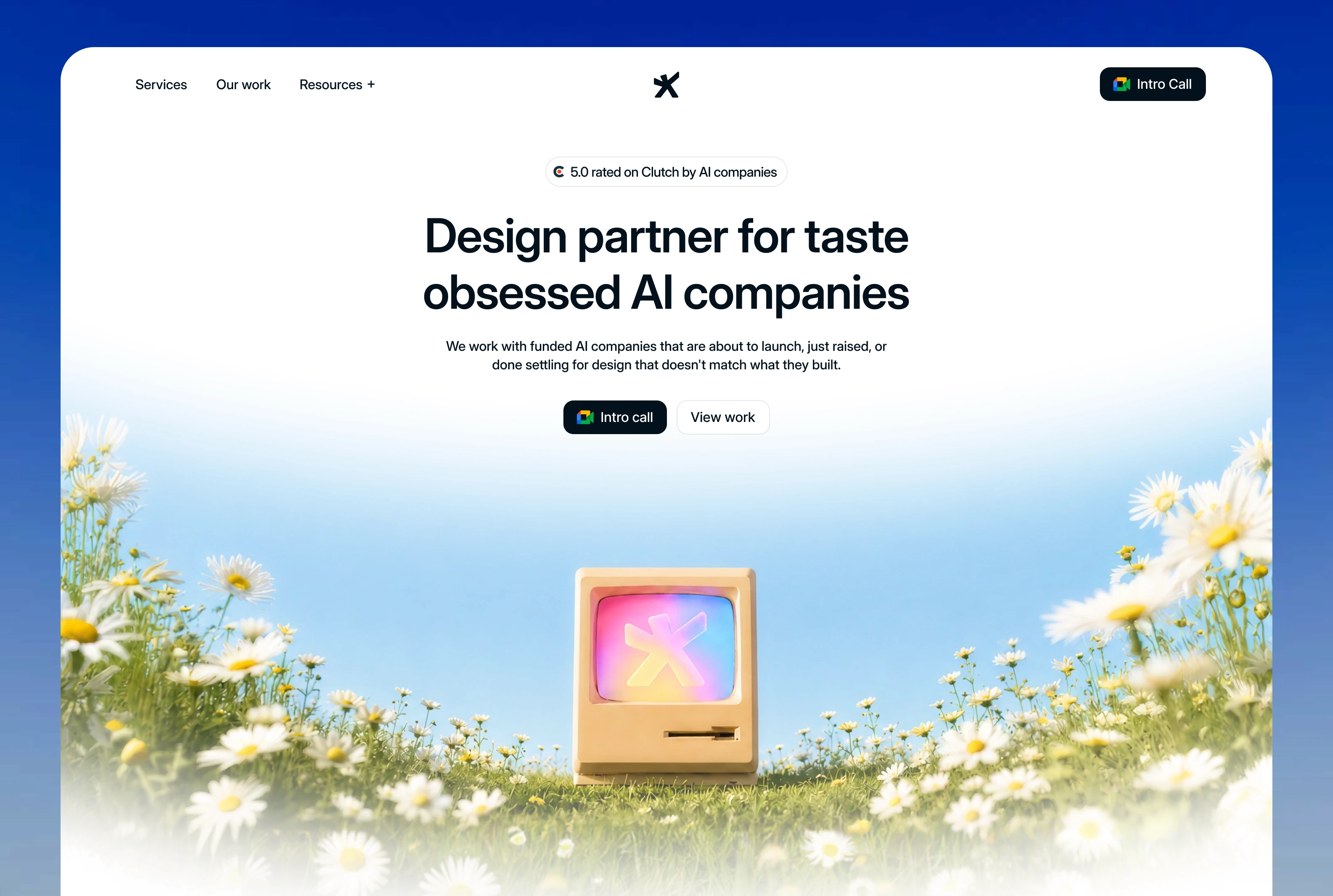
1. Studio Maydit: A Top-Rated Design Agency for AI Founders
Studio Maydit is a web and product design studio. Its clients are AI founders in the US, UK, and Europe. For a data platform, the useful part is range. Framer suits the public site that has to explain the product in seconds. Webflow suits a team that wants marketers editing pages without an engineer. Custom code suits the product itself, where the connection flow and admin screens live. The work carries on into product design after the site ships, so the homepage promise and the setup screen behind it come from one team.
Dualite is the result on record. Design work behind a repositioned ICP helped that product pass 100,000+ users in seven months. The lesson carries over to data tools: who you sell to first shapes every screen you build. Other recent clients are Wave, PixelFlow, Mi-VAD, and 15 other AI and SaaS teams.
Most data platforms keep adding connectors and pages after launch, so the monthly retainer is often the natural start. It covers new pages, campaigns, and product design, with no long lock-in. A team with a pilot date can take fixed scope instead, which runs three to four weeks. Every fixed-scope project closes with a diagnosis of what is leaking in the product, and on a data platform that is usually the step where access is requested and never granted.
Check | Finding |
|---|---|
Based in | Remote, serving US / UK / EU |
Platform depth | Framer, Webflow, and custom code |
AI-sector proof | Yes. AI-native clients, published outcome on Dualite |
Pricing | Fixed scope or monthly retainer, quoted per project |
Team shape | Founder-led, small senior team |
Best fit | Data platform teams whose pilots stall at the access and setup step |
Bring a screen recording of a new customer connecting their warehouse. Book a 30-minute call.

2. basement.studio
basement.studio is based in Mar del Plata and Los Angeles, was founded in 2018, and has 11 to 50 people working in custom code. It publishes a minimum, and its named clients are Vercel, Cursor, ElevenLabs, Harvey AI, and Scale AI. Scale AI sits close to this category, since its business is the data that trains models. A studio that writes code can build your connection flow, not only draw it.
The team is mid-sized for a platform with many screens ahead. Because it builds, agree early who owns the front end after launch.
Check | Finding |
|---|---|
Based in | Mar del Plata, Argentina and Los Angeles, USA |
Founded | 2018 |
Team size | 11-50 |
Primary platform | Custom code |
AI-sector proof | Yes. Published AI client work |
Named clients | Vercel, Cursor, ElevenLabs, Harvey AI, Scale AI |
Pricing | Published minimum |
Best fit | Data platform teams that want the setup flow designed and built by one team |
3. Lazarev
Lazarev has worked from San Francisco since 2015 and has 51 to 200 people. It works across several platforms, publishes a minimum, and shows AI work for Payoneer, Peel, Elva, and Mozayix. Payoneer moves money for businesses, so its screens deal with accounts, permissions, and records a finance team must trust. That is very close to the admin half of your first version.
Its size suits a long roadmap more than a four-week MVP. Ask which senior people stay on the work every week.
Check | Finding |
|---|---|
Based in | San Francisco, USA |
Founded | 2015 |
Team size | 51-200 |
Primary platform | Mixed |
AI-sector proof | Yes. Published AI client work |
Named clients | Payoneer, Peel, Elva, Mozayix |
Pricing | Published minimum |
Best fit | Data platforms whose buyers care most about roles, permissions, and records |
4. Clay
Clay has worked from San Francisco since 2016, with 51 to 200 people, work across several platforms, and published AI work. It publishes a minimum, and its clients are Slack, Stripe, Google, Coinbase, and Amazon. Stripe and Coinbase both put dense financial numbers in front of ordinary users. A studio with that list has seen how large software companies keep a busy screen calm.
These are some of the biggest names in software. An early data platform may find the process heavier than a first version needs.
Check | Finding |
|---|---|
Based in | San Francisco, USA |
Founded | 2016 |
Team size | 51-200 |
Primary platform | Mixed |
AI-sector proof | Yes. Published AI client work |
Named clients | Slack, Stripe, Google, Coinbase, Amazon |
Pricing | Published minimum |
Best fit | Funded data platforms that want enterprise-grade polish from the start |
5. Feely Studio
Feely Studio is a distributed team of 1 to 10 people in Europe, working across several platforms, with published AI work and a published minimum. Its named clients are Noxus, Mutiny, Luasai, and Basic Capital. A team this small means your founder talks straight to the people drawing the screens. Nothing gets lost between an account manager and a designer, which helps when the product changes weekly.
No founding year is published. With 1 to 10 people, a long enterprise pilot plus a new public site could stretch it thin.
Check | Finding |
|---|---|
Based in | Distributed, Europe |
Founded | Not published |
Team size | 1-10 |
Primary platform | Mixed |
AI-sector proof | Yes. Published AI client work |
Named clients | Noxus, Mutiny, Luasai, Basic Capital |
Pricing | Published minimum |
Best fit | Early data platforms that want a small AI-literate team at a known starting price |

6. Digidop
Digidop is a Paris Webflow studio founded in 2021, with 1 to 10 people and a published minimum. Its named clients are TSE Energy, Ramify, and StreamNative. StreamNative is a data streaming company, so the team has already explained deep data plumbing to buyers on a public site. That helps when your homepage has to make a warehouse connection sound safe.
AI proof is partial, and the work centres on Webflow sites. The in-product setup flow and admin screens sit outside what it shows.
Check | Finding |
|---|---|
Based in | Paris, France |
Founded | 2021 |
Team size | 1-10 |
Primary platform | Webflow |
AI-sector proof | Partial. Tech clients, no published AI case study |
Named clients | TSE Energy, Ramify, StreamNative |
Pricing | Published minimum |
Best fit | Data platforms that need the public site to explain infrastructure clearly |
7. SuperSkills
SuperSkills is a team of 1 to 10 in Walnut Creek, working across several platforms with published AI work. Its one named client is The Cut. A team this size can move fast on a narrow first version, and its AI work means it will expect model answers to need a design of their own, including the moment an answer is wrong.
No founding year, no pricing, and only one client are published. That is thin evidence for a buyer who must justify the choice to a data team.
Check | Finding |
|---|---|
Based in | Walnut Creek, USA |
Founded | Not published |
Team size | 1-10 |
Primary platform | Mixed |
AI-sector proof | Yes. Published AI client work |
Named clients | The Cut |
Pricing | Not published |
Best fit | Very early teams testing one narrow question flow before a pilot |
8. Edgar Allan
Edgar Allan has worked from Atlanta since 2014, with 51 to 200 people and a Webflow practice. Its named clients are Porsche, Duracell, and NCR. NCR runs systems for banks and retailers, so the team knows large companies where many people approve a launch. Your enterprise buyers behave the same way when a new tool asks for their data.
Pricing is not published, AI proof is partial, and the work is marketing sites. None of it shows a product with setup or admin screens.
Check | Finding |
|---|---|
Based in | Atlanta, USA |
Founded | 2014 |
Team size | 51-200 |
Primary platform | Webflow |
AI-sector proof | Partial. Enterprise clients, no published AI case study |
Named clients | Porsche, Duracell, NCR |
Pricing | Not published |
Best fit | Later-stage data platforms that need a large marketing site for enterprise buyers |
9. Flow Ninja
Flow Ninja is a Belgrade Webflow studio founded in 2018, with 11 to 50 people. A team that size can staff a quick public site, and the Webflow focus means your marketers could edit it later without help.
It sits ninth because it names no clients, publishes no pricing, and shows only partial AI proof. A data platform asks buyers to trust it with a warehouse, and this studio gives you little you can check.
Check | Finding |
|---|---|
Based in | Belgrade, Serbia |
Founded | 2018 |
Team size | 11-50 |
Primary platform | Webflow |
AI-sector proof | Partial. Web clients, no published AI case study |
Named clients | Not published |
Pricing | Not published |
Best fit | Teams that need a simple marketing site and nothing inside the product |
10. Lighthouse Digital
Lighthouse Digital is a London Webflow studio with a published minimum, for HelloSelf, Freetrade, and IGN. Freetrade is an investing app, so the team has shown numbers to everyday users in a way that feels safe. The public starting price also makes budgeting simple.
It ranks last here. There is no AI work, no team size, and no founding year on record, and nothing in the portfolio is a data tool or a setup flow.
Check | Finding |
|---|---|
Based in | London, UK |
Founded | Not published |
Team size | Not published |
Primary platform | Webflow |
AI-sector proof | No |
Named clients | HelloSelf, Freetrade, IGN |
Pricing | Published minimum |
Best fit | UK teams that want a plain marketing site at a visible price |
How to choose between them
Start with where your pilots stall, not with whose portfolio looks best.
Customers sign up and never connect their data. You need the setup flow designed and built. Studio Maydit or basement.studio.
The data team blocks the pilot over control. You need scope, roles, and activity screens. Lazarev or Clay.
You need a small team quickly and a price you can plan around. Feely Studio or Digidop.
The public site cannot explain what the product touches. Digidop or Edgar Allan.
One test for the first call: ask how they would design the moment a customer grants access to a warehouse. A studio that knows this market talks about read-only scope, a checklist the champion can forward, and plain error messages. A studio that jumps to the dashboard has not seen the problem yet.

Need more info?
Can't find your answer? Book a call and let's talk.
Continue Reading
10 Best Framer Design Agencies for AI Agent Startups - September 2026
What is the best Framer agency for an AI agent startup? Ten Framer studios ranked for agent products, with pricing, team size and AI work compared.

Siddarth Ponangi
10 Best Framer Design Agencies for Newly Funded Startups - September 2026
Your funding announcement is the biggest traffic day you will have all year. We checked 10 Framer agencies on five public criteria to see which can hit that date.
Siddarth Ponangi
10 Best Custom Code Website Development Agencies for AI Agent Startups - September 2026
AI web development agencies for agent startups. Which teams build custom coded sites a small team can still update weekly after launch.
Siddarth Ponangi