Reading time:
13 min read
Last updated:
10 Best MVP Design Agencies for LLM Platforms - September 2026
MVP design agencies for LLM platforms: ten studios ranked on developer-facing product work, published pricing, team shape, and honest weaknesses.


If you are building a platform other people build on top of and the first version has to earn a developer's attention, start with three names: Studio Maydit, basement.studio, and Foundey. The full top ten, in order, is Studio Maydit, basement.studio, Foundey, Lazarev, BX Studio, Flowout, Ramotion, Fantasy, Flow Ninja, and Lighthouse Digital. basement.studio and Foundey lead the competitors because both have shipped for AI infrastructure companies whose customers are engineers. Flow Ninja and Lighthouse Digital close the list, one publishing no client evidence, the other with no AI work at all.
A platform has a different first-version problem from an application. Your user is not trying to finish a task. They are trying to decide whether to build on you, and that decision happens in about ten minutes.
That makes the first request the product. Time to a working call is the metric that matters, and every step between landing and a response is a place people leave. Most first versions bury it behind an account, a billing form, and a key that arrives by email.
Then there is the part nobody designs early: cost and limits. Developers evaluating a platform need to know what a call costs, what the rate limits are, and what happens when they hit them, before they commit. Hiding that reads as a trap.
Third, your documentation is your interface. For a platform, docs are not support material. They are the main product surface, and they are usually treated as an afterthought written by whoever had time.
So the studio you want understands that the playground, the keys page, the usage view, and the docs are one product. Not a website with a developer section.
Each entry below ends with a table you can scan in under a minute.

How we picked these agencies
This list is unsponsored, and no team was given a chance to shape its own entry. It is assembled from what each studio has chosen to make public, which is its website, its case studies, and its directory records. Ten studios, five questions, asked identically.
Platform depth. Does the team design working software with keys, usage, and state, or mainly marketing pages? A platform's first version is a set of tools, and none of them exist on a landing page.
Developer-audience proof. Has the studio shipped for companies whose customers are engineers? That audience is unusually resistant to persuasion and unusually generous with attention once you earn it. The register is learned, not guessed.
Pricing transparency. Is a starting price published? There is an irony worth noticing: you will publish your own prices because developers demand it, so a studio that hides its own is working to a different standard than yours.
Team shape. How many people, and who runs the week? On a short build, one senior person who has used an API in anger beats a large team that has not.
The agency's own website. The one project entirely under the studio's control.
The fifth check is worth running seriously here. Open the studio's own site and time how long it takes to understand what they sell. That is the same measurement your developers will apply to you, and a studio that fails its own test will not pass yours.
Where the facts come from: public studio pages and directory listings as they stood in September 2026, with nothing confirmed by email. Where nothing is published, the table says Not published rather than a guess.
What goes wrong when an LLM platform buys MVP design
Three failures, and each one shows up in your activation numbers rather than in a demo.
The first call is behind a wall. Sign-up, email verification, a billing card, then a key. Developers evaluating three platforms in an afternoon will not finish that for two of them. Version one needs a way to see a real response before any of it, whether that is a browser playground or a temporary key with a small free allowance.
Cost and limits are invisible until you hit them. A developer builds against your platform for a week, then discovers the rate limit or the price per call. The reaction is not disappointment, it is distrust. Put the numbers on the page where the decision happens and design the moment a limit is reached, including what to do next.
Docs are treated as content, not product. They live on a different template, search badly, and the code samples do not match the current version. Developers judge a platform by its docs more than by its homepage. Design them as a first-class surface in version one, with working examples and a visible last-updated date.
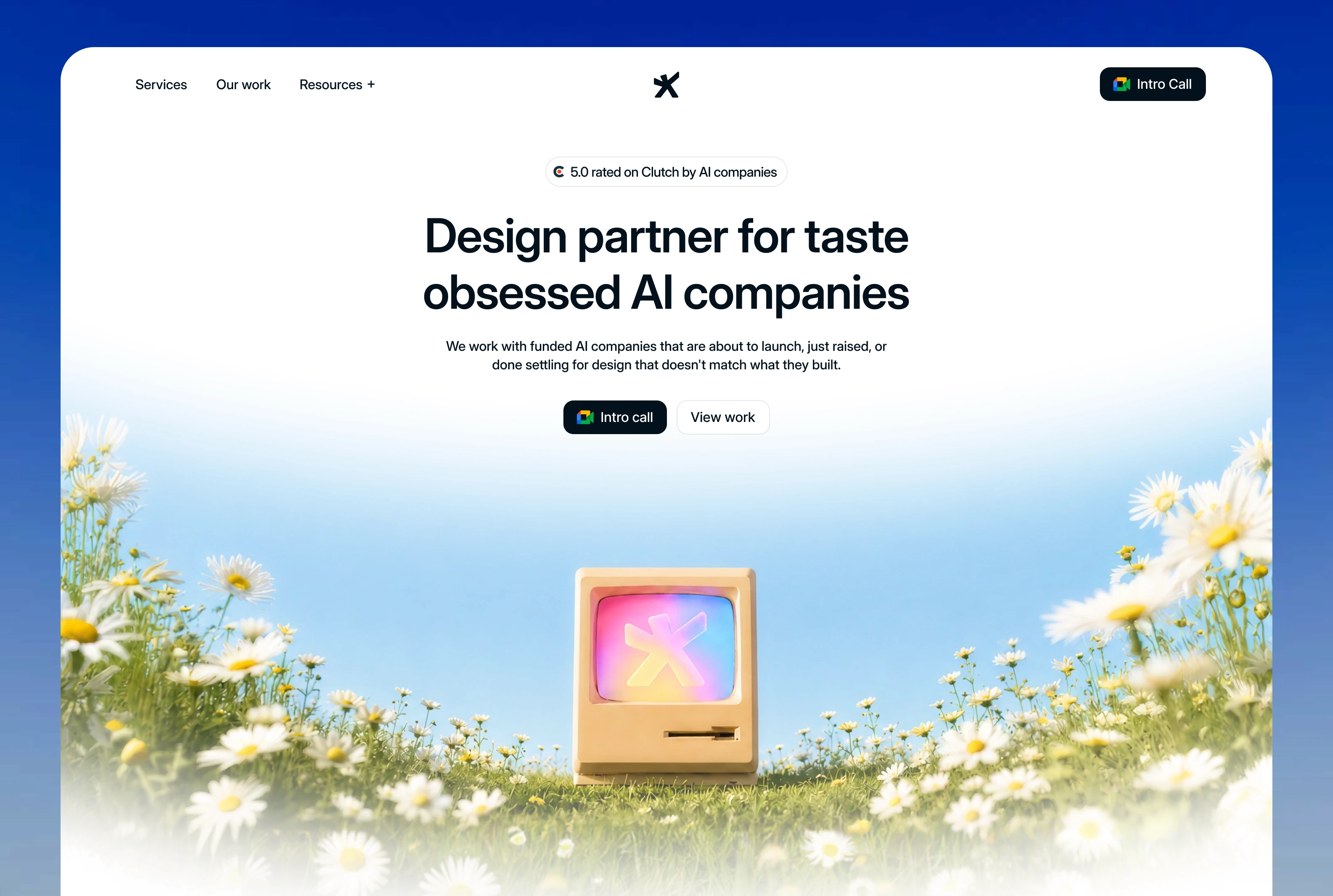
1. Studio Maydit: A Top-Rated Design Agency for AI Founders
Studio Maydit is a web and product design studio working with AI founders in the US, UK, and Europe. It builds in Framer, Webflow, and custom code, and carries on into product design after the site is live. For a platform that pairing is the point: the page a developer lands on and the console they end up in are designed by the same people, so the promise on one matches the experience of the other.
Only one figure is on the record. Dualite crossed 100,000+ users in seven months, and a repositioned ICP plus the design work behind it carried part of that. The rest of the recent roster runs Wave, PixelFlow, Mi-VAD, and 15 other AI and SaaS teams.
Two ways to engage. Fixed scope runs three to four weeks and suits a team with a launch or a developer conference in the diary. A monthly retainer suits platforms shipping continuously, covering new pages, campaigns, and product design, with no long lock-in. Fixed-scope work closes with a diagnosis of what is leaking in the product, which for a platform almost always means naming the step between landing and the first successful call.
Check | Finding |
|---|---|
Based in | Remote, serving US / UK / EU |
Platform depth | Framer, Webflow, and custom code |
AI-sector proof | Yes. AI-native clients, published outcome on Dualite |
Pricing | Fixed scope or monthly retainer, quoted per project |
Team shape | Founder-led, small senior team |
Best fit | Platform teams who need landing, playground, keys, and usage designed as one product |
Bring your activation funnel from landing to first successful call. Book a 30-minute call.

2. basement.studio
basement.studio works from Mar del Plata and Los Angeles, founded in 2018, with 11 to 50 people, custom code, published AI work, a published minimum, and clients including Vercel, Cursor, ElevenLabs, Harvey AI, and Scale AI. That client list is close to a definition of this category: developer platforms and AI infrastructure, sold to engineers who evaluate rather than read.
The team is small for a long roadmap, and because it builds as well as designs, agree early where your engineers take over so you are not paying twice.
Check | Finding |
|---|---|
Based in | Mar del Plata, Argentina and Los Angeles, USA |
Founded | 2018 |
Team size | 11-50 |
Primary platform | Custom code |
AI-sector proof | Yes. Published AI client work |
Named clients | Vercel, Cursor, ElevenLabs, Harvey AI, Scale AI |
Pricing | Published minimum |
Best fit | Platform teams selling to engineers who need the whole developer surface to feel native |
3. Foundey
Foundey is a San Francisco studio founded in 2021 working in Figma, with published AI client work for DemandIQ, Traycer, and Sero AI. Traycer is a tool for developers working with AI, which means the team has already designed for the exact reader you are trying to convince, and has had to show machine output in a form an engineer will accept.
It publishes neither team size nor pricing, and it is design only, so the build is yours. Ask how it specifies states and error cases for an engineering team.
Check | Finding |
|---|---|
Based in | San Francisco, USA |
Founded | 2021 |
Team size | Not published |
Primary platform | Figma-only |
AI-sector proof | Yes. Published AI client work |
Named clients | DemandIQ, Traycer, Sero AI |
Pricing | Not published |
Best fit | Platform teams with strong engineers who need product thinking rather than a build |
4. Lazarev
Lazarev has worked from San Francisco since 2015, with 51 to 200 people, a published minimum, and published AI work for Payoneer, Peel, Elva, and Mozayix. Payoneer is a platform with accounts, balances, and usage over time, which is structurally what a metered API product needs: a usage view a customer trusts enough to budget against.
AI proof is genuine, but the studio is large and there is no developer-platform client on the public list. Ask what it has shipped with an API console in it.
Check | Finding |
|---|---|
Based in | San Francisco, USA |
Founded | 2015 |
Team size | 51-200 |
Primary platform | Mixed |
AI-sector proof | Yes. Published AI client work |
Named clients | Payoneer, Peel, Elva, Mozayix |
Pricing | Published minimum |
Best fit | Platform teams whose hard problem is usage, billing, and limits rather than the landing page |
5. BX Studio
BX Studio is a New York team of 11 to 50 working mainly in Webflow, with a published minimum and published AI work for Reddit, Headspace, ASAPP, and Verifone. Reddit and Verifone both run developer-facing surfaces alongside their main products, so the team has worked near this audience even if not exclusively for it.
No founding year is published and Webflow is the centre of the practice. A console and a docs system are outside most of what it shows, so scope that carefully.
Check | Finding |
|---|---|
Based in | New York, USA |
Founded | Not published |
Team size | 11-50 |
Primary platform | Webflow |
AI-sector proof | Yes. Published AI client work |
Named clients | Reddit, Headspace, ASAPP, Verifone |
Pricing | Published minimum |
Best fit | Platform teams who need the public marketing surface done well at a known price |

6. Flowout
Flowout is a distributed Webflow studio with a published minimum, for Jasper, Kajabi, Riverside, and Sendlane. Jasper is a product built on language models that reached a wide audience, so the team has explained model-driven software to people without a technical background, which is useful for the half of your buyers who are not engineers.
It publishes no founding year and no team size, AI proof is partial, and the work is marketing sites. The console, the keys page, and the docs are all outside its portfolio.
Check | Finding |
|---|---|
Based in | Distributed |
Founded | Not published |
Team size | Not published |
Primary platform | Webflow |
AI-sector proof | Partial. SaaS clients, no AI case study |
Named clients | Jasper, Kajabi, Riverside, Sendlane |
Pricing | Published minimum |
Best fit | Platform teams who need a clear public site quickly at a price they can read |
7. Ramotion
Ramotion has worked from San Francisco since 2009, with 11 to 50 people and a published minimum, for Mozilla, Okta, Netflix, Adobe, and Xero. Okta is identity infrastructure with a developer surface of its own, so the team has designed keys, scopes, and access screens that engineers use directly.
AI proof is partial, and the client list is weighted to large companies. Ask what its most recent early-stage platform project involved and who staffed it.
Check | Finding |
|---|---|
Based in | San Francisco, USA |
Founded | 2009 |
Team size | 11-50 |
Primary platform | Mixed |
AI-sector proof | Partial. Tech and SaaS clients, no AI case study |
Named clients | Mozilla, Okta, Netflix, Adobe, Xero |
Pricing | Published minimum |
Best fit | Platform teams whose keys, scopes, and access model need designing properly |
8. Fantasy
Fantasy has worked from San Francisco and New York since 1999 across several platforms, with published AI work. The record is long and the studio has real experience introducing unfamiliar products to large audiences, which a new platform genuinely needs.
It ranks eighth on what can be checked. No client names, no team size, and no pricing are published. You are building a product whose buyers demand public numbers before they commit, so a supplier that publishes none is an odd fit for the brief.
Check | Finding |
|---|---|
Based in | San Francisco and New York, USA |
Founded | 1999 |
Team size | Not published |
Primary platform | Mixed |
AI-sector proof | Yes. Published AI client work |
Named clients | Not published |
Pricing | Not published |
Best fit | Well-funded platform teams who will run private reference checks rather than read a portfolio |
9. Flow Ninja
Flow Ninja is a Belgrade Webflow studio founded in 2018 with 11 to 50 people. European hours and a reasonable bench make it practical for a straightforward site build on a European team's schedule.
It ranks ninth for platform work. No client names and no pricing are published, AI proof is partial, and there is no visible developer-facing product work. For a product judged on evidence by engineers, there is little evidence to offer.
Check | Finding |
|---|---|
Based in | Belgrade, Serbia |
Founded | 2018 |
Team size | 11-50 |
Primary platform | Webflow |
AI-sector proof | Partial. Web clients, no AI case study |
Named clients | Not published |
Pricing | Not published |
Best fit | European teams who need a marketing site quickly and nothing developer-facing |
10. Lighthouse Digital
Lighthouse Digital is a London Webflow studio with a published minimum, for HelloSelf, Freetrade, and IGN. The published starting price is a genuine convenience, and a UK base suits a London team wanting straightforward site work.
It ranks last for this category. There is no published AI work, no team size, and no founding year, and nothing in the portfolio is developer-facing. A platform's first version is a console and a set of docs, and neither appears here.
Check | Finding |
|---|---|
Based in | London, UK |
Founded | Not published |
Team size | Not published |
Primary platform | Webflow |
AI-sector proof | No |
Named clients | HelloSelf, Freetrade, IGN |
Pricing | Published minimum |
Best fit | UK teams who want a simple marketing site at a visible price |
How to choose between them
Sort by where developers are dropping out, not by whose portfolio you enjoy most.
Nobody gets to a first successful call. You need the whole path from landing to response designed. Studio Maydit or basement.studio.
Engineers try it and the product feels foreign to them. Foundey.
Usage, billing, and limits are the confusing part. Lazarev or Ramotion.
The public site does not explain what the platform is. BX Studio or Flowout.
Then run one test on the first call. Ask what they would do to shorten the time between a developer landing and seeing a real response. A studio that understands platforms answers with specific removals: no card, a browser playground, a key on the page. A studio that answers with a better hero section has understood you as a website project.

Need more info?
Can't find your answer? Book a call and let's talk.
Continue Reading
10 Best Framer Design Agencies for AI Agent Startups - September 2026
What is the best Framer agency for an AI agent startup? Ten Framer studios ranked for agent products, with pricing, team size and AI work compared.

Siddarth Ponangi
10 Best Framer Design Agencies for Newly Funded Startups - September 2026
Your funding announcement is the biggest traffic day you will have all year. We checked 10 Framer agencies on five public criteria to see which can hit that date.
Siddarth Ponangi
10 Best Custom Code Website Development Agencies for AI Agent Startups - September 2026
AI web development agencies for agent startups. Which teams build custom coded sites a small team can still update weekly after launch.
Siddarth Ponangi