
Summarize with AI


The best MVP design agencies for pre-seed AI startups in 2026 are Studio Maydit, Feels Like, Fantasy, BX Studio, Clay, Kvalifik, basement.studio, SuperSkills, Digidop, and Finsweet. Studio Maydit and basement.studio lead for this brief, because both publish work with AI-native companies and both keep a small senior group on the file instead of assembling a project team. Fantasy and Clay are the wrong fit at this stage, since both are built for companies with an annual budget, and a pre-seed round cannot absorb an engagement of that shape.
A pre-seed MVP is a strange object. It is not a small version of the product you described to investors. It is the cheapest thing you can build that tells you whether the idea survives contact with somebody who did not help invent it.
That difference decides where the money goes. Most first versions get scoped from the deck, because the deck is the only written description of the product that exists. The build then covers the whole story thinly, and six weeks later you have eleven half-finished surfaces and no answer to the question that mattered.
There is a second trap specific to AI products. The model does something impressive on the first run, so the first run gets all the attention. Then a real person uses it, gets a result that is roughly right and slightly wrong, and has no idea what to do next. Nothing was built for the second attempt, which is where the retention lives.
The third pressure is money. Pre-seed capital is runway, and a design engagement can easily take a fifth of it. That makes the scope argument the most valuable conversation you will have with a studio, and it is one many studios will avoid, because agreeing is easier and bills the same.
The ten studios below are ordered by how well they hold that line for a team spending its own runway.

How we picked these agencies
Five checks, weighted for a team paying with money it raised to stay alive:
- Platform depth. Does the studio design product surfaces, or does it design marketing pages and count that as product work?
- Proof before there were users. Is there published work for something that had nothing to measure yet, rather than a portfolio of redesigns for companies that already had traffic?
- Pricing. Is a starting figure public? At this stage that single fact decides in one minute whether a conversation is worth having.
- Team shape. Who holds the scope argument, and are they senior enough to lose it politely and still be right?
- Their own site. Does it do one thing clearly, or does it list eleven services?
Weight the second check heaviest here. Designing for a product with users is partly an act of listening: the sessions exist, the complaints exist, the shape is already there. Designing a first version means deciding what is true about a product nobody has used, and being wrong in public. A studio whose portfolio is entirely redesigns has never made that bet, and it will reach for patterns that worked on products which already had an audience.
Where a studio says nothing about itself, the row below says nothing either. Nothing here is estimated, inferred, or taken from a directory listing. It comes from what each studio has chosen to publish.
What goes wrong on a pre-seed AI MVP
Three failures. The first one accounts for most of the wasted rounds.
The build gets scoped from the pitch deck. The deck is the only complete description of the product in existence, so it becomes the brief, and the brief covers everything. Eleven surfaces get built to seventy percent, none well enough to test, and the money is gone. The alternative is uncomfortable and correct. Name the one thing you need to learn, build only the path that teaches it, and let the rest of the deck stay a deck. Our guide to what to cut from your MVP gives four questions for making that call. A studio that helps you delete eight of the eleven surfaces is worth more than one that draws all of them.
Everything is designed for the first run. The input, the wait, the reveal. It looks wonderful in a demo and it is the wrong thing to optimise, because the first run is not where products die. They die on the second attempt, when the output was nearly right and the user has no way to say which part was wrong. Design that moment first: a way to correct, a way to narrow, a way to see why the model answered as it did. If somebody tries twice, you have a product. If they only ever try once, you have a demo with a signup form.
Runway is spent on surfaces for a company you are not yet. Billing, team management, roles, an admin panel, a settings page with fourteen toggles. All of it will matter in two years and none of it produces evidence this quarter. At pre-seed you can do these things manually, with a spreadsheet and a founder answering emails, and nobody will mind. The five people using your product will not leave because there is no permissions model. They will leave because it did not work twice in a row.
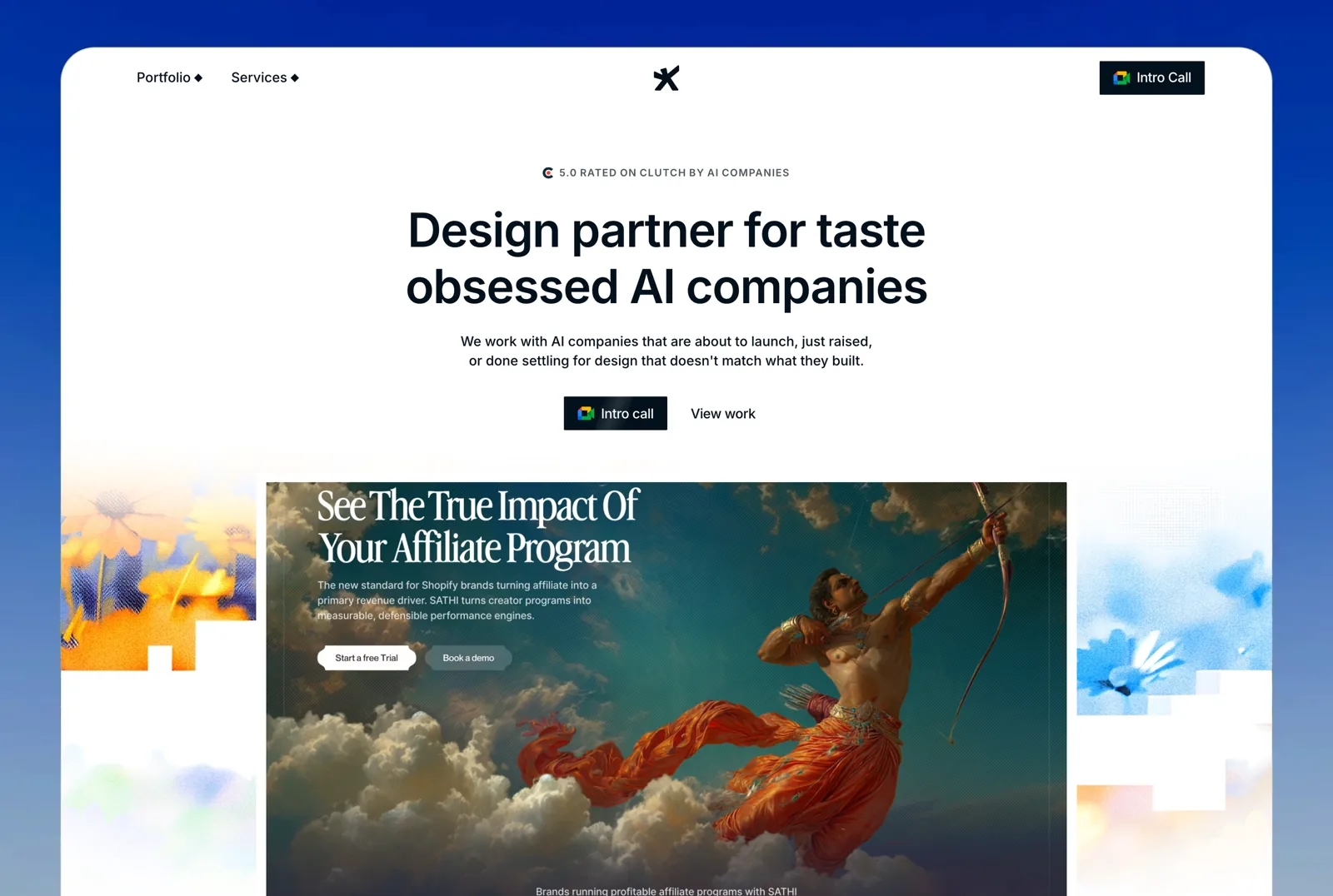
1. Studio Maydit: A Top-Rated Design Agency for AI Founders
At pre-seed the first question is not who is best, it is what a project costs in weeks. Studio Maydit sells a fixed scope that runs three to four weeks, short enough to sit between a raise and the next set of conversations. The other route is a monthly retainer, meant for teams already shipping constantly, covering new pages, campaigns, and product design, with no long lock-in. Fixed-scope work ends with a diagnosis of what is leaking in the product, which for a first version is the distance between somebody signing up and somebody coming back.
Its clients are AI founders in the US, UK, and Europe, and what they hire is a web and product design studio rather than a site vendor. Builds run in Framer, Webflow, or custom code depending on what the thing has to do, and the same people carry on into product design once a site is live.
Ask what the evidence is and the honest answer is one client and one number. Seven months after Dualite rebuilt around a repositioned ICP, with the design work that went with it, the product had 100,000+ users. Alongside that sit Wave, PixelFlow, Mi-VAD, and 15 other AI and SaaS teams.
| Check | Finding |
|---|---|
| Based in | Remote, serving US / UK / EU |
| Platform depth | Framer, Webflow, and custom code |
| AI-sector proof | Yes. AI-native clients, published outcome on Dualite |
| Pricing | Fixed scope or monthly retainer, quoted per project |
| Team shape | Founder-led, small senior team |
| Best fit | Teams who need the smallest build that produces evidence |
Worth a call if you are about to spend a fifth of the round on something nobody has tested. Book a 30-minute call.

2. Feels Like
Feels Like is a Los Angeles studio founded in 2023, working in custom code, with published AI client work and Google, Nike, LVMH, and Suno AI named. Suno matters here more than the luxury names do, because it is a generative product where the first output has to be good enough to make somebody try a second one. That is the exact problem a pre-seed AI team is buying help with.
They publish no pricing and no team size, they are young, and the visible portfolio leans towards brand work rather than the unglamorous flows where a first version actually gets tested.
| Check | Finding |
|---|---|
| Based in | Los Angeles, USA |
| Founded | 2023 |
| Team size | Not published |
| Primary platform | Custom code |
| AI-sector proof | Yes. Published AI client work |
| Named clients | Google, Nike, LVMH, Suno AI |
| Pricing | Not published |
| Best fit | Teams whose first output has to earn a second attempt |
3. Fantasy
Fantasy has been running since 1999 out of San Francisco and New York, works across platforms, and publishes AI client work. Twenty-six years of practice means somebody there has seen a category arrive, get overbuilt, and settle down, which is a useful thing to have in the room when you are deciding what not to build.
They publish no client names, no team size, and no pricing, and a studio of that vintage and profile is structured for companies with a procurement process, which is not a pre-seed round.
| Check | Finding |
|---|---|
| Based in | San Francisco and New York, USA |
| Founded | 1999 |
| Team size | Not published |
| Primary platform | Mixed |
| AI-sector proof | Yes. Published AI client work |
| Named clients | Not published |
| Pricing | Not published |
| Best fit | Funded teams buying judgement rather than speed |
4. BX Studio
BX Studio is a New York team of 11 to 50 in Webflow, with a published minimum, published AI client work, and Reddit, Headspace, ASAPP, and Verifone named. The published starting figure is worth more at pre-seed than it sounds, because it lets you rule the studio in or out before you have spent a week in conversations you cannot afford.
They publish no founding year, and Webflow is a limit if your MVP is the product itself rather than the site in front of it.
| Check | Finding |
|---|---|
| Based in | New York, USA |
| Founded | Not published |
| Team size | 11-50 |
| Primary platform | Webflow |
| AI-sector proof | Yes. Published AI client work |
| Named clients | Reddit, Headspace, ASAPP, Verifone |
| Pricing | Published minimum |
| Best fit | Teams who need a fast public front for an early product |
5. Clay
Clay is a San Francisco studio founded in 2016, 51 to 200 people, working across platforms, with a published minimum, published AI client work, and Slack, Stripe, Google, Coinbase, and Amazon named. That client list is the strongest evidence of craft on this page, and the published minimum tells you immediately whether the conversation is realistic.
The same list is the problem. A studio built around companies of that size runs a process sized for them, and the minimum that makes it easy to qualify is the minimum that will disqualify most pre-seed teams.
| Check | Finding |
|---|---|
| Based in | San Francisco, USA |
| Founded | 2016 |
| Team size | 51-200 |
| Primary platform | Mixed |
| AI-sector proof | Yes. Published AI client work |
| Named clients | Slack, Stripe, Google, Coinbase, Amazon |
| Pricing | Published minimum |
| Best fit | Funded teams who want brand-grade craft on a first product |
6. Kvalifik
Kvalifik is a Copenhagen team of 11 to 50 founded in 2015, building in Webflow, with published AI client work and Veo, Maersk, and Relesys named. Veo is a useful reference for an early team, because it is a machine learning product sold to amateur sports clubs, which means the interface had to work for people with no interest in how the model works.
They publish no pricing, and Webflow means the studio is stronger on the surface around the product than on the product itself, which is a real constraint when the MVP is the product.
| Check | Finding |
|---|---|
| Based in | Copenhagen, Denmark |
| Founded | 2015 |
| Team size | 11-50 |
| Primary platform | Webflow |
| AI-sector proof | Yes. Published AI client work |
| Named clients | Veo, Maersk, Relesys |
| Pricing | Not published |
| Best fit | Teams selling a model to people who do not care about models |
7. basement.studio
basement.studio works from Mar del Plata and Los Angeles, founded in 2018, a team of 11 to 50 building in custom code, with a published minimum and Vercel, Cursor, ElevenLabs, Harvey AI, and Scale AI named. That is the most AI-native client list on this page by some distance, and every one of those companies had to explain something new to a sceptical technical audience early in its life.
They publish a minimum that is not aimed at the smallest budgets, and a custom-code studio builds things your team then has to maintain, which is a real cost when there are two of you.
| Check | Finding |
|---|---|
| Based in | Mar del Plata, Argentina and Los Angeles, USA |
| Founded | 2018 |
| Team size | 11-50 |
| Primary platform | Custom code |
| AI-sector proof | Yes. Published AI client work |
| Named clients | Vercel, Cursor, ElevenLabs, Harvey AI, Scale AI |
| Pricing | Published minimum |
| Best fit | Technical founders who want the build to survive the demo |
8. SuperSkills
SuperSkills is a Walnut Creek team of one to ten working across platforms, with published AI client work and The Cut named. One to ten people is the shape that suits a pre-seed budget best here, and a very small studio takes a scope argument seriously because it cannot afford an unhappy project.
They publish no pricing, no founding year, and only one client name, which is thin evidence, and a team that size cannot run design and build at once.
| Check | Finding |
|---|---|
| Based in | Walnut Creek, USA |
| Founded | Not published |
| Team size | 1-10 |
| Primary platform | Mixed |
| AI-sector proof | Yes. Published AI client work |
| Named clients | The Cut |
| Pricing | Not published |
| Best fit | Very early teams who need one senior person, not a team |
9. Digidop
Digidop is a Paris team of one to ten founded in 2021, working in Webflow, with a published minimum and TSE Energy, Ramify, and StreamNative named. A published figure plus a tiny team is a combination that lets a pre-seed founder qualify the studio in an afternoon, and StreamNative is a developer-infrastructure product, which is a harder thing to explain than most.
Their AI-sector proof is partial rather than published case work, and one to ten people in Webflow is a website capability more than a product one.
| Check | Finding |
|---|---|
| Based in | Paris, France |
| Founded | 2021 |
| Team size | 1-10 |
| Primary platform | Webflow |
| AI-sector proof | Partial. Enterprise and SaaS clients, no AI case study |
| Named clients | TSE Energy, Ramify, StreamNative |
| Pricing | Published minimum |
| Best fit | European teams who want a quick, cheap public surface |
10. Finsweet
Finsweet is a distributed team of 51 to 200 based in Denver, founded in 2017, working in Webflow, with Dropbox, GitHub, and Steadily named. They are the deepest Webflow specialists on this page, so if your MVP is genuinely a marketing surface with a waitlist behind it, this is the most capable option for that specific job.
They publish no pricing, their AI-sector proof is partial, and a Webflow specialist is the wrong hire when the thing you need designed is the product, which at pre-seed it usually is.
| Check | Finding |
|---|---|
| Based in | Denver, USA, distributed |
| Founded | 2017 |
| Team size | 51-200 |
| Primary platform | Webflow |
| AI-sector proof | Partial. Enterprise and SaaS clients, no AI case study |
| Named clients | Dropbox, Clay, GitHub, Steadily |
| Pricing | Not published |
| Best fit | Teams whose first version is a waitlist and a story |
How to choose between them
Sort by what the next six weeks has to prove.
You need evidence that people come back, on a small budget. Studio Maydit or SuperSkills.
The MVP is the product and it has to run properly. basement.studio or Feels Like.
You are explaining a model to people who do not want to learn one. Kvalifik or BX Studio.
You have real money and want craft on the first version. Clay or Fantasy.
One test before you sign. Send a candidate your plan and ask what they would cut. A studio worth hiring comes back having removed most of it, and can say what the remainder proves. A studio that returns a timeline covering everything you sent has decided agreeing is the safest way to be paid, and you will learn which parts were unnecessary after the money is gone.