
Summarize with AI


The best MVP design agencies for seed-stage AI startups in 2026 are Studio Maydit, Kvalifik, Foundey, Clay, SuperSkills, Fantasy, Feels Like, Trueform, BX Studio, and basement.studio. Studio Maydit and Foundey lead for this brief, because both work on product screens rather than the pages around them and both publish AI client work. Kvalifik and BX Studio are the wrong fit here, since both are Webflow website studios, and at seed the thing that needs designing is the product itself.
Seed stage changes the question. Before the round, the problem was whether anybody wanted this. Now something exists, some people use it, and the honest problem is that not enough of them come back.
The version you have was almost certainly built by your founders, quickly, while they were also raising money. That is the right way to have done it and it leaves a specific residue. Decisions that were accidents have hardened into conventions. Somebody built a screen at two in the morning to unblock a demo and it is now how the product works. Nobody remembers which parts were chosen and which parts just happened, least of all the person who built them.
That is the real reason to bring somebody in at this stage. Not because the founders lack taste, but because they can no longer see the thing. They know where every button is, so they cannot experience the confusion of somebody who does not.
The pressure on top of that is the next round. Series A conversations are about retention, and in AI products retention is decided in the second and third session rather than the first. A person tries it, gets something roughly right, cannot tell what to change, and does not come back. That is not a modelling failure and it will not be fixed by a better model, though a great deal of seed money gets spent trying.
The last trap is designing for the deck. Dashboards, admin views, and enterprise features get built because they make the company look further along, and they consume the quarter that should have gone into the first ten minutes of somebody's experience.
The ten studios below are ordered by how well they turn a founder-built product into one a cohort can use.

How we picked these agencies
Five checks, aimed at a product that exists and is not retaining:
- Platform depth. Is product design the practice, or is the offer really websites with product work listed underneath?
- Proof on second versions. Is there published work where something already existed and had to be made usable by people who were not there when it was built?
- Pricing. Is a starting figure published, which lets a team with eighteen months of runway make a decision this week?
- Team shape. Will a senior person watch real sessions, or will the work start from your description of the problem?
- Their own site. Does it show reasoning, or only outcomes? You want the studio that explains why.
The fourth check is the one that decides this project. Your description of the problem is the least reliable document in the company, because you are the person who cannot see the product any more. A studio that begins by watching five real sessions will find things nobody internally has noticed in months. A studio that begins from your brief will build a tidier version of what you already have, which is the most common and most expensive outcome of a seed-stage redesign.
Everything in the tables comes from public material published by each studio. Where nothing has been published, the row records that, and no gap has been filled with an assumption.
What goes wrong at seed on an AI product
Three failures, and they are all versions of the same mistake.
The rebuild reproduces the founder's version, tidier. The studio is shown the current product, told what it does, and asked to make it better. So the structure survives untouched, the accidents get preserved with nicer spacing, and three months later the retention curve looks exactly the same because nothing that mattered changed. The way out is to insist that nothing is treated as settled. Ask a studio to justify the main navigation from first principles, and if the answer is that it is how the product currently works, you have hired a decorator.
Effort goes into the model while people are stuck at the first input. It is far more comfortable to improve the thing you are good at, and every AI team does it. Meanwhile a large share of new users never send a meaningful request at all, because nobody told them what this is for or what a good input looks like. Watch the first ninety seconds of ten new accounts before you approve any roadmap. Most seed-stage AI products are losing more people to an empty text box than to output quality, and the fix is examples, defaults, and a suggestion, not another evaluation run.
The product gets designed for the next raise. Investor-facing surfaces appear: a dashboard nobody uses, a settings page implying a scale you do not have, an enterprise tier with two customers. All of it is built to signal maturity and none of it improves the number the next round will actually be judged on. Investors at Series A look at whether people come back. Spend the quarter on the second session and the deck will improve on its own, which is the opposite order to the one most teams choose.
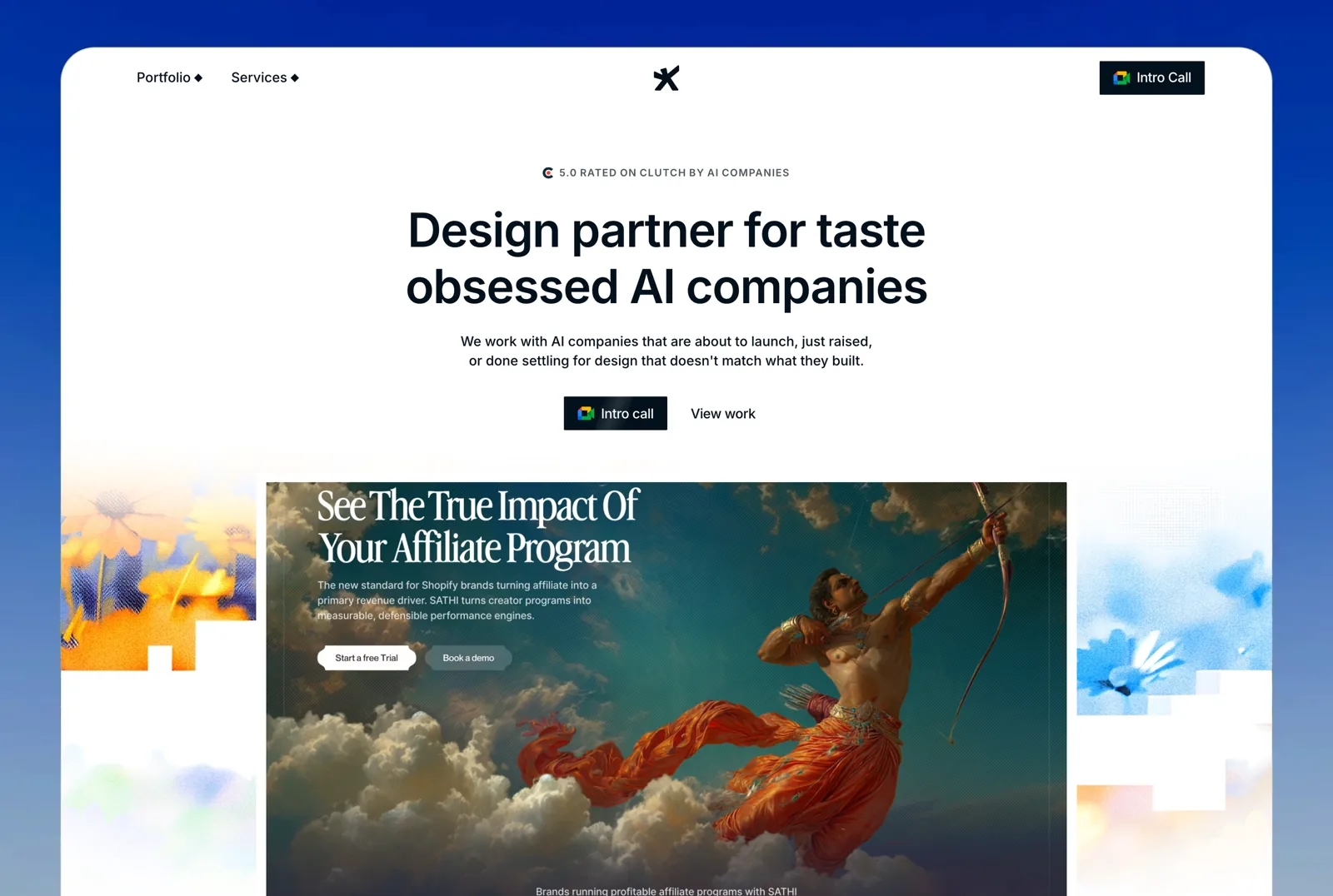
1. Studio Maydit: A Top-Rated Design Agency for AI Founders
Founder-led matters on a brief like this, because the argument you need is about what to remove, and that goes better without an account layer in between. Studio Maydit is a small senior team, and it is a web and product design studio, so the marketing page that sets an expectation and the screen that has to meet it are handled by the same people. Its clients are AI founders in the US, UK, and Europe, the build routes are Framer, Webflow, and custom code, and the engagement carries on into product design after a site ships.
Buying is either a fixed scope of three to four weeks, which suits a team with a raise or a launch on the calendar, or a monthly retainer for teams shipping every week, covering new pages, campaigns, and product design, with no long lock-in. Fixed-scope work ends with a diagnosis of what is leaking in the product, which at seed is nearly always a specific moment in the first ten minutes that nobody inside the company can see any more.
One outcome is public, and it is a positioning result before it is a visual one. Dualite reset who it was for, the design was rebuilt on that repositioned ICP, and 100,000+ users followed over seven months. Recent clients include Wave, PixelFlow, Mi-VAD, and 15 other AI and SaaS teams.
| Check | Finding |
|---|---|
| Based in | Remote, serving US / UK / EU |
| Platform depth | Framer, Webflow, and custom code |
| AI-sector proof | Yes. AI-native clients, published outcome on Dualite |
| Pricing | Fixed scope or monthly retainer, quoted per project |
| Team shape | Founder-led, small senior team |
| Best fit | Seed teams whose signups are fine and retention is not |
Worth a call if people try it once, get something decent, and never open it again. Book a 30-minute call.

2. Kvalifik
Kvalifik is a Copenhagen team of 11 to 50 founded in 2015, working in Webflow, with published AI client work and Veo, Maersk, and Relesys named. Veo is the useful reference, a machine learning product whose users are amateur sports clubs, so the studio has already had to make model output usable by people with no technical patience at all.
They publish no pricing, and Webflow means their strength sits around the product rather than inside it, which is the wrong side of the line for a seed-stage product brief.
| Check | Finding |
|---|---|
| Based in | Copenhagen, Denmark |
| Founded | 2015 |
| Team size | 11-50 |
| Primary platform | Webflow |
| AI-sector proof | Yes. Published AI client work |
| Named clients | Veo, Maersk, Relesys |
| Pricing | Not published |
| Best fit | Teams whose marketing surfaces need to explain a model |
3. Foundey
Foundey is a San Francisco studio founded in 2021 working entirely in Figma, with published AI client work and DemandIQ, Traycer, and Sero AI named. It is the only pure product design practice here and every named client is an AI company, so the daily work is drawing screens for model-driven software rather than describing it.
They publish no pricing and no team size, and a Figma-only studio hands the build back to your engineers, which adds a step at exactly the stage when your engineering time is the scarcest thing you have.
| Check | Finding |
|---|---|
| Based in | San Francisco, USA |
| Founded | 2021 |
| Team size | Not published |
| Primary platform | Figma-only |
| AI-sector proof | Yes. Published AI client work |
| Named clients | DemandIQ, Traycer, Sero AI |
| Pricing | Not published |
| Best fit | Seed teams with engineers who need the screens decided |
4. Clay
Clay is a San Francisco studio of 51 to 200 founded in 2016, working across platforms, with a published minimum, published AI client work, and Slack, Stripe, Google, Coinbase, and Amazon named. Products at that scale are decided by small repeated interactions, which is exactly the territory a retention problem lives in, and the published minimum tells you quickly whether the conversation is realistic.
The scale is also the difficulty. A studio built around companies of that size runs a process sized for them, and the minimum will exclude most seed-stage teams before the first call.
| Check | Finding |
|---|---|
| Based in | San Francisco, USA |
| Founded | 2016 |
| Team size | 51-200 |
| Primary platform | Mixed |
| AI-sector proof | Yes. Published AI client work |
| Named clients | Slack, Stripe, Google, Coinbase, Amazon |
| Pricing | Published minimum |
| Best fit | Well funded seed teams who want consumer-scale craft |
5. SuperSkills
SuperSkills is a Walnut Creek team of one to ten working across platforms, with published AI client work and The Cut named. At that size the senior person is the person doing the work, and on a project where the whole value is noticing what founders cannot see, direct attention beats capacity.
They publish no pricing, no founding year, and one client name, which is thin evidence for a decision of this size, and a team of one to ten cannot carry product and marketing at the same time.
| Check | Finding |
|---|---|
| Based in | Walnut Creek, USA |
| Founded | Not published |
| Team size | 1-10 |
| Primary platform | Mixed |
| AI-sector proof | Yes. Published AI client work |
| Named clients | The Cut |
| Pricing | Not published |
| Best fit | Seed teams who want one senior designer, closely involved |
6. Fantasy
Fantasy has run from San Francisco and New York since 1999, works across platforms, and publishes AI client work. Twenty-six years means somebody there has watched several categories go from novelty to habit, and knowing which parts of a new product become routine is genuinely useful when you are deciding what the second version keeps.
They publish no client names, no team size, and no pricing, so there is very little to evaluate in advance, and a studio of that profile is built for companies with a procurement process rather than a seed round.
| Check | Finding |
|---|---|
| Based in | San Francisco and New York, USA |
| Founded | 1999 |
| Team size | Not published |
| Primary platform | Mixed |
| AI-sector proof | Yes. Published AI client work |
| Named clients | Not published |
| Pricing | Not published |
| Best fit | Funded teams buying judgement about what lasts |
7. Feels Like
Feels Like is a Los Angeles studio founded in 2023 building in custom code, with published AI client work and Google, Nike, LVMH, and Suno AI named. Suno is a generative product where the first result has to be good enough to make somebody try again, which is precisely the second-session problem a seed-stage AI team is trying to solve.
They publish no pricing and no team size, they are young, and the portfolio leans towards brand-led work rather than the unglamorous flows where retention is won.
| Check | Finding |
|---|---|
| Based in | Los Angeles, USA |
| Founded | 2023 |
| Team size | Not published |
| Primary platform | Custom code |
| AI-sector proof | Yes. Published AI client work |
| Named clients | Google, Nike, LVMH, Suno AI |
| Pricing | Not published |
| Best fit | Teams whose first result must earn a second attempt |
8. Trueform
Trueform is a Swiss studio founded in 2022 working in Framer, with a published minimum, published AI client work, and Miro, Morning Brew, Bilt Rewards, and Gather named. Miro is a complex tool that had to feel obvious within a minute, and that first-minute discipline is the part of your product currently losing people.
They publish no team size, they are young, and Framer is a website platform, so the product screens at the centre of this brief are outside their main practice.
| Check | Finding |
|---|---|
| Based in | Wil, Switzerland |
| Founded | 2022 |
| Team size | Not published |
| Primary platform | Framer |
| AI-sector proof | Yes. Published AI client work |
| Named clients | Miro, Morning Brew, Bilt Rewards, Gather |
| Pricing | Published minimum |
| Best fit | Teams whose public pages need to change every week |
9. BX Studio
BX Studio is a New York team of 11 to 50 working in Webflow, with a published minimum, published AI client work, and Reddit, Headspace, ASAPP, and Verifone named. Headspace is a consumer product built entirely around getting people to come back, and a published starting figure makes the studio quick to qualify.
They publish no founding year, and Webflow is a website practice, so the product work a seed-stage rebuild requires sits outside what this team does.
| Check | Finding |
|---|---|
| Based in | New York, USA |
| Founded | Not published |
| Team size | 11-50 |
| Primary platform | Webflow |
| AI-sector proof | Yes. Published AI client work |
| Named clients | Reddit, Headspace, ASAPP, Verifone |
| Pricing | Published minimum |
| Best fit | Teams whose acquisition problem is bigger than retention |
10. basement.studio
basement.studio works from Mar del Plata and Los Angeles, founded in 2018, 11 to 50 people building in custom code, with a published minimum and Vercel, Cursor, ElevenLabs, Harvey AI, and Scale AI named. That is the most AI-native client list on this page, and building in code means the studio can ship the change rather than describe it, which suits a team whose engineers are already fully committed.
The published minimum is not aimed at the smallest seed budgets, and a custom-code engagement leaves your team maintaining something they did not write.
| Check | Finding |
|---|---|
| Based in | Mar del Plata, Argentina and Los Angeles, USA |
| Founded | 2018 |
| Team size | 11-50 |
| Primary platform | Custom code |
| AI-sector proof | Yes. Published AI client work |
| Named clients | Vercel, Cursor, ElevenLabs, Harvey AI, Scale AI |
| Pricing | Published minimum |
| Best fit | Seed teams who need the work built, not just specified |
How to choose between them
Sort by where the cohort is actually being lost.
People sign up and never send a real request. Studio Maydit or Foundey.
The first result is fine and nobody returns. Feels Like or SuperSkills.
The product works and nobody understands what it is for. Kvalifik or Trueform.
Your engineers have no capacity to build the fix. basement.studio or Clay.
One test before you sign. Ask a candidate what they would want to see in week one. A studio that has done this work answers with recordings of new accounts and an hour with your support messages. A studio that asks for your roadmap and your brand guidelines has told you it plans to work from your description of the problem, and your description of the problem is the thing that has already been wrong for six months.