
Summarize with AI


Clay in San Francisco and BX Studio in New York are the two outside studios we would call first for a US-based AI startup designing its first product. Both have American offices, both show published AI work, and both publish a minimum. Clay's clients include Stripe and Coinbase. BX Studio's include Reddit, Headspace, and ASAPP. The full ranking puts Studio Maydit first, then Clay, BX Studio, Fantasy, Phantom, Trueform, SuperSkills, Feely Studio, Kvalifik, and Flow Ninja. The last two are the wrong fit here: Kvalifik's proof is European, and Flow Ninja names no clients at all.
The US is the biggest market for software. It is also the least patient one.
American buyers try things on their own before they talk to anyone. A head of operations signs up on a Tuesday night, gives your product ten minutes, and decides. If the first screen needs a founder to explain it, the trial is already over. Nobody books a follow-up call to find out what they missed.
The same buyers work under rules that catch young teams out. Company websites and apps get sued over accessibility every year, and large customers ask for an accessibility report before they buy. Security questions come early, often in the first sales call.
Then there is the practical side of hiring a studio. Some of the strongest teams sit in Europe, six to nine hours ahead. That can work, but every question you send after lunch waits a night for an answer. Over a six-week build, those nights add up to real weeks.
This list weighs that trade. Studios with US clients and US hours earn a place near the top. Studios that are strong but far away can still rank, as long as the time gap is stated plainly in their entry.

The five questions behind the ranking
Every studio answered the same five questions, using only what it shows in public. No placement was bought, and no studio checked its own entry.
- Platform depth. Does the studio design the product people log in to, or only the site in front of it? A US buyer judges you on the trial, so the signed-in screens matter most.
- US-market proof and time-zone overlap. Has the studio worked for American companies, and does its working day overlap with yours? US clients mean it knows the products your buyers compare you to. Shared hours mean feedback lands the same day.
- Pricing transparency. Is there a published minimum, yes or no? Seed rounds are planned line by line, and a known floor lets you rule studios in or out before a sales call.
- Team shape. How many people, and who does the work you pay for? A small startup needs senior attention, and a big studio may hand it to someone newer.
- The agency's own website. The one project the studio designed for itself.
Think of that site as an audition you did not have to schedule. Try it on your phone, then find the case studies with only a keyboard. If the studio skips the basics on its own work, it will skip them on yours.
Everything in the tables below came from public pages that anyone can check, visited in September 2026. Where a studio shares nothing, the table shows Not published.
What goes wrong when a US-based AI startup designs its MVP
Every question costs a day. The studio is strong, so you sign, even though its team is eight hours ahead. You review screens at 3 p.m. and send notes. They arrive after the designers have gone home. The answer comes back the next morning, with one question that you answer at lunch. A six-week project turns into eight. Before you sign, ask how many working hours you share. If it is under three, agree on one fixed daily slot, and write briefs complete enough to act on without a reply.
Accessibility waits for version two. The MVP ships with light grey text, icons with no labels, and a chart that only works with a mouse. Nobody on the team uses a screen reader, so nobody notices. Then a large customer asks for an accessibility report as part of buying, and the answers are mostly no. Fixing it means touching every screen. Build contrast, keyboard use, and labels into the first component set. It adds little time at the start and saves a painful rewrite later. It also helps every user, not only the ones with a disability.
The trial ends before the product proves itself. You copy the standard fourteen-day free trial. But the AI needs the customer's own data and a week of use before its output is good. So the first strong result shows up on day twelve, and most people stopped logging in on day three. Design the first session to show a real result, using sample data if you have to. Then time the trial, the emails, and the upgrade prompt to the moment the value appears, not to a number on a calendar.
1. Studio Maydit: A Top-Rated Design Agency for AI Founders
AI startups in the US keep shipping after launch, so most start with a monthly retainer. It covers new pages, campaigns, and product design every month, with no long lock-in. A team that has one launch to hit can take fixed scope instead. That runs three to four weeks and ends with a diagnosis of what is leaking in the product, such as the point where trial users give up.
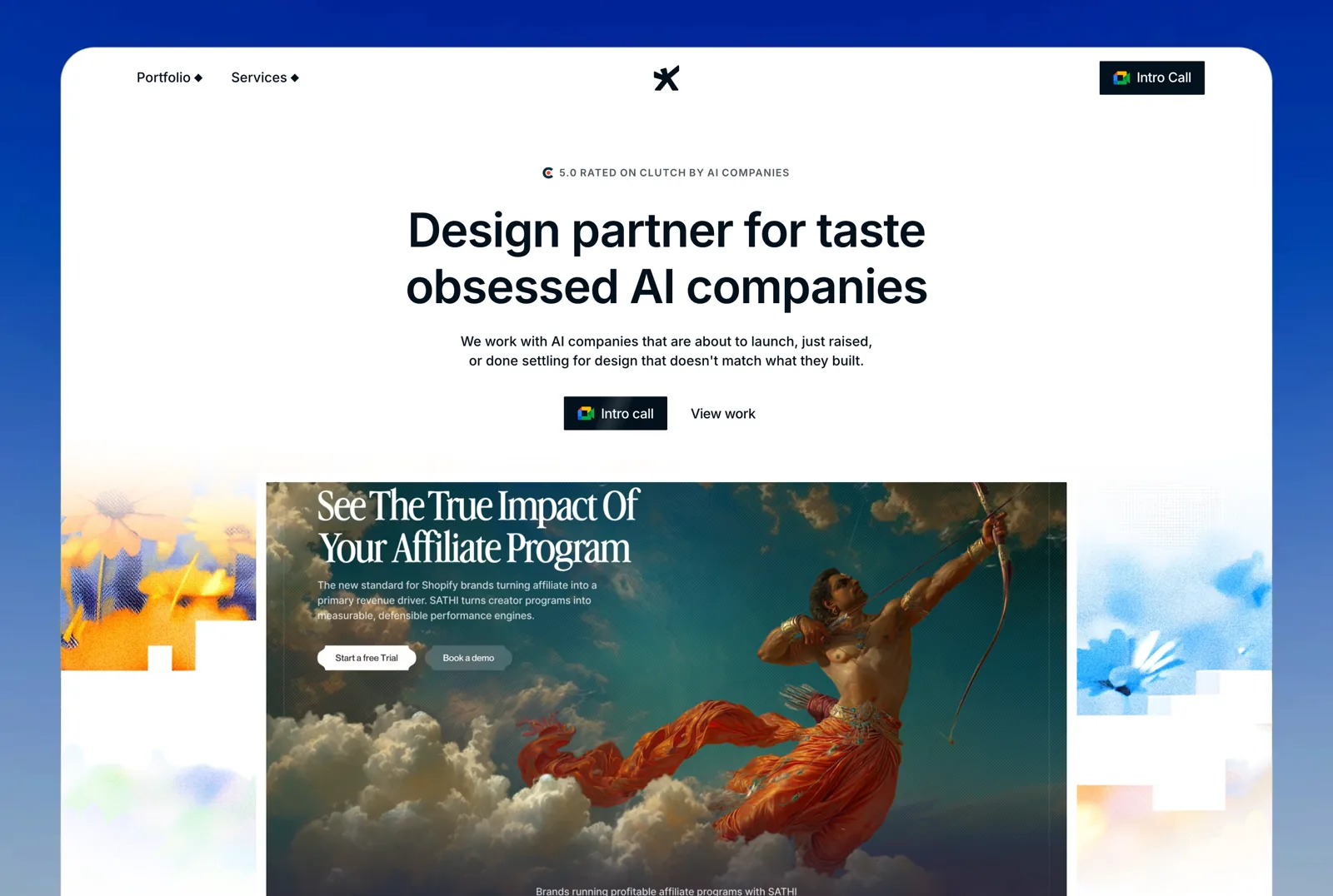
Studio Maydit is a web and product design studio. It works with AI founders in the US, UK, and Europe, fully remote. The build tool follows who will own the site. A founder who wants to update copy between calls gets Framer. A growth lead who will run experiments alone gets Webflow. A technical team that wants the site in its own repo gets custom code. Once the site is out, the work carries on into product design.
Proof sits with Dualite, which grew to 100,000+ users in seven months. Part of that came from design work supporting a repositioned ICP, pointing the product at the buyers most likely to stay. US trial users judge fast, so knowing exactly who you are for matters early. Recent clients also include Wave, PixelFlow, Mi-VAD, and 15 other AI and SaaS teams.
| Check | Finding |
|---|---|
| Based in | Remote, serving US / UK / EU |
| Platform depth | Framer, Webflow, and custom code |
| AI-sector proof | Yes. AI-native clients, published outcome on Dualite |
| Pricing | Fixed scope or monthly retainer, quoted per project |
| Team shape | Founder-led, small senior team |
| Best fit | US-based AI startups whose trial users decide in the first session |
Share your trial numbers and the step where people stop, and we will look at that first. Book a 30-minute call.

2. Clay
Clay has been open since 2016 and has 51 to 200 people in San Francisco. Its named clients, Slack, Stripe, Google, Coinbase, and Amazon, are all American, and it shows published AI work. Those are the products your US buyers use every day and quietly compare you with. It designs across several platforms and publishes a minimum.
Large clients set the pace in a studio this size. Get the names of your senior designers and a weekly review slot in the contract.
| Check | Finding |
|---|---|
| Based in | San Francisco, USA |
| Founded | 2016 |
| Team size | 51-200 |
| Primary platform | Mixed |
| AI-sector proof | Yes. Published AI client work |
| Named clients | Slack, Stripe, Google, Coinbase, Amazon |
| Pricing | Published minimum |
| Best fit | US AI startups that need a signed-in product held to big-brand standards |
3. BX Studio
BX Studio is a New York team of 11 to 50 that builds in Webflow and publishes a minimum. It shows published AI work and names Reddit, Headspace, ASAPP, and Verifone as clients. ASAPP sells AI for customer service to large US companies, so the team has explained an AI product to American business buyers. Its hours match any US team.
Webflow covers the public site, not the product behind the login, and no founding year is published. Ask who would design your signed-in screens.
| Check | Finding |
|---|---|
| Based in | New York, USA |
| Founded | Not published |
| Team size | 11-50 |
| Primary platform | Webflow |
| AI-sector proof | Yes. Published AI client work |
| Named clients | Reddit, Headspace, ASAPP, Verifone |
| Pricing | Published minimum |
| Best fit | US AI startups whose first job is a launch site that explains the product |
4. Fantasy
Fantasy has offices in San Francisco and New York and has been running since 1999, longer than anyone else on this list. It works across several platforms and shows AI work. With an office on each coast, a founder in either city shares its working day.
It publishes no named clients, no team size, and no pricing. There is little to verify, so ask for case studies under NDA before any pitch.
| Check | Finding |
|---|---|
| Based in | San Francisco and New York, USA |
| Founded | 1999 |
| Team size | Not published |
| Primary platform | Mixed |
| AI-sector proof | Yes. Published AI client work |
| Named clients | Not published |
| Pricing | Not published |
| Best fit | US founders who want a long-established studio on their own coast |
5. Phantom
Phantom is the London and Auckland studio in this list. It was founded in 2013, has 51 to 200 people, writes custom code, and shows AI work. Clients include Diageo, SAP, the Financial Times, and Zendesk, a support tool used by many American companies. One contract can cover both the design and the build.
Pricing is not published. London shares only the morning with the East Coast and almost nothing with the West, so plan decisions around a short window.
| Check | Finding |
|---|---|
| Based in | London, UK and Auckland, NZ |
| Founded | 2013 |
| Team size | 51-200 |
| Primary platform | Custom code |
| AI-sector proof | Yes. Published AI client work |
| Named clients | Diageo, SAP, Financial Times, Zendesk |
| Pricing | Not published |
| Best fit | East Coast AI teams that want design and production code from one studio |
6. Trueform
Trueform, founded in 2022 in Wil, Switzerland, works in Framer and publishes a minimum. Its named clients are Miro, Morning Brew, Bilt Rewards, and Gather, and it shows AI work. Morning Brew and Bilt Rewards are US brands, so the studio has designed for American readers and shoppers. A founder gets a quick, editable site at a known starting price.
Team size is not published, and Framer stops at the product login. The Swiss day ends before most US afternoons begin.
| Check | Finding |
|---|---|
| Based in | Wil, Switzerland |
| Founded | 2022 |
| Team size | Not published |
| Primary platform | Framer |
| AI-sector proof | Yes. Published AI client work |
| Named clients | Miro, Morning Brew, Bilt Rewards, Gather |
| Pricing | Published minimum |
| Best fit | US founders who need a polished launch site fast and can review in the morning |
7. SuperSkills
SuperSkills sits in Walnut Creek, in the San Francisco Bay Area, with a team of one to ten. It works across platforms, shows AI work, and names The Cut as its client. For a US founder with a tight, clear scope, a tiny team on the same clock means answers within hours.
With one client, no pricing, and no founding year, it is hard to judge. Keep the brief small and ask for recent AI screens.
| Check | Finding |
|---|---|
| Based in | Walnut Creek, USA |
| Founded | Not published |
| Team size | 1-10 |
| Primary platform | Mixed |
| AI-sector proof | Yes. Published AI client work |
| Named clients | The Cut |
| Pricing | Not published |
| Best fit | West Coast founders with one small flow to design quickly |
8. Feely Studio
Feely Studio is a distributed European team of one to ten that publishes a minimum. It shows AI client work for Noxus, Mutiny, Luasai, and Basic Capital. Mutiny is a San Francisco company, so Feely has worked for at least one US buyer. With a team this small, the person you brief is the person who designs.
No founding year is published, and its European hours overlap only briefly with yours. A tiny team also has little room if scope grows.
| Check | Finding |
|---|---|
| Based in | Distributed, Europe |
| Founded | Not published |
| Team size | 1-10 |
| Primary platform | Mixed |
| AI-sector proof | Yes. Published AI client work |
| Named clients | Noxus, Mutiny, Luasai, Basic Capital |
| Pricing | Published minimum |
| Best fit | US AI startups on a tight budget that can work in writing across time zones |
9. Kvalifik
Kvalifik is a Copenhagen Webflow studio of 11 to 50 people, founded in 2015. It shows AI work for Veo, Maersk, and Relesys, and it can build a clean launch site. Veo sells AI camera systems for sports clubs, so the studio has made a technical product easy for ordinary buyers to follow.
It is the wrong fit for most US teams. All its named proof is European, pricing is not published, Copenhagen is six to nine hours ahead, and Webflow does not reach the product.
| Check | Finding |
|---|---|
| Based in | Copenhagen, Denmark |
| Founded | 2015 |
| Team size | 11-50 |
| Primary platform | Webflow |
| AI-sector proof | Yes. Published AI client work |
| Named clients | Veo, Maersk, Relesys |
| Pricing | Not published |
| Best fit | US startups planning a European launch site, not the MVP itself |
10. Flow Ninja
Flow Ninja works in Webflow from Belgrade, with 11 to 50 people since 2018. AI proof is partial. A team that size could handle a basic marketing site, and Webflow lets a US marketer edit it afterwards without help.
It publishes no clients and no pricing, so there is no US work to check. Belgrade shares no normal hours with the West Coast. It is the wrong fit here.
| Check | Finding |
|---|---|
| Based in | Belgrade, Serbia |
| Founded | 2018 |
| Team size | 11-50 |
| Primary platform | Webflow |
| AI-sector proof | Partial. Web clients, no AI case study |
| Named clients | Not published |
| Pricing | Not published |
| Best fit | US teams that only need a simple site and can wait a day for replies |
How to choose between them
Pick based on where your trial is losing people.
Trial users sign up and leave in the first session. The product needs designing, not just the site. Studio Maydit or Clay.
Visitors do not understand what you sell. You need the launch site first, on US hours. BX Studio or Fantasy.
You want one team to design and write the code. Phantom, if a morning-only overlap works.
You need a site this month at a known starting price. Trueform or Feely Studio.
Then ask every studio one thing: at 4 p.m. your time, who answers a question, and when? The reply tells you how the next six weeks will feel.