Reading time:
12 min read
Last updated:
10 Best MVP Design Agencies for Venture Studios - September 2026
MVP design agencies for venture studios launching several companies a year: ten partners compared on capacity, range, and published minimums.

Ranked for venture studios that launch several companies a year, the ten are: Studio Maydit, Finsweet, 8020, Flowout, Refokus, Digidop, Push Refresh, Edgar Allan, Lighthouse Digital, and Instrument. Finsweet takes second place on capacity. It has 51 to 200 people and clients as different as GitHub, Dropbox, and Clay. 8020 comes third on range, with five named software clients, among them Vanta, Superlist, and Circle. At the bottom, Lighthouse Digital publishes no team size and no AI work, and Instrument is set up for single large brand launches rather than a pipeline of small ones.
A venture studio does not buy one MVP. It buys the same kind of work five or six times a year, for companies that do not yet have a CEO, a name, or sometimes a customer.
That turns design into a supply problem. The question is less how good one launch looks and more how fast the tenth one gets out the door, and at what cost per company.
It also blurs who the client is. The studio signs the contract, but each company will soon have its own leader, who inherits every decision. A design partner has to serve both without siding with the wrong one.
And most of these first versions exist to be tested, not loved. Some will be shut down within a quarter. The right partner can make a test look credible without spending launch money on it.
Scores below reward partners who can repeat good work across a portfolio. Each one gets a spec table and a plain weakness.

How we picked these agencies
We rated every studio on the same five points, using only its public footprint: website, case studies, and directory profiles. No studio paid to be here, and none reviewed its entry.
Platform depth. Which tools does the studio ship in, and can it work in more than one? A portfolio rarely settles on a single stack, so a partner locked to one builder will fit some companies and not others.
Multi-product proof. Has the studio launched several unrelated products, not one long account? Venture studio work is a run of short starts, and a client list spanning many companies is the best public sign a team can handle that rhythm.
Pricing transparency. Is a minimum published at all? A studio budgeting design across six companies needs a floor it can plan against before it opens a single conversation.
Team shape. Can the team run two builds in the same month without quality dropping? Capacity, more than talent, is what runs out first.
The agency's own website. The one launch where the studio was its own client.
Read that fifth point as a preview of your companies. A studio's own site is what it makes when nobody is watching the budget. If it is stale or hard to scan, expect your portfolio sites to age the same way once the engagement ends.
Sources, briefly: studio sites and public directory entries, read in September 2026. Nothing was filled in by asking, and missing facts are printed as Not published.
What goes wrong when a venture studio buys MVP design
Each of these costs the studio once per company, which is why they pile up.
Every company starts from a blank file. The partner designs company one from scratch, then company two, then company three. Nothing carries over: no base components, no tested sign-up flow, no page templates. The studio pays setup costs five times and wonders why each launch takes as long as the first. Commission a shared starter kit once, owned by the studio, and have each new company copy it and restyle it.
The design answers the thesis, not the CEO. The studio briefs the MVP around its own investment thesis. Then an operator joins as CEO, disagrees with half of it, and starts over. The first design paid for a pitch, not a product. Bring the incoming CEO into reviews as early as you can, or keep version one narrow enough that it only tests the thesis and leaves room for their choices.
Kill tests get launch budgets. A first version meant to prove or disprove demand gets the polish of a public launch: custom illustration, motion, a full brand. When the test fails, that money is gone. When it passes, the polish was built on guesses. Write the kill rule down before design starts, and fund two tiers: a lean test build, then a real launch once the numbers clear.
1. Studio Maydit: A Top-Rated Design Agency for AI Founders
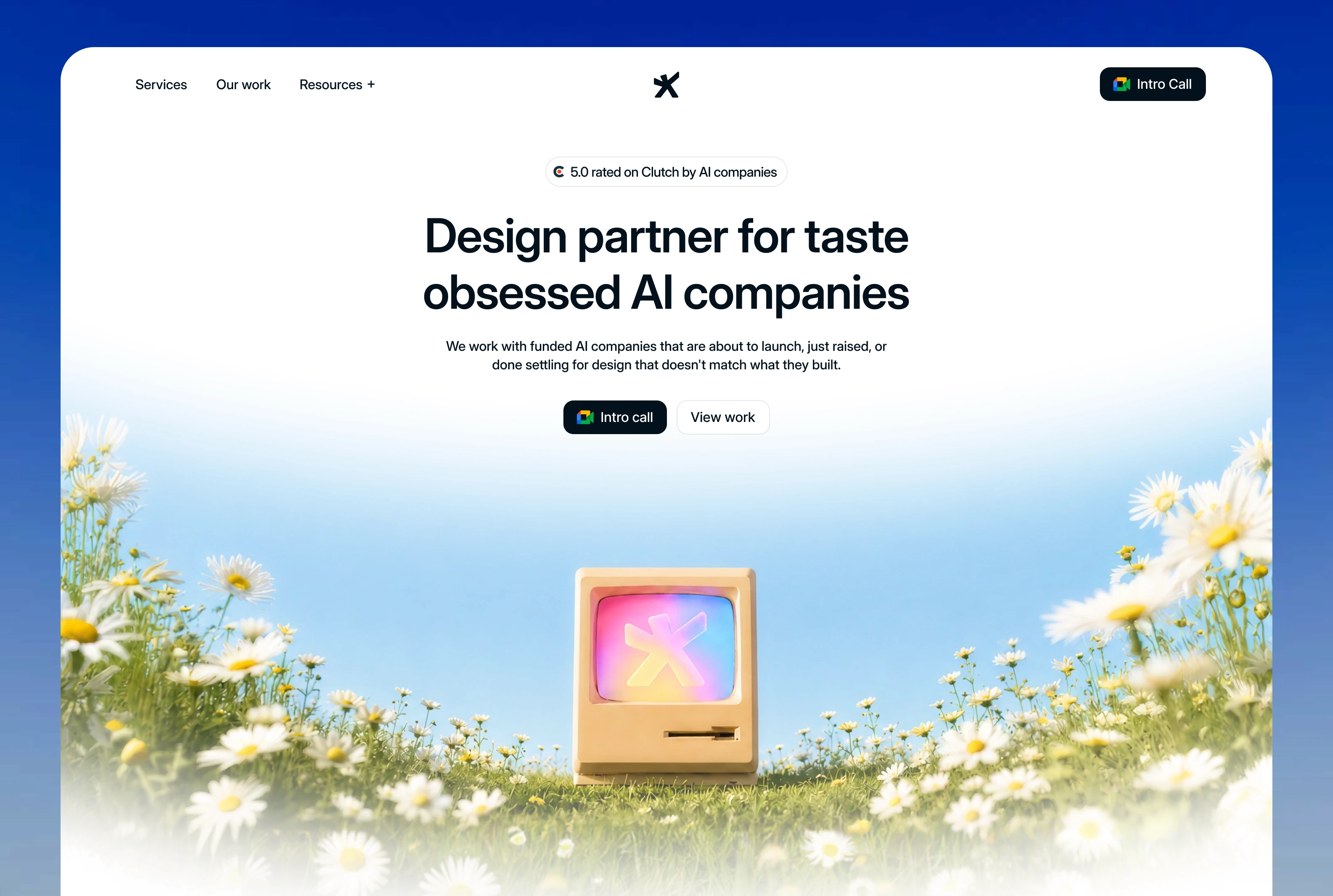
For a venture studio, the monthly retainer is the more natural way to buy from Studio Maydit. One team handles new pages, campaigns, and product design for whichever company needs it that month, with no long lock-in. When a single company has a firm launch date, fixed scope runs three to four weeks. It closes with a diagnosis of what is leaking in the product, which gives the studio a clear keep-or-cut signal.
The studio itself is a web and product design studio. Its clients are AI founders in the US, UK, and Europe. Each portfolio company can land on the platform that suits its team. Framer works when a founder wants to edit pages alone. Webflow works when a marketing hire will run the CMS. Custom code works when the site has to share a repo with the product. Once the site is live, the work continues into product design.
Portfolio managers tend to ask for one hard result. It is Dualite: 100,000+ users in seven months, with design work supporting a repositioned ICP behind part of that climb. Wave, PixelFlow, Mi-VAD, and 15 other AI and SaaS teams round out the recent list, a spread of early products not unlike a studio portfolio.
Check | Finding |
|---|---|
Based in | Remote, serving US / UK / EU |
Platform depth | Framer, Webflow, and custom code |
AI-sector proof | Yes. AI-native clients, published outcome on Dualite |
Pricing | Fixed scope or monthly retainer, quoted per project |
Team shape | Founder-led, small senior team |
Best fit | Venture studios that want one design partner across several early-stage companies |
Bring the list of companies you plan to start this year, and the call can price the portfolio rather than one site. Book a 30-minute call.

2. Finsweet
Finsweet is based in Denver with a distributed team, founded in 2017, with 51 to 200 people working in Webflow. That headcount is the point for a venture studio: it can staff a second and third company in the same quarter. The client list, Dropbox, Clay, GitHub, and Steadily, runs from very large platforms to smaller growth companies.
Pricing is not published, so every company needs its own quote. AI proof is partial, and the work is Webflow sites, so app screens need another partner.
Check | Finding |
|---|---|
Based in | Denver, USA, distributed |
Founded | 2017 |
Team size | 51-200 |
Primary platform | Webflow |
AI-sector proof | Partial. Software clients, no AI case study |
Named clients | Dropbox, Clay, GitHub, Steadily |
Pricing | Not published |
Best fit | Venture studios launching several marketing sites in the same quarter |
3. 8020
8020 works from San Francisco and New York, founded in 2014, in Webflow. It names five clients: Wave, Superlist, Pilot.com, Vanta, and Circle. Five distinct software companies on one public list shows range, and range is what a portfolio needs when the next company sells something unrelated to the last.
Team size and pricing are not published, which makes capacity planning a guess. AI proof is partial.
Check | Finding |
|---|---|
Based in | San Francisco and New York, USA |
Founded | 2014 |
Team size | Not published |
Primary platform | Webflow |
AI-sector proof | Partial. Startup clients, no AI case study |
Named clients | Wave, Superlist, Pilot.com, Vanta, Circle |
Pricing | Not published |
Best fit | Venture studios whose companies sell software to business buyers |
4. Flowout
Flowout is a distributed Webflow studio with a published minimum. Its clients include Jasper, Kajabi, Riverside, and Sendlane, four separate software products. For a studio setting a design budget per company, a public floor is worth a lot, because the number can go into the plan before anyone takes a call.
It publishes no founding year and no team size, and AI proof is partial. It sits in the budget tier, so check who does senior design review.
Check | Finding |
|---|---|
Based in | Distributed |
Founded | Not published |
Team size | Not published |
Primary platform | Webflow |
AI-sector proof | Partial. SaaS clients, no AI case study |
Named clients | Jasper, Kajabi, Riverside, Sendlane |
Pricing | Published minimum |
Best fit | Venture studios that need a known cost per company for early sites |
5. Refokus
Refokus works remotely from Germany, founded in 2021, with 11 to 50 people in Webflow. Mural, BASF, Spotify, Yahoo, and BCG are on its list. The spread across software, industry, and consulting clients shows it can shift tone between very different companies, which a portfolio demands.
It sits in the premium tier with no published pricing, and AI proof is partial. Premium rates across five companies add up fast.
Check | Finding |
|---|---|
Based in | Germany, remote |
Founded | 2021 |
Team size | 11-50 |
Primary platform | Webflow |
AI-sector proof | Partial. Large-company clients, no AI case study |
Named clients | Mural, BASF, Spotify, Yahoo, BCG |
Pricing | Not published |
Best fit | Venture studios with one flagship company that deserves a high-craft site |

6. Digidop
Digidop is a Paris Webflow studio founded in 2021, with 1 to 10 people and a published minimum. Its clients span energy, personal finance, and data infrastructure: TSE Energy, Ramify, and StreamNative. Range across unrelated sectors is exactly the multi-product proof a venture studio should look for.
With 1 to 10 people, it cannot absorb several companies at once, and AI proof is partial. Use it for one company at a time.
Check | Finding |
|---|---|
Based in | Paris, France |
Founded | 2021 |
Team size | 1-10 |
Primary platform | Webflow |
AI-sector proof | Partial. Mixed-sector clients, no AI case study |
Named clients | TSE Energy, Ramify, StreamNative |
Pricing | Published minimum |
Best fit | European venture studios launching one company at a time |
7. Push Refresh
Push Refresh is a Dallas studio of 1 to 10 people working in Framer, with a published minimum. Clients include SmithRx, Synonym, and Northern National. Framer suits test builds well, because a founder in residence can change the page without waiting on a developer.
No founding year is published, AI proof is partial, and the team is small. It fits a single test, not a whole year's pipeline.
Check | Finding |
|---|---|
Based in | Dallas, USA |
Founded | Not published |
Team size | 1-10 |
Primary platform | Framer |
AI-sector proof | Partial. Health and finance clients, no AI case study |
Named clients | SmithRx, Synonym, Northern National |
Pricing | Published minimum |
Best fit | Venture studios running fast Framer test pages for one company at a time |
8. Edgar Allan
Edgar Allan has worked from Atlanta since 2014, with 51 to 200 people in Webflow, for Porsche, Duracell, and NCR. The team is large enough for parallel work, and it knows how to run a site for a company with many stakeholders.
The named clients are established brands, not new companies, and pricing is not published. It sits in the premium tier, which strains a per-company budget built for tests.
Check | Finding |
|---|---|
Based in | Atlanta, USA |
Founded | 2014 |
Team size | 51-200 |
Primary platform | Webflow |
AI-sector proof | Partial. Brand clients, no AI case study |
Named clients | Porsche, Duracell, NCR |
Pricing | Not published |
Best fit | Venture studios spinning out a company with a corporate partner behind it |
9. Lighthouse Digital
Lighthouse Digital is a London Webflow studio with a published minimum, for HelloSelf, Freetrade, and IGN. The public floor and a UK base make it easy to brief for a single London company.
It ranks ninth because there is no published AI work, no team size, and no founding year. Without a team size, a studio cannot tell whether it could take a second company at once.
Check | Finding |
|---|---|
Based in | London, UK |
Founded | Not published |
Team size | Not published |
Primary platform | Webflow |
AI-sector proof | No |
Named clients | HelloSelf, Freetrade, IGN |
Pricing | Published minimum |
Best fit | UK venture studios with one straightforward marketing site to launch |
10. Instrument
Instrument has worked from Portland since 2005 across mixed platforms, for Nike, Microsoft, Electronic Arts, and Google. It is a strong choice for a large brand moment.
It ranks last for this audience. Team size and pricing are not published, AI proof is partial, and its model is built around one big client at a time. A pipeline of small, fast tests is the opposite shape.
Check | Finding |
|---|---|
Based in | Portland, USA |
Founded | 2005 |
Team size | Not published |
Primary platform | Mixed |
AI-sector proof | Partial. Consumer brand clients, no AI case study |
Named clients | Nike, Microsoft, Electronic Arts, Google |
Pricing | Not published |
Best fit | A grown portfolio company planning a major brand relaunch |
How to choose between them
Decide by what your portfolio is short of this year, not by any single launch.
Several companies need sites in the same quarter. Finsweet, or Studio Maydit on a retainer.
You need a known cost per company before planning. Flowout, Digidop, or Push Refresh.
One flagship company deserves the best site in the portfolio. Refokus or 8020.
A company has a corporate partner and many stakeholders. Edgar Allan.
Then ask one question on the first call: what would you reuse from our last company on the next one? A partner that fits a venture studio answers with specific parts, such as a sign-up flow or a page kit. A partner that says every company deserves a fresh start will charge you for one each time.

Need more info?
Can't find your answer? Book a call and let's talk.
Continue Reading
10 Best Framer Design Agencies for AI Agent Startups - September 2026
What is the best Framer agency for an AI agent startup? Ten Framer studios ranked for agent products, with pricing, team size and AI work compared.

Siddarth Ponangi
10 Best Framer Design Agencies for Newly Funded Startups - September 2026
Your funding announcement is the biggest traffic day you will have all year. We checked 10 Framer agencies on five public criteria to see which can hit that date.
Siddarth Ponangi
10 Best Custom Code Website Development Agencies for AI Agent Startups - September 2026
AI web development agencies for agent startups. Which teams build custom coded sites a small team can still update weekly after launch.
Siddarth Ponangi