
Summarize with AI


The best Next.js development agencies for AI agent startups in 2026 are Studio Maydit, Engine Digital, Phantom, Feels Like, basement.studio, Ramotion, Instrument, Refokus, SuperSkills, and Finsweet. Studio Maydit and basement.studio lead for agent teams, because both work in code, both have shipped for AI companies whose products are hard to show, and both are small enough that a senior person stays on the account. Refokus and Finsweet are the wrong fit for this particular job, since both are Webflow studios and the reason you are reading about Next.js is that Webflow cannot run your agent on the page.
There is a specific reason agent teams end up in a Next.js conversation, and it is worth naming before you brief anyone.
You reached for code because you want the agent live on the site. Not a video of it, not a carousel of screenshots, the real thing, taking a real instruction and doing something in front of a stranger. That is a reasonable instinct. An agent is a verb, and no static layout has ever successfully described a verb. The moment you show one running, the explaining stops.
The consequence is the part teams underestimate. The website is no longer marketing. It is a second product surface, with its own queue, its own rate limits, its own failure states, and its own bill. It runs unauthenticated, in front of anybody, including people who will try to break it for fun. It is now something you operate.
That changes who you should hire. You are not buying a brochure that happens to be built in React. You are buying a small application that has to look like brand work, load like a marketing page, and stay up on the day you get posted somewhere busy.
The ten studios below are ranked on how well they handle a site that is also a piece of running software.

How we picked these agencies
This is a teardown, not a directory listing. For each agency we read their own site and their public record, then checked five things you can verify yourself in an afternoon:
- Platform depth. Is one craft their real specialism, or one line on a long service menu?
- AI-sector proof. Named AI clients and published work, or just the word "AI" in the copy?
- Pricing. Do they publish a minimum at all, or keep it behind a call?
- Team shape. Who actually does the work, and how many clients are they carrying at once?
- Their own site. Distinctive, or the same template as everyone else on this list?
That last one gets skipped most often. An agency's own website is the only project where nobody overruled them. No client committee, no inherited brand book. If their own site is forgettable, you have found their ceiling.
Every fact below comes from the agency's own site or a public listing. Where a number is not public, we say so rather than guessing.
What goes wrong when the website has to run the product
Three failures repeat on agent sites built in code, and all three come from the same root: nobody decided who owns the thing after launch.
The live demo is designed for the happy path only. In the studio, on a fast connection, with a sensible prompt, the agent looks magical. Then a real visitor types something vague, or sarcastic, or in another language, and the interface has nothing to say. Or the model takes eleven seconds and the page shows a spinner with no sense of progress, so the visitor decides it has hung and leaves. The states that decide whether the demo helps you are the slow one, the refused one, the wrong-answer one, and the queue-is-full one. Those are design problems, not engineering problems, and they need to be in the brief on day one rather than discovered in the last week.
Nobody owns the site after the invoice clears. A Next.js site is a deployment, dependencies, an API key with a spend limit, and a demo endpoint that somebody has to watch. A studio that hands over a repository and disappears has handed you a small operational burden your engineers did not plan for. It usually surfaces four months later, when a dependency needs updating, the person who wrote it is gone, and your two backend engineers are mid-sprint on the actual product. Agree who is on call for the site, and what happens when the demo starts costing more than expected, before you sign anything.
The site and the docs describe two different products. Agent companies ship fast, and the docs move with the product because engineers keep them honest. The marketing site does not, because updating it means a ticket with an agency. Within a quarter the homepage promises three integrations that shipped, misses the two that shipped last month, and describes a workflow you have since replaced. Technical buyers check the docs first and treat the mismatch as a signal about how carefully you work. Build the site so your own team can change the words without a deployment, or accept that it will be wrong most of the time.
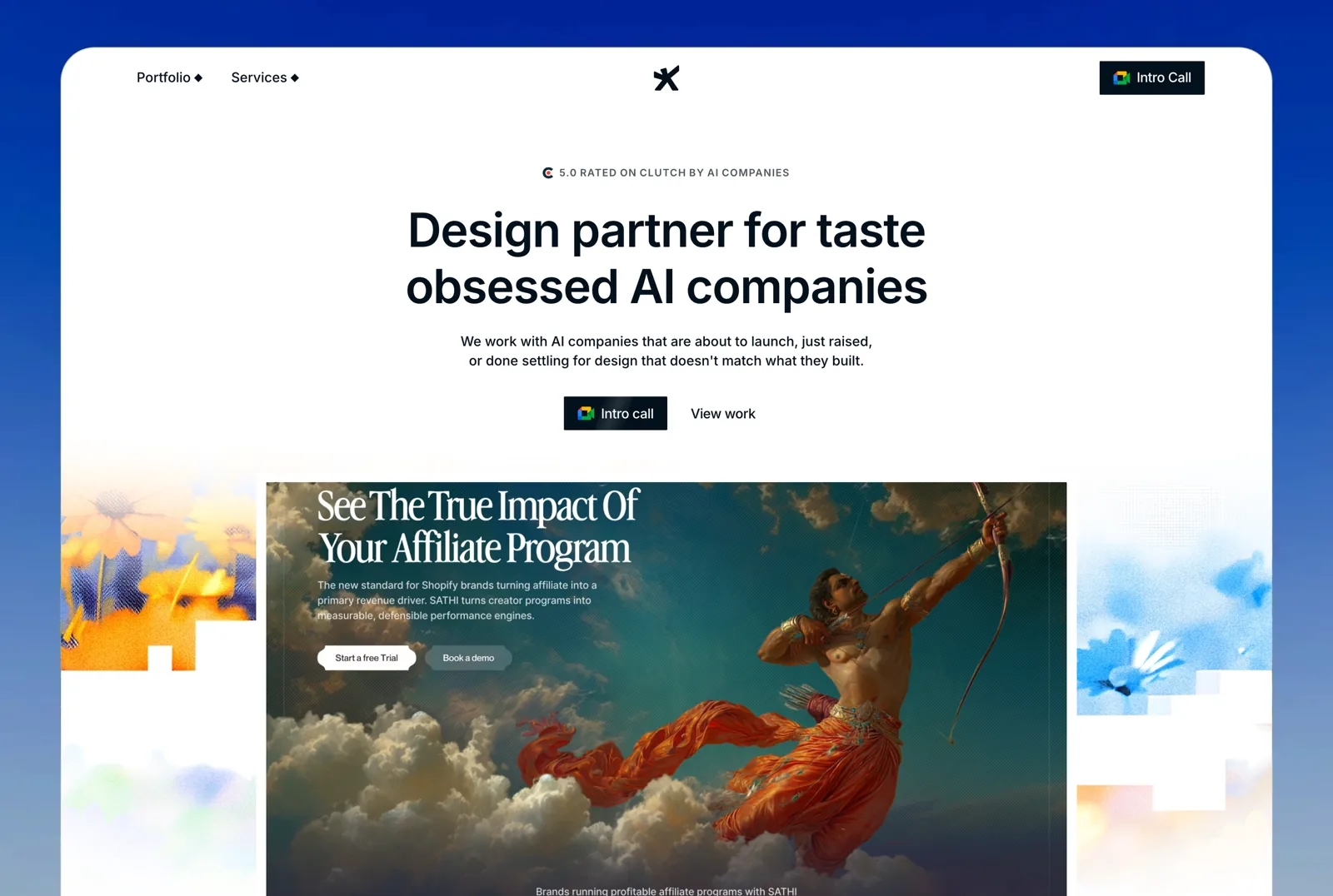
1. Studio Maydit: A Top-Rated Design Agency for AI Founders
Studio Maydit is a web and product design studio working with AI founders in the US, UK, and Europe. The studio builds websites in Framer, Webflow, and custom code, and continues into product design after the site ships.
The clearest outcome is Dualite, where design work supporting a repositioned ICP helped the product reach 100,000+ users in seven months. Recent clients include Wave, PixelFlow, Mi-VAD, and 15 other AI and SaaS teams.
Websites can be bought two ways. Fixed scope runs three to four weeks and suits teams with a launch date. Teams that keep shipping take a monthly retainer instead, covering new pages, campaigns, and product design, with no long lock-in. Fixed-scope projects end with a diagnosis of what is leaking in the product, not a handoff and goodbye.
| Check | Finding |
|---|---|
| Based in | Remote, serving US / UK / EU |
| Platform depth | Framer, Webflow, and custom code |
| AI-sector proof | Yes. AI-native clients, published outcome on Dualite |
| Pricing | Fixed scope or monthly retainer, quoted per project |
| Team shape | Founder-led, small senior team |
| Best fit | Agent teams putting a working demo on the marketing site |
Maydit is the right call if the demo is the argument and the failure states are still undesigned. Book a 30-minute call.

2. Engine Digital
Engine Digital works from Vancouver and New York, founded in 2002, building in custom code, with Adidas, Autodesk, Goldman Sachs, and HP named. Two decades of shipping software for large organisations means they treat a website as a system with owners and uptime rather than a deliverable, which is exactly the mindset a site that runs an agent needs.
Their AI-sector proof is partial, they publish no pricing and no team size, and their process is built for clients who can staff a project team for months, which an eight-person agent company cannot.
| Check | Finding |
|---|---|
| Based in | Vancouver and New York |
| Founded | 2002 |
| Team size | Not published |
| Primary platform | Custom code |
| AI-sector proof | Partial. Enterprise clients, no published AI case study |
| Named clients | Adidas, Autodesk, Goldman Sachs, HP |
| Pricing | Not published |
| Best fit | Agent teams selling into large regulated buyers |
3. Phantom
Phantom works from London and Auckland, founded in 2013, with 51 to 200 people, building in custom code, with Diageo, SAP, Financial Times, and Zendesk named, plus published AI client work. They are strong at making an interface feel deliberate rather than assembled, and for an agent product the interaction around the demo is the whole argument, so that craft goes directly to the thing that matters.
They publish no pricing, a firm that size will not put its best people on a small account, and their engagements assume a message that stays still for a year, which an agent roadmap does not.
| Check | Finding |
|---|---|
| Based in | London, UK and Auckland, NZ |
| Founded | 2013 |
| Team size | 51-200 |
| Primary platform | Custom code |
| AI-sector proof | Yes. Published AI client work |
| Named clients | Diageo, SAP, Financial Times, Zendesk |
| Pricing | Not published |
| Best fit | Agent teams whose demo needs to feel like a product |
4. Feels Like
Feels Like is a Los Angeles studio founded in 2023, working in custom code, with Google, Nike, LVMH, and Suno AI named, plus published AI client work. Suno is the reference to look at, because it is a product whose output is generated and unpredictable, and they found a way to present it without pretending the result is fixed. That is the same presentation problem an agent has.
They publish no pricing and no team size, they are young, and a studio whose strength is expressive work can push an agent demo towards spectacle when what a technical buyer wants is legibility.
| Check | Finding |
|---|---|
| Based in | Los Angeles, USA |
| Founded | 2023 |
| Team size | Not published |
| Primary platform | Custom code |
| AI-sector proof | Yes. Published AI client work |
| Named clients | Google, Nike, LVMH, Suno AI |
| Pricing | Not published |
| Best fit | Agent teams with one launch that has to be remembered |
5. basement.studio
basement.studio works from Mar del Plata and Los Angeles, founded in 2018, with 11 to 50 people, building in custom code, with a published minimum and Vercel, Cursor, ElevenLabs, Harvey AI, and Scale AI named. That is the most relevant client list here by some distance. They have built the marketing surface for companies whose buyers are developers, and they ship in the same stack you are asking about.
They are small, so senior availability is genuinely limited and booking takes time, and their visual signature is strong enough that a demo can end up serving the design rather than the other way round.
| Check | Finding |
|---|---|
| Based in | Mar del Plata, Argentina and Los Angeles, USA |
| Founded | 2018 |
| Team size | 11-50 |
| Primary platform | Custom code |
| AI-sector proof | Yes. Published AI client work |
| Named clients | Vercel, Cursor, ElevenLabs, Harvey AI, Scale AI |
| Pricing | Published minimum |
| Best fit | Agent teams whose buyers are developers |
6. Ramotion
Ramotion is a San Francisco team of 11 to 50, founded in 2009, working across platforms, with a published minimum and Mozilla, Okta, Netflix, Adobe, and Xero named. Okta is the useful one for an agent company, because it is infrastructure that has to look trustworthy to people who will read your security page before your homepage. Ramotion is comfortable with brand systems that carry that weight.
Their AI-sector proof is partial, their centre of gravity is identity and brand rather than running interfaces, and a mixed-platform studio will lean on a partner for the parts of a Next.js build that actually execute.
| Check | Finding |
|---|---|
| Based in | San Francisco, USA |
| Founded | 2009 |
| Team size | 11-50 |
| Primary platform | Mixed |
| AI-sector proof | Partial. Enterprise and SaaS clients, no AI case study |
| Named clients | Mozilla, Okta, Netflix, Adobe, Xero |
| Pricing | Published minimum |
| Best fit | Agent teams who need to look like infrastructure |
7. Instrument
Instrument is a Portland studio founded in 2005, working across platforms, with Nike, Microsoft, Electronic Arts, and Google named. They are one of the few studios on this list who have built interactive marketing experiences at real scale, and an agent demo that has to survive a busy launch day is closer to that kind of work than to a normal website.
Their AI-sector proof is partial, they publish no pricing and no team size, and the engagement shape suits a company with a marketing organisation, which an agent startup at this stage does not have.
| Check | Finding |
|---|---|
| Based in | Portland, USA |
| Founded | 2005 |
| Team size | Not published |
| Primary platform | Mixed |
| AI-sector proof | Partial. Enterprise and SaaS clients, no AI case study |
| Named clients | Nike, Microsoft, Electronic Arts, Google |
| Pricing | Not published |
| Best fit | Agent teams with a launch moment and budget to match |
8. Refokus
Refokus is a German remote team of 11 to 50, founded in 2021, working in Webflow, with Mural, BASF, Spotify, Yahoo, and BCG named. They are one of the more technically ambitious teams in the Webflow world, and if your honest requirement turns out to be a fast marketing site with the demo living on a separate subdomain your engineers own, that split is cheaper and they build it well.
They publish no pricing, their AI-sector proof is partial, and their platform is not the one this article is about, so a genuinely integrated Next.js build is outside what they do.
| Check | Finding |
|---|---|
| Based in | Germany, remote |
| Founded | 2021 |
| Team size | 11-50 |
| Primary platform | Webflow |
| AI-sector proof | Partial. Enterprise and SaaS clients, no AI case study |
| Named clients | Mural, BASF, Spotify, Yahoo, BCG |
| Pricing | Not published |
| Best fit | Agent teams keeping the demo off the marketing site |
9. SuperSkills
SuperSkills is a small Walnut Creek team of one to ten, working across platforms, with The Cut named and published AI client work. A team this size means the person you meet is the person who works on it, and for a company that will change its product description twice during the project, that short line between decision and change is worth more than process.
They name only one client, publish no pricing, no team size detail, and no founding year, and a team of that size cannot carry an operational commitment for a site that runs an agent.
| Check | Finding |
|---|---|
| Based in | Walnut Creek, USA |
| Founded | Not published |
| Team size | 1-10 |
| Primary platform | Mixed |
| AI-sector proof | Yes. Published AI client work |
| Named clients | The Cut |
| Pricing | Not published |
| Best fit | Early agent teams who need speed over process |
10. Finsweet
Finsweet is a Denver-based distributed team of 51 to 200, founded in 2017, working in Webflow, with Dropbox, Clay, GitHub, and Steadily named. They are unusually rigorous about structure and componentry, and if your real problem is a documentation-adjacent marketing site with many pages that has to stay consistent, that discipline is the relevant strength.
Their AI-sector proof is partial, they publish no pricing, and they are a Webflow specialist, so the one requirement that brought you here, running your agent on the page, is not something they build.
| Check | Finding |
|---|---|
| Based in | Denver, USA, distributed |
| Founded | 2017 |
| Team size | 51-200 |
| Primary platform | Webflow |
| AI-sector proof | Partial. Enterprise and SaaS clients, no AI case study |
| Named clients | Dropbox, Clay, GitHub, Steadily |
| Pricing | Not published |
| Best fit | Agent teams who need many pages kept consistent |
How to choose between them
Sort by what the site actually has to do.
A working agent runs on the page. Studio Maydit or basement.studio.
Developers are the buyers and they judge the stack. basement.studio or Phantom.
A large or regulated buyer has to trust you. Engine Digital or Ramotion.
You need a fast site and the demo can live elsewhere. Refokus or Finsweet.
One test before signing. Describe your slowest, ugliest failure case, the one where the agent takes fifteen seconds and then gets it wrong, and ask what the page shows. A studio that understands this work will start asking about timeouts, partial output, and what the visitor can do next. A studio that says it will design a nice loading animation is treating the hardest part of your product as decoration.