Summarize with AI


For an AI automation startup that wants its website in Next.js, Studio Maydit fits best, because it writes custom code, has AI clients on record, and can keep designing the product after the site is live. Ranked by fit, the ten studios worth reviewing are Studio Maydit, Engine Digital, Ramotion, BX Studio, Kvalifik, Foundey, Trueform, Finsweet, Push Refresh, and Flowout. Engine Digital and Ramotion lead the other nine. Engine Digital is the only competitor here whose main platform is custom code, and Ramotion works across platforms and posts a minimum price. Push Refresh and Flowout fit least, because both build in no-code tools and show only partial AI proof. One honest note: most of the nine build in Webflow, Framer, or design files, so they are the right call only if your site does not truly need Next.js.
Picture a startup whose product watches a support inbox. It tags each ticket, drafts a reply, and holds any refund above a set amount until a person approves it. The product app is already written in Next.js. The founders want the website in the same stack, and the reason is not fashion.
The site and the app meet at one moment. A head of support reads a page called "Send large refunds to a manager first." She likes it and clicks "Use this workflow." What happens next decides whether she becomes a user.
On most sites, that button opens a blank signup form. After the form she lands on an empty dashboard and has to rebuild the workflow she just read about, step by step. Many people quit right there. On a site built with care, the click carries the workflow through signup. Her first screen inside the app is that exact workflow, filled in and waiting for one approval to run.
That handoff is hard to build in a page builder and natural in Next.js, because the site and the app can share code, styles, and a sense of who the visitor is. A returning customer sees "Open your dashboard" instead of "Start free trial."
So this ranking asks one thing. Can the studio build a site that hands buyers straight into the product, and has it worked for AI companies before?

How we ranked studios for an automation company's Next.js site
Our sources were each studio's public pages and directory listings, checked this month. Every place on this list is unpaid.
- Who writes the code. We looked at the main platform each studio names. A Next.js brief favours studios that write custom code themselves. A Webflow or Framer studio scores lower here, even when its design is strong.
- Proof with AI products. We counted named AI clients and published AI work. Automation tools are hard to explain on a page, because the product mostly runs in the background, so a studio that has done it once has a head start.
- Whether a minimum price is public. We only recorded yes or no, never a figure. Automation startups often price by usage, so founders know how hard it is to budget against a number nobody will say.
- How big the team is, and who you get. We compared headcount with the size of the studio's usual clients. A ten-person automation startup wants the people who pitched the work to also do it.
- What the studio's own site does. We opened each one on a phone. Is there real code at work, such as live data or a sign-in, or only static pictures and scroll effects?
The fifth check says a lot. A studio's own website is the one job where nobody else signs off. If it is a slow page of pictures, that is likely the ceiling of what you will get.
Each fact comes from the studio's site or a public directory profile. When something is not published, the table says Not published. We did not guess to fill a gap.
What goes wrong when an automation startup hires a Next.js studio
The site and the app look like two different companies. The studio brings its own fonts, buttons, and words. The site is lovely. Then a buyer clicks "Start free" and lands in a product with a different blue, square corners, and a menu that calls workflows "flows." For a second she wonders if she clicked the wrong link. Ask the studio to build the site from your product's own colours and components, so both halves feel like one place.
Every template page ends at a blank form. The template gallery gets the most design time, and each card has a "Use this" button. Behind every button sits the same signup page, and after it, an empty dashboard. The visitor picked a workflow, and the product forgot it. Ask how the chosen template travels through signup, and what the very first screen in the app will show.
The demo shows only the perfect run. The hero plays a smooth video. A ticket comes in, the AI tags it, a reply goes out, done. Ops buyers have been burned before, so they want to see the messy case: a step that fails, a retry, a refund waiting for a person, and a log that says what happened. A site that hides those moments reads as a promise, not a product. Ask the studio to design one real run with a failed step and a human approval in it.
1. Studio Maydit: A Top-Rated Design Agency for AI Founders
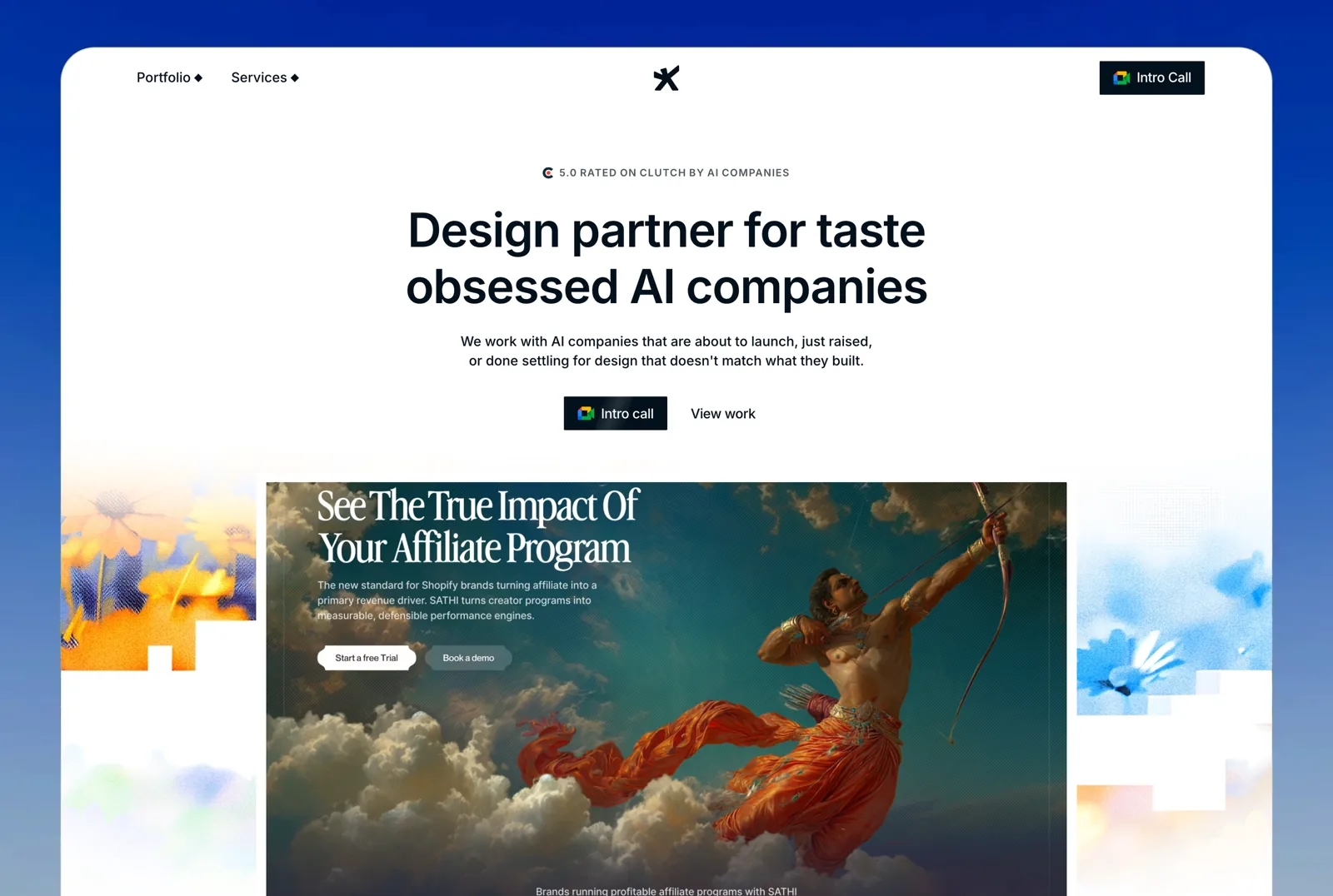
For an automation startup, the website and the first screen of the app are one journey, and Studio Maydit designs both. It is a web and product design studio for AI founders in the US, UK, and Europe. It builds in Framer, Webflow, and custom code, and when the site has to hand a visitor straight into a Next.js app, custom code is the path it picks. Once the site is live, the same team continues into product design, starting with the screens a new user sees after signup.
Dualite shows that pairing at work. In the Dualite case study, an AI dev tool, the studio designed the site and the product side by side, and design work supporting a repositioned ICP helped it reach 100,000+ users in seven months. Other recent clients are Wave, PixelFlow, and Mi-VAD, plus 15 other AI and SaaS teams.
Most teams start with a fixed scope of three to four weeks, timed to a launch or a new release. At the end comes a diagnosis of what is leaking in the product, so you learn where trial users give up before their first workflow runs. If you keep shipping templates and features every month, a monthly retainer covers new pages, campaigns, and product design, with no long lock-in.
| Check | Finding |
|---|---|
| Based in | Remote, serving US / UK / EU |
| Platform depth | Framer, Webflow, and custom code |
| AI-sector proof | Yes. AI-native clients, published outcome on Dualite |
| Pricing | Fixed scope or monthly retainer, quoted per project |
| Team shape | Founder-led, small senior team |
| Best fit | AI automation teams whose Next.js site must carry visitors straight into a working first workflow |
Show us the path from your best template page to the first screen in your app, and we will point out where people drop. Book a 30-minute call.

2. Engine Digital
Engine Digital has worked since 2002 from Vancouver and New York, and custom code is its main platform. That makes it the one studio in this pool, after Maydit, whose record points straight at a coded build that can share code with your app. Its clients include Adidas, Autodesk, Goldman Sachs, and HP. Those are the kind of large buyers an automation startup hopes to land, so ask how the studio has handled their vendor reviews.
AI-sector proof is partial, and team size and pricing are not published. The record says custom code, not which framework, so ask whether the team ships Next.js and who would own the code after launch.
| Check | Finding |
|---|---|
| Based in | Vancouver and New York |
| Founded | 2002 |
| Team size | Not published |
| Primary platform | Custom code |
| AI-sector proof | Partial. Enterprise clients, no AI case study |
| Named clients | Adidas, Autodesk, Goldman Sachs, HP |
| Pricing | Not published |
| Best fit | Automation startups selling to large companies that want a coded site from an established team |
3. Ramotion
Ramotion is a San Francisco studio founded in 2009, with 11 to 50 people and a published minimum. It names Mozilla, Okta, Netflix, Adobe, and Xero as clients. Okta and Xero both sell software that plugs into other tools, which is the same story an automation startup must tell. It works across platforms, so it can plan the brand, the site, and the product look together.
Its main platform is mixed, not custom code, so confirm that its own developers would write the Next.js. AI-sector proof is partial, and the client list is mostly large companies.
| Check | Finding |
|---|---|
| Based in | San Francisco, USA |
| Founded | 2009 |
| Team size | 11-50 |
| Primary platform | Mixed |
| AI-sector proof | Partial. Software clients, no AI case study |
| Named clients | Mozilla, Okta, Netflix, Adobe, Xero |
| Pricing | Published minimum |
| Best fit | Funded automation startups that want the brand, site, and app to look like one system |
4. BX Studio
BX Studio is a New York team of 11 to 50 with a published minimum and published AI client work. Its named clients are Reddit, Headspace, ASAPP, and Verifone. ASAPP works on AI for customer service, which sits close to the support inbox example above. A team that has explained that kind of product will need less briefing from you.
It builds in Webflow, not Next.js, so a site that shares code with your app is outside its usual work. Its founding year is not published.
| Check | Finding |
|---|---|
| Based in | New York, USA |
| Founded | Not published |
| Team size | 11-50 |
| Primary platform | Webflow |
| AI-sector proof | Yes. Published AI client work |
| Named clients | Reddit, Headspace, ASAPP, Verifone |
| Pricing | Published minimum |
| Best fit | AI automation teams selling to support leaders who are happy with a Webflow site |
5. Kvalifik
Kvalifik has worked from Copenhagen since 2015 and has 11 to 50 people. It has published AI client work, and its named clients are Veo, Maersk, and Relesys. Maersk is a shipping and logistics company, a business that runs on process, which is the world many automation buyers live in. For a European startup, it also offers shared working hours.
It builds in Webflow rather than Next.js, and it does not publish a price. Your own engineers would need to build any handoff into the app.
| Check | Finding |
|---|---|
| Based in | Copenhagen, Denmark |
| Founded | 2015 |
| Team size | 11-50 |
| Primary platform | Webflow |
| AI-sector proof | Yes. Published AI client work |
| Named clients | Veo, Maersk, Relesys |
| Pricing | Not published |
| Best fit | European automation startups that sell to operations teams and can run the site on Webflow |
6. Foundey
Foundey is a San Francisco studio founded in 2021 with published AI client work. DemandIQ, Traycer, and Sero AI are named clients. It works in Figma only, so it hands over designs, not a built site.
That is the weakness for a Next.js brief: someone else must write the code. It works only if your own engineers will build the site from its files. Team size and pricing are not published.
| Check | Finding |
|---|---|
| Based in | San Francisco, USA |
| Founded | 2021 |
| Team size | Not published |
| Primary platform | Figma-only |
| AI-sector proof | Yes. Published AI client work |
| Named clients | DemandIQ, Traycer, Sero AI |
| Pricing | Not published |
| Best fit | AI automation teams with front-end engineers who want design files to build from in Next.js |
7. Trueform
Trueform is a Swiss studio from Wil, founded in 2022, with published AI client work and a published minimum. Miro, Morning Brew, Bilt Rewards, and Gather are named clients. Miro is a tool teams connect to many other apps, so Trueform has worked on a product whose value depends on what it plugs into.
It builds in Framer, not Next.js, and its team size is not published. A Framer site cannot share code with your app, so the jump from site to product stays a plain link.
| Check | Finding |
|---|---|
| Based in | Wil, Switzerland |
| Founded | 2022 |
| Team size | Not published |
| Primary platform | Framer |
| AI-sector proof | Yes. Published AI client work |
| Named clients | Miro, Morning Brew, Bilt Rewards, Gather |
| Pricing | Published minimum |
| Best fit | Automation startups that want a polished site their marketers can edit fast |
8. Finsweet
Finsweet is a distributed team of 51 to 200, based in Denver and founded in 2017. Dropbox, Clay, GitHub, and Steadily are named clients. GitHub and Dropbox sell to developers and IT teams, the same people who review an automation tool's access before it is switched on.
Its platform is Webflow, so a Next.js site is not what it offers. AI-sector proof is partial, and no price is published.
| Check | Finding |
|---|---|
| Based in | Denver, USA, distributed |
| Founded | 2017 |
| Team size | 51-200 |
| Primary platform | Webflow |
| AI-sector proof | Partial. Tech clients, no AI case study |
| Named clients | Dropbox, Clay, GitHub, Steadily |
| Pricing | Not published |
| Best fit | Automation startups that sell to technical buyers and want a large Webflow team |
9. Push Refresh
Push Refresh is a Dallas studio of one to ten people with a published minimum. Its named clients are SmithRx, Synonym, and Northern National. A team this small means the founder talks to the people doing the work, and it can move fast on a short site.
It builds in Framer, not Next.js, and AI-sector proof is partial. One to ten people leaves little room for app screens on top of the site, and no founding year is published.
| Check | Finding |
|---|---|
| Based in | Dallas, USA |
| Founded | Not published |
| Team size | 1-10 |
| Primary platform | Framer |
| AI-sector proof | Partial. Startup and services clients, no AI case study |
| Named clients | SmithRx, Synonym, Northern National |
| Pricing | Published minimum |
| Best fit | Very early automation teams that need a small, quick site before the product is public |
10. Flowout
Flowout is a distributed Webflow studio in the budget tier with a published minimum. Jasper, Kajabi, Riverside, and Sendlane are named clients, all software companies. For a startup watching cash, a known floor price helps.
It ranks last for a Next.js brief. It builds in Webflow, AI-sector proof is partial, and neither its founding year nor its team size is published, so you cannot tell from outside who would do the work.
| Check | Finding |
|---|---|
| Based in | Distributed |
| Founded | Not published |
| Team size | Not published |
| Primary platform | Webflow |
| AI-sector proof | Partial. SaaS clients, no AI case study |
| Named clients | Jasper, Kajabi, Riverside, Sendlane |
| Pricing | Published minimum |
| Best fit | Budget-conscious automation startups that have decided against Next.js for now |