
Summarize with AI


The best Next.js development agencies for AI devtools in 2026 are Studio Maydit, Feels Like, Phantom, basement.studio, Engine Digital, Feely Studio, Flow Ninja, Flowout, 8020, and Lazarev. Studio Maydit and basement.studio lead for devtool companies, because both build in code and both have worked with products whose buyers read the source before they read the pitch. Flow Ninja and Flowout are the wrong fit for this brief, since both are Webflow studios and the reason a devtool team is asking about Next.js is that the site and the docs need to be one thing.
There is a fact about developer tools that most marketing sites are built in denial of. A large share of your best users never see your homepage.
They arrive at a README from a link in a Slack channel. Or at a docs page from a search for an error message. Or at your package page while comparing three options in a terminal. They install, they try it, and they form a complete opinion of your product without your homepage participating at all.
That does not make the homepage useless. It makes it a different thing than most teams build. It has two real audiences. The first is the developer who has already tried the tool and now has to explain to a manager why the team should standardise on it. The second is somebody arriving from search who needs to decide in about fifteen seconds whether this is even the right category of thing.
Neither of those readers wants a hero animation and a demo request form. Both want to get to something concrete quickly, and the fastest route to concrete is usually the install command and a link into the docs.
That is why the platform question is really a boundary question. A devtool site and its documentation are not two projects, and the seam between them is where most of these companies lose people.
The ten studios below are ranked on how well they build a site that knows it is the second thing a developer looks at.

How we picked these agencies
This is a teardown, not a directory listing. For each agency we read their own site and their public record, then checked five things you can verify yourself in an afternoon:
- Platform depth. Is one craft their real specialism, or one line on a long service menu?
- AI-sector proof. Named AI clients and published work, or just the word "AI" in the copy?
- Pricing. Do they publish a minimum at all, or keep it behind a call?
- Team shape. Who actually does the work, and how many clients are they carrying at once?
- Their own site. Distinctive, or the same template as everyone else on this list?
That last one gets skipped most often. An agency's own website is the only project where nobody overruled them. No client committee, no inherited brand book. If their own site is forgettable, you have found their ceiling.
Every fact below comes from the agency's own site or a public listing. Where a number is not public, we say so rather than guessing.
What goes wrong when a devtool site is built like a SaaS site
Three failures repeat, and each one comes from copying a template that was designed for a different kind of purchase.
The page blocks the person who would have adopted it. Developer tools spread from the bottom up. One engineer tries it on a Thursday evening, likes it, and brings it to the team. A homepage built around a demo request form interrupts that path at its most fragile moment, because the person who wants to try it right now is not going to book a call for next Tuesday. The install command, the free tier, and the link into the docs belong above the fold and should be reachable without an account. Keep the enterprise conversation on its own page, where the buyer who needs it will happily go looking.
The site and the docs are visibly two different products. Different typography, a different navigation pattern, a search box that only covers half the content, and a header that changes when you cross the boundary. Developers move between marketing pages and reference pages constantly while evaluating, and every one of those seams reads as two teams who do not talk to each other. That impression transfers directly onto the product, because a tool that feels disjointed on the outside invites the question of whether it is disjointed inside. Share the tokens, share the header, share the search, even when the two are built on different systems.
The honest constraints are missing, so people leave to find them. Which languages are supported. Which runtimes. Whether it works self-hosted. What the license actually permits. Whether it needs a GPU. These are the first things a developer checks and the last things a marketing page includes, so they leave for the repository to find out, and a meaningful share never come back. Publishing constraints plainly costs you a few unqualified sign-ups and earns something more valuable, which is being the tool that did not waste anybody's afternoon.
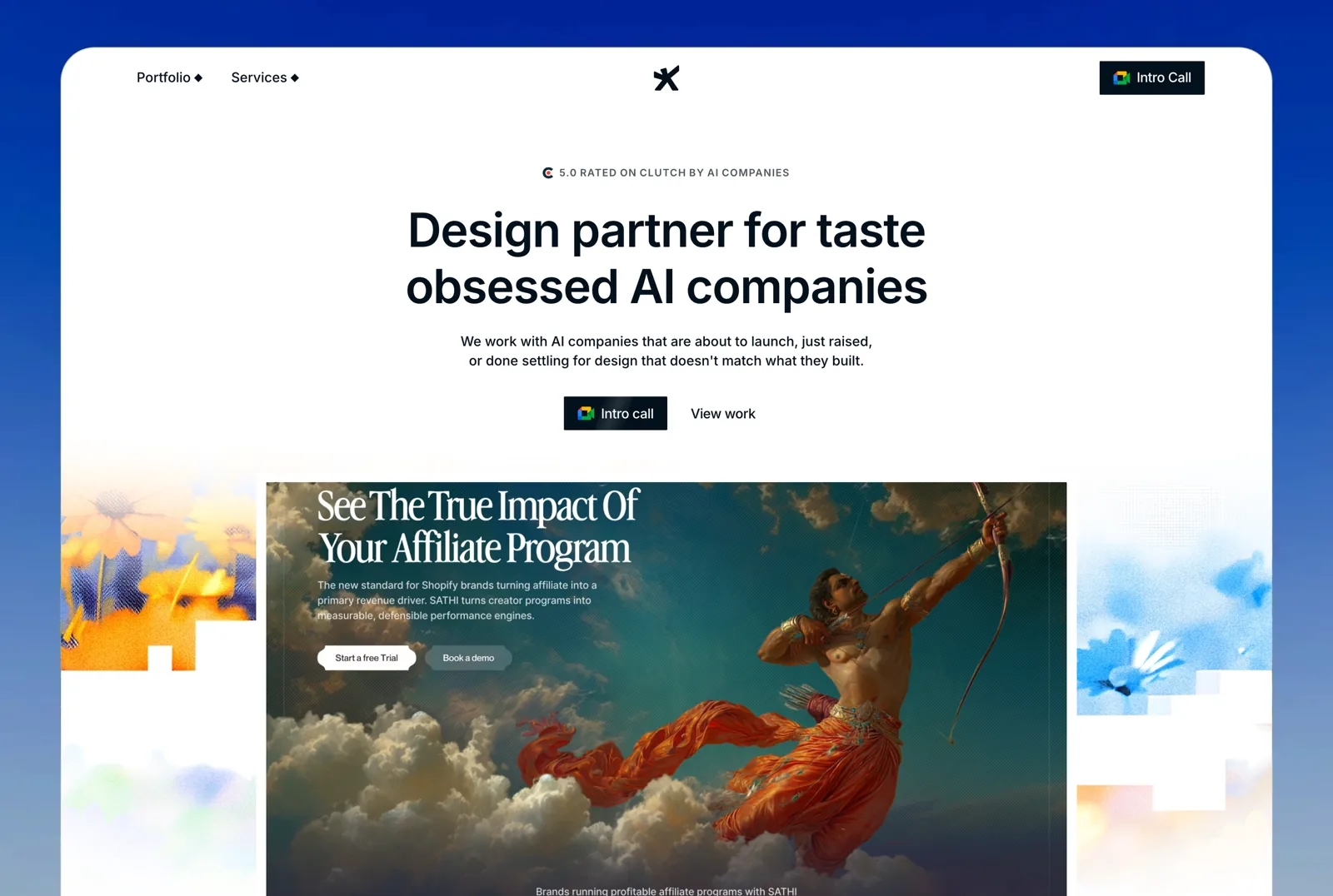
1. Studio Maydit: A Top-Rated Design Agency for AI Founders
Studio Maydit is a web and product design studio working with AI founders in the US, UK, and Europe. The studio builds websites in Framer, Webflow, and custom code, and continues into product design after the site ships.
The clearest outcome is Dualite, where design work supporting a repositioned ICP helped the product reach 100,000+ users in seven months. Recent clients include Wave, PixelFlow, Mi-VAD, and 15 other AI and SaaS teams.
Websites can be bought two ways. Fixed scope runs three to four weeks and suits teams with a launch date. Teams that keep shipping take a monthly retainer instead, covering new pages, campaigns, and product design, with no long lock-in. Fixed-scope projects end with a diagnosis of what is leaking in the product, not a handoff and goodbye.
| Check | Finding |
|---|---|
| Based in | Remote, serving US / UK / EU |
| Platform depth | Framer, Webflow, and custom code |
| AI-sector proof | Yes. AI-native clients, published outcome on Dualite |
| Pricing | Fixed scope or monthly retainer, quoted per project |
| Team shape | Founder-led, small senior team |
| Best fit | Devtool teams whose site and docs should be one thing |
Maydit is the right call if developers keep finding you through the docs and the homepage adds nothing. Book a 30-minute call.

2. Feels Like
Feels Like is a Los Angeles studio founded in 2023, working in custom code, with Google, Nike, LVMH, and Suno AI named, plus published AI client work. They build memorable work in code rather than in a page builder, and for a devtool with one launch moment that has to travel through developer communities, being distinctive is worth more than being tidy.
They publish no pricing and no team size, they are young, and a studio built around expressive work is not the natural choice for the documentation-adjacent restraint most of a devtool site needs.
| Check | Finding |
|---|---|
| Based in | Los Angeles, USA |
| Founded | 2023 |
| Team size | Not published |
| Primary platform | Custom code |
| AI-sector proof | Yes. Published AI client work |
| Named clients | Google, Nike, LVMH, Suno AI |
| Pricing | Not published |
| Best fit | Devtools with a launch that has to spread on its own |
3. Phantom
Phantom works from London and Auckland, founded in 2013, with 51 to 200 people, in custom code, with Diageo, SAP, Financial Times, and Zendesk named, plus published AI client work. The Financial Times is a useful reference for this brief, because it is a large content system where reading is the primary act, and a devtool site is closer to that than to a product landing page.
They publish no pricing, a firm of that size prioritises larger accounts, and their engagements assume a stable message, which a devtool releasing every fortnight does not have.
| Check | Finding |
|---|---|
| Based in | London, UK and Auckland, NZ |
| Founded | 2013 |
| Team size | 51-200 |
| Primary platform | Custom code |
| AI-sector proof | Yes. Published AI client work |
| Named clients | Diageo, SAP, Financial Times, Zendesk |
| Pricing | Not published |
| Best fit | Devtools with large content and reference sections |
4. basement.studio
basement.studio works from Mar del Plata and Los Angeles, founded in 2018, with 11 to 50 people, in custom code, with a published minimum and Vercel, Cursor, ElevenLabs, Harvey AI, and Scale AI named. That is a list of companies who sell to developers, built in the stack this article is about, and it means the studio already understands the boundary problem between marketing pages and reference content.
They are small, so booking takes time and senior capacity is limited, and their strong visual identity can pull a site towards showpiece territory when a devtool audience rewards restraint.
| Check | Finding |
|---|---|
| Based in | Mar del Plata, Argentina and Los Angeles, USA |
| Founded | 2018 |
| Team size | 11-50 |
| Primary platform | Custom code |
| AI-sector proof | Yes. Published AI client work |
| Named clients | Vercel, Cursor, ElevenLabs, Harvey AI, Scale AI |
| Pricing | Published minimum |
| Best fit | Devtools whose entire audience is developers |
5. Engine Digital
Engine Digital works from Vancouver and New York, founded in 2002, in custom code, with Adidas, Autodesk, Goldman Sachs, and HP named. Autodesk is the relevant one, a company whose software is bought by organisations and adopted by practitioners, which is the same two-audience split a devtool faces once it starts selling team licences.
Their AI-sector proof is partial, they publish no pricing and no team size, and their process is scaled for clients with project teams rather than a devtool company of twenty people.
| Check | Finding |
|---|---|
| Based in | Vancouver and New York |
| Founded | 2002 |
| Team size | Not published |
| Primary platform | Custom code |
| AI-sector proof | Partial. Enterprise clients, no published AI case study |
| Named clients | Adidas, Autodesk, Goldman Sachs, HP |
| Pricing | Not published |
| Best fit | Devtools selling team licences into large companies |
6. Feely Studio
Feely Studio is a small distributed European team of one to ten, working across platforms, with a published minimum and Noxus, Mutiny, Luasai, and Basic Capital named, plus published AI client work. Their clients are companies at a similar stage to most devtool startups, so they are used to describing a product whose scope changes between the brief and the launch.
They publish no founding year, a team of that size has real capacity limits for a large site, and mixed-platform work means the code half of a Next.js build is not their deepest specialism.
| Check | Finding |
|---|---|
| Based in | Distributed, Europe |
| Founded | Not published |
| Team size | 1-10 |
| Primary platform | Mixed |
| AI-sector proof | Yes. Published AI client work |
| Named clients | Noxus, Mutiny, Luasai, Basic Capital |
| Pricing | Published minimum |
| Best fit | Early devtools still deciding what the product is |
7. Flow Ninja
Flow Ninja is a Belgrade team of 11 to 50, founded in 2018, working in Webflow. They are structured for continuous work, and if the honest answer is that your marketing pages should be separate from your docs and editable by anyone on the team, that separation is cheaper to run and they build it well.
They publish no client names and no pricing, their AI-sector proof is partial, and Webflow is the wrong tool for the specific brief here, since it cannot share a code base with your documentation.
| Check | Finding |
|---|---|
| Based in | Belgrade, Serbia |
| Founded | 2018 |
| Team size | 11-50 |
| Primary platform | Webflow |
| AI-sector proof | Partial. Enterprise and SaaS clients, no AI case study |
| Named clients | Not published |
| Pricing | Not published |
| Best fit | Devtools keeping marketing pages fully separate |
8. Flowout
Flowout is a distributed Webflow team with a published minimum and Jasper, Kajabi, Riverside, and Sendlane named. A subscription arrangement suits the steady trickle of small marketing pages a devtool company generates, such as integration pages and comparison pages, which are easy to neglect when engineering owns the site.
They publish no founding year and no team size, their AI-sector proof is partial, and a request queue on a page builder is a poor fit for a site that has to share components with documentation.
| Check | Finding |
|---|---|
| Based in | Distributed |
| Founded | Not published |
| Team size | Not published |
| Primary platform | Webflow |
| AI-sector proof | Partial. Enterprise and SaaS clients, no AI case study |
| Named clients | Jasper, Kajabi, Riverside, Sendlane |
| Pricing | Published minimum |
| Best fit | Devtools who need a steady flow of small pages |
9. 8020
8020 works from San Francisco and New York, founded in 2014, in Webflow, with Wave, Superlist, Pilot.com, Vanta, and Circle named. Several of those grew from founder-led teams into companies with real marketing functions, and a studio used to that transition will not impose process a twenty-person devtool cannot support.
They publish no pricing and no team size, their AI-sector proof is partial, and their platform is Webflow, so the integration with documentation that brought you to this article is outside their build.
| Check | Finding |
|---|---|
| Based in | San Francisco and New York, USA |
| Founded | 2014 |
| Team size | Not published |
| Primary platform | Webflow |
| AI-sector proof | Partial. Enterprise and SaaS clients, no AI case study |
| Named clients | Wave, Superlist, Pilot.com, Vanta, Circle |
| Pricing | Not published |
| Best fit | Devtools building a marketing function for the first time |
10. Lazarev
Lazarev is a San Francisco team of 51 to 200, founded in 2015, working across platforms, with a published minimum and Payoneer, Peel, Elva, and Mozayix named, plus published AI client work. They are strong at making dense interfaces legible, and if part of your site is a dashboard preview or a console walkthrough, that is where a generic studio produces screenshots nobody can read.
Their AI-sector proof is strong but their published work is product design rather than developer marketing, they publish a minimum aimed at funded teams, and a firm that size moves slower than a devtool release cycle.
| Check | Finding |
|---|---|
| Based in | San Francisco, USA |
| Founded | 2015 |
| Team size | 51-200 |
| Primary platform | Mixed |
| AI-sector proof | Yes. Published AI client work |
| Named clients | Payoneer, Peel, Elva, Mozayix |
| Pricing | Published minimum |
| Best fit | Devtools with a console or dashboard to show |
How to choose between them
Sort by where your developers actually arrive.
Docs and site must share components and search. Studio Maydit or basement.studio.
A launch has to spread through developer channels. Feels Like or Feely Studio.
Team licences are now sold to large companies. Engine Digital or Phantom.
Marketing pages can stay separate and simple. Flow Ninja or Flowout.
One test before signing. Ask them where the install command goes and what a developer should be able to do without an account. A studio that has built for this audience will put something runnable in the first screen and argue for fewer gates. A studio that proposes a hero video and a demo request form is designing for a buyer who, in your category, usually arrives only after an engineer has already made the decision.
One more thing worth settling before you brief anyone. If the docs and the product stay in Next.js but the marketing team needs to publish without a deploy, the question is where the boundary sits. Running a Webflow front in front of a Next.js product covers which routes go where and what breaks when the split is left undecided.