
Summarize with AI


The best Next.js development agencies for AI infrastructure companies in 2026 are Studio Maydit, basement.studio, Feels Like, Engine Digital, Feely Studio, Fantasy, Clay, Phantom, Ramotion, and Pixelmatters. Studio Maydit and basement.studio lead for this brief, because both build in code for companies whose buyers evaluate the build itself, and an infrastructure site is inspected in a way a normal marketing site never is. Ramotion and Pixelmatters are the wrong fit here, since both work across platforms with partial AI proof, and the question that brought you to this page is specifically about building in code.
Your marketing site is a benchmark. You did not intend to publish one, but you did.
Infrastructure buyers are the most technically literate audience anybody sells to. They evaluate systems for a living, and evaluating starts the moment a page begins loading, well before anybody reads a headline.
So if your company sells low latency inference and your homepage takes four seconds to become useful, you have already made a claim about your engineering, and it contradicts the one in your headline. Some visitors will open the network tab. A few will screenshot it. That is not unfair, it is the audience behaving exactly as you would want them to behave when they evaluate your actual product.
This is the part that makes infrastructure different from other software marketing. Elsewhere, a site is a description of the product. Here it is a small sample of it.
There is a second thing this audience does that others do not. They read numbers as claims to be tested rather than as facts to be absorbed. A large figure with no conditions attached does not impress an infrastructure buyer, it makes them suspicious, because they know how easy it is to produce one. The methodology matters more than the result.
And underneath both of those sits the thing they actually need first, which is almost never on the page. Where does it run, what does it depend on, and what happens when a region goes down.
The ten studios below are ranked on how well they build for an audience that inspects the work.

How we picked these agencies
This is a teardown, not a directory listing. For each agency we read their own site and their public record, then checked five things you can verify yourself in an afternoon:
- Platform depth. Is one craft their real specialism, or one line on a long service menu?
- AI-sector proof. Named AI clients and published work, or just the word "AI" in the copy?
- Pricing. Do they publish a minimum at all, or keep it behind a call?
- Team shape. Who actually does the work, and how many clients are they carrying at once?
- Their own site. Distinctive, or the same template as everyone else on this list?
That last one gets skipped most often. An agency's own website is the only project where nobody overruled them. No client committee, no inherited brand book. If their own site is forgettable, you have found their ceiling.
Every fact below comes from the agency's own site or a public listing. Where a number is not public, we say so rather than guessing.
What goes wrong when the audience can read the build
Three failures repeat, and each one is a case of the site undermining the pitch.
The site's own performance argues against you. A homepage carrying three heavy animations, a video that autoplays, and a font stack that blocks rendering is a normal marketing decision everywhere else. Here it is a credibility problem, because the person reading it has spent the week shaving milliseconds off their own stack. The standard to hold is unforgiving and simple. Your marketing site should be measurably faster than the sites of the companies you compete with, and you should be able to say by how much. Any studio proposing an infrastructure site without discussing weight and render behaviour in the first conversation has misunderstood what they are building.
The numbers are impressive and unfalsifiable. Somebody writes a large multiple into the hero, and the reader immediately wants to know against what, on which hardware, at what batch size, and at which percentile. Without those conditions, the figure is not persuasive, it is disqualifying, since this audience has been burned by exactly that kind of claim before. The stronger move is to publish the methodology alongside the result and to include the case where you do worse. Naming your weak case is the fastest credibility you can buy with an engineer, and almost nobody does it.
The architecture is buried under the API. Infrastructure pages usually open with how nice the interface is, which is a reasonable instinct and the wrong order. Before a technical buyer cares about a code sample, they need to know where the thing runs, what it depends on, whether it can run in their own environment, and what the failure behaviour looks like. Those answers routinely sit four clicks deep or nowhere at all, so the evaluation stalls while somebody schedules a call to ask questions that could have been a diagram. Put the topology near the top, and let the code sample follow it.
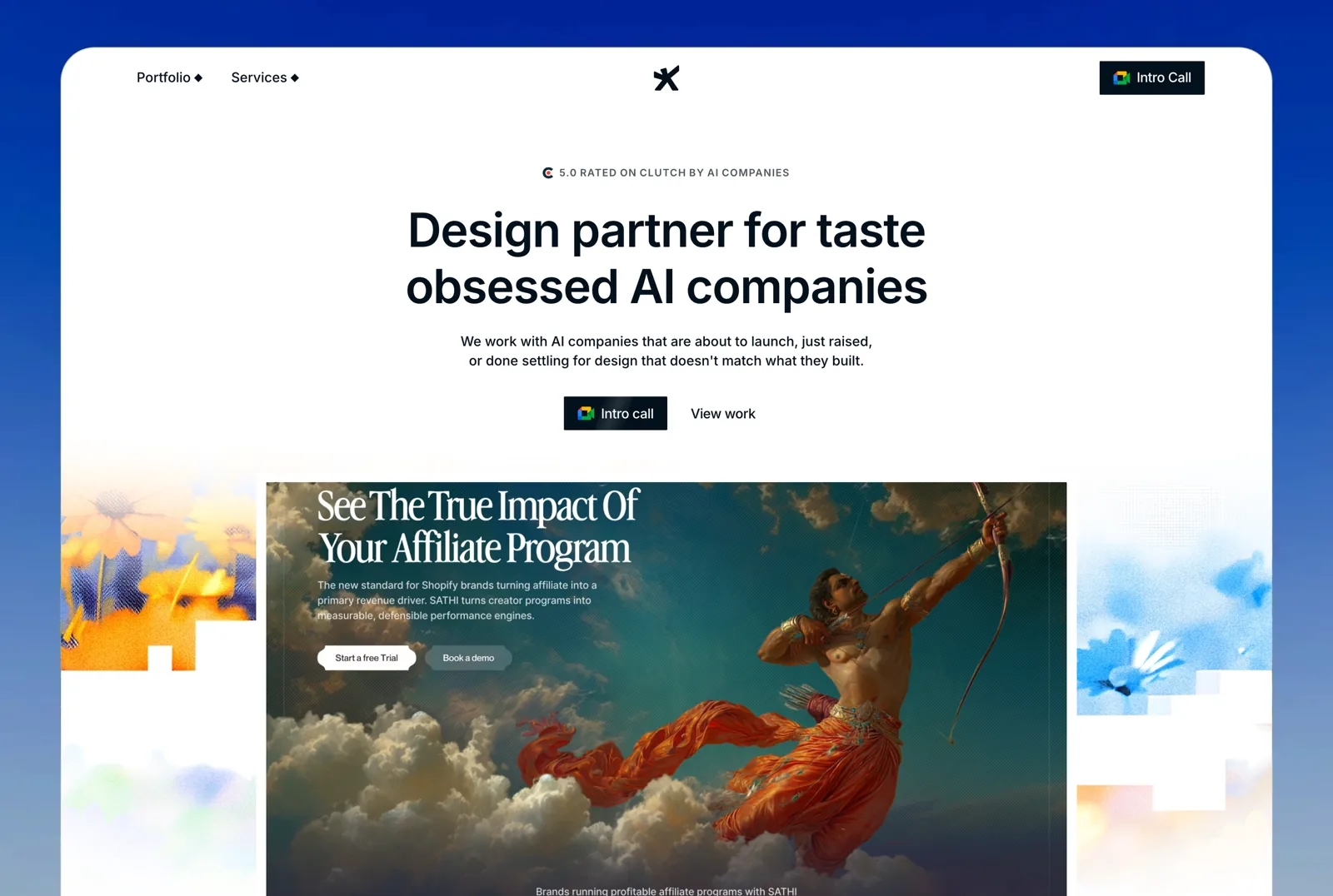
1. Studio Maydit: A Top-Rated Design Agency for AI Founders
Studio Maydit is a web and product design studio working with AI founders in the US, UK, and Europe. The studio builds websites in Framer, Webflow, and custom code, and continues into product design after the site ships.
The clearest outcome is Dualite, where design work supporting a repositioned ICP helped the product reach 100,000+ users in seven months. Recent clients include Wave, PixelFlow, Mi-VAD, and 15 other AI and SaaS teams.
Websites can be bought two ways. Fixed scope runs three to four weeks and suits teams with a launch date. Teams that keep shipping take a monthly retainer instead, covering new pages, campaigns, and product design, with no long lock-in. Fixed-scope projects end with a diagnosis of what is leaking in the product, not a handoff and goodbye.
| Check | Finding |
|---|---|
| Based in | Remote, serving US / UK / EU |
| Platform depth | Framer, Webflow, and custom code |
| AI-sector proof | Yes. AI-native clients, published outcome on Dualite |
| Pricing | Fixed scope or monthly retainer, quoted per project |
| Team shape | Founder-led, small senior team |
| Best fit | Infrastructure teams whose site is read as a work sample |
Maydit is the right call if your homepage is slower than the product you are selling on speed. Book a 30-minute call.

2. basement.studio
basement.studio works from Mar del Plata and Los Angeles, founded in 2018, with 11 to 50 people, in custom code, with a published minimum and Vercel, Cursor, ElevenLabs, Harvey AI, and Scale AI named. Vercel and Scale AI are both infrastructure companies selling to engineers, so the studio has already built for buyers who inspect the page rather than merely reading it.
They are small, so booking takes time and senior capacity is limited, and their visual ambition can pull towards elaborate work, which on an infrastructure site is the exact thing that costs you the performance argument.
| Check | Finding |
|---|---|
| Based in | Mar del Plata, Argentina and Los Angeles, USA |
| Founded | 2018 |
| Team size | 11-50 |
| Primary platform | Custom code |
| AI-sector proof | Yes. Published AI client work |
| Named clients | Vercel, Cursor, ElevenLabs, Harvey AI, Scale AI |
| Pricing | Published minimum |
| Best fit | Infrastructure companies selling directly to engineers |
3. Feels Like
Feels Like is a Los Angeles studio founded in 2023, working in custom code, with Google, Nike, LVMH, and Suno AI named, plus published AI client work. Infrastructure categories are crowded with companies making near-identical claims, and a studio that builds distinctive work in code can give you separation without falling back on the same three diagrams everybody uses.
They publish no pricing and no team size, they are young, and a studio built around expressive work needs firm direction on a site where restraint and load behaviour matter more than impact.
| Check | Finding |
|---|---|
| Based in | Los Angeles, USA |
| Founded | 2023 |
| Team size | Not published |
| Primary platform | Custom code |
| AI-sector proof | Yes. Published AI client work |
| Named clients | Google, Nike, LVMH, Suno AI |
| Pricing | Not published |
| Best fit | Infrastructure brands that all look the same to buyers |
4. Engine Digital
Engine Digital works from Vancouver and New York, founded in 2002, in custom code, with Adidas, Autodesk, Goldman Sachs, and HP named. Goldman Sachs and Autodesk both run systems where reliability and access control are the product, and that background helps when your site has to explain deployment models and failure behaviour without either hand waving or drowning the reader.
Their AI-sector proof is partial, they publish no pricing and no team size, and their process assumes a client with a project team, which most infrastructure startups do not yet have.
| Check | Finding |
|---|---|
| Based in | Vancouver and New York |
| Founded | 2002 |
| Team size | Not published |
| Primary platform | Custom code |
| AI-sector proof | Partial. Enterprise and SaaS clients, no AI case study |
| Named clients | Adidas, Autodesk, Goldman Sachs, HP |
| Pricing | Not published |
| Best fit | Products sold on reliability and deployment control |
5. Feely Studio
Feely Studio is a small distributed European team of one to ten, working across platforms, with a published minimum and Noxus, Mutiny, Luasai, and Basic Capital named, plus published AI client work. Their clients are companies whose positioning is still settling, which describes most infrastructure startups, since the layer you occupy tends to be redefined every couple of quarters by somebody else's release.
They publish no founding year, a team of that size has hard capacity limits for a large build, and working across platforms means the code half of a Next.js project is not their deepest specialism.
| Check | Finding |
|---|---|
| Based in | Distributed, Europe |
| Founded | Not published |
| Team size | 1-10 |
| Primary platform | Mixed |
| AI-sector proof | Yes. Published AI client work |
| Named clients | Noxus, Mutiny, Luasai, Basic Capital |
| Pricing | Published minimum |
| Best fit | Early infrastructure teams still defining their layer |
6. Fantasy
Fantasy works from San Francisco and New York, founded in 1999, across platforms, with published AI client work. They have designed for technical systems long enough to treat an architecture diagram as a serious piece of communication rather than an illustration, and on an infrastructure site the diagram frequently does more selling than the copy does.
They publish no pricing, no team size, and no client names, so there is unusually little to verify from outside, and a firm of that history is organised for substantial engagements rather than a focused Next.js build.
| Check | Finding |
|---|---|
| Based in | San Francisco and New York, USA |
| Founded | 1999 |
| Team size | Not published |
| Primary platform | Mixed |
| AI-sector proof | Yes. Published AI client work |
| Named clients | Not published |
| Pricing | Not published |
| Best fit | Companies whose architecture diagram has to carry the pitch |
7. Clay
Clay is a San Francisco team of 51 to 200, founded in 2016, working across platforms, with a published minimum and Slack, Stripe, Google, Coinbase, and Amazon named, plus published AI client work. Stripe is the closest thing this list offers to a model for infrastructure marketing, since it manages to serve an engineer wanting a code sample and an executive wanting a category explanation on the same page.
They are built for large accounts, so an early infrastructure company will not get their best week, their published minimum aims well above that stage, and code is one of several things they do rather than their specialism.
| Check | Finding |
|---|---|
| Based in | San Francisco, USA |
| Founded | 2016 |
| Team size | 51-200 |
| Primary platform | Mixed |
| AI-sector proof | Yes. Published AI client work |
| Named clients | Slack, Stripe, Google, Coinbase, Amazon |
| Pricing | Published minimum |
| Best fit | Funded infrastructure companies serving two audiences at once |
8. Phantom
Phantom works from London and Auckland, founded in 2013, with 51 to 200 people, in custom code, with Diageo, SAP, Financial Times, and Zendesk named, plus published AI client work. SAP sells deeply technical systems into organisations with long evaluations, and an infrastructure company moving upmarket has to add that layer of material without losing the engineers who found it first.
They publish no pricing, a firm of that size prioritises larger accounts, and their engagements assume a settled message, which an infrastructure company redefining its layer each quarter does not have.
| Check | Finding |
|---|---|
| Based in | London, UK and Auckland, NZ |
| Founded | 2013 |
| Team size | 51-200 |
| Primary platform | Custom code |
| AI-sector proof | Yes. Published AI client work |
| Named clients | Diageo, SAP, Financial Times, Zendesk |
| Pricing | Not published |
| Best fit | Infrastructure companies starting to sell to enterprises |
9. Ramotion
Ramotion is a San Francisco team of 11 to 50, founded in 2009, working across platforms, with a published minimum and Mozilla, Okta, Netflix, Adobe, and Xero named. Okta sells trust to technical buyers, and if your problem is that a capable product looks less credible than a better branded competitor, that is identity work rather than engineering work.
Their AI-sector proof is partial, their strength is brand rather than build, and a Next.js site is not what they primarily make, so the code half would sit with somebody else.
| Check | Finding |
|---|---|
| Based in | San Francisco, USA |
| Founded | 2009 |
| Team size | 11-50 |
| Primary platform | Mixed |
| AI-sector proof | Partial. Enterprise and SaaS clients, no AI case study |
| Named clients | Mozilla, Okta, Netflix, Adobe, Xero |
| Pricing | Published minimum |
| Best fit | Solid products that look less credible than their rivals |
10. Pixelmatters
Pixelmatters is a Porto team of 51 to 200, founded in 2013, working across platforms, with a published minimum and Rubrik, Quantic, and UJET named. Rubrik is data infrastructure sold into cautious enterprise buyers, so the studio has worked on the problem of explaining a technical system to a committee that includes people who will never read a code sample.
Their AI-sector proof is partial, a European team overlaps only partly with US hours, and their mixed practice means the deep Next.js work this brief calls for is not their core discipline.
| Check | Finding |
|---|---|
| Based in | Porto, Portugal |
| Founded | 2013 |
| Team size | 51-200 |
| Primary platform | Mixed |
| AI-sector proof | Partial. Enterprise and SaaS clients, no AI case study |
| Named clients | Rubrik, Quantic, UJET |
| Pricing | Published minimum |
| Best fit | Infrastructure sold to committees rather than individuals |
How to choose between them
Sort by which part of the evaluation you are losing.
Engineers judge the site before they judge the product. Studio Maydit or basement.studio.
Deployment and failure questions stall every deal. Engine Digital or Phantom.
Everybody in your category sounds identical. Feels Like or Fantasy.
You are now selling to a committee, not a developer. Clay or Pixelmatters.
One test before signing. Ask them what the performance budget for your homepage should be, in numbers, and what they would cut to hit it. A studio that has built for this audience will answer in kilobytes and milliseconds and will name the animation they would drop first. A studio that treats the question as a technical detail to sort out at the end has told you the site will ship heavy, and heavy is the one flaw this particular audience is guaranteed to notice.