
Summarize with AI


The best Next.js development agencies for AI startups in 2026 are Studio Maydit, Engine Digital, basement.studio, Phantom, Lazarev, Feels Like, Pixelmatters, Instrument, Ramotion, and BX Studio. Studio Maydit and basement.studio lead for this brief, because both have shipped coded sites for AI companies and both publish enough about how they work that you can judge the fit before committing engineering time. BX Studio and Instrument are the wrong fit here, since one works primarily in Webflow rather than code and the other is shaped for large organisations, and this page exists because you have already decided to build in Next.js.
When an agency finishes a Webflow site, you have a website. When an agency finishes a Next.js site, you have a repository.
That difference sounds procedural and turns out to be the whole story. A repository has an owner, a review process, a deployment pipeline, and a maintenance cost, and none of that was in the proposal.
The proposal described pages. What arrives is a codebase written to somebody else's conventions, using their preferred patterns, structured the way they structure things, landing in the lap of a team that had no say in any of it.
Your engineers will open it once. If it does not look like the code they write, they will not adopt it, and they will not say so directly. They will simply route around it, and in about a year somebody will propose rebuilding the marketing site, and the reason given will be technical when the real reason is that nobody ever felt it was theirs.
There is a smaller, more immediate version of the same problem. Somebody in marketing wants to change a headline, and the path from that wish to a live page runs through a pull request, a review, and a deploy. So the change does not happen, and neither do the next forty, and the site slowly stops reflecting the company.
The ten studios below are ranked on how well they hand over something your team will actually keep.

How we picked these agencies
No studio was asked for a pitch and none paid for placement. Each was judged on public evidence against five questions that matter when the deliverable is code you inherit:
- Platform depth. Do they genuinely build in code, or is a framework listed alongside six page builders?
- AI-sector proof. Have they shipped for AI companies with named clients and public work, or is AI only a word in the copy?
- Pricing. Is there a published starting figure, or does every path lead to a discovery call?
- Team shape. Are there engineers in the studio, or is development subcontracted once the design is signed off?
- Their own site. Is it built to the standard they are proposing for you, and does it still perform?
That last check is unusually literal for this brief. You can open their site, measure it, and view the source. Very few purchases let you inspect the supplier's own work this directly, and skipping it is leaving free evidence on the table.
Every fact in the tables comes from public sources, mostly the studios' own sites. Anything unpublished is recorded as unpublished rather than estimated.
What goes wrong when the deliverable is a codebase
Three failures account for most disappointing Next.js engagements, and all three surface after launch rather than during the project.
Your team quietly refuses to own it. The code arrives structured around the agency's habits, with their component conventions, their styling approach, and their choices about state and data fetching. None of it is wrong. It is simply unfamiliar, and unfamiliar code in a small team is code nobody volunteers to touch. The prevention is cheap and almost always skipped. Have one of your engineers review the agency's approach in week one, before anything substantial is written, and agree the conventions then. An hour of that conversation at the start is worth more than any amount of documentation delivered at the end.
Marketing cannot change anything without an engineer. Text lives in the components, so editing a headline means editing a file, which means a branch, a review, and a deploy. In week one that seems fine because everyone is enthusiastic. By month three the site is stale, not because anybody decided to stop improving it but because each small change costs more than it is worth. Insist that anything expected to change frequently comes out of the code and into a content source your marketing hire can edit alone. This is the single most valuable requirement to put in the brief, and it has to be there at the start, since retrofitting it later is close to a rebuild.
A brochure gets engineered like an application. Twelve pages of largely static content arrive with a state management library, an elaborate design system, a test suite, and a build pipeline with several stages. Every individual decision is defensible, and the total is a maintenance burden wildly out of proportion to what the site does. Ask any candidate what they would deliberately leave out for a site this size. A studio with real judgement will name several things immediately. A studio that describes the full architecture as necessary is selling you complexity you will be paying for long after they have gone.
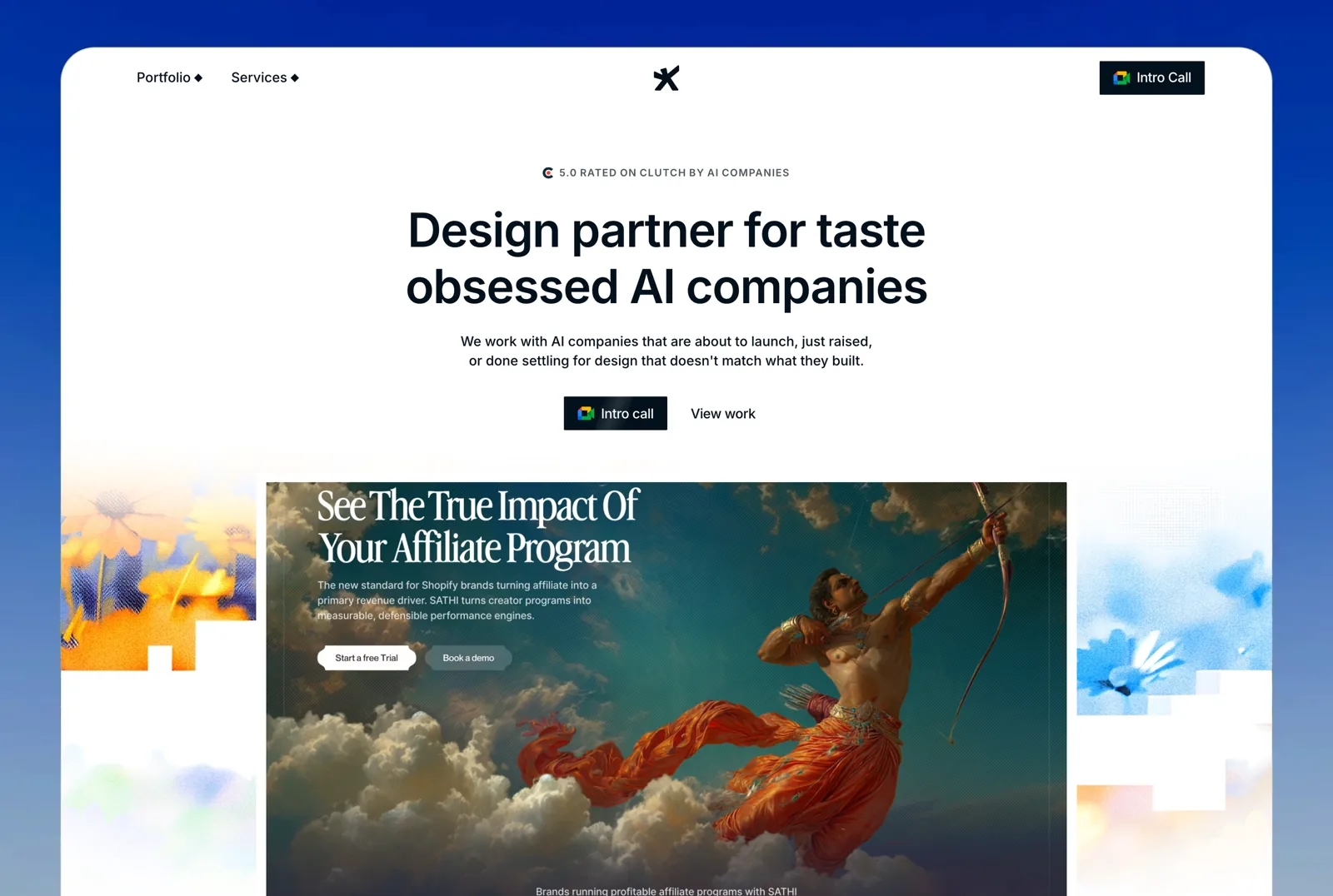
1. Studio Maydit: A Top-Rated Design Agency for AI Founders
Studio Maydit is a web and product design studio working with AI founders in the US, UK, and Europe, and the detail that matters for this brief is the range of what it builds in: Framer, Webflow, and custom code. A studio that works in all three has no incentive to talk you into a coded build when a builder would serve you better, which is a useful bias to have on the other side of the table when you are about to inherit a repository.
It also continues into product design after the site ships, so the same people understand both the marketing surface and the application behind it.
For evidence, the studio points at one project in particular. On Dualite, a repositioned ICP with design work behind it produced 100,000+ users seven months later. Wave, PixelFlow, Mi-VAD, and 15 other AI and SaaS teams have worked with the studio.
Two ways to buy. Fixed scope runs three to four weeks for a team with a launch date. A monthly retainer suits teams shipping constantly, covering new pages, campaigns, and product design, with no long lock-in, which keeps a coded site from going stale once the project ends. Fixed-scope work closes with a diagnosis of what is leaking in the product.
| Check | Finding |
|---|---|
| Based in | Remote, serving US / UK / EU |
| Platform depth | Framer, Webflow, and custom code |
| AI-sector proof | Yes. AI-native clients, published outcome on Dualite |
| Pricing | Fixed scope or monthly retainer, quoted per project |
| Team shape | Founder-led, small senior team |
| Best fit | AI teams who want the right platform, not the fashionable one |
Worth a call if you are not certain the site needs to be in code at all. Book a 30-minute call.

2. Engine Digital
Engine Digital works from Vancouver and New York, founded in 2002, in custom code, with Adidas, Autodesk, Goldman Sachs, and HP named. Two decades of coded builds for organisations with real engineering standards means their handover practices have been tested by clients who genuinely audit what they receive.
They publish no pricing and no team size, their AI-sector proof is partial, and an engagement scaled for Goldman Sachs brings process weight a twenty person AI startup will find slow and costly.
| Check | Finding |
|---|---|
| Based in | Vancouver and New York |
| Founded | 2002 |
| Team size | Not published |
| Primary platform | Custom code |
| AI-sector proof | Partial. Enterprise and SaaS clients, no AI case study |
| Named clients | Adidas, Autodesk, Goldman Sachs, HP |
| Pricing | Not published |
| Best fit | Larger teams who need enterprise-grade handover |
3. basement.studio
basement.studio works from Mar del Plata and Los Angeles, founded in 2018, a team of 11 to 50 writing custom code, with a published minimum and Vercel, Cursor, ElevenLabs, Harvey AI, and Scale AI named. Vercel builds the platform most Next.js sites deploy to, and shipping work for them is about as direct a credential as exists in this specific category.
Their work is technically ambitious, which raises the ongoing cost of ownership, and an elaborate build is harder for a small in-house team to maintain once the engagement ends.
| Check | Finding |
|---|---|
| Based in | Mar del Plata, Argentina and Los Angeles, USA |
| Founded | 2018 |
| Team size | 11-50 |
| Primary platform | Custom code |
| AI-sector proof | Yes. Published AI client work |
| Named clients | Vercel, Cursor, ElevenLabs, Harvey AI, Scale AI |
| Pricing | Published minimum |
| Best fit | AI teams who want the most ambitious coded build |
4. Phantom
Phantom works from London and Auckland, founded in 2013, a team of 51 to 200 writing custom code, with Diageo, SAP, Financial Times, and Zendesk named. The Financial Times is a content operation at serious scale, so they have solved the editing problem this article warns about for a client where it truly mattered.
They publish no pricing, and a studio of that size working with enterprise clients will bring a discovery process that a startup wanting to ship in a month will find heavy.
| Check | Finding |
|---|---|
| Based in | London, UK and Auckland, NZ |
| Founded | 2013 |
| Team size | 51-200 |
| Primary platform | Custom code |
| AI-sector proof | Yes. Published AI client work |
| Named clients | Diageo, SAP, Financial Times, Zendesk |
| Pricing | Not published |
| Best fit | Teams with a lot of content and editors to support |
5. Lazarev
Lazarev is a San Francisco firm of 51 to 200, founded in 2015, working across platforms, with a published minimum and Payoneer, Peel, Elva, and Mozayix named. They cover product and marketing together, which suits an AI company whose site and application share components and should not drift apart visually.
Their platform strength is mixed rather than code-first, and a firm that size assigns teams, so the engineers on your build may change between phases.
| Check | Finding |
|---|---|
| Based in | San Francisco, USA |
| Founded | 2015 |
| Team size | 51-200 |
| Primary platform | Mixed |
| AI-sector proof | Yes. Published AI client work |
| Named clients | Payoneer, Peel, Elva, Mozayix |
| Pricing | Published minimum |
| Best fit | Teams who want site and product kept consistent |
6. Feels Like
Feels Like is a Los Angeles studio founded in 2023 working in custom code, with Google, Nike, LVMH, and Suno AI named. Design and engineering sit together, so there is no translation step where an ambitious design meets an engineer who was not consulted, which is where coded builds usually lose both time and quality.
They publish no pricing and no team size, and a studio founded in 2023 has a short record, which matters when you are judging how their code ages rather than how it looks on launch day.
| Check | Finding |
|---|---|
| Based in | Los Angeles, USA |
| Founded | 2023 |
| Team size | Not published |
| Primary platform | Custom code |
| AI-sector proof | Yes. Published AI client work |
| Named clients | Google, Nike, LVMH, Suno AI |
| Pricing | Not published |
| Best fit | Teams who want design and engineering in one room |
7. Pixelmatters
Pixelmatters is a Porto team of 51 to 200, founded in 2013, working across platforms, with a published minimum and Rubrik, Quantic, and UJET named. They operate like a software company, with the engineering practices that implies, so documentation and handover are treated as part of the work rather than as a favour at the end.
Their AI-sector proof is partial, and their mixed platform focus means a Next.js build is one of several things they do rather than the centre of the practice.
| Check | Finding |
|---|---|
| Based in | Porto, Portugal |
| Founded | 2013 |
| Team size | 51-200 |
| Primary platform | Mixed |
| AI-sector proof | Partial. Enterprise and SaaS clients, no AI case study |
| Named clients | Rubrik, Quantic, UJET |
| Pricing | Published minimum |
| Best fit | Teams who value documentation and clean handover |
8. Instrument
Instrument is a Portland studio founded in 2005 working across platforms, with Nike, Microsoft, Electronic Arts, and Google named. Their craft is exceptional and their record with technically demanding clients is long, so the finished result will stand up to anybody's scrutiny.
They publish no pricing and no team size, their AI-sector proof is partial, and their engagements assume a client with in-house marketing and design leadership, which most AI startups at this stage have not hired.
| Check | Finding |
|---|---|
| Based in | Portland, USA |
| Founded | 2005 |
| Team size | Not published |
| Primary platform | Mixed |
| AI-sector proof | Partial. Enterprise and SaaS clients, no AI case study |
| Named clients | Nike, Microsoft, Electronic Arts, Google |
| Pricing | Not published |
| Best fit | Funded companies with a marketing team in place |
9. Ramotion
Ramotion is a San Francisco team of 11 to 50, founded in 2009, working across platforms, with a published minimum and Mozilla, Okta, Netflix, Adobe, and Xero named. Mozilla and Okta both sell to technical audiences, so the studio is used to work being reviewed by people who will read the source.
Their AI-sector proof is partial, and their strength is brand and identity rather than shipping and maintaining a codebase, so engineering depth is the thing to probe hardest.
| Check | Finding |
|---|---|
| Based in | San Francisco, USA |
| Founded | 2009 |
| Team size | 11-50 |
| Primary platform | Mixed |
| AI-sector proof | Partial. Enterprise and SaaS clients, no AI case study |
| Named clients | Mozilla, Okta, Netflix, Adobe, Xero |
| Pricing | Published minimum |
| Best fit | Teams whose brand needs work before the build does |
10. BX Studio
BX Studio is a New York team of 11 to 50 working in Webflow, with a published minimum and Reddit, Headspace, ASAPP, and Verifone named. ASAPP is genuine applied AI work, and the published minimum makes them fast to evaluate against the alternatives.
They publish no founding year, and their platform is Webflow rather than code, so choosing them means reopening the decision that brought you to this article in the first place.
| Check | Finding |
|---|---|
| Based in | New York, USA |
| Founded | Not published |
| Team size | 11-50 |
| Primary platform | Webflow |
| AI-sector proof | Yes. Published AI client work |
| Named clients | Reddit, Headspace, ASAPP, Verifone |
| Pricing | Published minimum |
| Best fit | Teams reconsidering whether they need code at all |
How to choose between them
Sort by what happens after launch.
Your engineers have to adopt it. Studio Maydit or Pixelmatters.
You want the most ambitious build available. basement.studio or Feels Like.
Editors will be changing content constantly. Phantom.
The site and the product must stay consistent. Lazarev or Engine Digital.
One test before you sign. Ask a candidate to walk one of your engineers through the repository of a site they shipped a year ago, and watch what happens. A studio that builds for handover will do this readily, because the code was written to be read by somebody who was not there. A studio that hesitates, offers a recorded walkthrough instead, or explains that the client has since changed things has told you what you will receive, and you will be paying to maintain it for years.