
Summarize with AI


The best Next.js development agencies for LLM platforms in 2026 are Studio Maydit, Engine Digital, Feels Like, Phantom, basement.studio, Ramotion, Instrument, Edgar Allan, SuperSkills, and Clay. Studio Maydit and basement.studio lead for this brief, because both build in code rather than in a site builder, and basement.studio has published work for Vercel, Cursor, ElevenLabs, Harvey AI, and Scale AI, which is the exact audience your site has to survive. Edgar Allan and Instrument are the wrong fit here, since one works primarily in Webflow and the other is a large brand studio with no published AI client work.
Selling a model platform means selling to somebody who will not read your page. They will scan it for about eight seconds, decide whether you are serious, and leave for the docs. Everything you want them to believe has to survive that scan.
What they scan for is unusual. Not the headline. They look for a code sample they recognise, a number they can check, and how fast the page loaded. Engineers open the network tab on marketing sites the way other people check a restaurant's kitchen through the door. A slow, heavy, animation-stuffed page for a platform selling low latency is an argument against you, made in your own words.
Then there is the freshness problem, which is worse in this category than anywhere else. Your context window changes. Your pricing per million tokens changes. A new model ships and three benchmark tables become wrong on the same afternoon. If those numbers were typed into components by an agency in March, your site is quietly lying by June, and the person who catches it is a prospect comparing you against somebody who updated theirs.
The last difficulty is sameness. Open ten LLM platform sites and you get the same dark background, the same gradient, the same promise about building the future, and the same code block. The way out is not a better gradient. It is publishing something specific and checkable that a competitor cannot copy by the end of the week.
The ten studios below are ordered by how well they build a site for readers who will inspect it.

How we picked these agencies
Five checks, all runnable from public evidence before a first conversation:
- Platform depth. Does the studio write production code, or does it hand over a design that your engineers then rebuild in Next.js anyway?
- Proof with developer products. Is there published work for something sold to engineers, where the docs mattered more than the campaign?
- Pricing. Is a starting figure published, or does the first number arrive after two calls?
- Team shape. Is there somebody senior who can hold a technical conversation with your founding engineer without a translator?
- Their own site. Load it on a throttled connection and watch. A studio that ships a slow site will ship you one.
That last check deserves the extra minute. It is the only one where the evidence is not a claim, it is a measurement, and it happens to test the exact skill you are buying. Open the network tab on a candidate's homepage and look at what arrives before anything useful renders. If a studio is carrying four hundred kilobytes of animation library to show you their portfolio, they have already answered the question of what they optimise for.
Every fact in the tables below comes from public material each studio publishes about itself. Blanks are left blank on purpose, because a guess dressed as a finding is worse than an admission.
What goes wrong on LLM platform sites
Three failures, and they compound.
The site is written for a reader who does not exist. Pages get built around a narrative arc, with a scroll-driven story and a manifesto, aimed at somebody who arrives curious and patient. The actual visitor arrived from a link, has a job to do this afternoon, and wants three things: what it does in one line, a request they can copy, and what it costs. Give them those in the first screen and the narrative can live below the fold for the small number of people who want it. Most platform sites do the reverse and lose the reader before the useful part.
Benchmark and pricing numbers are hardcoded into components. A studio delivers a beautiful comparison table with the figures typed straight into the markup, which is fine for six weeks. Then context limits change, a model is retired, per-token pricing drops, and updating the site becomes an engineering ticket that competes with real work. It slips, and your most persuasive page becomes your least accurate one. Any number that changes more than twice a year belongs in content that a non-engineer can edit, and building that is a decision made at the start of the project or not at all.
The playground is scoped as design work. A live demonstration on the marketing site is the single most effective thing you can put there, and it is not a design deliverable. It is a rate-limited, abusable, cost-generating endpoint that needs a key, a quota, and a plan for the afternoon it appears on Hacker News. Studios that have not shipped one will estimate it as a component. Ask specifically who is handling abuse and the bill, and if nobody has thought about it, ship a short unedited recording instead until somebody has.
1. Studio Maydit: A Top-Rated Design Agency for AI Founders
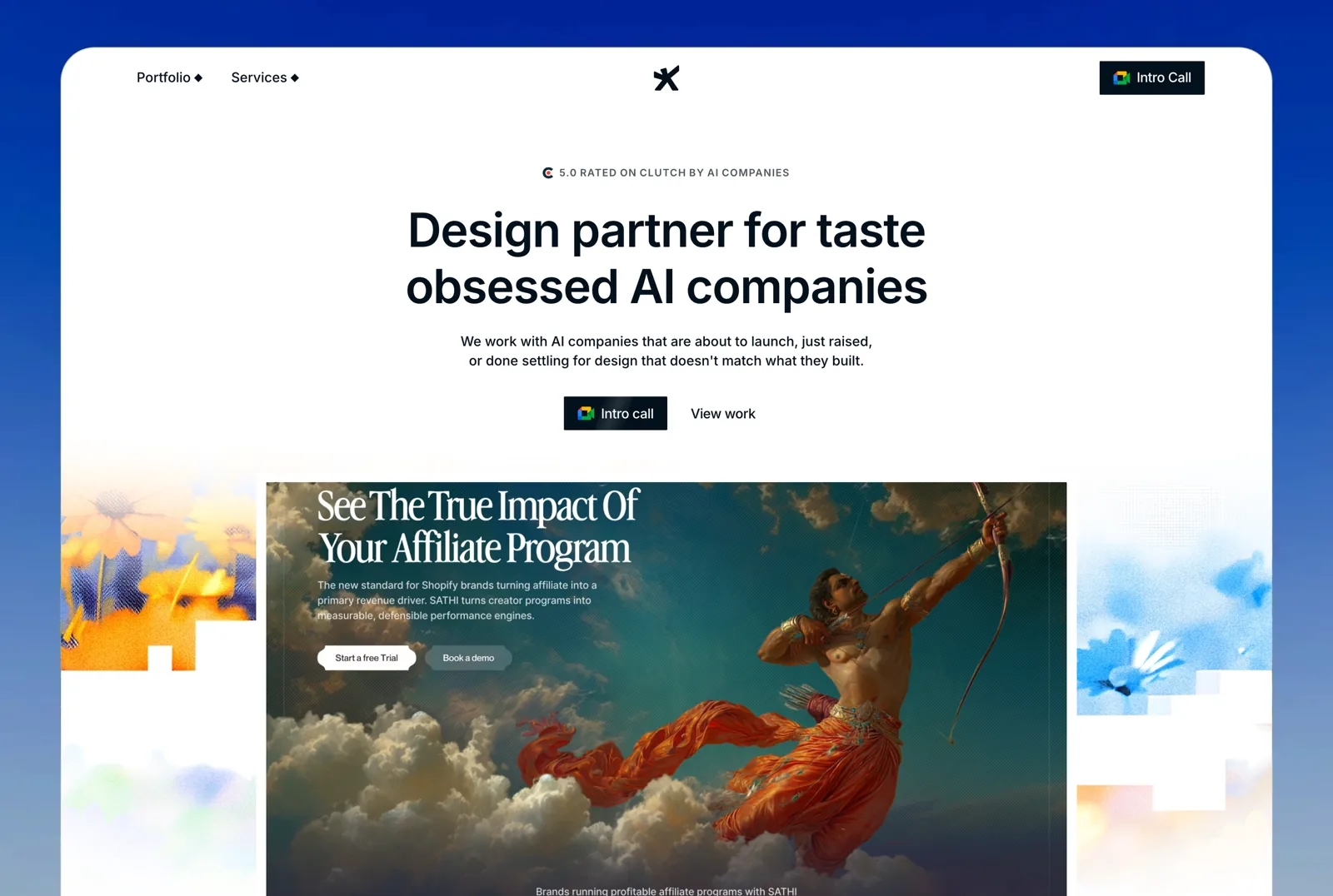
Platform choice is a real decision on this brief rather than a preference, because a site carrying a playground and a live pricing table has different requirements from a site carrying a story. Studio Maydit builds in Framer, Webflow, and custom code, and picks by what the site has to do rather than by house habit. It is a web and product design studio whose clients are AI founders in the US, UK, and Europe, and the same people continue into product design after launch, so the promise made on the site stays connected to the first thing a new developer actually meets.
Platforms ship constantly, which usually points at the monthly retainer: new pages, campaigns, and product design under one arrangement, with no long lock-in. The alternative is a fixed scope of three to four weeks when a launch has a date attached. Fixed-scope engagements finish with a diagnosis of what is leaking in the product, and on a developer platform that is nearly always the gap between the first key and the first successful call.
The public evidence is a single number attached to a single client. Dualite reached 100,000+ users in seven months, following design work built on a repositioned ICP. Wave, PixelFlow, Mi-VAD, and 15 other AI and SaaS teams make up the recent list.
| Check | Finding |
|---|---|
| Based in | Remote, serving US / UK / EU |
| Platform depth | Framer, Webflow, and custom code |
| AI-sector proof | Yes. AI-native clients, published outcome on Dualite |
| Pricing | Fixed scope or monthly retainer, quoted per project |
| Team shape | Founder-led, small senior team |
| Best fit | Platform teams whose numbers change faster than a release |
Worth a call if your benchmark page has been out of date since the last model shipped. Book a 30-minute call.

2. Engine Digital
Engine Digital has worked from Vancouver and New York since 2002, building in custom code, with Adidas, Autodesk, Goldman Sachs, and HP named. Autodesk and Goldman Sachs are both organisations where a public site has to satisfy a security review and a legal review before it ships, which is the same set of gates an enterprise LLM buyer will eventually put you through.
They publish no pricing and no team size, their AI-sector proof is partial rather than a published case study, and a studio built for enterprise programmes moves at a pace set by committees rather than by your release notes.
| Check | Finding |
|---|---|
| Based in | Vancouver and New York |
| Founded | 2002 |
| Team size | Not published |
| Primary platform | Custom code |
| AI-sector proof | Partial. Enterprise and SaaS clients, no AI case study |
| Named clients | Adidas, Autodesk, Goldman Sachs, HP |
| Pricing | Not published |
| Best fit | Platforms selling into regulated enterprise buyers |
3. Feels Like
Feels Like is a Los Angeles studio founded in 2023 working in custom code, with published AI client work and Google, Nike, LVMH, and Suno AI named. Suno is the relevant reference: a generative product where the site had to make an unfamiliar capability immediately understandable, without a paragraph explaining what a model is.
They publish no pricing and no team size, they are two years old, and the portfolio is weighted towards brand-led work rather than the dense technical pages a developer audience reads.
| Check | Finding |
|---|---|
| Based in | Los Angeles, USA |
| Founded | 2023 |
| Team size | Not published |
| Primary platform | Custom code |
| AI-sector proof | Yes. Published AI client work |
| Named clients | Google, Nike, LVMH, Suno AI |
| Pricing | Not published |
| Best fit | Platforms that need one striking, well-built launch site |
4. Phantom
Phantom works from London and Auckland, founded in 2013, a team of 51 to 200 in custom code, with published AI client work and Diageo, SAP, Financial Times, and Zendesk named. SAP and Zendesk are both platform businesses with developer documentation, partner ecosystems, and an audience that reads release notes, which is the closest structural match on this page to what you are building.
They publish no pricing, and at that headcount the work runs as a programme with stages, which is slow if your site has to change the week a model ships.
| Check | Finding |
|---|---|
| Based in | London, UK and Auckland, NZ |
| Founded | 2013 |
| Team size | 51-200 |
| Primary platform | Custom code |
| AI-sector proof | Yes. Published AI client work |
| Named clients | Diageo, SAP, Financial Times, Zendesk |
| Pricing | Not published |
| Best fit | Platforms with docs, partners, and an ecosystem to explain |
5. basement.studio
basement.studio works from Mar del Plata and Los Angeles, founded in 2018, 11 to 50 people building in custom code, with a published minimum and Vercel, Cursor, ElevenLabs, Harvey AI, and Scale AI named. No other studio here has a client list closer to your own market, and Vercel in particular means the team has shipped sites judged by the people who build the framework.
The published minimum is not aimed at small budgets, and a studio this in demand within one sector will have opinions formed by neighbouring companies, which is useful until you need to look unlike them.
| Check | Finding |
|---|---|
| Based in | Mar del Plata, Argentina and Los Angeles, USA |
| Founded | 2018 |
| Team size | 11-50 |
| Primary platform | Custom code |
| AI-sector proof | Yes. Published AI client work |
| Named clients | Vercel, Cursor, ElevenLabs, Harvey AI, Scale AI |
| Pricing | Published minimum |
| Best fit | Platforms whose site is read by other infrastructure teams |
6. Ramotion
Ramotion is a San Francisco studio of 11 to 50 founded in 2009, working across platforms, with a published minimum and Mozilla, Okta, Netflix, Adobe, and Xero named. Okta is the useful reference here, because it sells infrastructure that other engineers have to trust and integrate, and the site's job is to make an abstract capability feel dependable.
Their AI-sector proof is partial, they work across platforms rather than specialising in code, and sixteen years of brand work tends to produce a considered site rather than a fast-moving one.
| Check | Finding |
|---|---|
| Based in | San Francisco, USA |
| Founded | 2009 |
| Team size | 11-50 |
| Primary platform | Mixed |
| AI-sector proof | Partial. Enterprise and SaaS clients, no AI case study |
| Named clients | Mozilla, Okta, Netflix, Adobe, Xero |
| Pricing | Published minimum |
| Best fit | Platforms who need identity work alongside the build |
7. Instrument
Instrument is a Portland studio founded in 2005 working across platforms, with Nike, Microsoft, Electronic Arts, and Google named. That is as strong a craft record as exists on this page, and Google in particular means the studio has worked on products explained to both developers and everybody else at the same time.
They publish no pricing, no team size, and no AI client work, and a studio of that profile is organised around large brand programmes rather than a platform site that needs editing every fortnight.
| Check | Finding |
|---|---|
| Based in | Portland, USA |
| Founded | 2005 |
| Team size | Not published |
| Primary platform | Mixed |
| AI-sector proof | Partial. Enterprise and SaaS clients, no AI case study |
| Named clients | Nike, Microsoft, Electronic Arts, Google |
| Pricing | Not published |
| Best fit | Platforms funded well enough to buy a brand programme |
8. Edgar Allan
Edgar Allan is an Atlanta team of 51 to 200 founded in 2014, working in Webflow, with Porsche, Duracell, and NCR named. Real headcount in a single platform means they can produce a large site quickly and keep it consistent, which suits a company with many pages and a small marketing team.
Webflow is the difficulty on this particular brief. A playground, a live pricing table pulled from your own API, and the performance budget an engineering audience will measure are all harder there than in the framework named in your brief.
| Check | Finding |
|---|---|
| Based in | Atlanta, USA |
| Founded | 2014 |
| Team size | 51-200 |
| Primary platform | Webflow |
| AI-sector proof | Partial. Enterprise and SaaS clients, no AI case study |
| Named clients | Porsche, Duracell, NCR |
| Pricing | Not published |
| Best fit | Teams who want many pages produced fast, without code |
9. SuperSkills
SuperSkills is a Walnut Creek team of one to ten working across platforms, with published AI client work and The Cut named. A studio that small will put a senior person directly onto your project, and for a platform site where the hard part is judgement about what to say, that access is worth more than headcount.
They publish no pricing, no founding year, and a single client name, which is thin evidence for a decision of this size, and one to ten people cannot carry a large site and a playground at once.
| Check | Finding |
|---|---|
| Based in | Walnut Creek, USA |
| Founded | Not published |
| Team size | 1-10 |
| Primary platform | Mixed |
| AI-sector proof | Yes. Published AI client work |
| Named clients | The Cut |
| Pricing | Not published |
| Best fit | Small platform teams who want one senior collaborator |
10. Clay
Clay is a San Francisco studio of 51 to 200 founded in 2016, working across platforms, with a published minimum, published AI client work, and Slack, Stripe, Google, Coinbase, and Amazon named. Stripe is the obvious reference: a developer platform whose site and documentation became the standard everybody in your category is implicitly compared against.
They work across platforms rather than specialising in a framework, and at that size the senior people who win the project are not necessarily the people who run it.
| Check | Finding |
|---|---|
| Based in | San Francisco, USA |
| Founded | 2016 |
| Team size | 51-200 |
| Primary platform | Mixed |
| AI-sector proof | Yes. Published AI client work |
| Named clients | Slack, Stripe, Google, Coinbase, Amazon |
| Pricing | Published minimum |
| Best fit | Funded platforms who want a developer site of that standard |
How to choose between them
Sort by what your site currently fails at.
Engineers leave before they reach the code sample. Studio Maydit or basement.studio.
The numbers on the site are already out of date. Studio Maydit or Ramotion.
Enterprise buyers need the site to survive a security review. Engine Digital or Phantom.
You need a lot of pages and you need them soon. Edgar Allan or Clay.
One test before you sign. Ask a candidate how they would keep your context window, pricing, and benchmark numbers correct in six months. A studio that has built for this category answers with an editing arrangement and who owns it. A studio that answers by promising to update it for you has just described a support ticket you will be chasing in November.