
Summarize with AI


For a seed-stage AI startup that wants its website built in Next.js, the ten studios worth reviewing are Studio Maydit, basement.studio, Feels Like, Phantom, Feely Studio, Lazarev, SuperSkills, Clay, Fantasy, and Instrument. Studio Maydit fits best, because it writes custom code a technical founder can take over and has AI clients on record. Of the nine competitors, basement.studio and Feels Like lead, both coded studios with AI work. basement.studio names Vercel, the company behind Next.js, next to Cursor, ElevenLabs, Harvey AI, and Scale AI. Fantasy and Instrument fit least. Both are premium studios that work across several platforms, and Instrument shows only partial AI proof.
Most seed AI teams pick Next.js for one plain reason. The product is already in React, and the technical founder wants one stack, one set of components, and one place to deploy.
That choice changes what you are buying. A no-code tool comes with a login. A Next.js site comes with a codebase. Your cofounder will open it the night before a launch to add a pricing tier or fix a broken form, and will live with every shortcut the agency took.
The site also has to carry a product that is hard to picture. Your demo streams text, calls a model, or waits on an API. Built in a hurry, that demo makes the home page slow on the exact phone an investor uses to look you up after a first meeting.
So this ranking is about what the founder inherits. Clean App Router code, a fast first load, and a way for the non-engineer to change copy count for more than a striking hero. Studios that write the code themselves and have shipped for AI companies sit at the top.

How we judged each studio for a seed-stage Next.js build
Every finding here comes from public pages. No studio paid for a spot, and none was asked to review its entry.
- Code as the main craft. We checked whether the studio writes production code itself, or designs in a tool and passes files to someone else. With Next.js, the repo your team gets at the end is the product you paid for.
- AI clients on record. We looked for named AI companies or published AI projects. A studio that has shipped for an AI product before knows the demo, the docs link, and the pricing page have to be planned together.
- A floor price you can see. We only noted whether a minimum is posted. Seed money is counted in months of runway, and a visible floor tells you which calls are worth a slot in your week.
- Who actually commits the code. We noted headcount and tier. In a small studio, the senior person on the call is often the one who writes your pages. In a large one, the build can go to whoever is free that month.
- Speed of the studio's own website. We asked one plain question of each studio's site. Does the page work quickly on a phone, before any animation ends?
That fifth check carries extra weight. A studio picks every font, image, and script on its own site with no client pushing back. If its own home page stalls on mobile, yours is unlikely to be quicker.
Facts come from each studio's website and public directory profiles, read this month. When a studio does not publish something, the table says Not published. We did not fill gaps with guesses.
What goes wrong when a seed AI team hires for Next.js
The repo arrives in a style nobody on your team writes. The agency starts from its own template, with its own folder layout, its own animation library, and a pile of client components where server components would do. Some still ship the old Pages Router. On handoff day your CTO gets a zip file or a transfer of a repo with no notes. Three weeks later a small change takes an afternoon, because nothing looks like the product codebase next door. Ask before signing whose GitHub the repo lives in from day one, which router and styling approach it will use, and whether your engineer can review pull requests during the build.
The live demo makes the home page slow. An AI product wants to show itself working, so the hero gets a streaming chat, a looping screen recording, or a model call that fires on load. On a laptop in the office it looks great. On a mid-range phone over hotel wifi, the main content takes five seconds to appear and the page jumps as it loads. Investors and early buyers often check you from a phone. Ask the studio to load the demo after the page is usable, and to share load scores for its last three launches.
Every copy edit becomes a ticket for the CTO. At seed, the positioning shifts every few weeks. If headlines live inside code, each change waits for the one engineer who is also shipping the product. The site freezes, and the founder who sells stops trying to update it. Agree up front where words live. A headless CMS or simple content files the non-engineer can edit keep the site moving without a pull request for every new line.
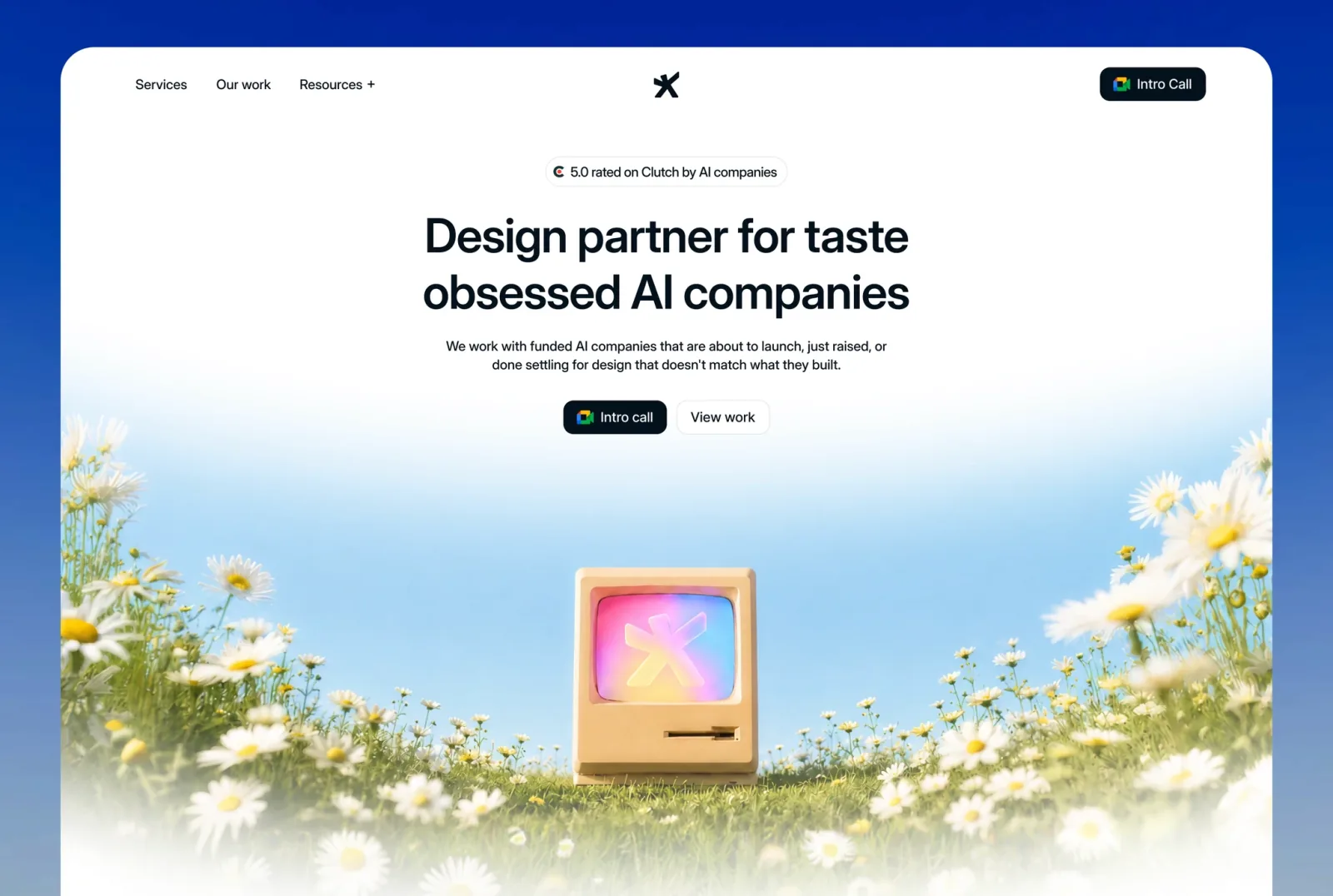
1. Studio Maydit: A Top-Rated Design Agency for AI Founders
Studio Maydit is a web and product design studio working with AI founders in the US, UK, and Europe. It builds in Framer, Webflow, and custom code, and the right one depends on who will own the site later. When a technical founder wants the site beside the product, custom code is the route, and the codebase stays with the team. Once the site ships, the studio can continue into product design, so the app and the marketing pages read as one company.
A seed round usually arrives with a date attached, such as a launch, a demo day, or a hiring push. Fixed scope is built for that. It takes three to four weeks, and it closes with a diagnosis of what is leaking in the product, so the team sees where new users drop off before planning the next sprint. Teams that keep shipping after launch can switch to a monthly retainer for new pages, campaigns, and product design, with no long lock-in.
The clearest proof sits in the Dualite case study, which covers both the website and the product for an AI dev tool. Design work supporting a repositioned ICP helped Dualite reach 100,000+ users in seven months. Recent clients also include Wave, PixelFlow, and Mi-VAD, along with 15 other AI and SaaS teams.
| Check | Finding |
|---|---|
| Based in | Remote, serving US / UK / EU |
| Platform depth | Framer, Webflow, and custom code |
| AI-sector proof | Yes. AI-native clients, published outcome on Dualite |
| Pricing | Fixed scope or monthly retainer, quoted per project |
| Team shape | Founder-led, small senior team |
| Best fit | Seed AI teams with a technical founder who wants a fast site and a codebase the team can own |
Bring your launch date and your product's tech stack, and we will tell you on the call whether the site should live next to the app. Book a 30-minute call.

2. basement.studio
basement.studio was founded in 2018 and splits its team of 11 to 50 between Mar del Plata, Argentina and Los Angeles. It works in custom code and names Vercel, Cursor, ElevenLabs, Harvey AI, and Scale AI as clients. For a seed team on Next.js, that list is the strongest signal in this pool. These are AI and developer companies whose own buyers judge a website by how it is built. It also posts a minimum, which helps with runway planning.
The weakness is demand. A seed company may be the smallest client in the queue next to names like these. Ask who will write your code, and when they can start.
| Check | Finding |
|---|---|
| Based in | Mar del Plata, Argentina and Los Angeles, USA |
| Founded | 2018 |
| Team size | 11-50 |
| Primary platform | Custom code |
| AI-sector proof | Yes. Published AI client work |
| Named clients | Vercel, Cursor, ElevenLabs, Harvey AI, Scale AI |
| Pricing | Published minimum |
| Best fit | Seed AI teams selling to developers, who want a coded site that earns respect from technical buyers |
3. Feels Like
Feels Like opened in Los Angeles in 2023 and builds in custom code. Suno AI sits on its client list next to Google, Nike, and LVMH. Suno is a consumer AI product with a strong voice, so this studio has shown it can make generated output feel like a brand. A young studio is also closer to the pace of a seed company than a twenty-year agency.
Team size and pricing are not published, so you learn both only after a call. The other names are large consumer brands. Ask how the studio hands a codebase to a two-engineer team.
| Check | Finding |
|---|---|
| Based in | Los Angeles, USA |
| Founded | 2023 |
| Team size | Not published |
| Primary platform | Custom code |
| AI-sector proof | Yes. Published AI client work |
| Named clients | Google, Nike, LVMH, Suno AI |
| Pricing | Not published |
| Best fit | Consumer AI startups that want a coded site with a distinct brand voice |
4. Phantom
Phantom was founded in 2013, runs from London and Auckland, and has 51 to 200 people. It builds in custom code and has AI work on record. Diageo, SAP, Financial Times, and Zendesk are named clients. A studio this deep in engineering can handle a site, a docs hub, and a product page set in one build, which matters if your seed round funds all three at once. The London base also suits European seed teams.
No price is posted, and the client list is mostly large enterprises. Expect a heavier process than a seed team usually needs.
| Check | Finding |
|---|---|
| Based in | London, UK and Auckland, NZ |
| Founded | 2013 |
| Team size | 51-200 |
| Primary platform | Custom code |
| AI-sector proof | Yes. Published AI client work |
| Named clients | Diageo, SAP, Financial Times, Zendesk |
| Pricing | Not published |
| Best fit | Well-funded seed teams in the UK or Europe that need site, docs, and product pages built together |
5. Feely Studio
Feely Studio is a distributed European team of one to ten people with a published minimum. Its named clients are Noxus, Mutiny, Luasai, and Basic Capital, mostly young AI and software companies. That is close to the exact profile of a seed AI startup, and a team this small means you talk to the people doing the work.
It works across platforms rather than custom code first, so confirm a Next.js build is on offer before scoping. Its founding year is not published.
| Check | Finding |
|---|---|
| Based in | Distributed, Europe |
| Founded | Not published |
| Team size | 1-10 |
| Primary platform | Mixed |
| AI-sector proof | Yes. Published AI client work |
| Named clients | Noxus, Mutiny, Luasai, Basic Capital |
| Pricing | Published minimum |
| Best fit | European seed AI teams that want a small crew and a known floor price |
6. Lazarev
Lazarev has worked from San Francisco since 2015 with 51 to 200 people. It posts a minimum and has AI clients on record, including Payoneer, Peel, Elva, and Mozayix. Its strength is interface design. For a seed team, that helps when the marketing site needs to show real product screens, and those screens need to match the app your engineers are building.
It works across platforms, not custom code first. Ask whether its own developers write the Next.js code or whether your team builds from its files.
| Check | Finding |
|---|---|
| Based in | San Francisco, USA |
| Founded | 2015 |
| Team size | 51-200 |
| Primary platform | Mixed |
| AI-sector proof | Yes. Published AI client work |
| Named clients | Payoneer, Peel, Elva, Mozayix |
| Pricing | Published minimum |
| Best fit | Seed AI teams whose site must show product screens that match the app |
7. SuperSkills
SuperSkills is a team of one to ten in Walnut Creek, USA, with AI work on record. The Cut is its named client. A studio this small can turn around a first site quickly, which matters when a seed team has a launch post scheduled and nothing live yet.
The public record is thin. One named client, no posted price, and no founding year make it hard to judge. It also works across platforms, so ask for a Next.js repo you can inspect.
| Check | Finding |
|---|---|
| Based in | Walnut Creek, USA |
| Founded | Not published |
| Team size | 1-10 |
| Primary platform | Mixed |
| AI-sector proof | Yes. Published AI client work |
| Named clients | The Cut |
| Pricing | Not published |
| Best fit | Tight-budget seed teams that need a simple first site live fast |
8. Clay
Clay is a San Francisco studio founded in 2016, with 51 to 200 people and a published minimum. Slack, Stripe, Google, Coinbase, and Amazon are named clients, and it has AI work on record. That is brand and product depth at the top of the market. If your real problem is a name, a story, and a visual system, Clay can carry it.
It is a premium studio sized for much larger companies. For a seed site where the job is clean code your founder can own, you would be paying for scale you do not use yet.
| Check | Finding |
|---|---|
| Based in | San Francisco, USA |
| Founded | 2016 |
| Team size | 51-200 |
| Primary platform | Mixed |
| AI-sector proof | Yes. Published AI client work |
| Named clients | Slack, Stripe, Google, Coinbase, Amazon |
| Pricing | Published minimum |
| Best fit | Seed AI teams with an unusually large round and a full brand to build |
9. Fantasy
Fantasy has offices in San Francisco and New York and has designed digital interfaces since 1999. It works across platforms and has AI work on record. That long history helps with AI products whose interfaces have no settled pattern yet.
It names no clients and publishes neither team size nor price. It is a premium studio, and nothing on record points to custom code as its main craft, which is a poor match for a seed Next.js brief.
| Check | Finding |
|---|---|
| Based in | San Francisco and New York, USA |
| Founded | 1999 |
| Team size | Not published |
| Primary platform | Mixed |
| AI-sector proof | Yes. AI work shown, clients not named |
| Named clients | Not published |
| Pricing | Not published |
| Best fit | Later-stage AI companies with a novel interface problem |
10. Instrument
Instrument has worked from Portland since 2005 and names Nike, Microsoft, Electronic Arts, and Google. It can run very large digital launches with many teams involved.
It ranks last here. AI proof is partial, team size and price are not published, and its client list is household brands. A seed AI team on Next.js would get little from that scale.
| Check | Finding |
|---|---|
| Based in | Portland, USA |
| Founded | 2005 |
| Team size | Not published |
| Primary platform | Mixed |
| AI-sector proof | Partial. Large tech clients, no AI case study |
| Named clients | Nike, Microsoft, Electronic Arts, Google |
| Pricing | Not published |
| Best fit | Large brands planning a major launch, not seed teams |