
Summarize with AI


The best Next.js development agencies for Series A AI startups in 2026 are Studio Maydit, Engine Digital, basement.studio, Feels Like, Phantom, Instrument, Ramotion, Pixelmatters, Feely Studio, and SuperSkills. Studio Maydit and Phantom lead for this brief, because both build in code and both publish AI client work, and Phantom has the headcount a post-raise site programme actually needs. SuperSkills and Feely Studio are the wrong fit here, since both are teams of one to ten, and the volume of work arriving after a Series A will exceed what either can hold.
A Series A quietly turns your website into three products that share a domain. It has to convince a buyer, recruit engineers who have other options, and look like the company described in the round announcement. The site you have was built to do none of those things, because it was built to explain an idea to about forty people.
The first thing that has usually gone stale is the story. Positioning shifts during a raise, sometimes several times, and the version that closed the round is rarely the version on the homepage. Founders discover this at the worst moment, when a wave of attention arrives from the funding announcement and lands on a page describing a company that stopped existing two months ago.
The second change is volume. Before the round you had five pages. Now you need customer stories, a careers section that grows every fortnight, comparison pages, a blog somebody has been hired to write, and documentation that keeps moving. That is not a bigger website, it is a publishing system, and it is the single most common thing to get wrong at this stage.
Which leads to the third problem, the one that causes quiet resentment for a year. The rebuild happens in code, correctly, and then nobody outside engineering can publish anything. Your new marketing hire files a request to change a headline and waits four days. Every advantage of the rebuild is spent on a queue.
The last one is that engineers now read your site as candidates rather than customers. They notice how it is built, how fast it is, and whether the careers page says anything that is not true of every company.
The ten studios below are ordered by how well they build a site for a company that just changed size.

How we picked these agencies
Five checks, weighted for a company with new money and a new set of obligations:
- Platform depth. Does the studio ship production code, or hand over designs your engineers rebuild while doing their actual jobs?
- Proof at the outgrowing stage. Is there published work for a company that had outgrown its first site and needed a system rather than a set of pages?
- Pricing. Is a starting figure public, which lets you compare seriously without spending three weeks in qualifying calls?
- Team shape. Is there enough capacity for a site that will keep growing for twelve months, and a senior person who stays across it?
- Their own site. Does it publish regularly? A studio that has not shipped a page in two years will build you something equally static.
The second check is worth insisting on. Building a five-page site and building a system that a marketing team runs for two years are different projects, and most portfolios show the first. Ask a candidate what happens when your team wants to add a customer story without help, and listen for whether the answer involves your people or theirs. If the answer is theirs, you have found a permanent dependency dressed as a service.
The tables record only what each studio has published about itself. Where nothing is published, the row says so, because the value of a comparison like this depends entirely on not filling gaps with plausible guesses.
What goes wrong on Series A websites
Three failures, and the first is the most costly because of when it happens.
The site describes the company that raised, not the company that exists. Positioning moved during the round and the homepage did not. Then the announcement lands, traffic arrives from people who have never heard of you, and the page tells them about the previous plan. This is worth fixing before the announcement rather than after, and it is a writing problem before it is a design one. Settle what you now sell, to whom, and against what alternative, and write those three sentences before anybody opens a design tool.
The rebuild removes your team's ability to publish. A studio builds a fast, well-structured site in code, hands it over, and every future change becomes an engineering ticket. Six months later your content hire has a backlog of eleven small edits and has stopped asking. The requirement to state at the start is which parts your own people must be able to change without a deploy: headlines, customer stories, careers listings, pricing copy, and the blog at minimum. Building for that costs a little more at the beginning and saves a year of friction.
The project is scoped as a redesign when the problem is a system. A redesign produces a beautiful set of pages and no answer to how the fiftieth page gets made. Two quarters later the site has drifted into three visual languages, because everything added after launch was improvised by whoever needed it. What a company at this stage needs is a small set of well-made page types, a place where content lives, and rules about what happens when something new is needed. It is a less exciting project to buy and it is the one that still looks good at your Series B.
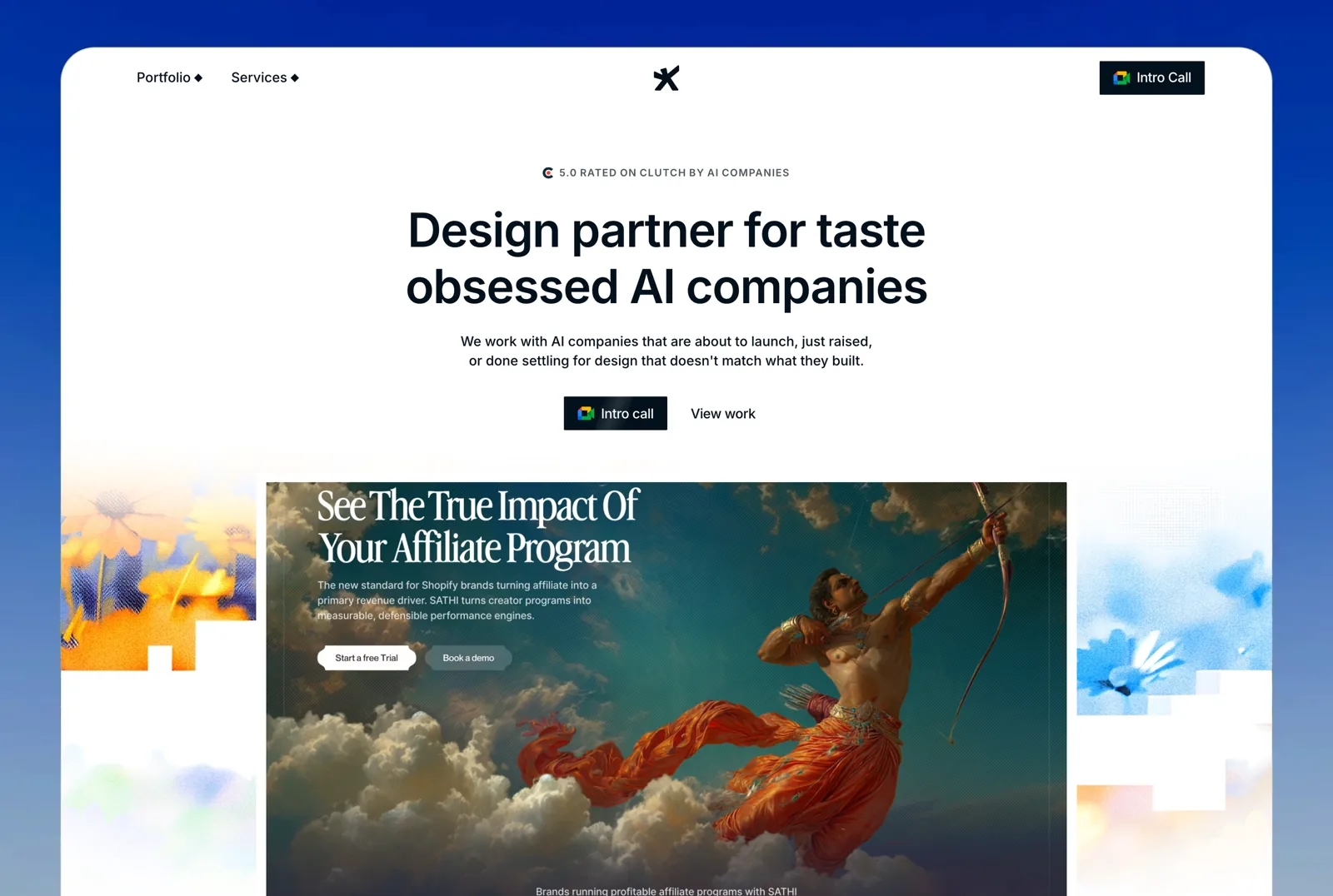
1. Studio Maydit: A Top-Rated Design Agency for AI Founders
Two things usually matter after a raise: getting a launch out on a date, and then keeping up with everything that follows it. Studio Maydit covers the first with a fixed scope of three to four weeks, and the second with a monthly retainer that takes in new pages, campaigns, and product design, carrying no long lock-in either way. Fixed-scope engagements finish with a diagnosis of what is leaking in the product, which after a Series A is often the distance between the traffic the announcement brought and the handful of accounts that survived their first week.
There is no account layer. It is founder-led with a small senior team, so the argument about what your company now says happens with the person who then builds the pages. AI founders across the US, UK, and Europe are the client base, and what they are buying is a web and product design studio. Framer, Webflow, and custom code are all available, chosen by what the site has to do, and the work runs on into product design once a site starts making promises the product has to keep.
One client comes with a number. Following design work built on a repositioned ICP, Dualite reached 100,000+ users seven months later. The recent list also holds Wave, PixelFlow, Mi-VAD, and 15 other AI and SaaS teams.
| Check | Finding |
|---|---|
| Based in | Remote, serving US / UK / EU |
| Platform depth | Framer, Webflow, and custom code |
| AI-sector proof | Yes. AI-native clients, published outcome on Dualite |
| Pricing | Fixed scope or monthly retainer, quoted per project |
| Team shape | Founder-led, small senior team |
| Best fit | Post-raise teams who need to publish weekly afterwards |
Worth a call if your homepage still describes the company you were before the round. Book a 30-minute call.

2. Engine Digital
Engine Digital has worked from Vancouver and New York since 2002, building in custom code, with Adidas, Autodesk, Goldman Sachs, and HP named. Companies of that size run large content operations with many contributors, so the studio has built the kind of structure a Series A company grows into rather than the kind it grows out of.
They publish no pricing and no team size, their AI-sector proof is partial, and an enterprise studio brings a process weighted for organisations far larger than yours, which shows up as time.
| Check | Finding |
|---|---|
| Based in | Vancouver and New York |
| Founded | 2002 |
| Team size | Not published |
| Primary platform | Custom code |
| AI-sector proof | Partial. Enterprise and SaaS clients, no AI case study |
| Named clients | Adidas, Autodesk, Goldman Sachs, HP |
| Pricing | Not published |
| Best fit | Teams building for enterprise buyers straight after a raise |
3. basement.studio
basement.studio works from Mar del Plata and Los Angeles, founded in 2018, 11 to 50 people in custom code, with a published minimum and Vercel, Cursor, ElevenLabs, Harvey AI, and Scale AI named. Every one of those companies passed through this exact moment recently, and Vercel means the team is judged by people who build the tooling your engineers use daily.
The published minimum sits above most first rebuilds, and a studio working repeatedly in one sector produces work that is recognisably of that sector, which is a problem only if you need to look different from your neighbours.
| Check | Finding |
|---|---|
| Based in | Mar del Plata, Argentina and Los Angeles, USA |
| Founded | 2018 |
| Team size | 11-50 |
| Primary platform | Custom code |
| AI-sector proof | Yes. Published AI client work |
| Named clients | Vercel, Cursor, ElevenLabs, Harvey AI, Scale AI |
| Pricing | Published minimum |
| Best fit | AI teams whose site is read by other engineering teams |
4. Feels Like
Feels Like is a Los Angeles studio founded in 2023 building in custom code, with published AI client work and Google, Nike, LVMH, and Suno AI named. A funding announcement is the one moment when a striking site earns disproportionate attention, and this is a team that makes striking things properly rather than decoratively.
They publish no pricing and no team size, they are young, and the portfolio is brand-led rather than built around the content systems a growing company needs six months later.
| Check | Finding |
|---|---|
| Based in | Los Angeles, USA |
| Founded | 2023 |
| Team size | Not published |
| Primary platform | Custom code |
| AI-sector proof | Yes. Published AI client work |
| Named clients | Google, Nike, LVMH, Suno AI |
| Pricing | Not published |
| Best fit | Teams who want the announcement site to be memorable |
5. Phantom
Phantom works from London and Auckland, founded in 2013, 51 to 200 people building in custom code, with published AI client work and Diageo, SAP, Financial Times, and Zendesk named. The Financial Times runs a genuine publishing operation, and SAP and Zendesk both maintain large product sites with documentation beside them, which is the structure you are about to need.
They publish no pricing, and at that headcount the engagement runs as a programme with stages, which is more process than a company of forty people usually wants to manage.
| Check | Finding |
|---|---|
| Based in | London, UK and Auckland, NZ |
| Founded | 2013 |
| Team size | 51-200 |
| Primary platform | Custom code |
| AI-sector proof | Yes. Published AI client work |
| Named clients | Diageo, SAP, Financial Times, Zendesk |
| Pricing | Not published |
| Best fit | Teams building a site that will keep growing for years |
6. Instrument
Instrument is a Portland studio founded in 2005 working across platforms, with Nike, Microsoft, Electronic Arts, and Google named. That is the strongest craft record here, and a company arriving at Series A with ambitions to be a category name will find few studios with more experience of building one.
They publish no pricing, no team size, and no AI client work, and a studio of that profile runs brand programmes on a scale and timeline that most companies at this stage cannot absorb.
| Check | Finding |
|---|---|
| Based in | Portland, USA |
| Founded | 2005 |
| Team size | Not published |
| Primary platform | Mixed |
| AI-sector proof | Partial. Enterprise and SaaS clients, no AI case study |
| Named clients | Nike, Microsoft, Electronic Arts, Google |
| Pricing | Not published |
| Best fit | Teams with budget for a full brand programme |
7. Ramotion
Ramotion is a San Francisco studio of 11 to 50 founded in 2009, working across platforms, with a published minimum and Mozilla, Okta, Netflix, Adobe, and Xero named. Series A is often when a company needs its identity fixed as well as its site, and this is a studio that can do both in one engagement rather than in two.
Their AI-sector proof is partial, and they work across platforms rather than specialising in the framework in your brief, so the build itself may be handled by generalists.
| Check | Finding |
|---|---|
| Based in | San Francisco, USA |
| Founded | 2009 |
| Team size | 11-50 |
| Primary platform | Mixed |
| AI-sector proof | Partial. Enterprise and SaaS clients, no AI case study |
| Named clients | Mozilla, Okta, Netflix, Adobe, Xero |
| Pricing | Published minimum |
| Best fit | Teams who need brand and site settled in one project |
8. Pixelmatters
Pixelmatters is a Porto studio of 51 to 200 founded in 2013, working across platforms, with a published minimum and Rubrik, Quantic, and UJET named. Rubrik went through several rounds of growing its public presence, and Portuguese hours overlap both Europe and the US east coast, which keeps a large project moving without overnight gaps.
Their AI-sector proof is partial, and at that size the individuals assigned to your project are decided after the contract rather than before it.
| Check | Finding |
|---|---|
| Based in | Porto, Portugal |
| Founded | 2013 |
| Team size | 51-200 |
| Primary platform | Mixed |
| AI-sector proof | Partial. Enterprise and SaaS clients, no AI case study |
| Named clients | Rubrik, Quantic, UJET |
| Pricing | Published minimum |
| Best fit | Teams who need capacity across European and US hours |
9. Feely Studio
Feely Studio is a distributed European team of one to ten, working across platforms, with a published minimum, published AI client work, and Noxus, Mutiny, Luasai, and Basic Capital named. A published figure and a small senior team make this a fast, direct arrangement, and Mutiny is a product built entirely around what converts on a website.
They publish no founding year, and one to ten people is not enough to run a full post-raise site programme alongside the pages that will keep arriving afterwards.
| Check | Finding |
|---|---|
| Based in | Distributed, Europe |
| Founded | Not published |
| Team size | 1-10 |
| Primary platform | Mixed |
| AI-sector proof | Yes. Published AI client work |
| Named clients | Noxus, Mutiny, Luasai, Basic Capital |
| Pricing | Published minimum |
| Best fit | Teams who want one senior collaborator on key pages |
10. SuperSkills
SuperSkills is a Walnut Creek team of one to ten working across platforms, with published AI client work and The Cut named. A studio that small gives you a senior person directly, which is genuinely useful for the hardest part of this project, deciding what the company now says about itself.
They publish no pricing, no founding year, and a single client name, which is thin evidence at this budget, and the capacity is far below what a growing site demands month after month.
| Check | Finding |
|---|---|
| Based in | Walnut Creek, USA |
| Founded | Not published |
| Team size | 1-10 |
| Primary platform | Mixed |
| AI-sector proof | Yes. Published AI client work |
| Named clients | The Cut |
| Pricing | Not published |
| Best fit | Teams who need positioning settled before a bigger build |
How to choose between them
Sort by what the round actually broke.
The site describes a company you are no longer. Studio Maydit or SuperSkills.
You need a system, not a redesign. Phantom or Engine Digital.
The announcement needs something people will remember. Feels Like or basement.studio.
The brand cannot carry the next two years. Ramotion or Instrument.
One test before you sign. Ask a candidate who will be able to publish a new customer story six months after launch, and get the answer in writing. A studio building for your growth names your people and describes how. A studio building for its own retainer describes a support process. Both are legitimate businesses. Only one of them leaves you able to move at the speed the round was raised for.