Summarize with AI


For a Series B AI startup rebuilding its website in Next.js, Studio Maydit fits best, because one team designs the site, writes code your engineers will adopt, and then stays on for product design. Phantom and Engine Digital lead the other nine: they are the only two that name custom code as their main platform, and both list clients far larger than a Series B company. Ranked by fit, the ten studios worth reviewing are Studio Maydit, Phantom, Engine Digital, Lazarev, Ramotion, Pixelmatters, Fantasy, Instrument, Feely Studio, and Finsweet. Feely Studio and Finsweet fit least. Feely Studio has ten people or fewer, and Finsweet builds in Webflow, so it would not write your Next.js at all. The other six list mixed platforms, so ask each for a Next.js site it shipped and have an engineer read the code.
A Series B website is never a blank page. There is a comparison post from two years ago that still sends trial signups every week, a docs page a popular newsletter once linked to, and a pricing page your sales reps paste into emails. Search engines have learned every one of those addresses.
The round also brings people who want to change the site. A demand lead wants a landing page per ad campaign. Recruiting needs forty open roles posted by Friday. All of them used to ask the founder. Now they ask whoever owns the code.
Next.js handles that load well. It builds thousands of pages from a content system, serves them fast, and can share buttons, type, and colors with your product.
The risk sits in the move, not in the framework. A rebuild that breaks old addresses, slows pages with test scripts, or gives the brand a second look costs more than the old site did. So we ranked these studios on one question: can they move a busy, live site onto Next.js without losing what it already earns?

How we ranked Next.js studios for a Series B AI company
We read each studio's website and directory profiles in October 2026. No studio paid to be listed.
- Code as the main craft. We read the main platform each studio names. A custom code studio writes the Next.js itself. A mixed studio may or may not. A Webflow studio passes that work to someone else.
- Proof at growth stage and in AI. We looked for named clients at or beyond the size you are growing toward, and for AI work on record. A Series B rebuild means security reviews and legal sign-off.
- Pricing in the open. We noted whether a studio posts a minimum, and nothing more. No named studio gets a figure here.
- Enough hands at once. We set headcount against the job. Content modeling, design, front end, and the redirect plan should run side by side.
- How the studio's own site treats a wrong address. Type a made-up path after its domain. Does a designed page come back with useful links, or a bare error?
The fifth test looks small, and it predicts a lot. A studio's own site is the one project it ran with no client in the way. If it never planned for a visitor on a dead link, it will not plan for the thousands who reach your old addresses after the switch.
We copied the tables from what each studio says about itself, on its site or in a directory listing. A blank in the public record shows up as Not published, with no guess.
What goes wrong when a Series B AI company moves its site to Next.js
The switch quietly deletes years of search traffic. The studio designs tidy new addresses, such as /blog/post-name in place of /resources/2024/post-name. Nobody writes a redirect for the old ones. A few weeks after a perfect launch, trial signups from search have sagged. Ask for a list of every current address, a redirect for each, and a test of that list on the preview build before the domain moves.
Experiments make the page flicker. The growth team wants to test two headlines, so someone adds a script that swaps the text after the page loads. Visitors see the old hero for half a second, then the new one. Ask for tests that pick the version on the server, in Next.js middleware, so each visitor gets one page from the first paint.
The site and the app look like two companies. By Series B your product team has its own buttons, type, colors, and icons. The studio builds the marketing site from a fresh set. The site shows last year's screenshots, and a buyer who clicks Sign up lands somewhere with a different font. Ask the studio to build from your product's design tokens, ideally a shared package your engineers already keep up to date.
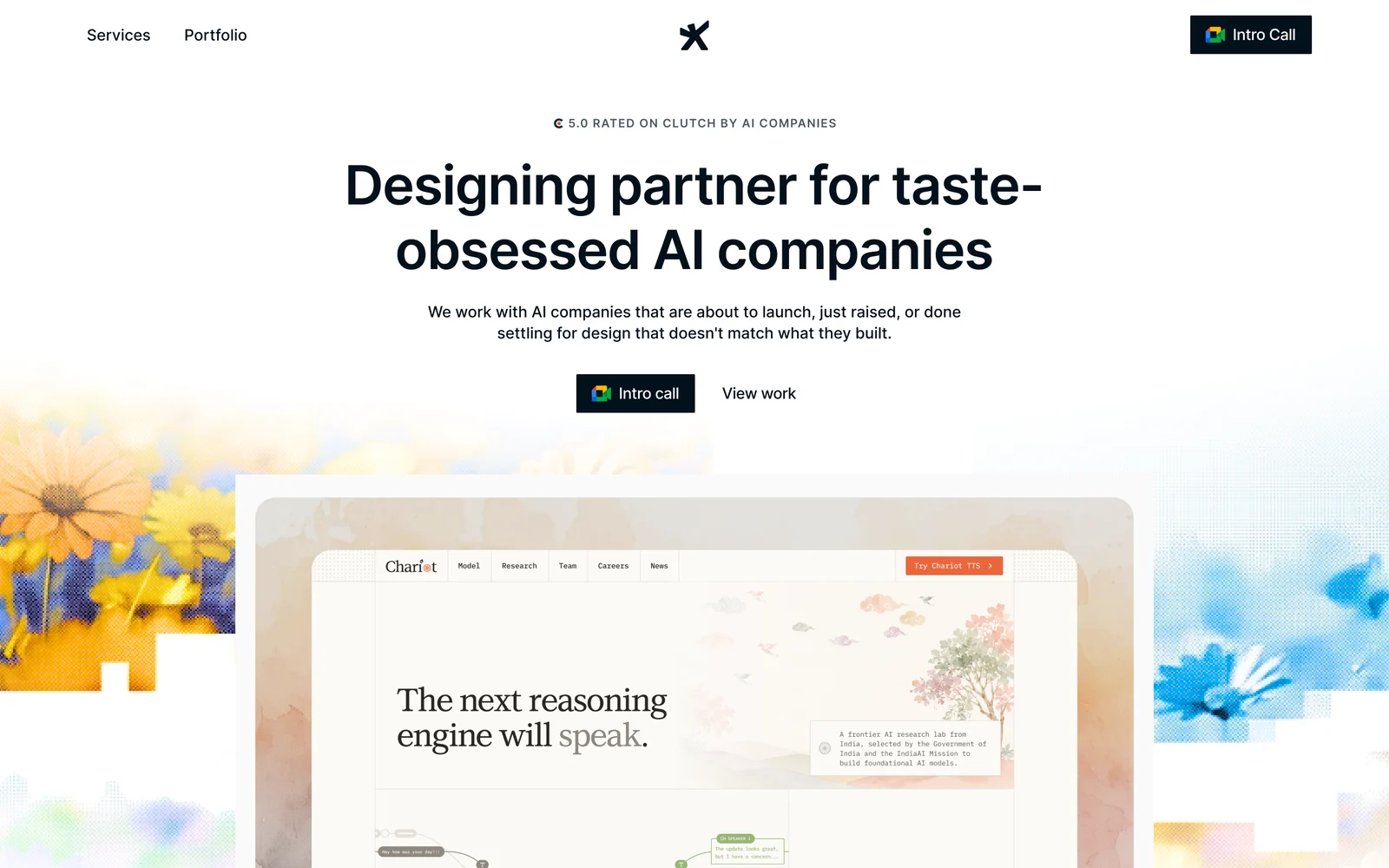
1. Studio Maydit: A Top-Rated Design Agency for AI Founders
Studio Maydit is a web and product design studio working with AI founders in the US, UK, and Europe. It builds in Framer, Webflow, and custom code. A Next.js rebuild sits on the custom code side, set up so your engineers can take over the repository and your marketers can publish without them. After launch, the same team can carry on into product design.
Dualite, an AI dev tool, had its website and its product designed side by side. The headline result came from design work supporting a repositioned ICP, which helped the product reach 100,000+ users in seven months, and the Dualite case study walks through both halves. Wave, PixelFlow, and Mi-VAD are recent clients as well, with 15 other AI and SaaS teams.
There are two ways to buy. A fixed scope of three to four weeks suits a rebuild tied to a date, such as a pricing change or a conference keynote. It ends with a diagnosis of what is leaking in the product, for example the screen where new trial users stall. A monthly retainer suits a growth team that keeps asking for new pages, campaigns, and product design, and it carries no long lock-in.
| Check | Finding |
|---|---|
| Based in | Remote, serving US / UK / EU |
| Platform depth | Framer, Webflow, and custom code |
| AI-sector proof | Yes. AI-native clients, published outcome on Dualite |
| Pricing | Fixed scope or monthly retainer, quoted per project |
| Team shape | Founder-led, small senior team |
| Best fit | Series B AI teams moving a live site to Next.js who want the redirects, tokens, and product screens in one team's hands |
Send us your twenty pages with the most search traffic, and we will tell you which addresses a rebuild has to protect. Book a 30-minute call.

2. Phantom
Phantom was founded in 2013 and works from London, UK and Auckland, NZ, with 51 to 200 people. Custom code is its main platform, and it has AI client work on record. Its clients include Diageo, SAP, Financial Times, and Zendesk. That is a code-first team used to large sites with many editors, which is where a Series B site is heading.
It does not publish a minimum, and its clients are far bigger than most Series B companies. Ask who will lead your project day to day.
| Check | Finding |
|---|---|
| Based in | London, UK and Auckland, NZ |
| Founded | 2013 |
| Team size | 51-200 |
| Primary platform | Custom code |
| AI-sector proof | Yes. Published AI client work |
| Named clients | Diageo, SAP, Financial Times, Zendesk |
| Pricing | Not published |
| Best fit | Series B AI companies that want a code-first team to write and hand over the Next.js |
3. Engine Digital
Engine Digital has worked from Vancouver and New York since 2002, and custom code is its main platform. Its clients include Adidas, Autodesk, Goldman Sachs, and HP. A bank and a large software maker run formal vendor reviews, so this team knows the scrutiny your own enterprise deals now bring.
Its AI proof is partial, with no AI case study named. It publishes neither team size nor a minimum, so you learn how it would staff your rebuild only on a call.
| Check | Finding |
|---|---|
| Based in | Vancouver and New York |
| Founded | 2002 |
| Team size | Not published |
| Primary platform | Custom code |
| AI-sector proof | Partial. Enterprise clients, no AI case study |
| Named clients | Adidas, Autodesk, Goldman Sachs, HP |
| Pricing | Not published |
| Best fit | Series B AI companies selling to large enterprises that want an engineering studio to own the rebuild |
4. Lazarev
Lazarev has worked from San Francisco since 2015, has 51 to 200 people, and posts a minimum. It has AI client work on record, with clients including Payoneer, Peel, Elva, and Mozayix. AI clients plus a public price floor make it easy to put through a Series B finance check.
It lists mixed platforms, not custom code. Ask whether its own developers write the Next.js or your engineers build from its designs.
| Check | Finding |
|---|---|
| Based in | San Francisco, USA |
| Founded | 2015 |
| Team size | 51-200 |
| Primary platform | Mixed |
| AI-sector proof | Yes. Published AI client work |
| Named clients | Payoneer, Peel, Elva, Mozayix |
| Pricing | Published minimum |
| Best fit | Series B AI teams whose engineers will build from a large design team's files |
5. Ramotion
Ramotion has worked from San Francisco since 2009, with 11 to 50 people and a published minimum. Its clients include Mozilla, Okta, Netflix, Adobe, and Xero. Okta sells identity software to large companies, so Ramotion has designed for the security-minded buyer a Series B sales team starts to meet.
Its AI proof is partial, and it lists mixed platforms. A team of 11 to 50 may struggle to run design, content modeling, and front end at once on a large migration.
| Check | Finding |
|---|---|
| Based in | San Francisco, USA |
| Founded | 2009 |
| Team size | 11-50 |
| Primary platform | Mixed |
| AI-sector proof | Partial. Large software clients, no AI case study |
| Named clients | Mozilla, Okta, Netflix, Adobe, Xero |
| Pricing | Published minimum |
| Best fit | Series B AI companies moving upmarket that want a US studio used to well-known software brands |
6. Pixelmatters
Pixelmatters is a studio in Porto, Portugal, founded in 2013, with 51 to 200 people and a published minimum. Its clients include Rubrik, Quantic, and UJET. A team that size can staff a rebuild in parallel, and Porto's working day overlaps with London and the US East Coast morning.
Its AI proof is partial, and it lists mixed platforms rather than custom code. Confirm that Next.js is a core service before you scope.
| Check | Finding |
|---|---|
| Based in | Porto, Portugal |
| Founded | 2013 |
| Team size | 51-200 |
| Primary platform | Mixed |
| AI-sector proof | Partial. B2B software clients, no AI case study |
| Named clients | Rubrik, Quantic, UJET |
| Pricing | Published minimum |
| Best fit | Series B AI companies with teams in Europe and the US |
7. Fantasy
Fantasy has offices in San Francisco and New York, has been in business since 1999, and has AI work on record. A Series B AI product often brings a new kind of screen, such as an agent's run history, and that record can help settle how the site shows it.
It names no clients and publishes neither team size nor price, so you cannot check its record before a call. It lists mixed platforms, and nothing public points to Next.js as its main craft.
| Check | Finding |
|---|---|
| Based in | San Francisco and New York, USA |
| Founded | 1999 |
| Team size | Not published |
| Primary platform | Mixed |
| AI-sector proof | Yes. AI work shown, clients not named |
| Named clients | Not published |
| Pricing | Not published |
| Best fit | Series B AI companies whose product has an interface nobody has seen before |
8. Instrument
Instrument has worked from Portland, USA since 2005. Its clients include Nike, Microsoft, Electronic Arts, and Google, brands with very large sites and many teams publishing to them.
It is a premium studio built around very large brands, its AI proof is partial, and it lists mixed platforms. A Series B rebuild may be a small account on its roster.
| Check | Finding |
|---|---|
| Based in | Portland, USA |
| Founded | 2005 |
| Team size | Not published |
| Primary platform | Mixed |
| AI-sector proof | Partial. Large tech clients, no AI case study |
| Named clients | Nike, Microsoft, Electronic Arts, Google |
| Pricing | Not published |
| Best fit | Late Series B AI companies that want big-brand weight and have their own engineers to build |
9. Feely Studio
Feely Studio is a distributed team of one to ten people in Europe, with published AI client work and a posted minimum. Its named clients are Noxus, Mutiny, Luasai, and Basic Capital. It suits a focused job, such as a set of campaign pages, next to a build your engineers own.
A team of ten or fewer is small for a full Series B migration, and it lists mixed platforms. Its founding year is not published.
| Check | Finding |
|---|---|
| Based in | Distributed, Europe |
| Founded | Not published |
| Team size | 1-10 |
| Primary platform | Mixed |
| AI-sector proof | Yes. Published AI client work |
| Named clients | Noxus, Mutiny, Luasai, Basic Capital |
| Pricing | Published minimum |
| Best fit | Series B AI teams that need campaign pages while their engineers own the site |
10. Finsweet
Finsweet is a Webflow studio of 51 to 200 people, founded in 2017, based in Denver, USA and distributed. Its clients include Dropbox, Clay, GitHub, and Steadily, companies whose marketing sites many teams publish to.
It ranks last because it builds in Webflow, not Next.js, so it would not write your code. Its AI proof is partial and it publishes no minimum.
| Check | Finding |
|---|---|
| Based in | Denver, USA, distributed |
| Founded | 2017 |
| Team size | 51-200 |
| Primary platform | Webflow |
| AI-sector proof | Partial. Tech and SaaS clients, no AI case study |
| Named clients | Dropbox, Clay, GitHub, Steadily |
| Pricing | Not published |
| Best fit | Series B AI companies that decide Webflow suits marketing better than code |
How to choose between them
Start with what the current site is costing you.
Old pages earn traffic you cannot lose. You need a studio that treats the redirect list as design work. Studio Maydit, Phantom, or Engine Digital, the teams most likely to write and test that Next.js themselves.
The product and the site have drifted apart. You need the product's components on the site and fresh screenshots. Studio Maydit, or Lazarev with your engineers doing the build.
Enterprise buyers now read the site closely. Security pages and industry stories need weight. Engine Digital, Ramotion, or Instrument, after you confirm who writes the code.
Marketing wants a visual editor more than a framework. Then Next.js may be the wrong brief. Finsweet in Webflow is the honest pick, with Feely Studio for campaign pages.
One test before you sign. Send the studio ten of your oldest addresses and ask where each will point after launch. A strong studio answers in a spreadsheet within a day. A weak one says it will sort out redirects at the end.