
Summarize with AI


The best Next.js development agencies for startups outgrowing Webflow in 2026 are Studio Maydit, Engine Digital, Lazarev, Feels Like, basement.studio, Phantom, 8020, Instrument, Ramotion, and Pixelmatters. Studio Maydit and Engine Digital lead for this brief, because both work in custom code rather than treating it as an occasional service, and a migration is engineering work wearing a design brief. 8020 and Ramotion are the wrong fit here, since 8020 builds primarily in Webflow, which is the platform you are leaving, and Ramotion works across platforms rather than as a code specialist.
Most write-ups of this move argue about whether you should do it. That argument is usually settled before anyone reads an article, and often for good reasons, so here is the more useful warning.
The migration will probably work. The site will be faster, the code will live in your repository, and your engineers will be happier. And roughly two months later your head of marketing will quietly stop shipping pages.
That is the real risk, and almost nobody prices it. In Webflow, a marketer builds a page on a Tuesday afternoon. Duplicate a template, change the copy, publish, send the link. Nobody is asked, no engineer is interrupted. That capability disappears the moment your site becomes an application, and what replaces it is a ticket queued behind product work.
Teams then discover the second thing, which is that much of their site was never really content. It was structure improvised inside a CMS. Collection lists faking a filter. Reference fields carrying layout decisions. Fields called Text 3. Modelled properly for a headless setup, half of it turns out to be workarounds rather than data.
Then there is everything you built visually and cannot export. The scroll behaviour, the hover states, the sequenced reveals, all of it authored in a proprietary interaction system that produces nothing portable. It has to be rebuilt by hand, from watching the old site, and it never comes back quite the same.
None of this means stay. It means the project is bigger than the quote suggests, and the parts that hurt are not the ones on the invoice.
The ten studios below are ordered by how well they move a site into code without taking your marketing team's speed with it.

How we picked these agencies
Five checks, weighted for a project that is half engineering and half handover:
- Platform depth. Does the studio genuinely build in code, or does it design and then hand the build to somebody else?
- Evidence of production front-end work. Are there named clients whose sites are real applications under load, rather than brochures? That work is what teaches a team about caching, previews, and deploys.
- Pricing. Is a starting figure public, so you can compare a migration quote against something rather than against nothing?
- Team shape. Is there senior capacity to run a migration alongside your normal marketing output, since the site still has to keep working while it is being replaced?
- Their own site. If a studio recommends this stack, their own build is the first sample you get for free.
The second check is where this list separates from a general design list. Any competent studio can produce a beautiful set of pages. Far fewer have shipped a front end that survived a traffic spike, a rollback, a broken build, and an editor who needs to publish without asking. Those situations decide whether your new site is an asset or a liability.
The tables record what each studio publishes about itself and nothing more. Where a figure is not public, the row says so rather than guessing at it. On a migration brief the unstated things matter, because a studio that will not describe its own operating details is unlikely to document yours.
What goes wrong when a startup leaves Webflow
Three failures, and the first shows up as a slowdown nobody can attribute.
Your marketing team loses its independence. The old site let them publish without permission. The new one does not, unless somebody deliberately builds that back in. Six weeks after launch, campaign pages start arriving late, experiments stop happening, and the reason never appears in a retrospective, because no single ticket was slow. Decide before the project starts which pages non-engineers must be able to create alone, then treat that as a hard requirement of the build rather than a nice-to-have in phase two. It is the single most valuable thing you can specify.
The content model gets ported instead of rebuilt. Years of a visual CMS leave behind fields that exist for layout reasons, collections used as switches, and relationships that encode a workaround somebody made in 2024. Copying that structure into a new system carries every past compromise forward and makes the next two years harder. Spend a week auditing what each field is actually for before anything is migrated. Expect to delete a third of it, and expect at least one argument about a field that turns out to be load bearing.
The interaction work is treated as a copy job. Everything animated in the old builder exists only inside it. There is no export, so it gets rebuilt by eye, usually last, usually by whoever has time. The result is a site that is technically identical and subtly deadened, and the people who notice are the ones who spent a year getting it right. Record what the current site does before you take it down, decide deliberately which behaviours are worth reproducing, and budget for them as work rather than as polish.
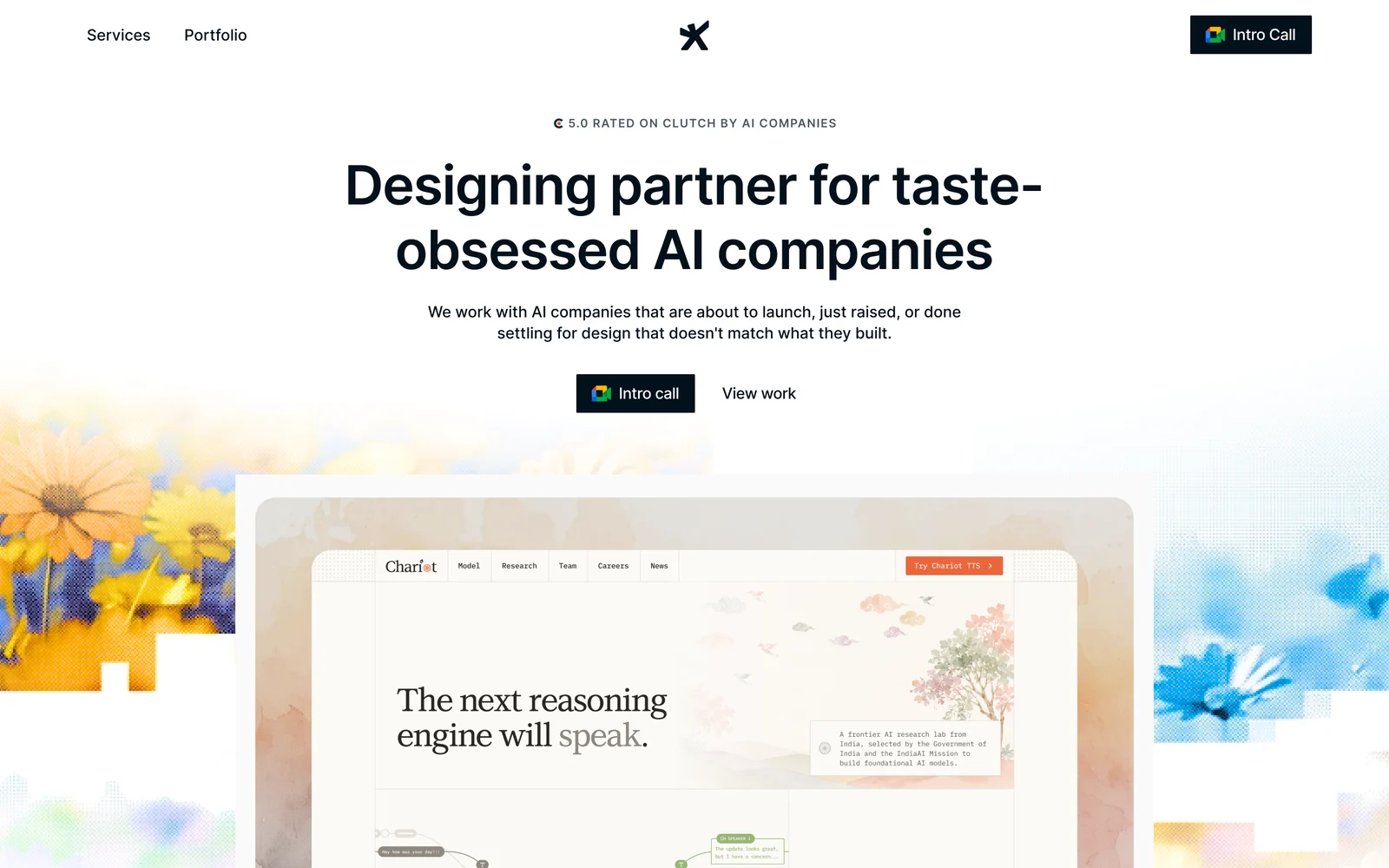
1. Studio Maydit: A Top-Rated Design Agency for AI Founders
A migration is a good test of whether a studio can work in more than one world. Studio Maydit builds in Framer, Webflow, and custom code, which means it can read what your current site is doing before deciding what the replacement should be, rather than starting from a preference. It is a web and product design studio, founder-led, with a small senior team.
Its clients are AI founders in the US, UK, and Europe, and the studio continues into product design after the site ships. On this brief that matters more than usual, because once your site lives in the same codebase as your product, the two stop being separate design problems.
The one published outcome belongs to Dualite. Seven months after design work was aligned to a repositioned ICP, the product had passed 100,000+ users. Wave, PixelFlow, Mi-VAD, and 15 other AI and SaaS teams are recent clients.
Fixed scope is three to four weeks and exists for teams working to a launch date, closing with a diagnosis of what is leaking in the product. Where the work does not stop at launch, a monthly retainer covers new pages, campaigns, and product design instead, with no long lock-in.
| Check | Finding |
|---|---|
| Based in | Remote, serving US / UK / EU |
| Platform depth | Framer, Webflow, and custom code |
| AI-sector proof | Yes. AI-native clients, published outcome on Dualite |
| Pricing | Fixed scope or monthly retainer, quoted per project |
| Team shape | Founder-led, small senior team |
| Best fit | Teams moving to code who still need marketing to ship alone |
Worth a call if the plan is to migrate and nobody has said what marketing does afterwards. Book a 30-minute call.

2. Engine Digital
Engine Digital has worked from Vancouver and New York since 2002, in custom code, with Adidas, Autodesk, Goldman Sachs, and HP named. Clients at that size run sites where downtime has consequences, and twenty-four years means this team has migrated platforms more times than most studios have existed.
They publish no pricing and no team size, their AI-sector proof is partial, and a studio built around enterprise programmes brings governance that a startup replacing one marketing site will experience as weight.
| Check | Finding |
|---|---|
| Based in | Vancouver and New York |
| Founded | 2002 |
| Team size | Not published |
| Primary platform | Custom code |
| AI-sector proof | Partial. Enterprise and SaaS clients, no AI case study |
| Named clients | Adidas, Autodesk, Goldman Sachs, HP |
| Pricing | Not published |
| Best fit | Teams whose site cannot afford a bad migration |
3. Lazarev
Lazarev is a San Francisco studio of 51 to 200 founded in 2015, working across platforms, with a published minimum, published AI client work, and Payoneer, Peel, Elva, and Mozayix named. Payoneer moves money at scale, so a broken deploy is a serious event here, and at that headcount your migration and your ongoing pages can run side by side.
They work across platforms rather than as a code specialist, and at 51 to 200 people the senior attention that wins the project is spread across several accounts once it starts.
| Check | Finding |
|---|---|
| Based in | San Francisco, USA |
| Founded | 2015 |
| Team size | 51-200 |
| Primary platform | Mixed |
| AI-sector proof | Yes. Published AI client work |
| Named clients | Payoneer, Peel, Elva, Mozayix |
| Pricing | Published minimum |
| Best fit | Teams who need the old site maintained during the move |
4. Feels Like
Feels Like is a Los Angeles studio founded in 2023 working in custom code, with published AI client work and Google, Nike, LVMH, and Suno AI named. LVMH work is judged on finish above almost everything else, which is the quality most at risk when interaction behaviour has to be rebuilt by hand rather than exported.
They publish no pricing and no team size, and a studio founded in 2023 has a shorter operating history than the others here for a project where the risk is mostly in what goes wrong afterwards.
| Check | Finding |
|---|---|
| Based in | Los Angeles, USA |
| Founded | 2023 |
| Team size | Not published |
| Primary platform | Custom code |
| AI-sector proof | Yes. Published AI client work |
| Named clients | Google, Nike, LVMH, Suno AI |
| Pricing | Not published |
| Best fit | Teams unwilling to lose craft in the rebuild |
5. basement.studio
basement.studio works from Mar del Plata and Los Angeles, founded in 2018, at 11 to 50 people, in custom code, with a published minimum, published AI client work, and Vercel, Cursor, ElevenLabs, Harvey AI, and Scale AI named. Vercel is the company behind the framework you are moving to, which is about as direct a qualification as this list offers.
Their working hours span Argentina and Los Angeles, which narrows the overlap for an east coast team, and a studio this visible among AI companies is likely to have a queue rather than availability.
| Check | Finding |
|---|---|
| Based in | Mar del Plata, Argentina and Los Angeles, USA |
| Founded | 2018 |
| Team size | 11-50 |
| Primary platform | Custom code |
| AI-sector proof | Yes. Published AI client work |
| Named clients | Vercel, Cursor, ElevenLabs, Harvey AI, Scale AI |
| Pricing | Published minimum |
| Best fit | Teams who want the stack's own specialists |
6. Phantom
Phantom works from London and Auckland, founded in 2013, at 51 to 200 people, in custom code, with published AI client work and Diageo, SAP, Financial Times, and Zendesk named. The Financial Times is an operation where editors publish continuously without engineering involvement, which is the capability most teams lose in this migration and rarely get back.
They publish no pricing, and a studio at that scale with clients of that size will run a process longer than a startup replacing one site wants to sit through.
| Check | Finding |
|---|---|
| Based in | London, UK and Auckland, NZ |
| Founded | 2013 |
| Team size | 51-200 |
| Primary platform | Custom code |
| AI-sector proof | Yes. Published AI client work |
| Named clients | Diageo, SAP, Financial Times, Zendesk |
| Pricing | Not published |
| Best fit | Teams who publish constantly and cannot slow down |
7. 8020
8020 works from San Francisco and New York, founded in 2014, in Webflow, with Wave, Superlist, Pilot.com, Vanta, and Circle named. Their Webflow depth is genuinely useful in one direction here, because a studio that knows the platform intimately can tell you which parts of your current site are structure and which are improvisation.
Webflow is their primary platform, which is the one you are trying to leave, and they publish no pricing and no team size, so the code side of this project would need somebody else.
| Check | Finding |
|---|---|
| Based in | San Francisco and New York, USA |
| Founded | 2014 |
| Team size | Not published |
| Primary platform | Webflow |
| AI-sector proof | Partial. Enterprise and SaaS clients, no AI case study |
| Named clients | Wave, Superlist, Pilot.com, Vanta, Circle |
| Pricing | Not published |
| Best fit | Teams auditing what their current site really contains |
8. Instrument
Instrument has worked from Portland since 2005, across platforms, with Nike, Microsoft, Electronic Arts, and Google named. Two decades of work for companies with enormous web estates means real familiarity with content models that grew by accident, which is the least glamorous and most decisive part of this project.
They publish no pricing and no team size, their AI-sector proof is partial, and they work across platforms rather than as a code shop, so the engineering half may be less deep than the brand half.
| Check | Finding |
|---|---|
| Based in | Portland, USA |
| Founded | 2005 |
| Team size | Not published |
| Primary platform | Mixed |
| AI-sector proof | Partial. Enterprise and SaaS clients, no AI case study |
| Named clients | Nike, Microsoft, Electronic Arts, Google |
| Pricing | Not published |
| Best fit | Teams with a large tangled content estate |
9. Ramotion
Ramotion is a San Francisco studio of 11 to 50 founded in 2009, working across platforms, with a published minimum and Mozilla, Okta, Netflix, Adobe, and Xero named. Seventeen years of continuous operation is its own kind of evidence, and a published starting figure means you can benchmark a migration quote before you have three of them.
Their AI-sector proof is partial, and working across platforms means code is one capability among several rather than the centre of the practice.
| Check | Finding |
|---|---|
| Based in | San Francisco, USA |
| Founded | 2009 |
| Team size | 11-50 |
| Primary platform | Mixed |
| AI-sector proof | Partial. Enterprise and SaaS clients, no AI case study |
| Named clients | Mozilla, Okta, Netflix, Adobe, Xero |
| Pricing | Published minimum |
| Best fit | Teams who want a benchmark before committing |
10. Pixelmatters
Pixelmatters is a Porto studio of 51 to 200 founded in 2013, working across platforms, with a published minimum and Rubrik, Quantic, and UJET named. Rubrik is enterprise infrastructure with a demanding technical audience, and at this headcount the migration and the pages you still need next month can be staffed separately.
Their AI-sector proof is partial, they work across platforms rather than as a code specialist, and Porto hours give a US west coast team only a morning window.
| Check | Finding |
|---|---|
| Based in | Porto, Portugal |
| Founded | 2013 |
| Team size | 51-200 |
| Primary platform | Mixed |
| AI-sector proof | Partial. Enterprise and SaaS clients, no AI case study |
| Named clients | Rubrik, Quantic, UJET |
| Pricing | Published minimum |
| Best fit | Teams running the migration and business as usual together |
How to choose between them
Sort by what you are most afraid of losing.
Marketing's ability to ship without asking. Studio Maydit or Phantom.
Uptime and a clean cutover. Engine Digital or Lazarev.
The finish and feel of the current site. Feels Like or basement.studio.
Sanity in a content model that grew wild. Instrument or 8020.
One test before you sign. Ask a candidate what your marketing team will be able to publish alone after launch, and have them answer with specific page types rather than a principle. Studios that have done this before will name the templates, describe the editing surface, and tell you which things will now need an engineer. Studios that have not will say the site will be easy to update, which is what everybody says, and is not the same thing at all.