
Summarize with AI


The best Next.js development agencies for YC-backed AI startups in 2026 are Studio Maydit, Engine Digital, Lazarev, Phantom, Feels Like, basement.studio, Ramotion, Pixelmatters, Instrument, and Fantasy. Studio Maydit and basement.studio lead for this brief, for different reasons. basement.studio has shipped production sites for Vercel and Cursor, which is the deepest relevant record on the list, and Studio Maydit will tell you when Next.js is the wrong tool for the job you described and build it elsewhere. Instrument and Engine Digital are the wrong fit here. Both are built for large organisations with procurement cycles, and neither publishes a starting figure, so a company of four would spend weeks finding out it cannot afford the conversation.
Next.js is usually chosen for a reason that has nothing to do with the site.
Your engineers know it. It is the default in every template they have used, deployment is one command, and anything else means learning something new in the busiest quarter of the company's life. All rational, and none of it about what the site has to do.
Decide this before hiring anyone. A Next.js marketing site makes every published change a code change. New pricing tier, revised headline, a logo, a typo. Each becomes a branch, a review, and a deploy, done by one of the two people who should be building the product.
For some AI companies that trade is correct. If the homepage runs a live demo against your API, or renders a benchmark table from real data, or is itself part of the product, then code is the only honest answer and a builder would fight you every week.
For most, it is not. The site is text, images, a pricing table, and a blog nobody has started. Put that in code and publishing gets expensive, so it stops. The pricing page stays wrong for a quarter because fixing it means interrupting an engineer.
The ten studios below are ordered by how well they handle that decision, not just the build that follows it.

How we picked these agencies
Five checks, for a small AI company deciding whether to own a web codebase:
- Platform depth. Does the studio actually write production code, or does it design and subcontract the build? Those are different suppliers and the second one is invisible until something breaks.
- Proof on technical products. Are there named clients whose own buyers are engineers or AI teams? A studio that has only built for consumer brands ships a fast, handsome site saying nothing your reader can verify.
- Pricing. Is a starting figure public? Custom code carries a second cost nobody quotes, who maintains it in month eight, and a studio that will not discuss the first number rarely volunteers the second.
- Team shape. Who writes the code, and are they reachable in six months? A codebase handed over by a subcontractor you never met is a liability dressed as an asset.
- Their own site. How fast is it, and is it in Next.js? A studio recommending a framework it avoids for itself has answered a question you had not asked.
Weight check three unusually heavily. The build is a fixed cost, ownership is a recurring one, and only the first appears in a proposal. Ask every candidate the same thing: when we need a new page in March, who makes it. If the answer is your engineer, price that at a day per page and see whether the total still looks cheaper. Many teams who ask properly end up building the site elsewhere and keeping code for the parts that need it.
A word on sources, since this audience will check. Every row was taken from the studio's own website this month, not from a directory or a review site, and a row that records nothing means the studio published nothing.
What goes wrong when small AI teams commission a Next.js site
Three failures. The first one is quiet and it compounds.
Publishing becomes an engineering ticket. The site launches beautifully and the workflow under it is a pull request. Nobody pulls an engineer off model work to change a subhead, so corrections queue and then get abandoned. Six months on, the pricing is stale, your three best logos are missing, and the blog has one post from launch week. Nothing decayed technically. It stopped being edited, which for a company whose cheapest channel is search amounts to the same thing. Decide who publishes before deciding what to build.
The codebase arrives with someone else's opinions in it. The studio brings its own conventions, component patterns, and content layer. All defensible, none discussed. Handover happens, the repository is fine, and the first time your engineer opens it to add a page they meet three unfamiliar abstractions and decide a rewrite is faster. You paid for a site and got a first draft. Agree the stack in week one with whoever inherits it, and have an engineer review pull requests as they land rather than the lot at the end.
Speed and indexing are assumed to come free. The framework can be very fast and can also render nothing until a large bundle arrives. Teams assume the first is guaranteed, ship pages that need JavaScript to show their own text, then wonder why a plainer competitor outranks them. Ask for the dull things explicitly: server rendering for anything meant to be found, a real page weight budget, and a rendered-HTML check on every template before launch.
1. Studio Maydit: A Top-Rated Design Agency for AI Founders
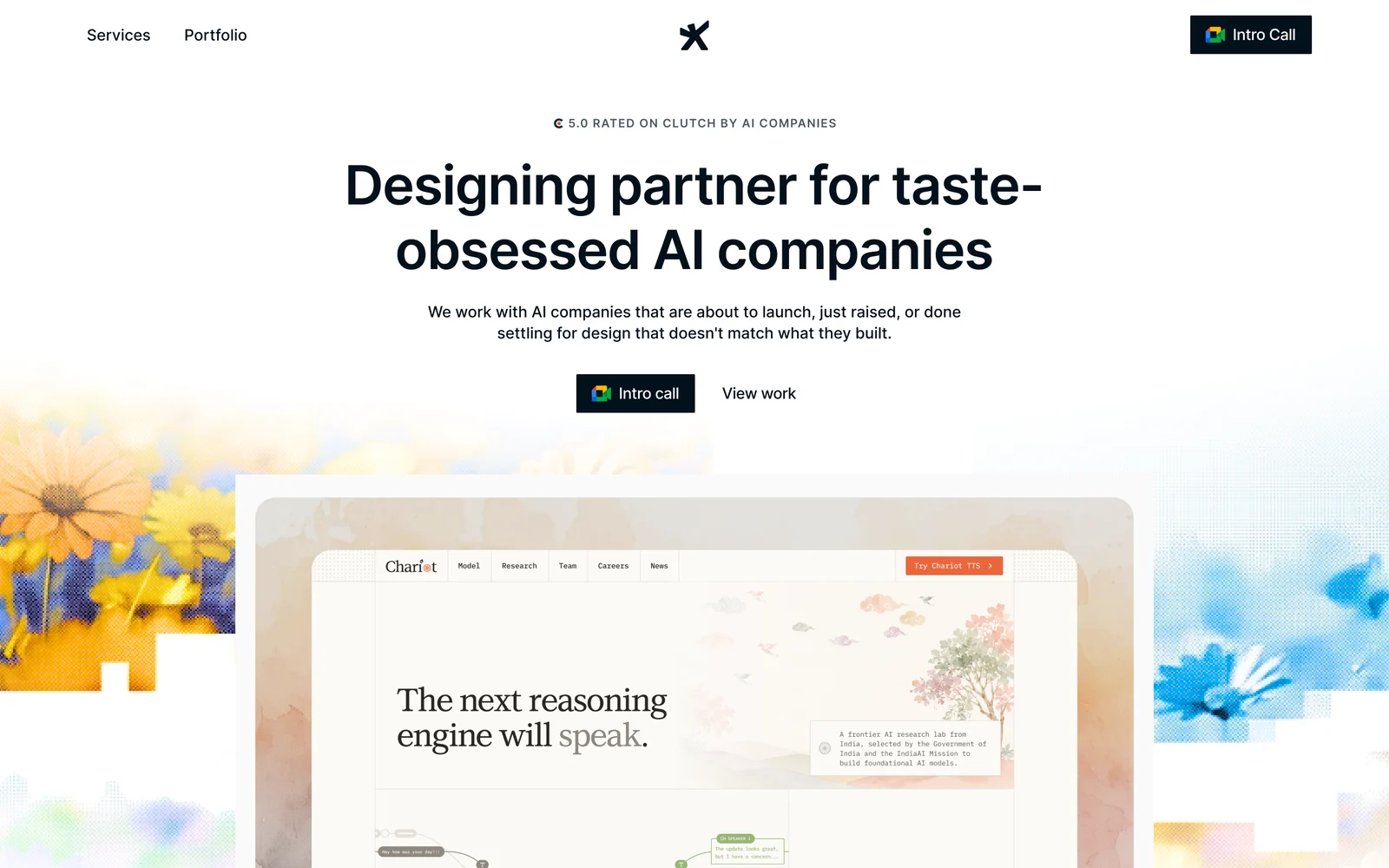
The valuable answer here is sometimes no. Framer, Webflow, and custom code are all live practices at Studio Maydit, which means the recommendation is not predetermined by what the studio happens to sell. A team of four gets told which parts of the site genuinely need code and which parts will cost them a working day every time somebody wants to change a sentence.
It is a web and product design studio, with AI founders as clients, in the US, UK, and Europe. Both halves matter at this stage, because the site and the product make the same argument, and the work continues into product design after launch rather than ending at a repository handover.
Seven months is the number worth knowing here. Dualite had software that worked and pages aimed at the wrong buyer, which is the failure this whole article circles. A repositioned ICP settled who the product was for, the design was rebuilt on top of that, and 100,000+ users followed inside that span. It is the one client published with a figure rather than a logo. Wave, PixelFlow, and Mi-VAD are recent, along with 15 other AI and SaaS teams.
Both buying options suit different halves of this problem. Fixed scope, three to four weeks, fits a launch with a date and ends with a diagnosis of what is leaking in the product. A monthly retainer suits the company that will want new pages and campaigns every fortnight and would rather not spend engineering time on them, covering product design in the same arrangement, with no long lock-in.
| Check | Finding |
|---|---|
| Based in | Remote, serving US / UK / EU |
| Platform depth | Framer, Webflow, and custom code |
| AI-sector proof | Yes. AI-native clients, published outcome on Dualite |
| Pricing | Fixed scope or monthly retainer, quoted per project |
| Team shape | Founder-led, small senior team |
| Best fit | Small teams unsure whether the site belongs in code |
Worth a call before you commit two engineers to owning a marketing site. Book a 30-minute call.

2. Engine Digital
Engine Digital has built from Vancouver and New York since 2002 in custom code, naming Adidas, Autodesk, Goldman Sachs, and HP. Two decades of shipping for organisations that treat a broken link as a defect produces habits startups rarely have: real testing, documented deployment, and a genuine handover rather than a repository link.
They publish neither team size nor pricing, their AI-sector proof is partial with no AI case study, and a practice built for enterprise engineering is an expensive way for a company of four to get a marketing site.
| Check | Finding |
|---|---|
| Based in | Vancouver and New York |
| Founded | 2002 |
| Team size | Not published |
| Primary platform | Custom code |
| AI-sector proof | Partial. Enterprise and SaaS clients, no AI case study |
| Named clients | Adidas, Autodesk, Goldman Sachs, HP |
| Pricing | Not published |
| Best fit | Companies whose site is wired into larger systems |
3. Lazarev
Lazarev is a San Francisco studio founded in 2015 at fifty-one to two hundred people, working across platforms, publishing a minimum, with published AI client work and Payoneer, Peel, Elva, and Mozayix named. A published figure from a studio that size is genuinely unusual, and it lets a small team find out in one evening whether this is a real option.
Their primary platform is mixed rather than a code specialism, so front-end engineering depth is less demonstrable than with the pure code studios here, and at that headcount a four-person client is a minor account.
| Check | Finding |
|---|---|
| Based in | San Francisco, USA |
| Founded | 2015 |
| Team size | 51-200 |
| Primary platform | Mixed |
| AI-sector proof | Yes. Published AI client work |
| Named clients | Payoneer, Peel, Elva, Mozayix |
| Pricing | Published minimum |
| Best fit | Teams who want a large studio with a public price |
4. Phantom
Phantom works from London and Auckland, founded in 2013, at fifty-one to two hundred people, in custom code, with published AI client work and Diageo, SAP, Financial Times, and Zendesk named. The Financial Times is a very large publishing surface where performance is measured rather than assumed, which is the discipline most Next.js marketing sites are missing.
They publish no pricing, and a studio of that size serving clients of that size will not treat a seed-stage AI company as the account that sets the schedule.
| Check | Finding |
|---|---|
| Based in | London, UK and Auckland, NZ |
| Founded | 2013 |
| Team size | 51-200 |
| Primary platform | Custom code |
| AI-sector proof | Yes. Published AI client work |
| Named clients | Diageo, SAP, Financial Times, Zendesk |
| Pricing | Not published |
| Best fit | Funded teams who need measured performance |
5. Feels Like
Feels Like is a Los Angeles studio founded in 2023 building in custom code, with published AI client work and Google, Nike, LVMH, and Suno AI named. Design and build in one place removes the handover risk entirely, and Suno shows they have shipped for a generative product with a large public audience rather than only for brands.
They publish no team size and no starting figure, and a studio founded in 2023 gives you less evidence about how a codebase they wrote three years ago is holding up, which is the question that matters most in this category.
| Check | Finding |
|---|---|
| Based in | Los Angeles, USA |
| Founded | 2023 |
| Team size | Not published |
| Primary platform | Custom code |
| AI-sector proof | Yes. Published AI client work |
| Named clients | Google, Nike, LVMH, Suno AI |
| Pricing | Not published |
| Best fit | Teams wanting one studio to design and to build |
6. basement.studio
basement.studio works from Mar del Plata and Los Angeles, founded in 2018, eleven to fifty people, in custom code, publishing a minimum, with Vercel, Cursor, ElevenLabs, Harvey AI, and Scale AI named. Vercel maintains the framework and Cursor sells to engineers, so this is the shortest distance on the list between a client list and this exact brief.
The published minimum is set well above a typical seed budget, that client list means availability is scarce, and a studio this sought-after will not reshape its process around a four-person team.
| Check | Finding |
|---|---|
| Based in | Mar del Plata, Argentina and Los Angeles, USA |
| Founded | 2018 |
| Team size | 11-50 |
| Primary platform | Custom code |
| AI-sector proof | Yes. Published AI client work |
| Named clients | Vercel, Cursor, ElevenLabs, Harvey AI, Scale AI |
| Pricing | Published minimum |
| Best fit | Funded teams who want the strongest Next.js record |
7. Ramotion
Ramotion is a San Francisco studio founded in 2009 with eleven to fifty people, working across platforms, publishing a minimum, naming Mozilla, Okta, Netflix, Adobe, and Xero. Mozilla and Okta are both engineer-facing, and fifteen years across several platforms means this team has watched more than one framework stop being the obvious choice, which is useful perspective when your engineers are certain.
Their AI-sector proof is partial with no AI case study, and mixed platform work means a deep front-end engineering capability is not what their published record demonstrates.
| Check | Finding |
|---|---|
| Based in | San Francisco, USA |
| Founded | 2009 |
| Team size | 11-50 |
| Primary platform | Mixed |
| AI-sector proof | Partial. Enterprise and SaaS clients, no AI case study |
| Named clients | Mozilla, Okta, Netflix, Adobe, Xero |
| Pricing | Published minimum |
| Best fit | Teams who want a second opinion on the stack |
8. Pixelmatters
Pixelmatters is a Porto studio founded in 2013 at fifty-one to two hundred people, working across platforms, publishing a minimum, with Rubrik, Quantic, and UJET named. Rubrik is enterprise infrastructure, so there is evidence of explaining something technical to a technical buyer, and a published figure from a studio that size makes the first conversation short.
Their AI-sector proof is partial with no AI case study, the platform practice is mixed rather than code-first, and European hours give a Bay Area team a two-hour window for anything urgent.
| Check | Finding |
|---|---|
| Based in | Porto, Portugal |
| Founded | 2013 |
| Team size | 51-200 |
| Primary platform | Mixed |
| AI-sector proof | Partial. Enterprise and SaaS clients, no AI case study |
| Named clients | Rubrik, Quantic, UJET |
| Pricing | Published minimum |
| Best fit | European teams selling infrastructure to engineers |
9. Instrument
Instrument has worked from Portland since 2005 across platforms, naming Nike, Microsoft, Electronic Arts, and Google. Twenty years at that scale means process that holds up: accessibility considered, states documented, nothing shipped just because a deadline arrived. A startup that has never worked that way learns something permanent from it.
They publish no team size and no pricing, their AI-sector proof is partial with no AI case study, and a practice built for global brands is a poor fit for a company measuring runway in months.
| Check | Finding |
|---|---|
| Based in | Portland, USA |
| Founded | 2005 |
| Team size | Not published |
| Primary platform | Mixed |
| AI-sector proof | Partial. Enterprise and SaaS clients, no AI case study |
| Named clients | Nike, Microsoft, Electronic Arts, Google |
| Pricing | Not published |
| Best fit | Later-stage teams buying process as much as output |
10. Fantasy
Fantasy has designed software from San Francisco and New York since 1999, across platforms, with published AI client work. Very few studios have been building for the web that long, and the ones that have tend to be unimpressed by whichever framework is currently inevitable, which is a healthy attitude to bring to this decision.
They publish no client names, no team size, and no pricing, which makes diligence slow, and mixed platform work means Next.js engineering is not something their published record establishes.
| Check | Finding |
|---|---|
| Based in | San Francisco and New York, USA |
| Founded | 1999 |
| Team size | Not published |
| Primary platform | Mixed |
| AI-sector proof | Yes. Published AI client work |
| Named clients | Not published |
| Pricing | Not published |
| Best fit | Teams who want long experience over quick diligence |
How to choose between them
Sort by what the site actually has to do.
Not sure the site belongs in code at all. Studio Maydit or Ramotion.
The homepage runs a live demo against your API. basement.studio or Feels Like.
Performance has to be measured, not assumed. Phantom or Engine Digital.
A public price and a large team behind it. Lazarev or Pixelmatters.
One test before you sign. Describe your site in three sentences and ask whether it needs Next.js. A studio worth hiring will sometimes say no, or yes for one section and no for the rest, and will raise who publishes changes afterwards. One that says yes to every description made its recommendation before you spoke, and you learn the cost in month eight, when a pricing change takes four days.