Summarize with AI


The best SaaS design agencies for AI cybersecurity startups in 2026 are Studio Maydit, Trueform, Feels Like, Phantom, Fantasy, SuperSkills, Lazarev, Kvalifik, BX Studio, and Flow Ninja. Studio Maydit and Trueform lead for this brief, because both publish how the work is bought and both have designed for technical products where the reader arrives suspicious. Flow Ninja and Kvalifik are the weakest fit here. Both are Webflow website practices, and the hard part of a security product is the trial and the queue, not the homepage.
Security software has a trap built into how it is sold. The normal software motion is try it, like it, buy it. Here the product cannot show its value until it is looking at real traffic, real logs, or real code, and nobody hands over any of those to a company they are still evaluating.
So the standard trial does not work, and most teams respond by removing the trial. What replaces it is a demo, a call, and a proof of concept that takes six weeks and a solutions engineer. That is not a sales strategy anyone chose. It is what happens when the product has no honest way to be useful on day one.
Meanwhile the product itself has two audiences who never overlap. Somebody senior signs, cares about coverage and compliance, and looks at the software twice a year. Somebody else lives in it at two in the morning, working a queue, deciding in seconds what deserves waking a colleague for.
Design attention almost always follows the money to the first person, which is why so many security products have an excellent executive dashboard and a working surface that feels like a punishment.
The ten studios below are ranked by how well they suit a team trying to make a suspicious buyer comfortable and an exhausted user faster.

How we picked these agencies
Five checks, written for a company selling security software to people paid to doubt it:
- Platform depth. Is the main work application design, or websites with a product service beside it? A security company needs both eventually, but the queue and the trial are where deals are actually won or lost.
- Sceptical-buyer proof. Have they designed for audiences that read documentation before marketing? Security, infrastructure, developer tools, and regulated finance all count. A studio whose portfolio is consumer brands has been rewarded for exactly the register that costs you credibility here.
- Pricing. Is a starting figure public? Publishing one is a small demonstration of the same behaviour you are asking your own buyers for, and it shortens your shortlist by a week.
- Team shape. How many people, and who stays on the work? Security products get reshaped when a detection approach changes, and that goes badly with a team that rotates after kickoff.
- Their own site. Read it as a sample. If it over-promises, expect a product that over-promises, and your buyer will notice before you do.
Check two deserves more weight than the rest combined, and it is worth being precise about why. Designing for a suspicious reader is a skill with its own rules: claims need a source next to them, confidence has to be graded rather than asserted, and the interface has to survive being read as evidence rather than as a picture. Ask which clients sold to security or infrastructure teams, and what the studio changed once a technical audience saw the first version.
Where the facts come from. Each row repeats what the studio states on its own site this month. Nothing is pulled from directories, review platforms, or inference. When a studio publishes nothing for a row, the table says so, because for this audience a company's willingness to state plain facts about itself is relevant information.
What goes wrong when a security product is designed like normal SaaS
Three failures, and the first one quietly caps how fast the company can grow.
The trial asks for what the trial was meant to justify. Sign up, then connect production logs, grant read access to the repository, or install an agent on real machines. Every one of those is a request for trust the buyer has no reason to extend yet. The way out is a first run that is genuinely useful on data nobody is protective of: a sample they upload, a public repository, a read-only scan of something already exposed. Give a real finding before asking for real access, and the order of the conversation changes.
Onboarding is built for the person who signs. The champion gets a guided setup, a coverage summary, and a dashboard that looks good in a renewal meeting. The analyst who has to live in the product gets dropped into an empty queue with no idea what good looks like. Seats go unused, usage stays flat, and at renewal the only defender is the person who never opened it. Design the first shift, not the first login, and measure whether somebody who was not in the sales process can work an alert without asking.
Alerts are designed as notifications rather than as work. Everything the system notices becomes an item, sorted by time, coloured by severity. Within a month the queue is longer than the day, and the team starts ignoring whole categories, which is the exact failure your product was bought to prevent. A queue is a workspace, not a feed. It needs grouping by cause, a defensible reason each item is ranked where it is, and a way to say not this one, not this kind, without leaving the screen.
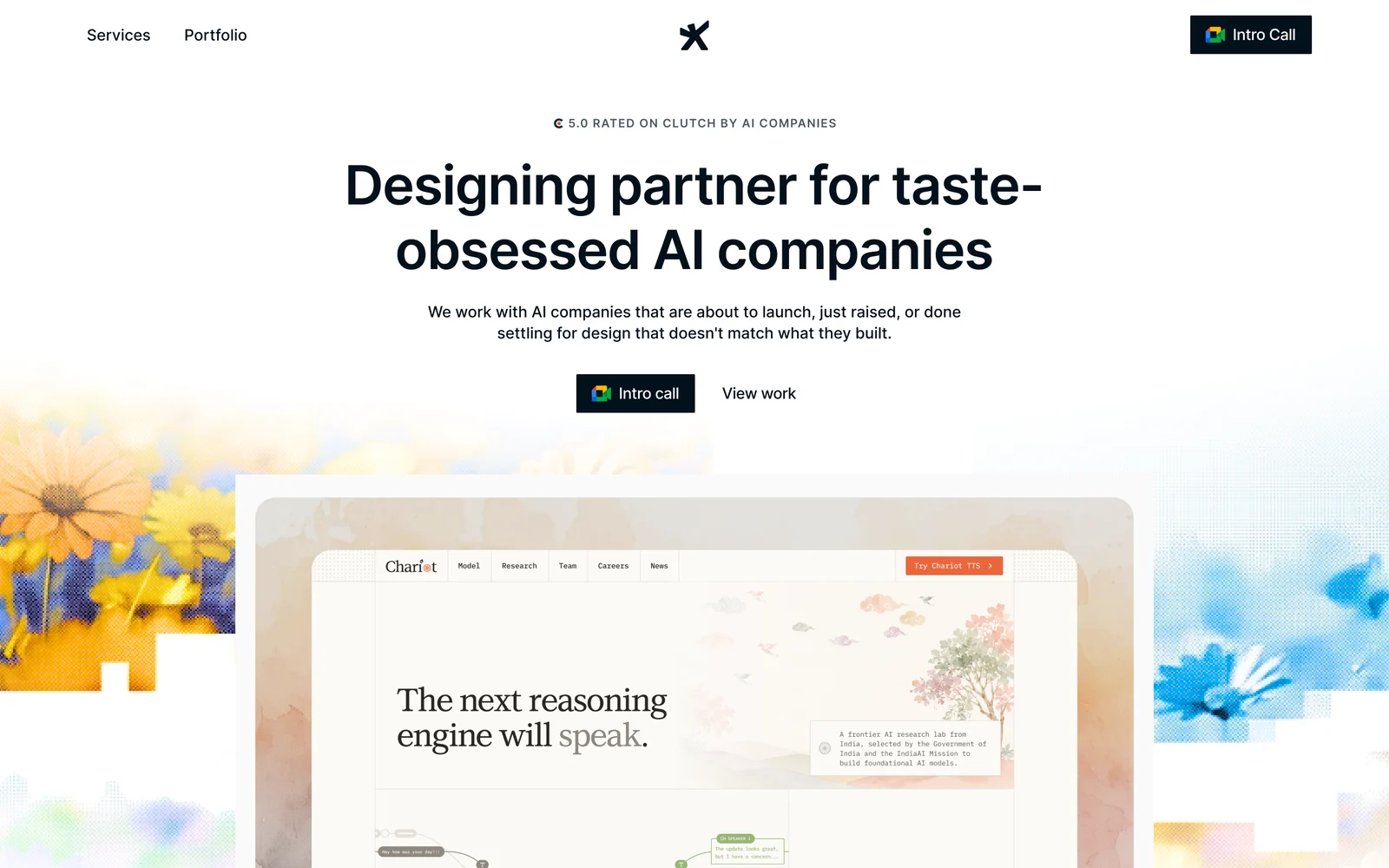
1. Studio Maydit: A Top-Rated Design Agency for AI Founders
One client is published with a figure attached rather than a logo. At Dualite a repositioned ICP was decided first, the design was rebuilt around that narrower user, and 100,000+ users arrived within seven months. That order matters for a security company, where the temptation is to widen the story until it covers every buyer and ends up convincing none of them. Wave, PixelFlow, and Mi-VAD are recent clients, alongside 15 other AI and SaaS teams.
Studio Maydit is a web and product design studio, and its clients are AI founders spread across the US, UK, and Europe. Framer, Webflow, and custom code are all live practices, and the choice is made by what the product needs rather than by preference. Work continues into product design after the site ships, which is where security companies tend to need it most, because the site can be fixed in a month and the queue cannot.
There are two ways to buy. Fixed scope runs three to four weeks and suits a team with a launch or a conference date to hit. A monthly retainer fits a company whose detection surface keeps changing, covering new pages, campaigns, and product design, with no long lock-in. Fixed-scope engagements finish with a diagnosis of what is leaking in the product. That means users, not data: the exact step where a trial goes quiet, or where an analyst stops trusting a score and goes back to their own tooling.
| Check | Finding |
|---|---|
| Based in | Remote, serving US / UK / EU |
| Platform depth | Framer, Webflow, and custom code |
| AI-sector proof | Yes. AI-native clients, published outcome on Dualite |
| Pricing | Fixed scope or monthly retainer, quoted per project |
| Team shape | Founder-led, small senior team |
| Best fit | Security teams whose trials stall before the first finding |
Worth a call if demos go well and trials go quiet. Book a 30-minute call.

2. Trueform
Trueform is a Swiss studio founded in 2022 working mainly in Framer, publishing a minimum, with published AI client work and Miro, Morning Brew, Bilt Rewards, and Gather named. Miro is a product where state changes without the user causing it, which is close to the problem a live security console has, and a published starting figure is the same plain-facts behaviour your own buyers demand from you.
They publish no team size, Framer is a website platform rather than an application one, and Swiss hours leave a US security team a short daily window.
| Check | Finding |
|---|---|
| Based in | Wil, Switzerland |
| Founded | 2022 |
| Team size | Not published |
| Primary platform | Framer |
| AI-sector proof | Yes. Published AI client work |
| Named clients | Miro, Morning Brew, Bilt Rewards, Gather |
| Pricing | Published minimum |
| Best fit | European security teams needing the site handled first |
3. Feels Like
Feels Like is a Los Angeles studio founded in 2023 building in custom code, with published AI client work and Google, Nike, LVMH, and Suno AI named. Suno is a generative product where the output cannot be guaranteed, so the team has had to present an uncertain result without it reading as a fault, which is exactly the problem a model-based detection score creates.
They publish no team size and no starting figure, and a portfolio weighted toward large consumer brands is the register that a security buyer is trained to discount.
| Check | Finding |
|---|---|
| Based in | Los Angeles, USA |
| Founded | 2023 |
| Team size | Not published |
| Primary platform | Custom code |
| AI-sector proof | Yes. Published AI client work |
| Named clients | Google, Nike, LVMH, Suno AI |
| Pricing | Not published |
| Best fit | Teams who want design and front end from one studio |
4. Phantom
Phantom works from London and Auckland, founded in 2013 with fifty-one to two hundred people, building in custom code, with published AI client work and Diageo, SAP, Financial Times, and Zendesk named. SAP and Zendesk are operational products where people work a queue all day, and that is the single most transferable experience on this list for a security console.
They publish no starting figure, and a studio of that size carries process weight that an early security startup with two engineers may find slow.
| Check | Finding |
|---|---|
| Based in | London, UK and Auckland, NZ |
| Founded | 2013 |
| Team size | 51-200 |
| Primary platform | Custom code |
| AI-sector proof | Yes. Published AI client work |
| Named clients | Diageo, SAP, Financial Times, Zendesk |
| Pricing | Not published |
| Best fit | Teams rebuilding a working console, not a homepage |
5. Fantasy
Fantasy has designed software from San Francisco and New York since 1999, across platforms, with published AI client work. Twenty-seven years of carrying technically difficult products to something usable is rare, and judgement about what to leave out is the scarcest skill in a category where every release adds another signal to the screen.
They publish no client names, no team size, and no starting figure, so evaluating them takes several calls, which is an awkward fit for a company that preaches transparency to its own market.
| Check | Finding |
|---|---|
| Based in | San Francisco and New York, USA |
| Founded | 1999 |
| Team size | Not published |
| Primary platform | Mixed |
| AI-sector proof | Yes. Published AI client work |
| Named clients | Not published |
| Pricing | Not published |
| Best fit | Teams buying judgement rather than throughput |
6. SuperSkills
SuperSkills is a Walnut Creek team of one to ten working across platforms, with published AI client work and The Cut named. Being small and in the Bay Area means a senior person can be looking at your trial flow within days, and for a company trying to fix the first fifteen minutes of an evaluation, speed is worth more than scale.
They name one client, publish no founding year and no starting figure, and one to ten people cannot cover a product surface that grows with every new detection type.
| Check | Finding |
|---|---|
| Based in | Walnut Creek, USA |
| Founded | Not published |
| Team size | 1-10 |
| Primary platform | Mixed |
| AI-sector proof | Yes. Published AI client work |
| Named clients | The Cut |
| Pricing | Not published |
| Best fit | Bay Area teams needing one flow fixed quickly |
7. Lazarev
Lazarev is a San Francisco studio founded in 2015 at fifty-one to two hundred people, working across platforms, publishing a minimum, with published AI client work and Payoneer, Peel, Elva, and Mozayix named. Payoneer moves money at scale under real regulatory pressure, so this team has designed where a confusing screen has consequences, and the published figure makes the option easy to assess.
Their platform practice is mixed rather than security-focused, and at that headcount an early-stage account gets a smaller team than the pitch implies.
| Check | Finding |
|---|---|
| Based in | San Francisco, USA |
| Founded | 2015 |
| Team size | 51-200 |
| Primary platform | Mixed |
| AI-sector proof | Yes. Published AI client work |
| Named clients | Payoneer, Peel, Elva, Mozayix |
| Pricing | Published minimum |
| Best fit | Funded teams wanting scale with a published number |
8. Kvalifik
Kvalifik is a Copenhagen studio founded in 2015 with eleven to fifty people and published AI client work, naming Veo, Maersk, and Relesys. Maersk is heavy operational software used by people doing a job rather than browsing, and Veo is a computer vision product, so the team has met both the queue problem and the confidence problem separately.
Their main platform is Webflow rather than application design, they publish no starting figure, and Copenhagen hours leave a West Coast team almost no overlap.
| Check | Finding |
|---|---|
| Based in | Copenhagen, Denmark |
| Founded | 2015 |
| Team size | 11-50 |
| Primary platform | Webflow |
| AI-sector proof | Yes. Published AI client work |
| Named clients | Veo, Maersk, Relesys |
| Pricing | Not published |
| Best fit | European teams buying the site and the brand together |
9. BX Studio
BX Studio is a New York team of eleven to fifty working in Webflow, publishing a minimum, with published AI client work and Reddit, Headspace, ASAPP, and Verifone named. Verifone is payments infrastructure and ASAPP sells automation into large cautious organisations, so the team has worked with the kind of buyer who sends a security questionnaire before a second call.
They publish no founding year, and Webflow as the primary platform means deep application work is not the main practice.
| Check | Finding |
|---|---|
| Based in | New York, USA |
| Founded | Not published |
| Team size | 11-50 |
| Primary platform | Webflow |
| AI-sector proof | Yes. Published AI client work |
| Named clients | Reddit, Headspace, ASAPP, Verifone |
| Pricing | Published minimum |
| Best fit | East Coast teams selling into large enterprises |
10. Flow Ninja
Flow Ninja is a Belgrade studio founded in 2018 with eleven to fifty people, working in Webflow. At that size several workstreams can run at once, and European rates let a security startup put more of its budget into detection engineering while still getting volume shipped.
They publish no client names and no starting figure, and their AI-sector proof is partial with no AI case study, so almost everything about fit has to be established on calls.
| Check | Finding |
|---|---|
| Based in | Belgrade, Serbia |
| Founded | 2018 |
| Team size | 11-50 |
| Primary platform | Webflow |
| AI-sector proof | Partial. Enterprise and SaaS clients, no AI case study |
| Named clients | Not published |
| Pricing | Not published |
| Best fit | Teams wanting volume at a European rate |
How to choose between them
Sort by what is actually broken rather than by who has the best logos.
Trials start and go quiet before a first finding. Studio Maydit or SuperSkills.
The console is unusable during a real shift. Phantom or Lazarev.
Analysts do not trust the model's score. Fantasy or Feels Like.
The site does not survive a technical reader. Trueform or BX Studio.
One test before you sign. Ask how they would make your product useful on day one without access to anything sensitive. A studio that understands this market answers with a specific first run: what a new user could upload, what the product would tell them, and why that finding is worth the next permission. A studio that answers by improving the demo has not understood that the demo was never the problem.