
Summarize with AI


The best SaaS design agencies for AI data platforms in 2026 are Studio Maydit, Kvalifik, SuperSkills, BX Studio, Lazarev, Phantom, Feely Studio, Clay, Trueform, and Feels Like. Studio Maydit and Kvalifik lead for this brief, because both have designed products where a model's output has to be explained rather than simply displayed. Trueform and Feels Like are the weakest fit here. Both do excellent work, and neither has a published practice in dense data interfaces, which is the whole of the problem.
Worth noting up front: every one of the nine studios below publishes AI client work. That is unusual for a list drawn on public criteria, and it means the differences here are about depth in data-heavy products rather than about whether the category is understood at all.
Now the part that decides your deals. Nobody evaluating your platform is starting from nothing. They already have a warehouse, something that moves data into it, something that watches it, and a reporting tool somebody in finance refuses to give up.
So the question they are actually asking is not what does this do. It is what do I turn off, what do I keep, and where does this sit between the two.
Most data platforms answer with capabilities. Lineage, quality checks, semantic modelling, natural language queries. Each is true, and none of them tells a head of data whether your product replaces the thing they bought last year or sits on top of it.
The consequence is specific and expensive. Evaluations stall, not because anyone dislikes the product, but because nobody can describe it accurately enough to defend it internally to a team that owns the tools it might displace.
There is a second problem underneath. A data product with no data connected is a blank screen, so the first five minutes are the hardest five minutes in this category, and they are usually designed last.
Read the ten below with one question in mind. Which of them could take your product and make a head of data say, in one sentence, what it replaces?

How we picked these agencies
Five checks, applied for a company selling data infrastructure to people who already own some:
- Platform depth. Is the core practice application design, or website production with a product line attached? Both matter here, but the screens that decide renewals hold thousands of rows and thousands of columns, and that is a specific craft.
- Data-heavy product proof. Have they designed interfaces where the content is large, messy, and generated rather than authored? Analytics, monitoring, logistics, and financial tooling all count. Designing for real cardinality is a different job from designing for a demo dataset.
- Pricing. Is a starting figure published? Your own buyers judge you on whether you are willing to be concrete before a call, and it is reasonable to apply the same test to a supplier.
- Team shape. How many people, and does the senior one stay through the work? Data products get reshaped once someone connects a genuinely large source, and that conversation needs whoever made the original decisions.
- Their own site. Look at how they explain their own service. If they cannot say plainly what they do and do not do, they will not solve that problem for you.
Check two is the one worth pressing on, and there is a good way to test it. Ask what happened when a client's real data turned out to be far larger or messier than the design assumed. Anyone who has shipped in this category has that story, and it usually involves rebuilding a table view, rethinking search, or finding that column names in the wild are unreadable. A studio without it has only worked with tidy sample data, which is why so many data products look excellent and behave badly.
On sources. Each table repeats what the studio publishes about itself on its own site this month, with nothing taken from directories or estimated. Where a studio publishes nothing for a row, that is what the table shows, and for a buyer used to auditing claims that distinction is the point.
What goes wrong when AI data platforms are designed
Three failures, and the first one silently caps your win rate.
The product describes capabilities instead of position. The site and the onboarding both list what the platform can do, which sounds thorough and leaves the evaluator no better off. What they need is a picture of the stack: this is what we replace, this is what we sit beside, this is what we feed. That diagram, repeated inside the product, is worth more than any feature list, because it lets your champion argue for you in a meeting you are not in. Teams avoid it because naming what you do not do feels like losing ground, and it is the fastest way to win a technical evaluation.
The empty state is a setup wizard. A new account has no data, so the product asks for a connection before it shows anything. That is the wrong order for a category where the buyer must justify granting access. Give a working example first: a sample warehouse they can explore, a public dataset, a read-only scan that produces one genuine observation about their own environment. Let somebody see the product doing its job before you ask them for credentials, and the first five minutes stop being a wall.
Screens are designed against clean data. The prototype has twelve tables with tidy names, so the design looks calm and considered. The customer arrives with four thousand tables, half named after a system nobody works on any more, columns full of nulls, and three things that all look like a customer identifier. Every interface decision that assumed order now fails: search, grouping, defaults, and the width of a column. Design against the ugliest real dataset you can get permission to use, and treat the tidy version as the exception it is.
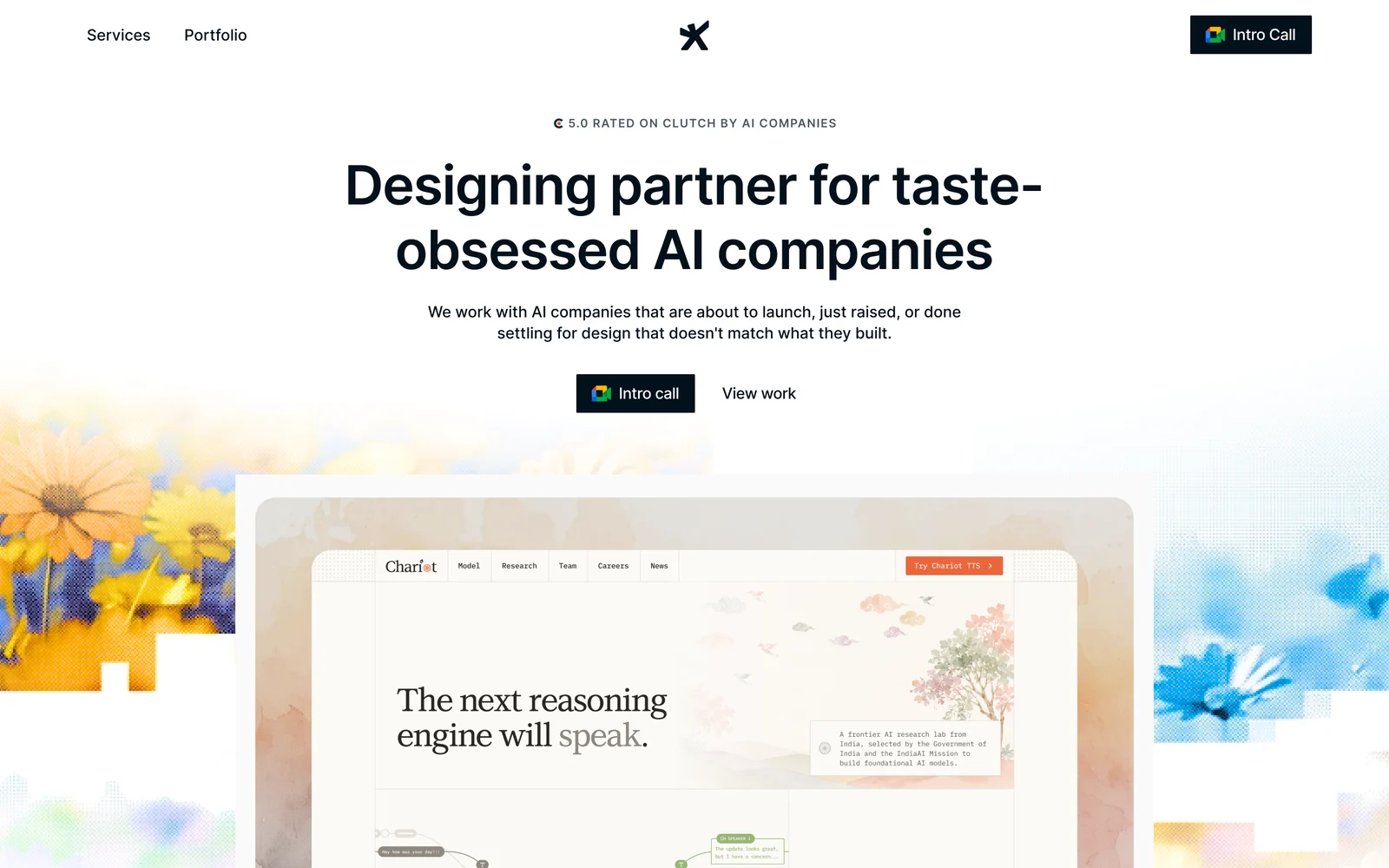
1. Studio Maydit: A Top-Rated Design Agency for AI Founders
Wave, PixelFlow, and Mi-VAD are recent clients, along with 15 other AI and SaaS teams, which is the kind of list that says the category is routine rather than novel here. Studio Maydit is a web and product design studio, and its clients are AI founders in the US, UK, and Europe, so a first call about pipelines and model outputs does not start with definitions.
Dualite is the one client published with a figure rather than a badge, and the sequence is what makes it relevant. A repositioned ICP was decided first, the design was rebuilt around that narrower user, and 100,000+ users arrived within seven months. Choosing exactly who the product is for is the same discipline a data platform needs when it decides what it replaces and what it sits beside.
On tooling, three practices run in parallel. Framer and Webflow for the public side, custom code where the interface has to handle real volume, with the choice made by what the product actually needs. The work continues into product design after the site ships, which in this category is where the difficult screens live. Two ways to buy it. Fixed scope runs three to four weeks and suits a team with a date fixed. A monthly retainer suits a team still discovering how customers' data behaves at scale, covering new pages, campaigns, and product design, with no long lock-in. Fixed-scope engagements end with a diagnosis of what is leaking in the product, which here usually means naming the point where an evaluation quietly stops.
| Check | Finding |
|---|---|
| Based in | Remote, serving US / UK / EU |
| Platform depth | Framer, Webflow, and custom code |
| AI-sector proof | Yes. AI-native clients, published outcome on Dualite |
| Pricing | Fixed scope or monthly retainer, quoted per project |
| Team shape | Founder-led, small senior team |
| Best fit | Data teams whose evaluations stall without a stated reason |
Worth a call if technical evaluations go quiet rather than going badly. Book a 30-minute call.

2. Kvalifik
Kvalifik is a Copenhagen studio founded in 2015 with eleven to fifty people and published AI client work, naming Veo, Maersk, and Relesys. Maersk runs on genuinely large operational data, and Veo is a computer vision product where a model's output has to be presented to people who did not train it, so both halves of this problem are in their portfolio.
Their main platform is Webflow rather than application design, they publish no starting figure, and Copenhagen hours leave a West Coast team very little overlap.
| Check | Finding |
|---|---|
| Based in | Copenhagen, Denmark |
| Founded | 2015 |
| Team size | 11-50 |
| Primary platform | Webflow |
| AI-sector proof | Yes. Published AI client work |
| Named clients | Veo, Maersk, Relesys |
| Pricing | Not published |
| Best fit | European data teams buying site and product together |
3. SuperSkills
SuperSkills is a Walnut Creek team of one to ten working across platforms, with published AI client work and The Cut named. Small and in the Bay Area means a senior person can be looking at your connection flow within days, which suits a company that already knows which five minutes of the product are failing.
They name a single client, publish no founding year and no starting figure, and one to ten people cannot cover a product surface that grows with every new integration.
| Check | Finding |
|---|---|
| Based in | Walnut Creek, USA |
| Founded | Not published |
| Team size | 1-10 |
| Primary platform | Mixed |
| AI-sector proof | Yes. Published AI client work |
| Named clients | The Cut |
| Pricing | Not published |
| Best fit | Bay Area teams fixing one screen quickly |
4. BX Studio
BX Studio is a New York team of eleven to fifty working in Webflow, publishing a minimum, with published AI client work and Reddit, Headspace, ASAPP, and Verifone named. Verifone is payments infrastructure and ASAPP sells automation into large organisations, so this team has worked with buyers who run a formal evaluation before they run a trial.
They publish no founding year, and Webflow as the primary platform means the dense application screens are not the core practice.
| Check | Finding |
|---|---|
| Based in | New York, USA |
| Founded | Not published |
| Team size | 11-50 |
| Primary platform | Webflow |
| AI-sector proof | Yes. Published AI client work |
| Named clients | Reddit, Headspace, ASAPP, Verifone |
| Pricing | Published minimum |
| Best fit | Teams selling into large enterprise data organisations |
5. Lazarev
Lazarev is a San Francisco studio founded in 2015 at fifty-one to two hundred people, working across platforms, publishing a minimum, with published AI client work and Payoneer, Peel, Elva, and Mozayix named. Payoneer handles high volumes of financial records under regulatory pressure, which is close to the density and consequence of a data platform, and the published figure makes assessment fast.
Their platform work is mixed rather than data-first, and at that headcount an early account gets a smaller team than the pitch implies.
| Check | Finding |
|---|---|
| Based in | San Francisco, USA |
| Founded | 2015 |
| Team size | 51-200 |
| Primary platform | Mixed |
| AI-sector proof | Yes. Published AI client work |
| Named clients | Payoneer, Peel, Elva, Mozayix |
| Pricing | Published minimum |
| Best fit | Funded teams wanting scale with a published number |
6. Phantom
Phantom works from London and Auckland, founded in 2013 with fifty-one to two hundred people, building in custom code, with published AI client work and Diageo, SAP, Financial Times, and Zendesk named. SAP is about as dense as enterprise software gets, and a studio that writes production code will find the point where a table view stops performing rather than handing you a design that cannot be built.
They publish no starting figure, and a studio of that size carries process weight an early data platform may find slow.
| Check | Finding |
|---|---|
| Based in | London, UK and Auckland, NZ |
| Founded | 2013 |
| Team size | 51-200 |
| Primary platform | Custom code |
| AI-sector proof | Yes. Published AI client work |
| Named clients | Diageo, SAP, Financial Times, Zendesk |
| Pricing | Not published |
| Best fit | Teams rebuilding screens that must hold real volume |
7. Feely Studio
Feely Studio is a distributed European team of one to ten working across platforms, publishing a minimum, with published AI client work and Noxus, Mutiny, Luasai, and Basic Capital named. Noxus and Mutiny are AI-native companies, and a small priced team is the quickest option here to evaluate and to start on a single bounded problem.
No founding year is published, one to ten people is thin cover for continuous work, and European hours give a US team a short daily window.
| Check | Finding |
|---|---|
| Based in | Distributed, Europe |
| Founded | Not published |
| Team size | 1-10 |
| Primary platform | Mixed |
| AI-sector proof | Yes. Published AI client work |
| Named clients | Noxus, Mutiny, Luasai, Basic Capital |
| Pricing | Published minimum |
| Best fit | Teams wanting a priced start on one bounded problem |
8. Clay
Clay is a San Francisco studio founded in 2016 at fifty-one to two hundred people, publishing a minimum, with published AI client work and Slack, Stripe, Google, Coinbase, and Amazon named. Stripe is the standard reference for making a technical product legible without dumbing it down, and very few studios anywhere have shipped interfaces used at that volume.
The published minimum assumes a company with revenue, the process expects a design counterpart on your side, and a small team will not set the schedule.
| Check | Finding |
|---|---|
| Based in | San Francisco, USA |
| Founded | 2016 |
| Team size | 51-200 |
| Primary platform | Mixed |
| AI-sector proof | Yes. Published AI client work |
| Named clients | Slack, Stripe, Google, Coinbase, Amazon |
| Pricing | Published minimum |
| Best fit | Funded teams with a designer already in place |
9. Trueform
Trueform is a Swiss studio founded in 2022 working mainly in Framer, publishing a minimum, with published AI client work and Miro, Morning Brew, Bilt Rewards, and Gather named. Miro handles a lot of live state on screen at once, and a published figure makes the first decision quick for a team that mostly needs its public positioning fixed.
They publish no team size, and Framer is a website platform, so the dense product screens that decide this category are outside what the practice covers.
| Check | Finding |
|---|---|
| Based in | Wil, Switzerland |
| Founded | 2022 |
| Team size | Not published |
| Primary platform | Framer |
| AI-sector proof | Yes. Published AI client work |
| Named clients | Miro, Morning Brew, Bilt Rewards, Gather |
| Pricing | Published minimum |
| Best fit | European teams whose site fails to explain the product |
10. Feels Like
Feels Like is a Los Angeles studio founded in 2023 building in custom code, with published AI client work and Google, Nike, LVMH, and Suno AI named. Suno is a generative product where the result cannot be promised in advance, so the team has had to present an uncertain output as a deliberate one, which is a useful instinct for a platform reporting model confidence.
They publish no team size and no starting figure, and a portfolio built on large consumer brands is a long way from dense data tooling.
| Check | Finding |
|---|---|
| Based in | Los Angeles, USA |
| Founded | 2023 |
| Team size | Not published |
| Primary platform | Custom code |
| AI-sector proof | Yes. Published AI client work |
| Named clients | Google, Nike, LVMH, Suno AI |
| Pricing | Not published |
| Best fit | Teams wanting design and front end from one studio |
How to choose between them
Sort by what is actually broken rather than by who has the largest logos.
Evaluations stall without a stated objection. Studio Maydit or BX Studio.
The product collapses on real customer data. Phantom or Clay.
Nothing useful happens before a connection is made. SuperSkills or Feely Studio.
Your site cannot explain where you sit in the stack. Trueform or Kvalifik.
One test before you sign. Ask them to draw where your product sits relative to the tools your buyer already owns, using only what is on your website today. A studio that understands this category will produce something specific and will point out where your own material is vague. A studio that repeats your feature list back has just shown you what your evaluators are experiencing.