
Summarize with AI


The best SaaS design agencies for AI devtool companies in 2026 are Studio Maydit, basement.studio, Engine Digital, Lighthouse Digital, Phantom, Fantasy, Feels Like, SuperSkills, BX Studio, and Kvalifik. Studio Maydit and basement.studio lead for this brief, and basement.studio is the clearest match on published work, having built for Vercel and Cursor, which are developer products that had to convert developers. Lighthouse Digital and Engine Digital are the weakest fit. One publishes no AI work at all, and the other is shaped around large consumer and financial brands.
Selling a developer tool breaks the normal SaaS funnel in one specific way. Your buyer does not read your site to decide. They read just enough to work out whether trying it is going to waste an afternoon, and then they try it.
This means the marketing surface and the technical surface are not two audiences. They are one person, ten minutes apart, and they notice when the voice changes.
The homepage says the integration takes five minutes. The quickstart assumes a configured environment, a key already in place, and familiarity with a concept the homepage never mentioned. The developer has now caught the company being optimistic, and that is expensive, because trust with this audience is mostly the absence of exaggeration.
Then there is the clock. Most devtool companies measure time to first successful call from account creation. The real clock starts on the landing page, and the minutes before sign-up are usually the ones nobody owns, because they sit between the marketing team and the docs team.
Pricing is the third surface, and it is the one most likely to be designed last. A developer cannot buy what they cannot estimate. If your pricing is in tokens, credits, or units of compute, the page has to let somebody who knows their own workload arrive at a monthly number.
A shortlist follows. The right studio is the one that asks to see your documentation before it asks to see your brand guidelines.

How we picked these agencies
Five checks, written for a company whose customers evaluate by trying rather than reading:
- Platform depth. Can they build, or do they hand over files? Devtool surfaces involve code samples, tabbed languages, live output, and copy buttons that behave properly. A studio delivering static files leaves your engineers to invent all of that at the end of a sprint.
- Developer-audience proof. Have they designed for people who distrust marketing by profession? It shows in restraint: fewer claims, more evidence, code visible above the fold, and no interstitial between a visitor and the thing they came to try.
- Pricing. Is a starting figure published? A studio selling to technical buyers should already understand why hiding a number annoys them, and whether they apply that to their own site is a fair signal.
- Team shape. How many people, and is the senior one on the work? Devtool design is mostly a series of small decisions about what to leave out, and those decisions get reversed when the work moves down a chain.
- Their own site. For this audience it is a working demonstration. If it loads slowly, buries what the studio does, or explains nothing without a form, that is the standard you would be buying.
Weight the second check heavily, and test it with a specific question. Ask what they changed on a project after watching a developer try the product for the first time. Real answers are small and unglamorous: a key moved earlier, a code sample shortened, an install step that turned out to be two steps. A studio without that story has designed for developers from the outside.
How these were checked. Each row repeats what the studio states publicly on its own site. Nothing came from directories, review platforms, or inference, and no figure is estimated. Where nothing is published, the row says so, which for a technical buyer is itself worth recording.
What goes wrong when devtool companies design their funnel
Three failures, and all three happen at the seam between marketing and documentation.
Two voices for one person. The site is written to persuade and the docs are written to instruct, usually by different people with different reviewers. The developer moves between them in under a minute and hears the tone change, which reads as the company having a sales version and a true version. Fix it by treating docs as part of the funnel rather than as reference material. The quickstart is a conversion page, and it should be reviewed by whoever owns conversion.
Nobody owns the minutes before sign-up. The funnel is usually measured from account creation, so the segment from landing page to first request is unowned and unmeasured. That segment is where most of the loss is: the developer who wanted to see a real response and found a form, the one who could not tell whether a credit card was required, the one who left to check whether the SDK supports their language. Instrument that stretch and design it as one continuous path, because to the person walking it, it is one path.
Pricing that cannot be estimated. Usage-based pricing is honest and almost always presented in a form nobody can convert into a bill. A page listing a price per thousand tokens asks the reader to know something they will not know until after they have integrated. Give them a way to arrive at a monthly figure from a workload they can recognise, whether that is a calculator, three worked examples, or a plain sentence about what a typical team spends. Otherwise the decision gets deferred, and deferred decisions in this category rarely come back.
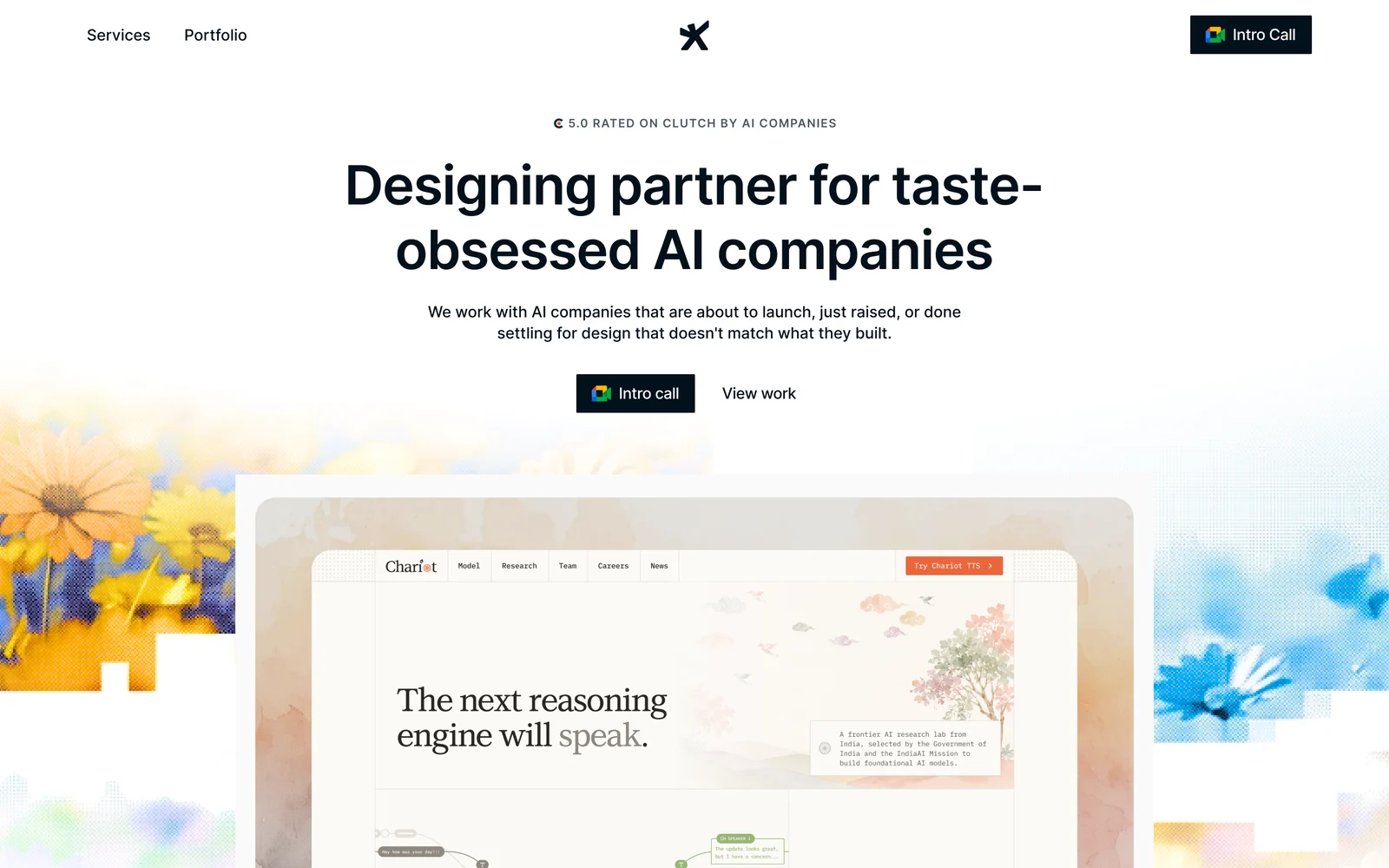
1. Studio Maydit: A Top-Rated Design Agency for AI Founders
The one client published with a number rather than a badge is Dualite. A repositioned ICP came first, the design was rebuilt around that narrower user, and 100,000+ users followed in seven months. For a devtool company that sequence is the relevant part, because deciding exactly which developer you are for is what makes a landing page short enough to be read and a quickstart short enough to be finished. Wave, PixelFlow, and Mi-VAD are recent clients, along with 15 other AI and SaaS teams.
Studio Maydit is a web and product design studio. Its clients are AI founders in the US, UK, and Europe, and the work continues into product design after the site ships, which for a developer product is where the funnel actually ends. The build side is chosen per project. Framer where the marketing surface changes with every release, Webflow where a growth hire needs the pages under their control, and custom code where documentation, samples, and live output have to behave as one thing.
Two ways to buy it. Fixed scope runs three to four weeks, which is enough to take the path from landing page to first successful call and rebuild it as a single sequence. A monthly retainer suits a company shipping new capabilities faster than it can describe them, covering new pages, campaigns, and product design, with no long lock-in. Fixed-scope work ends with a diagnosis of what is leaking in the product, and in this category the leak is usually a specific step where a developer had to leave the page to find something out.
| Check | Finding |
|---|---|
| Based in | Remote, serving US / UK / EU |
| Platform depth | Framer, Webflow, and custom code |
| AI-sector proof | Yes. AI-native clients, published outcome on Dualite |
| Pricing | Fixed scope or monthly retainer, quoted per project |
| Team shape | Founder-led, small senior team |
| Best fit | Devtool teams losing developers between landing and first call |
Worth a call if sign-ups look healthy and first successful calls do not. Book a 30-minute call.

2. basement.studio
basement.studio has worked from Mar del Plata and Los Angeles since 2018 with eleven to fifty people, publishes a minimum, builds in custom code, and names Vercel, Cursor, ElevenLabs, Harvey AI, and Scale AI. That is the closest thing to a direct precedent on this page. Those are developer products whose websites had to survive being read by the same people who would then read the docs.
Custom code means your engineers inherit a real codebase, which is an advantage only if there is somebody to own it after the project ends.
| Check | Finding |
|---|---|
| Based in | Mar del Plata, Argentina and Los Angeles, USA |
| Founded | 2018 |
| Team size | 11-50 |
| Primary platform | Custom code |
| AI-sector proof | Yes. Published AI client work |
| Named clients | Vercel, Cursor, ElevenLabs, Harvey AI, Scale AI |
| Pricing | Published minimum |
| Best fit | Devtool companies whose site and docs must feel like one product |
3. Engine Digital
Engine Digital has built in custom code from Vancouver and New York since 2002, naming Adidas, Autodesk, Goldman Sachs, and HP. Autodesk is technical software with a demanding user base, and twenty-three years of engineering-led delivery means complicated integrations are routine rather than a risk.
They publish no team size and no starting figure, their AI-sector proof is partial with no AI case study, and a practice built for large brands works at a governance pace that a devtool shipping weekly will find slow.
| Check | Finding |
|---|---|
| Based in | Vancouver and New York |
| Founded | 2002 |
| Team size | Not published |
| Primary platform | Custom code |
| AI-sector proof | Partial. Enterprise and SaaS clients, no AI case study |
| Named clients | Adidas, Autodesk, Goldman Sachs, HP |
| Pricing | Not published |
| Best fit | Later-stage devtools selling into large organisations |
4. Lighthouse Digital
Lighthouse Digital is a London Webflow studio that publishes a minimum and names HelloSelf, Freetrade, and IGN. The published figure and a Webflow build make this a quick, predictable way to fix a marketing site that a small team then edits itself.
They publish no founding year, no team size, and no AI client work, and their clients are consumer products rather than developer tools, so the specific problem of writing for a sceptical technical reader is not in evidence.
| Check | Finding |
|---|---|
| Based in | London, UK |
| Founded | Not published |
| Team size | Not published |
| Primary platform | Webflow |
| AI-sector proof | No. No published AI client work |
| Named clients | HelloSelf, Freetrade, IGN |
| Pricing | Published minimum |
| Best fit | Devtool teams who only need the marketing site fixed |
5. Phantom
Phantom works from London and Auckland, founded 2013, fifty-one to two hundred people, building in custom code with published AI client work and Diageo, SAP, Financial Times, and Zendesk named. SAP and Zendesk are both products with real documentation surfaces, and the combination of AI experience and engineering depth is rare in this group.
They publish no starting figure, and a studio of that size and client profile is priced for companies with revenue, so the first conversation will be about whether you are large enough.
| Check | Finding |
|---|---|
| Based in | London, UK and Auckland, NZ |
| Founded | 2013 |
| Team size | 51-200 |
| Primary platform | Custom code |
| AI-sector proof | Yes. Published AI client work |
| Named clients | Diageo, SAP, Financial Times, Zendesk |
| Pricing | Not published |
| Best fit | Funded devtools needing design and engineering in one place |
6. Fantasy
Fantasy has designed products from San Francisco and New York since 1999 and publishes AI client work. A practice that old has watched several generations of technical interface conventions arrive and be discarded, which is genuinely useful when your category is inventing its patterns as it goes.
They publish no team size, no named clients, and no starting figure, so a technical buyer used to verifying claims has almost nothing to check here, which is an awkward starting position.
| Check | Finding |
|---|---|
| Based in | San Francisco and New York, USA |
| Founded | 1999 |
| Team size | Not published |
| Primary platform | Mixed |
| AI-sector proof | Yes. Published AI client work |
| Named clients | Not published |
| Pricing | Not published |
| Best fit | Funded devtools buying long-view interface judgement |
7. Feels Like
Feels Like is a Los Angeles studio founded in 2023 that builds in custom code, publishes AI client work, and names Google, Nike, LVMH, and Suno AI. Suno is an AI product that had to explain something unfamiliar quickly, and building in code means the finished marketing surface is a real one rather than a handover.
They publish no team size and no starting figure, and their client list leans toward consumer and brand work, so the developer-audience question is one you would be testing on your own project.
| Check | Finding |
|---|---|
| Based in | Los Angeles, USA |
| Founded | 2023 |
| Team size | Not published |
| Primary platform | Custom code |
| AI-sector proof | Yes. Published AI client work |
| Named clients | Google, Nike, LVMH, Suno AI |
| Pricing | Not published |
| Best fit | Devtools wanting a built marketing surface with real craft |
8. SuperSkills
SuperSkills is a one to ten person studio in Walnut Creek with published AI client work and mixed platform experience. At that size the person who reads your documentation is the person designing against it, and continuity matters when the work is a long sequence of small decisions about what to remove.
They publish no founding year, no starting figure, and name only The Cut, so there is very little to verify beforehand, and a team that size cannot carry both a site and a docs surface at pace.
| Check | Finding |
|---|---|
| Based in | Walnut Creek, USA |
| Founded | Not published |
| Team size | 1-10 |
| Primary platform | Mixed |
| AI-sector proof | Yes. Published AI client work |
| Named clients | The Cut |
| Pricing | Not published |
| Best fit | Small devtool teams wanting one senior pair of hands |
9. BX Studio
BX Studio is a New York Webflow practice of eleven to fifty people that publishes a minimum, publishes AI client work, and names Reddit, Headspace, ASAPP, and Verifone. A published figure plus a mid-size team makes this one of the more predictable engagements here, and ASAPP is real AI product work rather than a brand campaign.
They publish no founding year, and Webflow as the primary platform means code samples, tabbed languages, and live output will need engineering support from your side.
| Check | Finding |
|---|---|
| Based in | New York, USA |
| Founded | Not published |
| Team size | 11-50 |
| Primary platform | Webflow |
| AI-sector proof | Yes. Published AI client work |
| Named clients | Reddit, Headspace, ASAPP, Verifone |
| Pricing | Published minimum |
| Best fit | Devtools wanting a fast, predictable marketing rebuild |
10. Kvalifik
Kvalifik is a Copenhagen studio founded in 2015 with eleven to fifty people, publishing AI client work and naming Veo, Maersk, and Relesys. Danish studios of that size tend to run a visible, structured process, which suits a technical client who wants to see the reasoning rather than be presented with a result.
They publish no starting figure, Webflow is the primary platform, and their client work is enterprise and sports technology rather than developer tooling.
| Check | Finding |
|---|---|
| Based in | Copenhagen, Denmark |
| Founded | 2015 |
| Team size | 11-50 |
| Primary platform | Webflow |
| AI-sector proof | Yes. Published AI client work |
| Named clients | Veo, Maersk, Relesys |
| Pricing | Not published |
| Best fit | European devtools wanting a structured, explainable process |
How to choose between them
Sort by what is actually broken rather than by who has the most impressive logos.
Developers sign up and never make a successful call. Studio Maydit or basement.studio.
The site and the docs sound like two different companies. Phantom or Feels Like.
Nobody can work out what they would pay you. Fantasy or SuperSkills.
The marketing site is a month behind every release. BX Studio or Kvalifik.
One test before you sign. Ask them to read your quickstart and tell you where they would stop if they had fifteen minutes and mild scepticism. A studio that understands this audience will point at a specific step and explain what the reader does not yet know at that moment. A studio that talks about the hero section has looked at your website and not at your product.