
Summarize with AI


The best SaaS design agencies for AI fintech startups in 2026 are Studio Maydit, Kvalifik, Trueform, BX Studio, 8020, Digidop, Flowout, Finsweet, Lighthouse Digital, and Clay. Studio Maydit and Clay lead for this brief, and Clay has the most directly relevant portfolio on the page, having designed for Stripe and Coinbase, which are the two products every AI fintech team is implicitly compared against. Lighthouse Digital and Flowout are the weakest fit. One publishes no AI work at all, and the other is a subscription website practice, neither of which reaches a decision that has to be justified.
Regulated and probabilistic is the hardest combination in software design. Regulated systems are built to be explainable and repeatable. Models are neither, by construction.
Everything difficult about your product comes from that collision. A customer is declined, flagged, held, or limited by something that did not follow a rule anybody wrote down. They want to know why, and they are entitled to an answer they can act on. Your interface has to produce one.
Most AI fintech products do not. The screen says the application was unsuccessful, offers a support link, and stops. That is not a design shortcut, it is a business cost. Every unexplained decision becomes a support conversation, and support conversations in this category are long, unhappy, and occasionally regulatory.
Behind that sits the second half of the problem. Somebody inside your company has to review these cases, and that person's tool is almost always designed last, by nobody, and usually turns out to be a spreadsheet with a shared login.
And there is a temptation specific to AI companies here. The instinct is to hide the machinery and present a clean result. Fintech customers trust the opposite. They trust timestamps, statuses, reference numbers, and a clear record of who did what and when. The boring surface is the trust surface.
Ten studios follow. Score them on one thing before anything else: has any of their work ever had to be defensible?

How we picked these agencies
Five checks, written for a company whose software makes decisions about other people's money:
- Platform depth. Is this a product practice or a website practice? The distinction decides everything here, because your regulated surfaces are inside the application. A studio that produces excellent marketing pages will not touch the screen where a customer is told no.
- Regulated-sector proof. Have they designed anything that had to be explained after the fact? Financial services, healthcare, and insurance all impose it. It shows up as a habit: showing state history rather than current state, keeping a record of who acted, and writing messages that assume somebody will quote them back.
- Pricing. Is a starting figure published? It is a small signal about how a studio treats disclosure, and in a category where your own product is judged on exactly that, it is a fair one to apply.
- Team shape. How many people, and is the senior one on the work? Decisions about how much to reveal in a decline message are judgement calls with legal weight, and they are not the sort of thing to delegate to whoever has capacity.
- Their own site. They set the brief and approved the result. Look at whether it states anything concrete, since concreteness under scrutiny is the skill you are hiring for.
Weight the second check heavily, and test it directly. Ask about a project where the interface had to tell somebody a decision had gone against them. Good answers describe the specific wording, what was deliberately not said, and who reviewed it. A studio without that experience will treat a decline screen as an empty state to be softened, which is precisely the instinct that generates complaints.
These tables were compiled from one place, which is each studio's own website. No directories, no ratings services, nothing inferred from a headcount or a client logo. An unstated fact is recorded as unstated, which in a regulated market is the habit you would want from a supplier anyway.
What goes wrong when AI fintech products get designed
Three failures, and every one of them ends up in your support queue.
The decision has no actionable reason. A model declines, flags, or limits, and the customer sees a polite sentence with nothing in it. The reason exists, somewhere, as a set of contributing factors, but it never reaches the screen because nobody wanted to commit to a wording. So the customer contacts support, support cannot see the reasoning either, and the case escalates to the one person who can read the model output. Decide early what you will disclose, write it as product copy rather than as legal text, and make sure the reason and the next step arrive together. A decline the customer can act on is a retained customer.
The review queue is an afterthought. Every AI fintech company ends up with humans reviewing edge cases, and that team's tool is built from whatever was available: an admin panel, a spreadsheet, a shared inbox. The result is slow reviews, inconsistent outcomes, and no record of why one case went one way. This is a real product with real users who happen to work for you, and it deserves the same design attention as the customer surface. Reviewer throughput is usually the cheapest improvement available in the whole company.
Trust is treated as a marketing job. Compliance badges go on the homepage, and the product stays opaque. But nobody decides to trust a financial product on a landing page. They decide in the transaction detail view, when they can see the timestamp, the status history, the reference, and what happens next. AI companies tend to hide that layer because it looks unpolished. In fintech it is the thing being bought, and a product that shows its working converts better than one that looks effortless.
1. Studio Maydit: A Top-Rated Design Agency for AI Founders
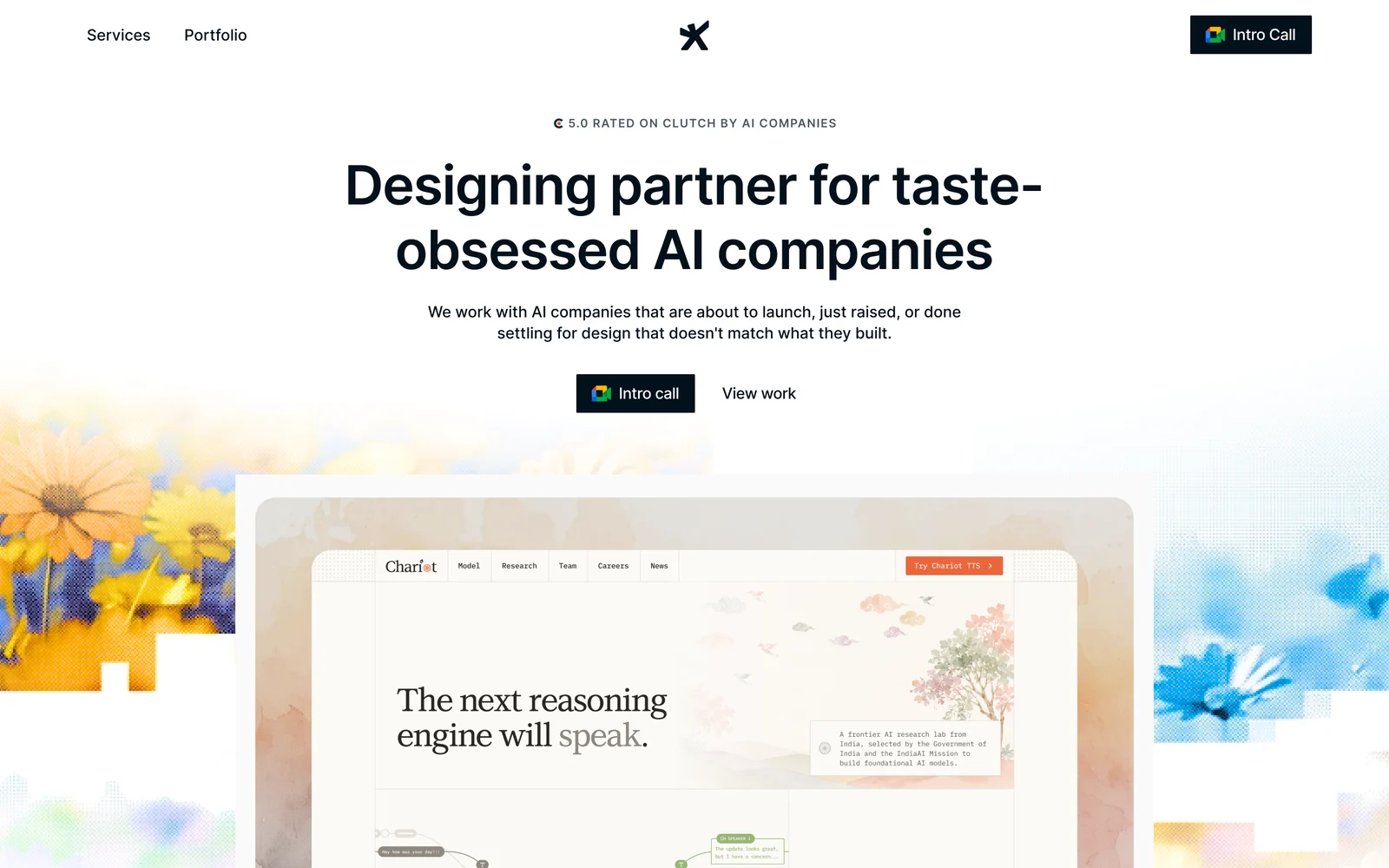
The work continues into product design after the site ships, and in this category that is not an extension, it is the main event. The website persuades somebody to open an account. The screens that decide whether they stay are the decision notice, the review queue, and the transaction history, and none of those are on the marketing surface. Studio Maydit is a web and product design studio, and its clients are AI founders in the US, UK, and Europe, which means a conversation about model output reaching a regulated screen starts from shared ground.
Seven months is the span on the one engagement published with a number attached to it. Dualite had a repositioned ICP by the end of that period, the product was designed around the narrower user that decision produced, and 100,000+ users arrived inside the same window. What makes it relevant here is the sequence rather than the total: deciding precisely who is being served is also what turns a risk threshold into something defensible rather than arbitrary. Recent clients include Wave, PixelFlow, and Mi-VAD, along with 15 other AI and SaaS teams. Tooling is picked per job. Framer for a marketing surface that changes whenever products or permissions do. Webflow when a growth team wants the pages under its own control. Custom code for the screens that carry a record somebody may later have to defend.
Buying works two ways. Fixed scope runs three to four weeks, which fits one defined job such as rebuilding the path a declined customer takes. A monthly retainer suits a company shipping regulated surfaces continuously, covering new pages, campaigns, and product design, with no long lock-in. Fixed-scope projects end with a diagnosis of what is leaking in the product, and in this category the leak is usually a screen that generates a support ticket every time it appears.
| Check | Finding |
|---|---|
| Based in | Remote, serving US / UK / EU |
| Platform depth | Framer, Webflow, and custom code |
| AI-sector proof | Yes. AI-native clients, published outcome on Dualite |
| Pricing | Fixed scope or monthly retainer, quoted per project |
| Team shape | Founder-led, small senior team |
| Best fit | AI fintech teams whose decisions arrive without a reason |
Worth a call if support keeps explaining what the product should have said. Book a 30-minute call.

2. Kvalifik
Kvalifik is a Copenhagen studio founded in 2015 with eleven to fifty people, publishing AI client work and naming Veo, Maersk, and Relesys. Maersk is an operational environment where a decision has consequences and a record, and Danish practices of that size tend to run a structured, documented process, which is easier to justify to a compliance function.
They publish no starting figure, and Webflow as the primary platform means the regulated screens inside your product will need a separate arrangement.
| Check | Finding |
|---|---|
| Based in | Copenhagen, Denmark |
| Founded | 2015 |
| Team size | 11-50 |
| Primary platform | Webflow |
| AI-sector proof | Yes. Published AI client work |
| Named clients | Veo, Maersk, Relesys |
| Pricing | Not published |
| Best fit | European AI fintechs wanting a documented process |
3. Trueform
Trueform is a Framer studio in Wil, Switzerland, founded in 2022, publishing a minimum and AI client work, with Miro, Morning Brew, Bilt Rewards, and Gather named. Bilt Rewards is consumer financial product work, and a Swiss base means the studio operates in a market where financial conservatism is the default assumption rather than a constraint to be explained.
They publish no team size, and a Framer practice is a website practice, so your decision notices and review tooling are somebody else's job.
| Check | Finding |
|---|---|
| Based in | Wil, Switzerland |
| Founded | 2022 |
| Team size | Not published |
| Primary platform | Framer |
| AI-sector proof | Yes. Published AI client work |
| Named clients | Miro, Morning Brew, Bilt Rewards, Gather |
| Pricing | Published minimum |
| Best fit | AI fintechs whose marketing surface changes constantly |
4. BX Studio
BX Studio is a New York Webflow practice of eleven to fifty people, publishing a minimum and AI client work, naming Reddit, Headspace, ASAPP, and Verifone. Verifone is payments infrastructure and ASAPP is genuine AI product work, which is a more relevant pair for this brief than most portfolios here, and a published figure makes the engagement predictable.
They publish no founding year, and Webflow as the primary platform means the strength is the acquisition surface rather than the regulated one.
| Check | Finding |
|---|---|
| Based in | New York, USA |
| Founded | Not published |
| Team size | 11-50 |
| Primary platform | Webflow |
| AI-sector proof | Yes. Published AI client work |
| Named clients | Reddit, Headspace, ASAPP, Verifone |
| Pricing | Published minimum |
| Best fit | AI fintechs rebuilding the acquisition surface quickly |
5. 8020
8020 has worked from San Francisco and New York since 2014 and names Wave, Superlist, Pilot.com, Vanta, and Circle. Pilot and Vanta both sell trust as the product, and Circle is financial infrastructure, so the studio has repeatedly had to write for buyers who are actively looking for reasons to be cautious.
They publish no team size and no starting figure, their AI-sector proof is partial with no AI case study, and Webflow production stops at the marketing site.
| Check | Finding |
|---|---|
| Based in | San Francisco and New York, USA |
| Founded | 2014 |
| Team size | Not published |
| Primary platform | Webflow |
| AI-sector proof | Partial. Enterprise and SaaS clients, no AI case study |
| Named clients | Wave, Superlist, Pilot.com, Vanta, Circle |
| Pricing | Not published |
| Best fit | AI fintechs whose website has to survive a cautious reader |
6. Digidop
Digidop is a one to ten person Paris studio founded in 2021 that publishes a minimum and names TSE Energy, Ramify, and StreamNative. Ramify is a French investment platform, which is directly relevant experience, and a published figure means the first conversation is short and useful.
Their AI-sector proof is partial with no AI case study, they work in Webflow, and a team of one to ten people has no capacity buffer if your scope moves.
| Check | Finding |
|---|---|
| Based in | Paris, France |
| Founded | 2021 |
| Team size | 1-10 |
| Primary platform | Webflow |
| AI-sector proof | Partial. Enterprise and SaaS clients, no AI case study |
| Named clients | TSE Energy, Ramify, StreamNative |
| Pricing | Published minimum |
| Best fit | European AI fintechs needing a fast, priced website build |
7. Flowout
Flowout is a distributed Webflow subscription practice that publishes a minimum and names Jasper, Kajabi, Riverside, and Sendlane. Regulated companies rewrite marketing copy constantly as products and permissions change, and a subscription removes the quoting conversation from every one of those edits.
They publish no founding year and no team size, their AI-sector proof is partial with no AI case study, and subscription website production is volume work rather than product design.
| Check | Finding |
|---|---|
| Based in | Distributed |
| Founded | Not published |
| Team size | Not published |
| Primary platform | Webflow |
| AI-sector proof | Partial. Enterprise and SaaS clients, no AI case study |
| Named clients | Jasper, Kajabi, Riverside, Sendlane |
| Pricing | Published minimum |
| Best fit | AI fintechs rewriting marketing copy every other week |
8. Finsweet
Finsweet has built in Webflow from Denver since 2017 with fifty-one to two hundred distributed people, naming Dropbox, Clay, GitHub, and Steadily. Steadily is insurance, which is the closest thing here to a regulated build, and they are the deepest Webflow engineering practice on this page.
They publish no starting figure, their AI-sector proof is partial with no AI case study, and website engineering does not reach a decision notice or a review queue.
| Check | Finding |
|---|---|
| Based in | Denver, USA, distributed |
| Founded | 2017 |
| Team size | 51-200 |
| Primary platform | Webflow |
| AI-sector proof | Partial. Enterprise and SaaS clients, no AI case study |
| Named clients | Dropbox, Clay, GitHub, Steadily |
| Pricing | Not published |
| Best fit | AI fintechs whose site has genuine technical requirements |
9. Lighthouse Digital
Lighthouse Digital is a London Webflow studio that publishes a minimum and names HelloSelf, Freetrade, and IGN. Freetrade is a regulated UK investment product, so the studio has worked inside financial promotions rules, which are stricter than most designers ever encounter.
They publish no founding year, no team size, and no AI client work at all, and Webflow production leaves the probabilistic half of your product entirely untouched.
| Check | Finding |
|---|---|
| Based in | London, UK |
| Founded | Not published |
| Team size | Not published |
| Primary platform | Webflow |
| AI-sector proof | No. No published AI client work |
| Named clients | HelloSelf, Freetrade, IGN |
| Pricing | Published minimum |
| Best fit | UK fintechs needing a site that respects promotions rules |
10. Clay
Clay has designed software in San Francisco since 2016 at fifty-one to two hundred people, publishing a minimum and AI client work, naming Slack, Stripe, Google, Coinbase, and Amazon. Stripe and Coinbase are the two most relevant references on this page, both products where showing state, history, and status clearly is the entire trust mechanism.
At that size the senior people who win the work are not always on it, and a practice built for companies of that scale is priced accordingly.
| Check | Finding |
|---|---|
| Based in | San Francisco, USA |
| Founded | 2016 |
| Team size | 51-200 |
| Primary platform | Mixed |
| AI-sector proof | Yes. Published AI client work |
| Named clients | Slack, Stripe, Google, Coinbase, Amazon |
| Pricing | Published minimum |
| Best fit | Funded AI fintechs rebuilding a regulated product surface |
How to choose between them
Sort by what is actually broken rather than by which logo reassures your board.
Declined customers contact support because the screen said nothing. Studio Maydit or Clay.
Your review team works in a spreadsheet. Kvalifik or BX Studio.
Cautious buyers read the site and do not sign up. 8020 or Lighthouse Digital.
Marketing copy changes faster than anyone can ship it. Flowout or Trueform.
One test before you sign. Show them your current decline or hold message and ask what they would change. A studio that has worked in this category will ask who reviewed the wording, what you are permitted to disclose, and what the customer is supposed to do next. A studio that offers to make it feel warmer has understood the sentence and not the situation.