
Summarize with AI


The best SaaS design agencies for AI healthtech startups in 2026 are Studio Maydit, basement.studio, Kvalifik, Trueform, Lazarev, Phantom, Feels Like, BX Studio, Digidop, and Flow Ninja. Studio Maydit and Lazarev lead for this brief, because both do product design at the depth a clinical workflow needs and both publish AI client work. Flow Ninja and Digidop are the weakest fit. One names no clients at all, and the other is a one to ten person Webflow studio, which is a long way from designing a screen a clinician will use between two appointments.
Healthtech has a design problem that has almost nothing to do with the model and everything to do with the eleven minutes.
That is roughly how long a clinician has with a patient. In those eleven minutes they are already moving between a records system, a scheduling tool, a messaging app, and something that keeps logging them out. Your product arrives into that.
If it arrives as another notification, it will lose. Not because it is wrong, but because the person receiving it has spent three years learning to dismiss things that appear in that position on the screen.
There is a second gap, and it is commercial rather than clinical. You write your website for the doctor. The doctor does not buy it. A procurement committee buys it, alongside an information security review and somebody responsible for regulatory posture, and none of those three people can find themselves anywhere on your site.
Ten studios follow. The question to keep in mind is which of them would ask about the eleven minutes before asking about your brand.

How we picked these agencies
Five checks, written for a product that has to fit inside somebody else's working day:
- Platform depth. Is product and interface design the practice, or website production with a product service attached? Your difficult screens are a clinician's worklist, a suggestion in context, and an administrator's report. All three are inside the application, so a page-led studio will improve the surface that was already fine.
- Proof in constrained workflows. Have they designed for a user who cannot stop what they are doing? That is the specific discipline here. It shows up in logistics, in field operations, and in financial trading as much as in clinical software, and it teaches how to add information to a screen without taking the user out of their task.
- Pricing. Is a starting figure published? Healthcare buyers move slowly and your own board moves quickly, and a public number lets you start a supplier comparison in an afternoon instead of a fortnight.
- Team shape. How large, and does a senior person stay on the work? Deciding when your product should speak and when it should stay quiet is a judgement made on every screen, and getting it wrong in either direction is expensive: too loud and it is ignored, too quiet and it is not used.
- Their own site. No client shaped it. If it makes its case to a specific reader rather than to everybody, that is a studio that can write for a procurement group and a clinician separately.
Weight the second check most heavily, and ask one thing. What did they do the last time information had to reach somebody who was mid-task? A good answer is about placement, timing, and what happens if the person ignores it. A weaker answer is about a notification component.
Everything in the tables below is drawn from what the studios publish about themselves. No directory data, no aggregate scores, no estimates written in to fill a column. Where a studio has published nothing the row is left saying so, which is the standard your own clinical claims are held to and a reasonable one to apply to a supplier.
What goes wrong when AI healthtech products are designed
Three failures, and each one is a good product losing to the environment it was dropped into.
The suggestion becomes another alert. Clinical software has spent two decades teaching its users that notifications are mostly noise, and your product inherits that training whether or not it deserves to. A recommendation delivered as a banner is dismissed by reflex, and within a fortnight the dismissal is not conscious. Put the information where the decision is already being made, in the record, in the worklist, in the order. Fewer interruptions and better placement beats a better model shown in the wrong part of the screen.
The product is built as a destination when it needs to be a passenger. A standalone dashboard is easier to design, easier to demo, and easier to be proud of. It is also a place a busy clinician has to remember to visit, which they will not. The successful version of your product usually looks less impressive: a panel inside an existing system, a column added to a list somebody already opens, a summary that appears in a note being written anyway. Design for where the user already is, even when that means your interface is mostly somebody else's.
The site speaks to the clinician and the committee never appears. Your homepage is written for the person who will use the product, which feels right and is commercially backwards. The people who decide are running a security review, a compliance assessment, and a budget comparison, and they need to find data handling, integration approach, evidence, and deployment answers without emailing you. Give them their own path through the site. It does not dilute the clinical message, because the clinician was never going to read that page anyway.
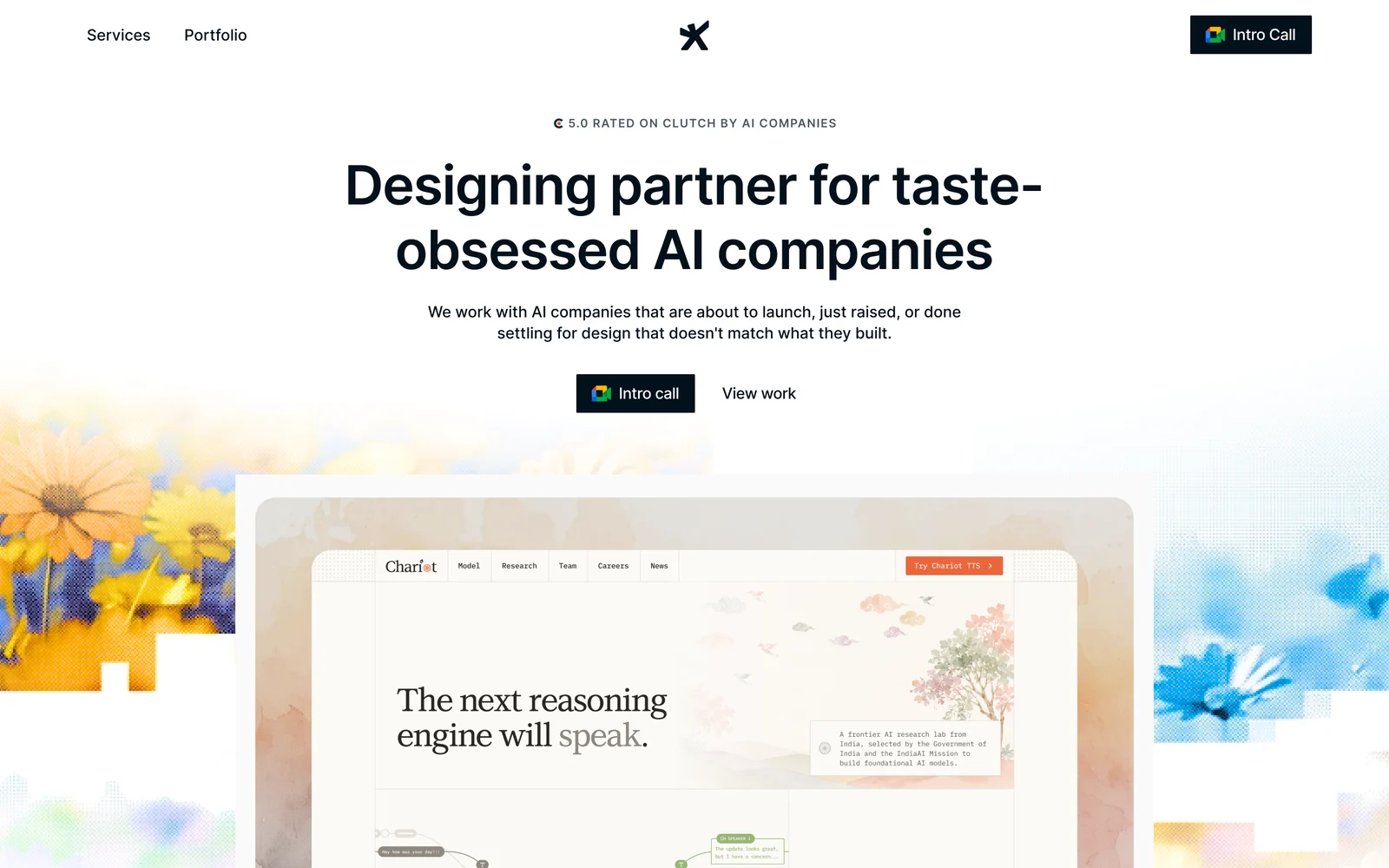
1. Studio Maydit: A Top-Rated Design Agency for AI Founders
No long lock-in is the part worth reading twice if you are selling into health systems, because your own calendar is not yours. A pilot slips a quarter, a security review takes eleven weeks, and a launch waits on a committee that meets monthly. A monthly retainer that covers new pages, campaigns, and product design without a long commitment matches that rhythm. The other option is fixed scope, three to four weeks, sized for one job such as moving your suggestion out of a banner and into the record where the decision actually happens.
Studio Maydit is a web and product design studio, and its clients are AI founders in the US, UK, and Europe, so a discussion about where a model's output should appear and how loudly begins from shared ground. Work continues into product design after the site ships, which in healthtech is nearly all of the value, since a clinician never sees your homepage and lives entirely inside the screens that come after it. Platform choice follows the brief. Framer where positioning is still moving between two buyers. Webflow where a marketer wants the pages. Custom code where the interface has to sit inside a workflow rather than beside it.
Dualite carries the published number. The sequence began with narrowing: a repositioned ICP, then a product designed for the smaller group that choice defined, then 100,000+ users over seven months. Healthtech teams should take the order seriously, because a product built for one specialty and one moment in the day is adopted, while one built for every clinician is opened once. Recent clients include Wave, PixelFlow, and Mi-VAD, along with 15 other AI and SaaS teams. Fixed-scope projects end with a diagnosis of what is leaking in the product, which here usually names the screen where a clinician stopped and did it the old way instead.
| Check | Finding |
|---|---|
| Based in | Remote, serving US / UK / EU |
| Platform depth | Framer, Webflow, and custom code |
| AI-sector proof | Yes. AI-native clients, published outcome on Dualite |
| Pricing | Fixed scope or monthly retainer, quoted per project |
| Team shape | Founder-led, small senior team |
| Best fit | Healthtech teams whose product is accurate and being ignored |
Worth a call if your pilots go well and nobody uses it in month three. Book a 30-minute call.

2. basement.studio
basement.studio works in custom code from Mar del Plata and Los Angeles, has since 2018 at eleven to fifty people, publishes a minimum, and names Vercel, Cursor, ElevenLabs, Harvey AI, and Scale AI. Harvey builds AI for legal work, where an output has to be checked by a professional before anyone relies on it, which is the closest structural match here to a clinical recommendation.
Their strength is launch moments and marketing surfaces rather than the long workflow screens where healthtech is actually adopted, and a team that size across clients that visible has little slack.
| Check | Finding |
|---|---|
| Based in | Mar del Plata, Argentina and Los Angeles, USA |
| Founded | 2018 |
| Team size | 11-50 |
| Primary platform | Custom code |
| AI-sector proof | Yes. Published AI client work |
| Named clients | Vercel, Cursor, ElevenLabs, Harvey AI, Scale AI |
| Pricing | Published minimum |
| Best fit | Healthtech teams whose launch has to convince a technical audience |
3. Kvalifik
Kvalifik is a Copenhagen studio of eleven to fifty working mainly in Webflow since 2015, with published AI client work and Veo, Maersk, and Relesys named. Relesys builds software for people who work standing up rather than at a desk, which is the closest thing in this list to designing for a clinician who cannot stop and read.
No starting figure is published, their depth is Webflow rather than product interfaces, and their market is Northern European enterprise rather than the health systems you are likely to be selling into.
| Check | Finding |
|---|---|
| Based in | Copenhagen, Denmark |
| Founded | 2015 |
| Team size | 11-50 |
| Primary platform | Webflow |
| AI-sector proof | Yes. Published AI client work |
| Named clients | Veo, Maersk, Relesys |
| Pricing | Not published |
| Best fit | European healthtech teams designing for frontline staff |
4. Trueform
Trueform has worked in Framer from Switzerland since 2022, publishes a minimum and AI client work, naming Miro, Morning Brew, Bilt Rewards, and Gather. A published price makes them quick to engage, and Swiss proximity to a heavily regulated pharmaceutical industry is a useful instinct to have in the room.
They publish no team size, and a Framer practice lives on the marketing surface, so the clinical workflow screens that decide your adoption are not what the portfolio demonstrates.
| Check | Finding |
|---|---|
| Based in | Wil, Switzerland |
| Founded | 2022 |
| Team size | Not published |
| Primary platform | Framer |
| AI-sector proof | Yes. Published AI client work |
| Named clients | Miro, Morning Brew, Bilt Rewards, Gather |
| Pricing | Published minimum |
| Best fit | Healthtech teams rebuilding a site for two different buyers |
5. Lazarev
Lazarev is a San Francisco studio founded in 2015 at fifty-one to two hundred people, publishing a minimum and AI client work, naming Payoneer, Peel, Elva, and Mozayix. Payoneer operates under financial supervision in many countries, so this studio has designed inside constraints that were set by a regulator rather than by a product manager.
At that size the people who pitch may not be the ones drawing, so ask for names, and their client base is not healthcare, so the clinical vocabulary will have to be taught.
| Check | Finding |
|---|---|
| Based in | San Francisco, USA |
| Founded | 2015 |
| Team size | 51-200 |
| Primary platform | Mixed |
| AI-sector proof | Yes. Published AI client work |
| Named clients | Payoneer, Peel, Elva, Mozayix |
| Pricing | Published minimum |
| Best fit | Healthtech teams needing a large regulated surface designed |
6. Phantom
Phantom has built in custom code from London and Auckland since 2013, at fifty-one to two hundred people, publishing AI client work and naming Diageo, SAP, Financial Times, and Zendesk. SAP is the kind of system your product will have to live beside or inside, and a studio working at that scale understands what it means to be a passenger rather than a destination.
No starting figure is published, and a practice that size with clients that large brings timelines and costs built for institutions rather than for a startup running a pilot.
| Check | Finding |
|---|---|
| Based in | London, UK and Auckland, NZ |
| Founded | 2013 |
| Team size | 51-200 |
| Primary platform | Custom code |
| AI-sector proof | Yes. Published AI client work |
| Named clients | Diageo, SAP, Financial Times, Zendesk |
| Pricing | Not published |
| Best fit | Healthtech teams integrating with large existing systems |
7. Feels Like
Feels Like has built in custom code from Los Angeles since 2023, publishing AI client work and naming Google, Nike, LVMH, and Suno AI. Consumer-facing work at that level means the studio treats the person receiving something as a real audience with limited patience, which is the discipline your patient-facing screens most need.
No team size and no starting figure are published, and a studio founded in 2023 has not yet taken a product through the kind of security and compliance review a health system will run.
| Check | Finding |
|---|---|
| Based in | Los Angeles, USA |
| Founded | 2023 |
| Team size | Not published |
| Primary platform | Custom code |
| AI-sector proof | Yes. Published AI client work |
| Named clients | Google, Nike, LVMH, Suno AI |
| Pricing | Not published |
| Best fit | Healthtech teams fixing the patient-facing half |
8. BX Studio
BX Studio is a New York team of eleven to fifty working mainly in Webflow, publishing a minimum and AI client work, with Reddit, Headspace, ASAPP, and Verifone named. Headspace handles sensitive personal information at scale and ASAPP sells AI into large cautious organisations, so both halves of your buying problem appear in their portfolio.
They publish no founding year, and Webflow is a website platform, so the clinical screens where your product succeeds or fails will be handed to your engineers as designs.
| Check | Finding |
|---|---|
| Based in | New York, USA |
| Founded | Not published |
| Team size | 11-50 |
| Primary platform | Webflow |
| AI-sector proof | Yes. Published AI client work |
| Named clients | Reddit, Headspace, ASAPP, Verifone |
| Pricing | Published minimum |
| Best fit | Healthtech teams whose site must satisfy a procurement group |
9. Digidop
Digidop is a one to ten person Paris studio founded in 2021, working in Webflow with a published minimum, naming TSE Energy, Ramify, and StreamNative. Ramify is a French financial product that had to look trustworthy from the first screen, which is the tone a healthtech site is reaching for with a cautious institutional reader.
Partial AI proof with no case study, a very small team, and Webflow only, so this covers the marketing site and nothing that touches a clinical workflow.
| Check | Finding |
|---|---|
| Based in | Paris, France |
| Founded | 2021 |
| Team size | 1-10 |
| Primary platform | Webflow |
| AI-sector proof | Partial. Enterprise and SaaS clients, no AI case study |
| Named clients | TSE Energy, Ramify, StreamNative |
| Pricing | Published minimum |
| Best fit | European healthtech teams rebuilding a site at a known price |
10. Flow Ninja
Flow Ninja is a Belgrade studio of eleven to fifty people working in Webflow since 2018. A team that size concentrated in one city can hold a long site engagement without subcontracting, and European hours suit a company selling into European health systems.
They publish no clients and no starting figure, and their AI-sector proof is partial with no case study, which leaves a healthcare procurement process with nothing at all to assess.
| Check | Finding |
|---|---|
| Based in | Belgrade, Serbia |
| Founded | 2018 |
| Team size | 11-50 |
| Primary platform | Webflow |
| AI-sector proof | Partial. Enterprise and SaaS clients, no AI case study |
| Named clients | Not published |
| Pricing | Not published |
| Best fit | Healthtech teams needing steady European Webflow capacity |
How to choose between them
Sort by where your product is losing, not by which studio has the most healthcare logos.
Clinicians dismiss the suggestion without reading it. Studio Maydit or Lazarev.
Your product is a dashboard nobody opens. Phantom or Studio Maydit.
Procurement and security stall every deal. BX Studio or Trueform.
Patients abandon the part they have to complete themselves. Feels Like or Kvalifik.
One test before you sign. Show them a screen recording of a clinician using your product in a real session, not a demo, and ask what they would change first. A studio that understands constrained workflows will point at when something appears rather than at how it looks. A studio that does not will start with the visual design of the panel, which is the part nobody in that recording was looking at.