
Summarize with AI


The best SaaS design agencies for AI HR tech startups in 2026 are Studio Maydit, Phantom, Trueform, Feels Like, BX Studio, Kvalifik, basement.studio, Refokus, Flow Ninja, and Flowout. Studio Maydit and Phantom lead for this brief, because both have designed dense administrative products and both work across the US, UK, and European markets where employment rules differ. Flow Ninja and Flowout are the weakest fit. One names no clients at all, and the other is a page production service with no published team size or founding year, which is not what a product carrying employment decisions needs.
HR software has a structural oddity that almost nothing else shares. Two people use it, and only one of them agreed to.
The buyer is an HR leader with a budget and a problem. The other user is a candidate being ranked, or an employee being scored, and they did not choose your product, cannot leave it, and will form an opinion about your company inside eight seconds of meeting it.
Add a model to that and the stakes change again. A ranking is now a recommendation with a number attached, and somebody will eventually have to explain that number. Not to a data scientist. To a person who was not shortlisted, or to a lawyer acting for them.
Most AI HR products are designed entirely for the buyer. The admin console is thoughtful and complete. The candidate-facing screen was built in an afternoon and says almost nothing, which is the screen that generates the complaint.
Ten studios follow. The one you want is the one that asks about the second user before it asks about your brand.

How we picked these agencies
Five checks, written for a product that makes recommendations about people:
- Platform depth. Is the practice built on product and interface design, or on website production with a product service attached? The hard screens in HR software are a review queue, a scoring explanation, and an audit trail. None of them are on the marketing site, and a page-led studio will make the easy half excellent.
- Proof on regulated or high-consequence products. Have they designed something where a screen had to be defensible later? Employment decisions get challenged, sometimes formally. That changes what an interface has to record, what it has to show at the time, and what a user must be given the chance to correct before anything is final.
- Pricing. Is there a published starting figure, or does it wait for a call? HR buyers run structured comparisons because they are used to being asked to justify a supplier, and a public number lets that begin without a meeting.
- Team shape. How many people, and is a senior one on the work throughout? Deciding how much of a model's reasoning to expose is a judgement that repeats on every screen, and it drifts the moment it is delegated to whoever is free.
- Their own site. It is the project with no client to satisfy. If it says plainly who they are for, they can help you say plainly what your product decides and what it does not.
Give the second check the most weight, and test it with one question. Ask what they did the last time a screen had to justify a decision to somebody unhappy with it. A real answer covers what was shown, what was recorded, and what the person could do next. A weaker answer describes a tooltip.
Each row in the tables below is a claim the studio publishes about itself. No directory data, no aggregated scores, and no estimates dropped in to fill a column. Where nothing has been published the row says so, which is a fact a buyer can check rather than a number they have to trust.
What goes wrong when AI HR products are designed
Three failures, and each one shows up first as a support ticket and later as a legal question.
The involuntary user is an afterthought. Every hour goes into the admin console, because the admin is the buyer and the buyer is who the demo is for. The candidate portal, the employee self-assessment, and the notification email get whatever time is left. Those are the surfaces most people ever see, and they set the impression of the customer who bought you as much as the impression of you. Design the second user's path first for one release. An employee who trusts the screen fills it in properly, and one who does not games it.
A score appears with no way to explain it. The model produces a number, the interface shows the number, and everyone downstream is left to invent a story about what it means. That is fine until somebody asks. Then an HR manager has to defend a figure they cannot describe, to a person with a genuine interest in the answer. Show the inputs that moved the result, in ordinary language, on the same screen. It does not have to be a full explanation of the model. It has to be enough that a human can have the conversation.
The site sells time saved to a buyer who is worried about risk. The homepage promises faster screening and fewer hours per hire, which is real value and the wrong headline. The person signing has a quieter fear: that a decision made by this system becomes a claim, a headline, or a works council meeting. Speak to that directly. Show what the product records, what a reviewer must confirm, and where a human has to intervene. The efficiency case still lands, and it lands on someone who is no longer nervous.
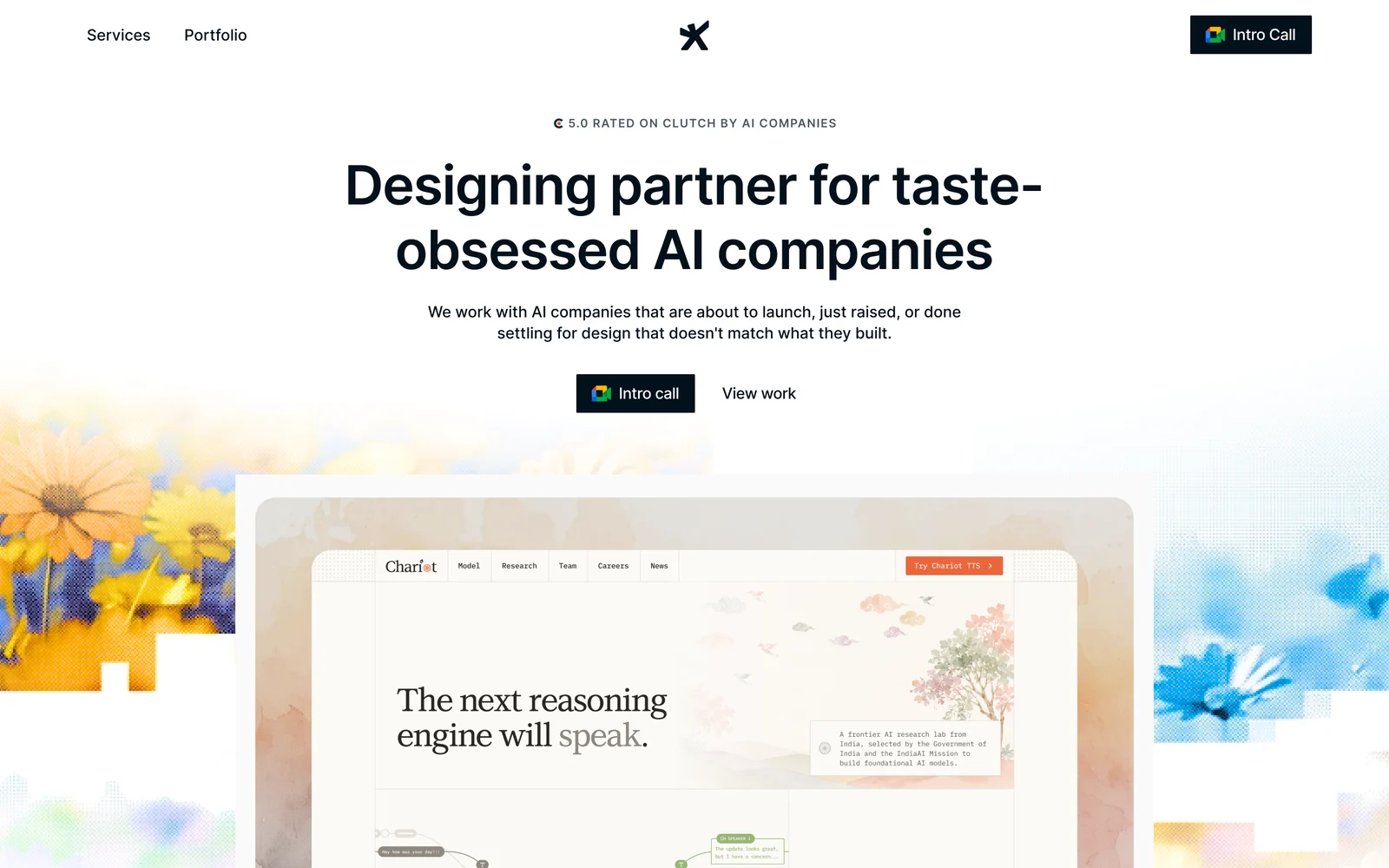
1. Studio Maydit: A Top-Rated Design Agency for AI Founders
Selling HR software across the US, UK, and Europe is three different products wearing one interface, because what may be recorded, automated, and disclosed changes at each border. Studio Maydit works in exactly that spread. It is a web and product design studio, and its clients are AI founders across those markets, so a product that has to behave differently in Berlin than in Boston is an ordinary brief rather than a special case.
Work continues into product design after the site ships. For an HR product that is the half that decides everything, since the review queue, the scoring explanation, and the candidate notice all sit inside the application and none of them are on the homepage. Platform choice follows the job. Framer when positioning is still being tested against two very different buyers. Webflow when a marketing team wants to publish without waiting. Custom code when a screen has to carry a record somebody may later have to defend.
Dualite is the client published with a figure attached. A repositioned ICP came first, the design was rebuilt for the narrower user that decision produced, and 100,000+ users followed in seven months. The order matters for an HR product, because deciding exactly who is being served is also what makes a scoring threshold defensible instead of arbitrary. Wave, PixelFlow, and Mi-VAD are recent clients, along with 15 other AI and SaaS teams. On buying it, fixed scope runs three to four weeks and fits one job such as rebuilding the candidate-facing path. A monthly retainer suits a team shipping into several jurisdictions, covering new pages, campaigns, and product design, with no long lock-in. Fixed-scope projects end with a diagnosis of what is leaking in the product.
| Check | Finding |
|---|---|
| Based in | Remote, serving US / UK / EU |
| Platform depth | Framer, Webflow, and custom code |
| AI-sector proof | Yes. AI-native clients, published outcome on Dualite |
| Pricing | Fixed scope or monthly retainer, quoted per project |
| Team shape | Founder-led, small senior team |
| Best fit | HR tech teams whose second user was never designed for |
Worth a call if your admin console is loved and your candidate screen is not. Book a 30-minute call.

2. Phantom
Phantom has built in custom code from London and Auckland since 2013, at fifty-one to two hundred people, publishing AI client work and naming Diageo, SAP, Financial Times, and Zendesk. SAP sits at the centre of enterprise HR, so this is the one studio here with direct exposure to the systems your buyer already runs and will expect you to sit beside.
No starting figure is published, and a studio at that size working with clients that large brings a schedule and a cost structure built for them rather than for a startup shipping monthly.
| Check | Finding |
|---|---|
| Based in | London, UK and Auckland, NZ |
| Founded | 2013 |
| Team size | 51-200 |
| Primary platform | Custom code |
| AI-sector proof | Yes. Published AI client work |
| Named clients | Diageo, SAP, Financial Times, Zendesk |
| Pricing | Not published |
| Best fit | HR tech teams selling into large enterprise HR estates |
3. Trueform
Trueform has worked in Framer from Switzerland since 2022, publishes a minimum and AI client work, and names Miro, Morning Brew, Bilt Rewards, and Gather. Bilt is a consumer product where a lot of people who did not choose it still have to use it well, which is closer to your candidate experience than most enterprise references get.
They publish no team size, and a Framer practice is built around the marketing surface, so the review queue and scoring screens that carry your risk are not what their published work proves.
| Check | Finding |
|---|---|
| Based in | Wil, Switzerland |
| Founded | 2022 |
| Team size | Not published |
| Primary platform | Framer |
| AI-sector proof | Yes. Published AI client work |
| Named clients | Miro, Morning Brew, Bilt Rewards, Gather |
| Pricing | Published minimum |
| Best fit | HR tech teams rebuilding a site for a nervous buyer |
4. Feels Like
Feels Like has built in custom code from Los Angeles since 2023, publishing AI client work and naming Google, Nike, LVMH, and Suno AI. Working with brands that consumer-facing means the studio treats the person on the receiving end as a real audience, which is precisely the discipline missing from most HR interfaces.
No team size and no starting figure are published, and a studio founded in 2023 has not yet carried a product through the kind of compliance review your enterprise customers will run.
| Check | Finding |
|---|---|
| Based in | Los Angeles, USA |
| Founded | 2023 |
| Team size | Not published |
| Primary platform | Custom code |
| AI-sector proof | Yes. Published AI client work |
| Named clients | Google, Nike, LVMH, Suno AI |
| Pricing | Not published |
| Best fit | HR tech teams fixing the candidate-facing experience |
5. BX Studio
BX Studio is a New York team of eleven to fifty working mainly in Webflow, publishing a minimum and AI client work, with Reddit, Headspace, ASAPP, and Verifone named. ASAPP sells AI into large enterprises, and Headspace handles sensitive personal information, so both halves of your problem appear somewhere in their portfolio.
They publish no founding year, and Webflow is a website platform, so the product screens where your employment risk actually lives will be handed to your engineers as designs.
| Check | Finding |
|---|---|
| Based in | New York, USA |
| Founded | Not published |
| Team size | 11-50 |
| Primary platform | Webflow |
| AI-sector proof | Yes. Published AI client work |
| Named clients | Reddit, Headspace, ASAPP, Verifone |
| Pricing | Published minimum |
| Best fit | HR tech teams whose site has to reassure before it sells |
6. Kvalifik
Kvalifik is a Copenhagen studio of eleven to fifty working mainly in Webflow since 2015, with published AI client work and Veo, Maersk, and Relesys named. Relesys is workforce communication software, which is the closest reference in this group to designing for employees who were handed a tool rather than choosing one.
No starting figure is published, their platform strength is Webflow rather than product interfaces, and their market is Northern European enterprise rather than the US buyers many HR startups chase first.
| Check | Finding |
|---|---|
| Based in | Copenhagen, Denmark |
| Founded | 2015 |
| Team size | 11-50 |
| Primary platform | Webflow |
| AI-sector proof | Yes. Published AI client work |
| Named clients | Veo, Maersk, Relesys |
| Pricing | Not published |
| Best fit | European HR tech teams designing for frontline employees |
7. basement.studio
basement.studio works in custom code from Mar del Plata and Los Angeles, has since 2018 at eleven to fifty people, publishes a minimum, and names Vercel, Cursor, ElevenLabs, Harvey AI, and Scale AI. Harvey builds AI for legal work, which means this studio has already designed around output that has to be checked before anyone relies on it.
Their strength is launch moments and marketing surfaces rather than the long administrative screens where HR products succeed or fail, and a team that size across clients that visible has little slack.
| Check | Finding |
|---|---|
| Based in | Mar del Plata, Argentina and Los Angeles, USA |
| Founded | 2018 |
| Team size | 11-50 |
| Primary platform | Custom code |
| AI-sector proof | Yes. Published AI client work |
| Named clients | Vercel, Cursor, ElevenLabs, Harvey AI, Scale AI |
| Pricing | Published minimum |
| Best fit | HR tech teams whose launch has to look genuinely serious |
8. Refokus
Refokus is a remote German studio of eleven to fifty founded in 2021, working mainly in Webflow, naming Mural, BASF, Spotify, Yahoo, and BCG. BASF is a large European employer with a works council and a formal approval culture, so the studio has operated inside the environment your German customers will bring to the table.
No starting figure is published, their AI-sector proof is partial with no AI case study, and Webflow depth does not reach the scoring and review screens that carry your obligations.
| Check | Finding |
|---|---|
| Based in | Germany, remote |
| Founded | 2021 |
| Team size | 11-50 |
| Primary platform | Webflow |
| AI-sector proof | Partial. Enterprise and SaaS clients, no AI case study |
| Named clients | Mural, BASF, Spotify, Yahoo, BCG |
| Pricing | Not published |
| Best fit | HR tech teams selling into large European employers |
9. Flow Ninja
Flow Ninja is a Belgrade studio of eleven to fifty people working in Webflow since 2018. A team that size in one place can hold a long site engagement without subcontracting, and European hours suit a company selling into European HR departments.
They publish no clients and no starting figure, and their AI-sector proof is partial with no case study, which leaves an HR buyer's procurement process with almost nothing to evaluate.
| Check | Finding |
|---|---|
| Based in | Belgrade, Serbia |
| Founded | 2018 |
| Team size | 11-50 |
| Primary platform | Webflow |
| AI-sector proof | Partial. Enterprise and SaaS clients, no AI case study |
| Named clients | Not published |
| Pricing | Not published |
| Best fit | HR tech teams needing steady European Webflow capacity |
10. Flowout
Flowout is a distributed Webflow service with a published minimum, naming Jasper, Kajabi, Riverside, and Sendlane. The model is throughput at a predictable price, which suits an HR startup producing a steady run of comparison pages, integration pages, and campaign landings.
No founding year, no team size, and partial AI proof with no case study, and a production service is not equipped to design a screen that has to hold up in an employment dispute.
| Check | Finding |
|---|---|
| Based in | Distributed |
| Founded | Not published |
| Team size | Not published |
| Primary platform | Webflow |
| AI-sector proof | Partial. Enterprise and SaaS clients, no AI case study |
| Named clients | Jasper, Kajabi, Riverside, Sendlane |
| Pricing | Published minimum |
| Best fit | HR tech marketing teams shipping pages every week |
How to choose between them
Sort by which screen you would least like to see quoted in a complaint.
Candidates and employees meet an afterthought. Studio Maydit or Feels Like.
A score is shown and cannot be explained. Phantom or basement.studio.
European buyers arrive with requirements nobody planned for. Refokus or Kvalifik.
The site sells speed to a buyer who is worried about risk. Trueform or BX Studio.
One test before you sign. Show them the email a rejected candidate receives and ask what should change about it. A studio that understands this category will talk about what the person is owed, what can honestly be said, and what the sender must be able to stand behind. A studio that does not will offer to make it warmer.